

AI Rumored to Break RSA with Classical Polynomial-Time Factoring
Rumors suggest OpenAI and Anthropic may have discovered a classical polynomial-time algorithm for integer factorization, which would break RSA encryption and undermine modern cryptography, potentially bypassing the need for quantum computers and forcing a fundamental rethink of digital security foundations.
Reading font
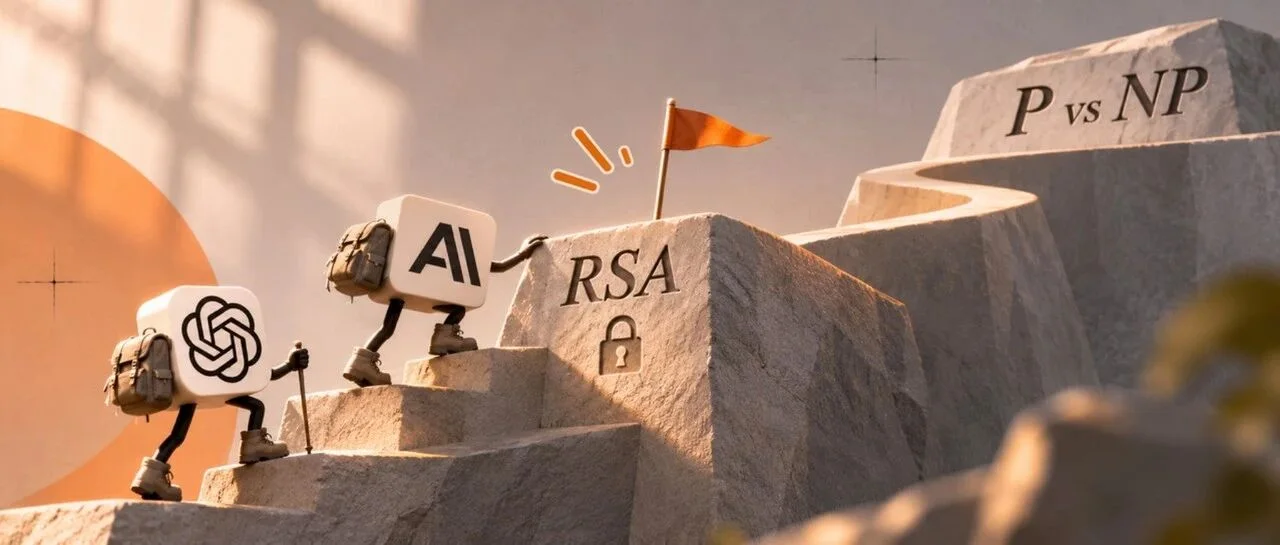
A Cryptographic Rumor Shakes the Foundations of Internet Security
On November 25, renowned computer scientist and quantum computing expert Scott Aaronson updated his blog with a striking title containing four "HOLY SHIT" exclamations. He revealed that rumors circulating for about ten days allege one or both of OpenAI and Anthropic have found a method to perform large integer factorization in polynomial time on classical computers. If true and practically usable, this would directly overturn the security basis of the RSA cryptosystem, which has underpinned internet security for nearly half a century.
The Core Claim: Factoring in P on Classical Hardware
The rumor centers on "Factoring in P" — the existence of a classical polynomial-time algorithm for integer factorization. RSA relies on the asymmetry that multiplying two large primes is easy, but factoring their product is hard. For example, computing 61 × 53 = 3233 is trivial, but reversing the process for a 2048-bit modulus is currently infeasible. The 2020 record factored RSA-250 (829 bits), still far from the 2048-bit keys in common use. A classical polynomial-time algorithm would collapse this hardness assumption, enabling private key recovery from public keys on existing hardware.
Historical Context: The Quantum Alternative
Since 1994, Peter Shor's algorithm has shown that a sufficiently powerful fault-tolerant quantum computer could factor integers in polynomial time. However, engineering challenges — qubit scale, error correction, hardware stability — have kept this threat theoretical. The rumored classical breakthrough would sidestep the need for quantum hardware entirely, achieving the same cryptographic break with today's computers.
Implications Beyond Confidentiality
RSA also provides authentication via digital signatures. Software updates, for instance, are signed with a private key and verified with the public key. If private keys can be derived, attackers could forge trusted signatures, distributing malicious updates that pass verification. This would affect digital certificates, enterprise identity, software supply chains, and critical infrastructure trust relationships.
Corroborating Signals from AI Labs
In October, OpenAI released 376 research papers across mathematics and theoretical computer science, notably omitting cryptography. Aaronson noted that AI labs were quietly investigating whether their latest models could break important cryptographic protocols. On November 25, Andrew Curran confirmed hearing similar rumors for ~10 days. Simultaneously, both Anthropic and OpenAI published proofs related to VP ≠ VNP in algebraic complexity theory, with OpenAI stating its result dated to November 6. These rapid, parallel math breakthroughs led Aaronson to say, "For the first time in my life I feel deep down that a proof of P ≠ NP is not far off."
Google's AI Math Research Adds Weight
On the same day, Google Research released six papers from its AI system Cogentic, three directly addressing integer factorization and discrete logarithms. While not yet achieving polynomial-time factoring, they demonstrate AI's deepening penetration into core cryptographic mathematics. Modern cryptography rests on multiple hardness assumptions: RSA on factoring, Diffie-Hellman and ECC on discrete logarithms. Post-quantum standards (NIST 2024) use lattice- and hash-based schemes, but quantum resistance does not guarantee classical resistance. The 2022 break of SIKE (a post-quantum candidate) by a classical mathematical attack illustrates this risk. AI could accelerate discovery of such attacks across all assumption families.
Safety and Deployment Dilemmas
Axios reported on November 24 that undisclosed internal models at OpenAI and Anthropic are becoming so capable that employees worry about safe public release. OpenAI acknowledged new safety requirements may slow deployments. The timing of Aaronson's disclosure fuels speculation that cryptographic breakthroughs may be a factor in delayed releases. For AI labs, a factoring algorithm poses a uniquely difficult responsible-disclosure problem: replacing a ubiquitous cryptosystem requires global software/hardware upgrades, and withholding the result does not prevent independent rediscovery by others using AI.
Conclusion: An Era-Defining Shift May Be Underway
Since Shor's algorithm, cryptographers have prepared for quantum computers to eventually break RSA. The unexpected twist is that AI-discovered classical mathematics might achieve this first. The rumors remain unverified, but the convergence of signals — top experts' alarm, parallel math breakthroughs, and AI labs' own safety hesitations — suggests the cryptographic community must seriously consider the possibility that the mathematical foundations of digital trust are far more fragile than assumed.
References: https://x.com/kimmonismus/status/2125602411540566221 , https://x.com/AndrewCurran_/status/2125589468786909510 , https://x.com/Polymarket/status/2125708240554242058
For questions about attribution, corrections or content rights, please contactand we will review it promptly.