Apache Tika is an open-source Java toolkit that automatically detects and parses over 1000 file formats through a unified API, making it essential for enterprise document management and RAG systems with metadata extraction, OCR support, and multiple deployment options.
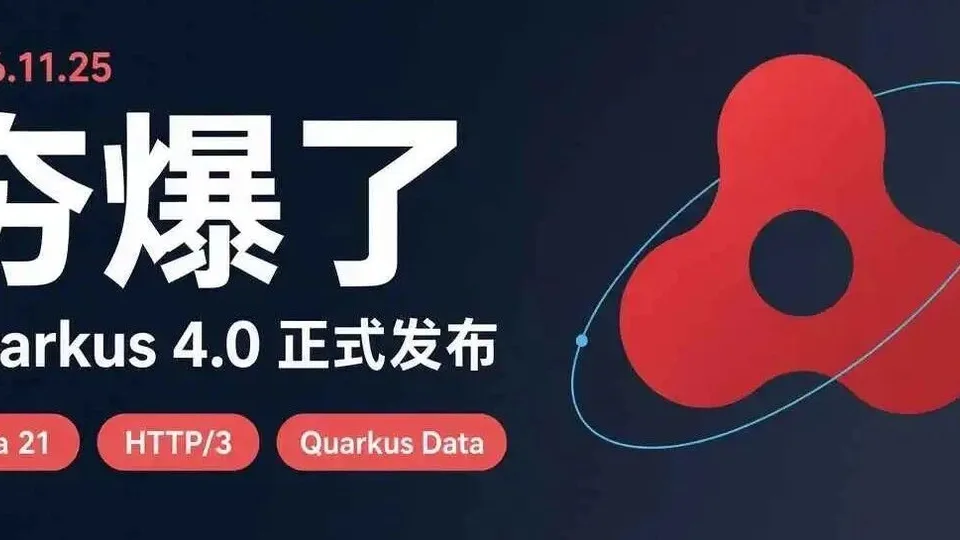
Quarkus 4.0 upgrades to Java 21, Vert.x 5, Jackson 3, and introduces Quarkus Data for compile-time repository generation, optional HTTP/3 support, virtual threads for blocking REST endpoints, and built-in observability with @Observed annotation, plus migration tips and code examples.
This article presents a unified operation logging framework using Java annotations and reflection to automatically detect field changes between object states, generating structured audit logs for create, update, and delete actions with customizable field formatting and nested object support.
This article details the design and implementation of a lightweight workflow engine using Java 21, Spring Boot, and MySQL, covering JSON-based process definitions, versioning, dynamic assignee resolution, multi-approval modes with concurrency control, condition evaluation, node transitions, rejection/resubmission patterns, timeout reminders, and event-driven integration with business systems.
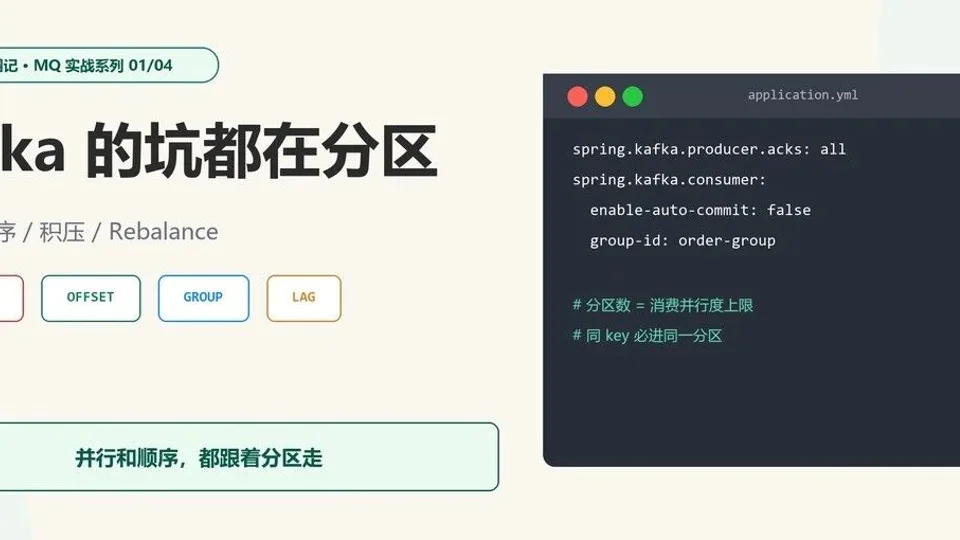
This article explains how Kafka's partition model underpins four common issues—consumer parallelism limits, message ordering, rebalance storms, and lag buildup—and provides Spring Boot configuration patterns for reliable production and consumption with manual offset commits, idempotent producers, and dead-letter handling.
A comprehensive guide to reading Spring Framework 7.0.8 source code, covering environment setup with JDK 25/Gradle, module architecture overview, six core modules (core, beans, context, AOP, tx, webmvc) deep dive with key classes and debugging breakpoints, reading methodology, interview Q&A, and Spring 7.0 new features.
ASP.NET Core middleware is instantiated once at startup, so injecting Scoped services like DbContext in the constructor causes captive dependency—shared instances across requests lead to connection pool exhaustion and data corruption; instead, inject Scoped services via InvokeAsync parameters to get per-request instances.
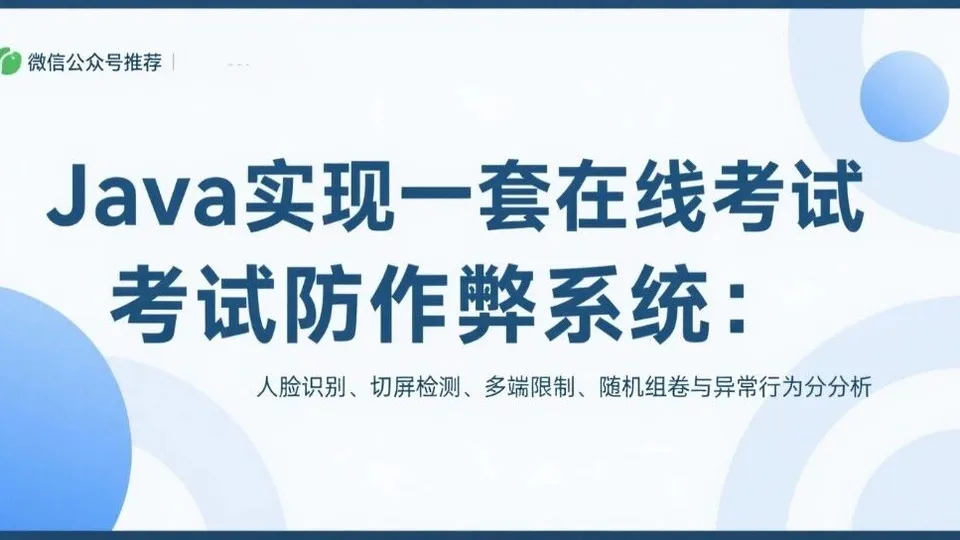
This article details the design of a scalable online exam anti-cheating system using Java 21, Spring Boot, MySQL, Redis, and WebSocket, covering identity verification, session management, random paper generation, screen-switch detection, heartbeat monitoring, answer versioning, server-side timing, risk-based anomaly analysis, and deployment architecture for 5000 concurrent examinees.
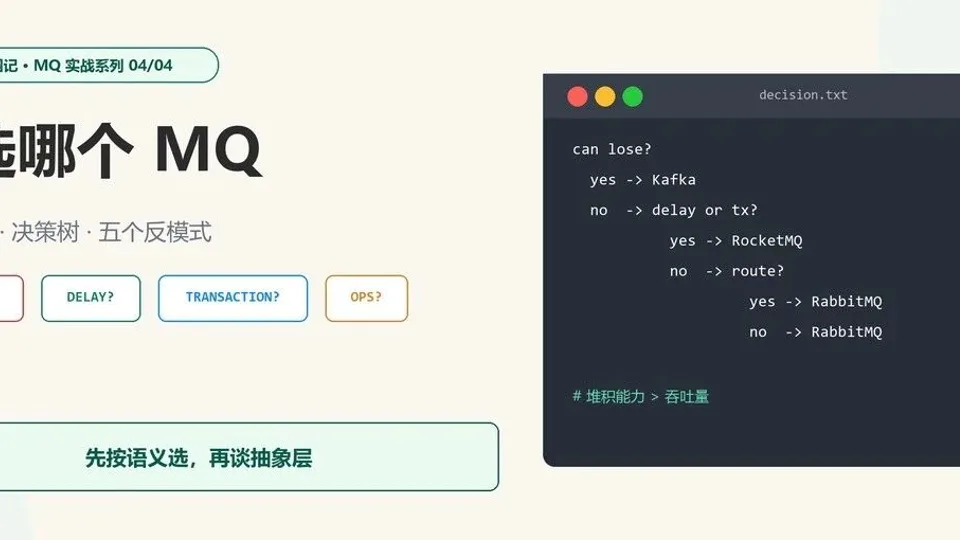
This article provides a practical framework for selecting a message queue by first answering three critical questions about message loss tolerance, semantic requirements, and operational capacity, then comparing RabbitMQ, Kafka, and RocketMQ across six dimensions, highlighting why backlog capacity matters more than throughput, and listing five real-world anti-patterns to avoid.
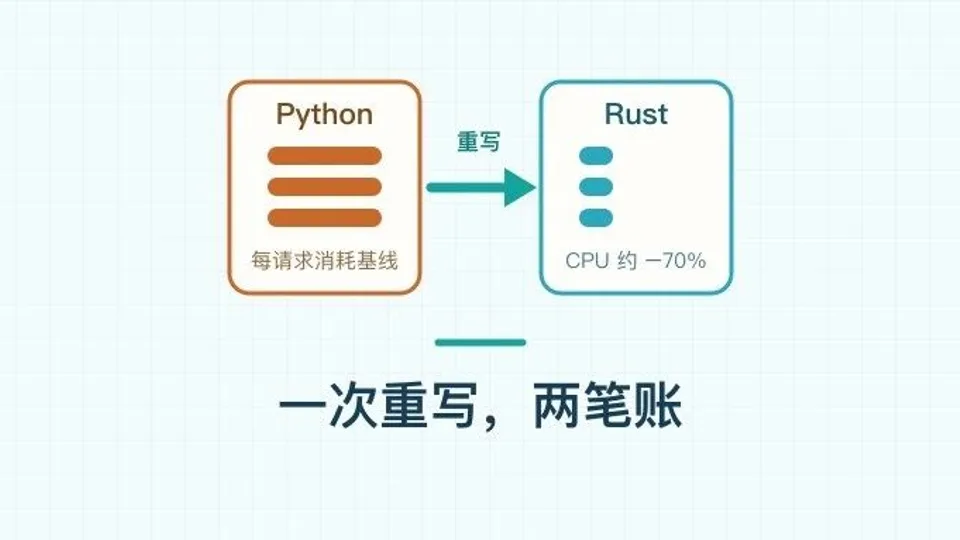
Anthropic migrated its Messages API from Python to Rust, cutting per-request CPU by 70% and memory by over 80%, but the migration took months despite AI writing the first version in a week; the article analyzes runtime savings, cross-language overhead, verification challenges, and break-even calculus for AI-assisted rewrites.
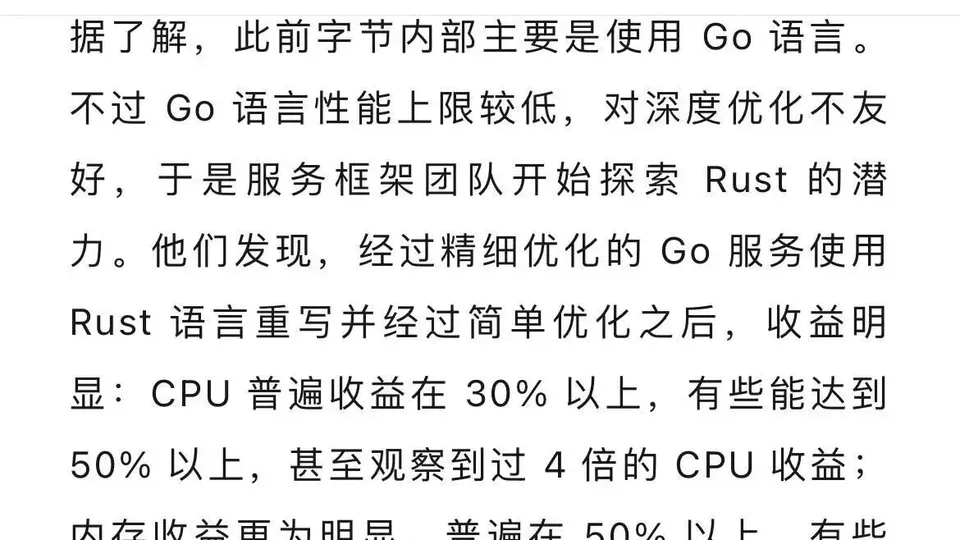
A team migrated a high-load Java microservice to Rust after GC pauses caused high CPU and costs; benchmarks showed Rust achieved 2-5x higher throughput on 1-2 servers vs 8 Java servers, cutting annual cloud costs by ~200k RMB, but required a steep learning curve, slower initial development, and strict code reviews.
This article details the design and implementation of a bounded, non-preemptive Go priority task scheduler with weighted fair queuing, backpressure handling, graceful shutdown protocols, Kafka integration patterns, and comprehensive verification strategies for production reliability.
Fast-Anything is an open-source CLI tool that uses AI agents to port only the hottest, pure functions from Python, Node, Ruby, etc. to Rust, verifies correctness by replaying up to 500 real calls plus edge cases, and enables reversible, per-function Rust crates—delivering up to 116x speedups while avoiding full rewrites.
Tencent's advertising team built an agent-based continuous code governance process that reduced business code by 43.42%, improved architecture health from 53.5 to 69.1, cut microservices from 25 to 16, and eliminated 85% of unreferenced functions through scheduled scanning, rule-based agent execution, and automated line-by-line review with deterministic evidence.
This final episode of a 10-part Java concurrency series uses a flash sale post-mortem with three simultaneous failures to demonstrate how to convert scattered knowledge into team-wide capability through decision trees, automated checklists, and runtime guardrails.
This guide covers systematic concurrency troubleshooting: diagnosing deadlocks via Coffman conditions and ThreadMXBean patrols, resolving CPU 100% spikes with a five-step jstack/Arthas workflow, distinguishing livelock from starvation, detecting thread leaks via heap dumps, and implementing monitoring templates for production readiness.
This article details production-grade multi-agent architectures for Java backends, covering when to split agents, six high-ROI scenarios, topology patterns (Supervisor, Pipeline, Map-Reduce, Debate), communication protocols, framework selection (Spring AI, LangChain4j, LangGraph4j), and core code for orchestration, checkpointing, idempotency, and observability.
This tutorial introduces AviatorScript, a high-performance JVM expression engine that evolved into a full scripting language, covering Maven setup, expression evaluation, variable binding, built-in functions, custom function creation, and script file execution with code examples.
Spring AI 2.1 introduces framework-level tool call confirmation for human-in-the-loop agent safety, ordered Message Parts to preserve model reasoning order across providers, OpenAI Responses API support for combined tool use and reasoning, and a new DecisionModel interface for probabilistic classification tasks.
This article details the design of a real-time ride-hailing dispatch system using Spring Boot, Redis GEO for driver location, two-phase candidate selection, time-bound dispatch invitations, database transaction-based concurrency control for order acceptance, timeout-based redispatch rounds, WebSocket location tracking, and cancellation handling, emphasizing data consistency over raw proximity.