

Alibaba Cloud Monitoring Q&A Agent Upgrade: From Single Query to Knowledge Closed-Loop
Alibaba Cloud's upgraded monitoring Q&A agent, built on AgentCore, unifies eight diagnostic domains into a single agent accessible via DingTalk, Web, and OpenAPI, using skills and runbooks for evidence-based troubleshooting and establishing a knowledge closed-loop through post-mortem reviews, validation, and continuous iteration.
Reading font
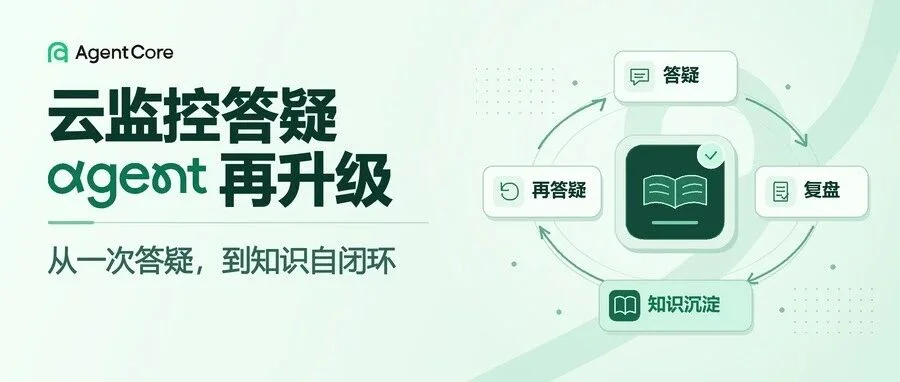
The article details the evolution of Alibaba Cloud's monitoring Q&A agent, now hosted on AgentCore as a unified QwenPaw Agent supporting eight diagnostic domains: CloudLens, CMS 1.0, CMS 2.0, Alerting, APM, Cloud Synthetic Monitoring, RUM, and Probe. The agent integrates with DingTalk, a Web workbench (via AG‑UI/SSE), and an OpenAPI for TAM/AES experts in the unified on‑call routing.
Architecture: One Agent, Eight Domains
The agent selects domain‑specific Skills and Runbooks based on signals in the user query (e.g., EtlMeta + workspace/addon → CMS 2.0; EtlMeta + CloudLens/SLS/log delivery → log delivery). Shared tools (ticket reading, SOP retrieval, log/metric queries) are reused across domains. Evidence sources include tickets, SOPs, SLS logs, POP gateway logs, API responses, and metric read‑backs. The agent retains session context (evidence, excluded possibilities, pending items) for multi‑step investigation.
From On‑Call Experience to Executable Skills
Knowledge construction started by organizing SOPs, tool entry points, and troubleshooting conventions for CMS 1.0/2.0, CloudLens, and Alerting, later expanding to APM, Synthetic, RUM, and Probe. Human SOPs assume implicit knowledge (region, time window, pagination, error classification); these defaults were made explicit in Skills. Each Skill defines applicability conditions, reverse boundaries, minimal steps, risk constraints, and output requirements. Reference materials hold detailed fields, regional differences, long commands, and case examples.
AgentCore Hosting & Persistent Storage
The unified agent is hosted on AgentCore. Business‑side packages (behavior rules, routing tables, capability registry, Skills, Runbooks) are versioned and published. NAS via AgenticFS provides persistent storage mounted at /mnt/agenticfs/private (agent‑specific files) and /mnt/agenticfs/shared (shared artifacts). Private directory structure: codes/ (SOP knowledge base + source code), cli/ (CLI, plugins, dependencies), downloads/ (attachments, exports, temp files). A startup script verifies NAS writability, repo/tool dependencies, and loads per‑shell environments.
Web Workbench Integration via AG‑UI
The Web workbench uses a business backend to call AgentCore's AG‑UI endpoint ( POST /ag-ui/agent) over SSE. Key identifiers: threadId (conversation), runId (single run), messageId (per message). Frontend consumes structured events: RUN_STARTED, TEXT_MESSAGE_START/CONTENT/END, TOOL_CALL_START/ARGS/END, TOOL_CALL_RESULT, RUN_FINISHED/ERROR. The backend saves message snapshots and forwards increments; page refresh restores state from saved snapshots. Authentication and authorization are enforced server‑side.
Three Access Channels
DingTalk : 1‑on‑1 chat or group @ observe-oncall. Example: paste a ticket link → agent extracts ECS instance, region, script HTTP 404 (NoSuchKey), compares script versions across regions in a table.
Web Workbench : Persistent sessions with search, history, image input, collaboration, Markdown export. Example: ticket about “data export data points” fee → agent lists CMS 2.0 access policy and MetricExporter as leads; follow‑up narrows to missing call logs and usage details.
Unified On‑Call Routing (OpenAPI) : TAM/AES experts call the same agent during ticket handling; unsolved issues escalate to product engineering.
Real‑World Alert Diagnosis Cases
822 Events: Which Rules, Which Nodes?
Query: ShardingMaxRt alerts 11:00‑11:50. Agent returned 32 same‑parameter rules, 822 event records (alert + recovery), grouped by instance and data node. Rule condition: $Average >= 10000 (µs = 10 ms), 60 s period, 3 consecutive breaches. Two pitfalls: rule name prefix ≠ actual alerted object; max RT ≠ average RT. Follow‑up compared rule bindings before/after: 30 rules still account‑level, 2 narrowed to single instance. Historical binding changes inferred from event distribution + metrics (old records overwritten).
Cluster Healthy but P1 Alert
Rule contained absent(...) (Prometheus “no time series” function) with 300 s duration. Timeline: 15:48 collection component upgrade request; 15:51+ multiple metrics stopped returning data; ~5 min later rule fired. Evidence points to collection pipeline, but upgrade‑failure mechanism not proven; customer cluster Pod status unavailable.
Two Phone Calls from One Alert
PostgreSQL alert: console shows voice+SMS on fire, only SMS on recovery, yet user received two calls. Agent aligned events and channel records: one fire event → one voice request with two recipient numbers → two independent outbound calls; subsequent fire events in channel silence window; recovery only SMS. Conclusion: both calls belong to “fire”, no recovery call found. Distinction: platform called two numbers once each vs. same phone ringing twice — requires per‑number, per‑call‑time verification.
Other Scenarios (ECS, Redis, RUM, Log Delivery)
Cross‑account ECS : Ready without metric checking, policy metric-agent, query releases=0 → shifted from “not deployed” to verifying policy declaration, deployment records, and metrics on both sides.
Redis Audit : Corrected callerUid / callerParentId misattribution; identity anchored to gateway audit log.
RUM List Count Mismatch : Added delete records, widened time window, traced incremental events → moved from “sync omission” to create/delete/consume chain; no consume record ≠ proven consume failure.
PAI‑EAS Log Delivery Time : Separated config creation time, log timestamp, receive timestamp; difference of two timestamps ≠ delivery latency.
Log Distribution Latency : Joint check of control plane, source, target, error records; “no anomaly found” scoped to actual sampling window.
Knowledge Closed‑Loop: “Razor‑Style Iteration”
After each investigation, a structured review produces:
List redundant calls, high‑cost outputs, incomplete flows; distinguish execution gaps from doc gaps.
Shorter reusable query paths (pagination, time window, output scope).
Skill/Runbook change proposals with target files, evidence, validation steps.
Sanitized candidate experience fed to knowledge maintenance pipeline.
Local Engineering Environment (LoongSuite + Codex CLI)
Code repo, Skills, SOPs, diagnostic tools co‑located. Example: Japan region addon install failure → agent traced error to service‑side code location and region config; produced cause, evidence scope, verification method. Changes generated as diffs, committed to Git after authorization.
Periodic Full Audit
Four source categories: official help docs, internal QA docs, offline handling flows, ticket lists. Sub‑agents verify each item against current knowledge base/Runbooks, record gaps, conflicts, and evidence. Verified updates patched into knowledge base, Skill references, or Runbooks. Customer IDs, resource IDs, raw responses sanitized. Single‑ticket external wording generalized after scope validation.
From Online Review to Formal Knowledge
Two‑stage: online investigation → review + candidate experience; authorized maintenance flow → Git (review, test, package, publish). MEMORY.md in agent package serves as read‑only knowledge index. Workbench stores answer judgments and review records. Weekly manual ticket reviews also audit AI answer accuracy, re‑test and correct troubleshooting methods.
Constraints: Bind Judgment to Specific Answer; Evidence‑Driven Immersion
Human judgment attached to a concrete business reply (not the whole conversation). Later replies don’t overwrite earlier judgments.
Even if a business conclusion is wrong, successful query steps (params, pagination, fields, stop conditions) can be reused. Only confirmed‑correct conclusions with evidence generate candidate knowledge rules. Retracted explanations excluded from review.
Recent Metrics & Example: NLB Ticket → Reusable Query Path
Last month: 822 deduplicated sessions (528 business/usage, 294 debug/maintenance/unclassified). Alert/notification top topic. Last week: 28 PRs merged from Web workbench reviews — categories: tool/env adaptation (7), alert/notification (6), metric/data validation (6), log audit/delivery (4), resource query/attribution (4), availability monitoring (1).
NLB ticket (2026‑11‑18): Customer tags NLB, new tagged NLB not auto‑joined group while existing NLBs present. Old session mis‑interpreted “historical members exist” as “tag auto‑join supports this product”. Review steps:
Corrected inferences: shallow clone → full history → verified tag events vs. full sync product mapping; retracted “re‑sync will fix”.
Selected correct business reply (marked “correct”), review scope covered entire session up to that point.
Authorized both knowledge candidate and PR submission; required full application group troubleshooting method in SOP knowledge base referenced by main Runbook.
Agent wrote changes to four layers: Skill reference (support matrix, judgment matrix, minimal steps, stop conditions), Skill SKILL.md (trigger branches + refs), main Runbook (shortcut for on‑call), SOP knowledge base (full explanation).
Tracked permissions/delivery gaps: Agent repo PR created but reviewer assignment not confirmed; SOP repo push permission denied; deployment‑attestation gap noted.
After authorization, continued from breakpoint: SOP MR + reviewer confirmation; Agent repo PR already merged. Archived merge status per repo/branch, cleaned temp workspace.
Outstanding tool issue: reviewer assignment API returned success but list empty; fixed with correct parameters in next round.
Guiding Conventions
Human judgment bound to specific reply; review covers explicit session boundary; overturned judgments removed; final answer retains unknowns.
Every knowledge entry documents required inputs, applicability, evidence entry points, stop conditions. Record form proposes leads; invocation sources verified via corresponding entry‑point logs.
Reuse successful tool calls; parameterize customer data; update repo originals. Details in references; routing at entry; cross‑repo delivery by authorization.
Track draft → verified → PR created → merged → deployed → actual hit. Without same‑caliber comparison data, record observable results first.
Tool fixes have targets; knowledge gaps have target files. Next similar issue will test the refined query path.
Continuous Accumulation & Invitation
AgentCore handles hosting/runtime; one agent selects domain capabilities; team continuously maintains knowledge, tools, evidence standards. DingTalk, AG‑UI Web workbench, and OpenAPI enable continuous follow‑up, evidence supplementation, handoff. Workbench integrates messages, collaboration permissions, review records into daily workflow.
Long‑term polishing focuses on: Can Request ID trace to entry? Does Ready state have real metric backing? Are human corrections written into next‑version troubleshooting? Weekly ticket + AI answer review; periodic audit of official help, internal QA, handling flows, ticket logs; improvements reviewed, published, then regression‑tested with similar questions.
Frontline teams (support, PDSA, TAM, AES, technical services) invited to use: provide time, region, resource ID, Request ID, error/alert screenshots. Ad‑hoc help via DingTalk observe-oncall; continuous investigation, evidence review, collaboration, review via Web workbench; TAM/AES via OpenAPI in unified routing. Replies must be verified by on‑call engineer before customer communication. Corrections welcomed in original session for review and integration into Skills, Runbooks, knowledge base.
For questions about attribution, corrections or content rights, please contactand we will review it promptly.