

Ant Open-Sources Ling-3.2-air: 124B Multimodal MoE Scores 58% on SWE-bench Pro
Ant's inclusionAI releases Ling-3.2-air, a 124B native multimodal MoE model with 55B active parameters under MIT license, achieving 58.28% on SWE-bench Pro and outperforming GPT-5, Claude, and Gemini on coding benchmarks, though legal hallucination issues persist.
Reading font
Model Release Overview
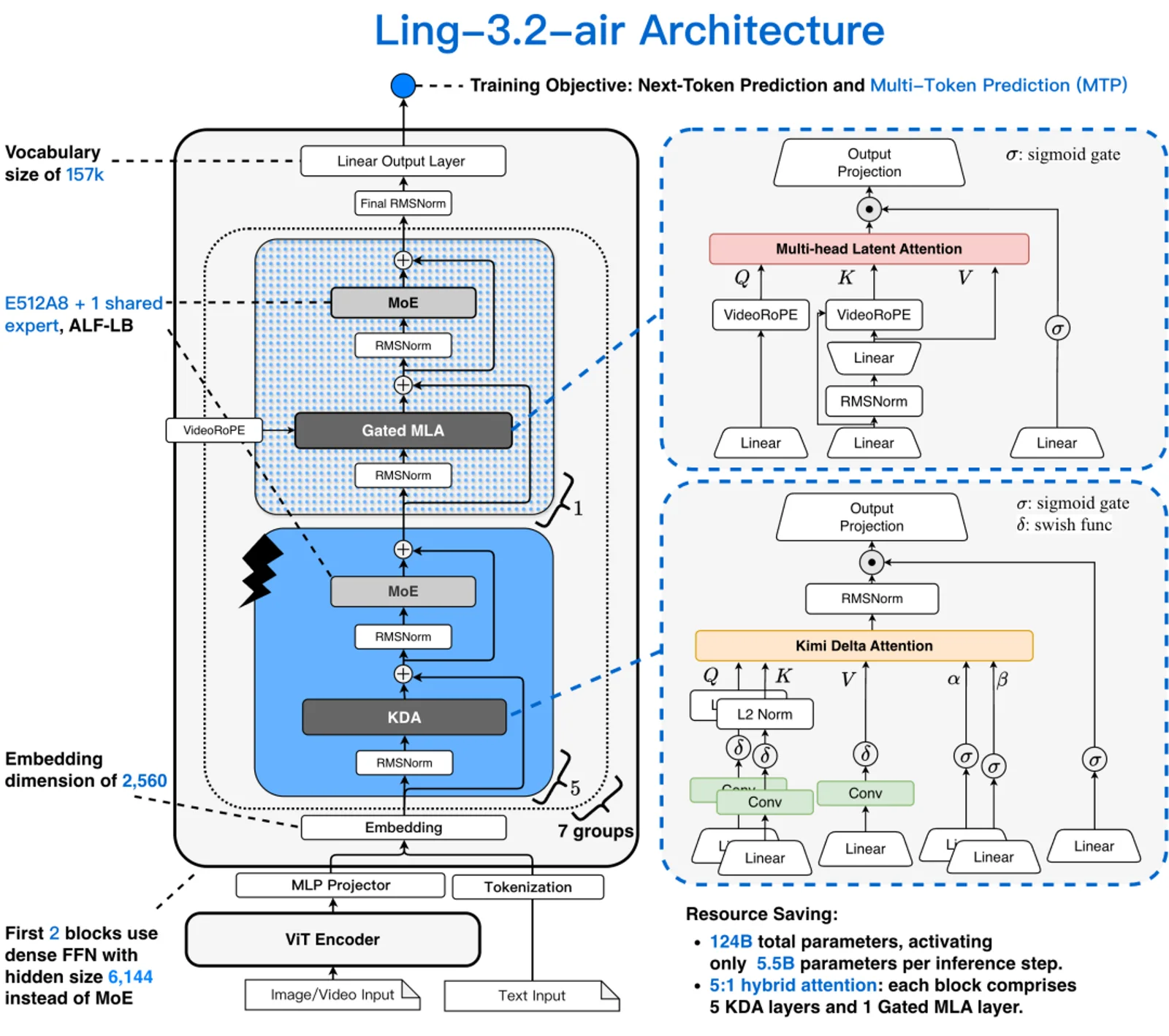
Ant Group's inclusionAI lab has published Ling-3.2-air on Hugging Face under an MIT license. The model is a native multimodal mixture-of-experts (MoE) architecture that processes text, images, and video. Total parameters: 124 billion ; active parameters per token: 55 billion . Weights are distributed across 13 safetensors shards totaling approximately 129 GB , stored in FP8 E4M3 precision.
Benchmark Results
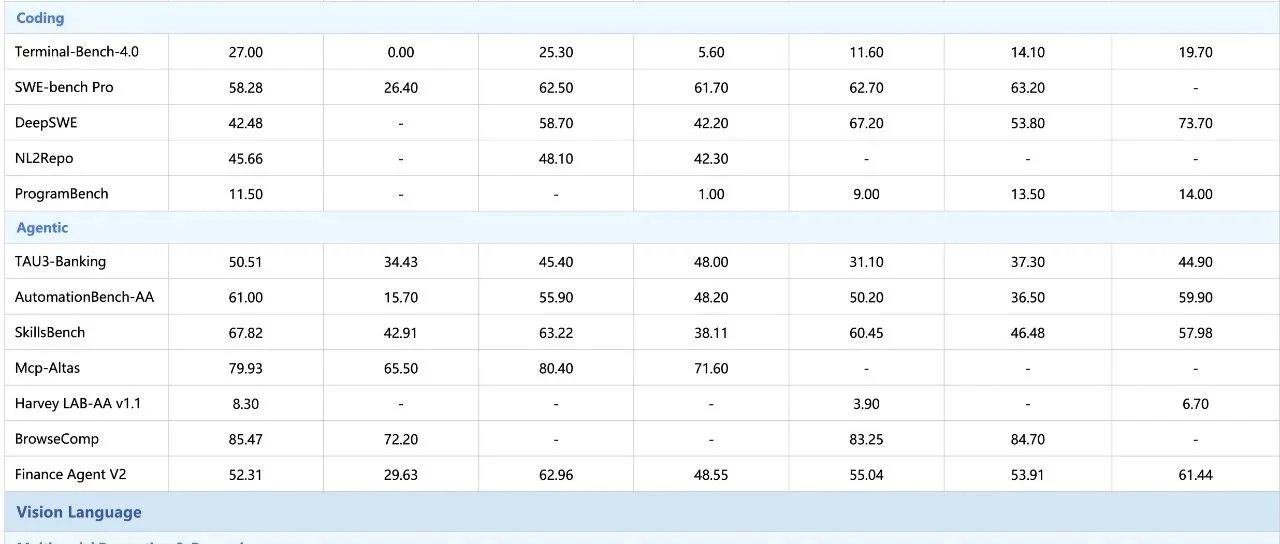
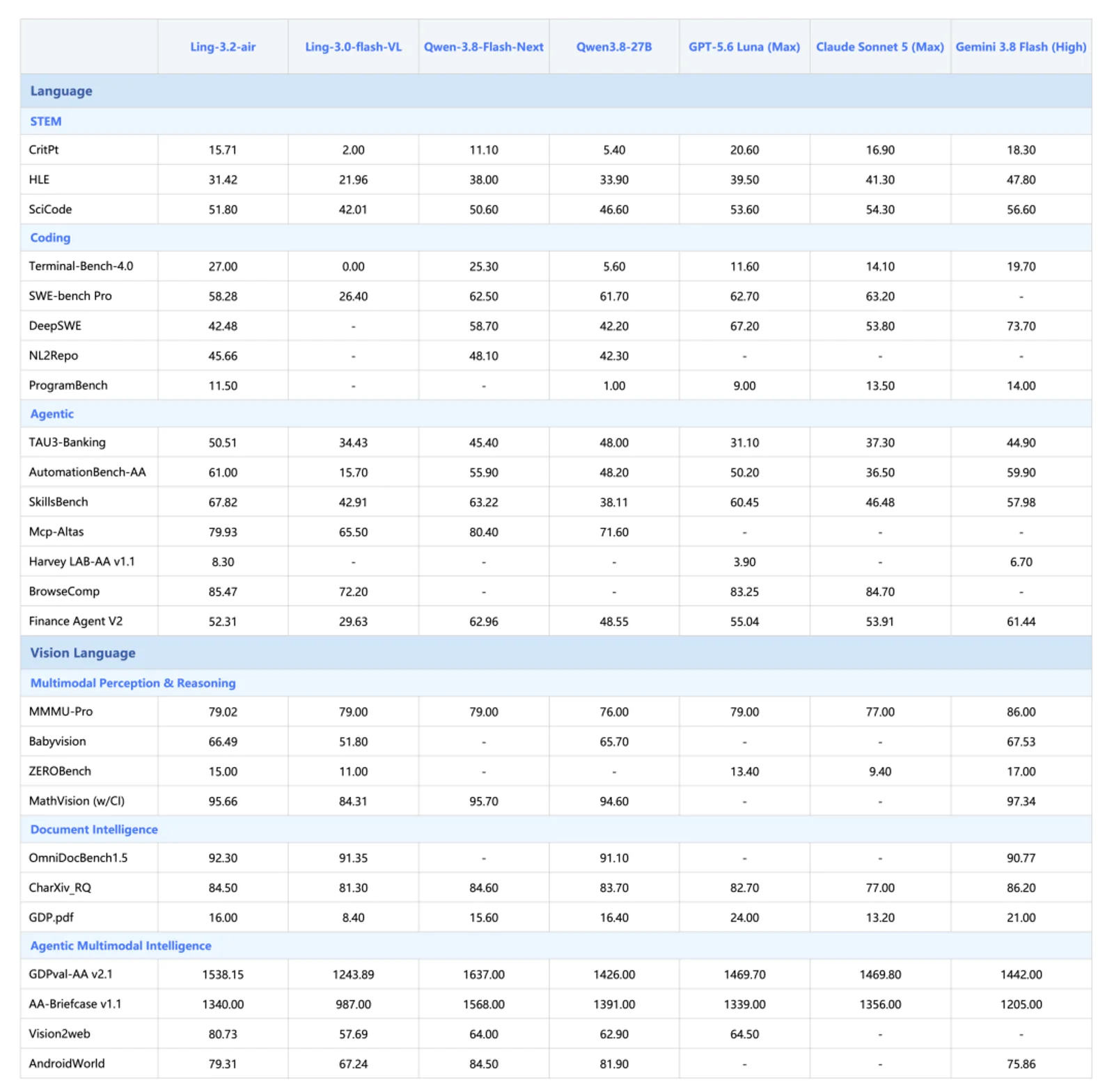
The official model card provides a comparison table against the previous generation Ling-3.0-flash-VL and several contemporary models (Qwen3.8-27B, GPT-5.6 Luna, Claude Sonnet 5, Gemini 3.8 Flash). Key improvements:
SWE-bench Pro : 26.40 → 58.28
AutomationBench-AA : 15.7% → 61%
Terminal-Bench 4.0 pass rate: 0% → 27%
AA-Briefcase v1.1 Elo: 987 → 1340 (+353)
GDP.pdf full pass rate: 8.4% → 16%
On the legal benchmark Harvey LAB-AA v1.1 , the criterion pass rate reaches 87.7% , but the full pass rate drops from 8.3% (before material hallucination check) to 0.8% after the check, indicating a notable hallucination problem when handling legal documents.
Architecture Details
Layers : 42 Transformer layers
Attention : 35 layers use Kimi Delta Attention , 7 layers use gated multi-head latent attention (ratio 5:1)
First two layers : dense
MoE layers : 512 routed experts, top-8 activated per token, plus 1 shared expert
Native context : 260k tokens, extended to 1 million via YaRN
Weight format : FP8 E4M3, enabling the 129 GB checkpoint size
Deployment Requirements
The model card specifies hardware recommendations:
Recommended : 4× 141 GB-class GPUs (H20-3e or H200) or a 4-card Blackwell node for 260k context
80 GB GPUs (H100, H800) require scaling to 8 cards
Inference engines : SGLang provides a day-0 Docker image with MTP speculative decoding; Ant maintains a vLLM fork for support
All weights, inference code, and the MIT license are publicly available.
Limitations Noted
The model exhibits hallucination in professional legal tasks: material that does not appear in source documents is incorrectly treated as present, causing the full pass rate on Harvey LAB-AA v1.1 to collapse to 0.8% after hallucination filtering.
Sources
Model card: https://huggingface.co/inclusionAI/Ling-3.2-air (license, parameters, architecture, official self-reported scores including comparison table images). SGLang deployment guide: https://docs.sglang.io/cookbook/autoregressive/InclusionAI/Ling-3.2-air (context length, precision, GPU configuration).
For questions about attribution, corrections or content rights, please contactand we will review it promptly.