

CompletableFuture Async Orchestration: Avoiding Three Production Disasters
This article dissects Java's CompletableFuture through three real production incidents, covering its state machine, callback semantics, thread pool pitfalls, exception propagation, DAG orchestration patterns, timeout control, context propagation, and source code internals with practical templates and a seven-point safety checklist.
Reading font
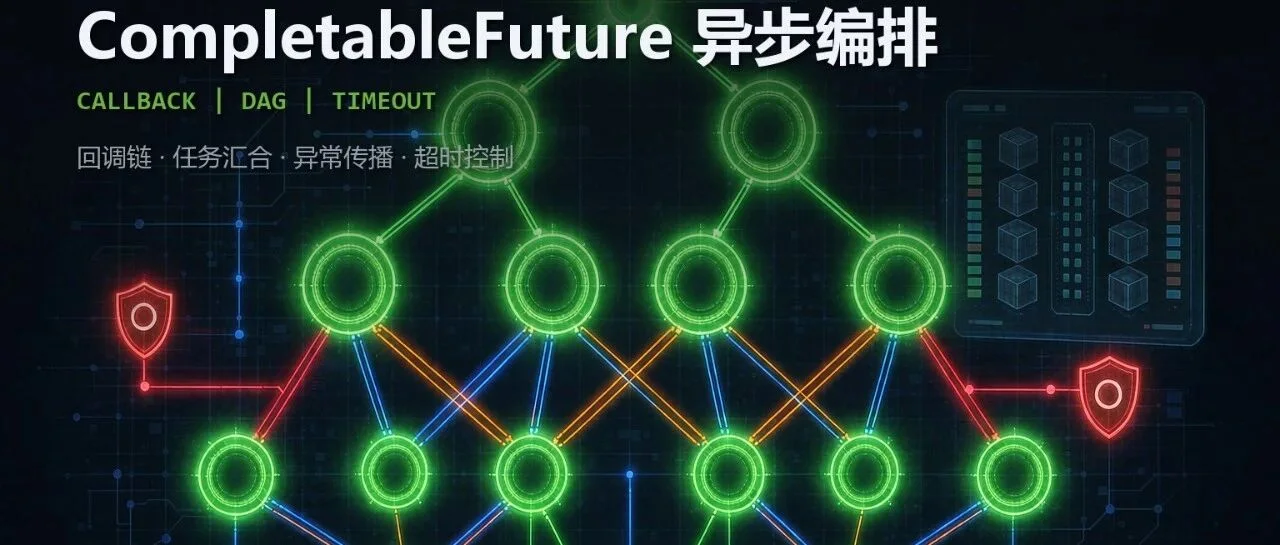
The article opens with three production incidents that expose CompletableFuture's default-configuration traps:
Incident 1 : Using supplyAsync without a custom executor routes I/O tasks to ForkJoinPool.commonPool (size = cores-1, JVM-wide shared, daemon threads). During a promotion spike, 40 slow RPC calls saturated the 7-thread pool on an 8-core machine, queuing thousands of tasks and paralyzing all JVM parallelism (parallel streams, Arrays.parallelSort, other CFs). Fix: always pass a dedicated, monitored thread pool for business async work.
Incident 2 : A callback chain inserted a blocking get() to fetch another future's result, collapsing parallel orchestration into serial execution. P99 latency jumped from 80 ms to 480 ms. Fix: use allOf + join for multi-way joins; keep waiting only at the outermost layer.
Incident 3 : An NPE in a pricing step was swallowed because no exceptionally / handle was attached. The exception sat in the future; callers never called get, so monitoring only showed rising timeout rates. Two days later the root cause was found. Fix: attach per-branch exceptionally for local fallbacks and an outer handle / whenComplete for logging and global fallback.
Why CompletableFuture: Future's Three Sins
Futureonly offers get (blocking), no completion callback, and no composition API. Five 200 ms tasks submitted in parallel but serially get -ed take 1000 ms. CF turns the "receipt" into a pipeline: completion triggers callbacks immediately, chaining ( thenApply / thenCompose) and multi-way joins ( allOf / anyOf / thenCombine) become first-class APIs, and exceptions propagate through a dedicated recovery channel. Five 200 ms tasks via allOf finish in 200 ms — P99 equals the longest path, not the sum.
State Machine & Creation
CF's internal state is a volatile int ( NEW → COMPLETING via CAS → NORMAL / EXCEPTIONAL via ordered write; also CANCELLED, INTERRUPTING / INTERRUPTED). One-way, irreversible; terminal state fires callbacks once. Creation paths: supplyAsync(supplier, executor) (standard), runAsync (no return), completedFuture(v) (pre-completed), new CompletableFuture() + manual complete / completeExceptionally (event-driven). Observation: get / join only at the outermost layer; callbacks ( thenXxx) inside the chain. get throws checked exceptions; join throws unchecked CompletionException — prefer callback-style join semantics inside chains.
Default commonPool: Three Traps
Pool size = cores-1 (8 cores → 7 threads; dual-core → 1 thread). I/O tasks quickly saturate it.
Shared across the entire JVM: parallel streams, Arrays.parallelSort, all default CFs compete for the same threads.
Daemon threads — main exit doesn't wait; batch jobs lose tasks.
Iron rule : supplyAsync(task, bizPool) for all business async. Pool sizing follows the I/O formula from the thread-pool chapter: adequate threads, bounded queue, named thread factory, explicit rejection policy. CPU-bound short tasks can stay in commonPool; I/O tasks go to custom pools. CF chains can even switch pools per stage (RPC on I/O pool, compression on CPU pool) — a granularity synchronous code cannot achieve.
Callback Semantics & Thread Ownership
Three core callbacks: thenApply(Function<T,U>) — synchronous 1-in-1-out transformation (formatting, calculation). thenCompose(Function<T,CF<U>>) — async chaining; callback returns a CompletableFuture that gets flattened. Classic error : using thenApply for an async call produces CF<CF<U>> nesting; outer join yields the inner future, not the value. thenCombine(other, BiFunction) — merges two independent results. allOf / anyOf — three-or-more way join (wait-all) or race (first-complete).
Thread ownership rules (frequent interview topic, root cause of context loss):
No Async suffix: runs on the thread that completes the source future; if already complete, runs immediately on the caller's thread. Async without executor: submits to commonPool (or caller thread if already complete). Async with executor: submits to the specified pool.
Corollaries: heavy callbacks should use Async +pool; ThreadLocal context is lost across threads (solved in §5.3); non- Async callbacks have non-deterministic execution threads — avoid thread-dependent code there.
Consumer & Recovery APIs
thenAccept(Consumer)— consumes result, no return. thenRun(Runnable) — ignores result, runs on completion. whenComplete(BiConsumer) — observes result or exception without rewriting ; exception continues propagating. Ideal for metrics/logging. exceptionally(Function<Throwable,T>) — runs only on exception, returns fallback value that replaces the exception (swallows it). handle(BiFunction) — runs on both normal and exceptional completion, returns new result that rewrites downstream view. Unified recovery exit.
Discipline : logging → whenComplete; fallback → exceptionally; logged unified recovery → handle. Common bug: returning a fallback inside whenComplete — it doesn't rewrite the result.
Exception Propagation & DAG Orchestration
Exceptions propagate like Stream short-circuit: any stage failing exceptionally skips all intermediate non-recovery callbacks and jumps to the first exceptionally / handle / whenComplete. Standard two-layer recovery:
Leaf layer (each supplyAsync) gets its own exceptionally with a branch-specific default — one branch failing doesn't sink the whole page.
Outermost layer gets a handle for unified logging and final fallback.
Anti-pattern: only an outermost exceptionally — local failure becomes global degradation.
Product-page DAG template (fixes incidents 1 & 2):
Leaf layer: three parallel supplyAsync (item, price, stock), each with its own pool and exceptionally fallback.
Dependency layer: detail → recommendations via thenCompose.
Join layer: allOf(f1,f2,f3).join() then assemble.
Budget: orchestrated P99 = longest path (detail 120 ms), not sum (480 ms). Critical-path discipline : invest optimization budget in the longest leg; short legs speeding up don't help.
Timeout control (Java 9+): orTimeout(t,unit) completes exceptionally with TimeoutException; completeOnTimeout(default,t) completes normally with a default value. Discipline: attach once at the outermost layer — multiple attachments overwrite semantics and multiply timers. Java 8 compatibility uses a single-thread ScheduledExecutorService calling completeExceptionally(new TimeoutException()); CAS semantics ensure race safety (task wins → timeout no-op; timeout wins → task result ignored). anyOf race caveat: losers keep running in the pool — must pair with task-level timeouts, loser monitoring, and optionally applyToEither for two-way races.
Orchestration Budget: Three Accounts
Thread-count account: three parallel branches consume 3× pool capacity; verify pool can absorb peak concurrency (queue budget from thread-pool chapter).
Fallback account: each branch's fallback must be pre-built (cached snapshot, default config); fallback latency counts in budget.
Failure account: allOf joins exceptionally if any branch fails exceptionally — leaf exceptionally must convert exceptions to defaults before the join.
Production Templates (Four Scenarios)
5.1 Product Page Aggregation: allOf + Independent Pools + Per-Branch Fallback
private final Executor bizPool = new ThreadPoolExecutor(16, 32, 60, SECONDS, new ArrayBlockingQueue<>(200), new NamedFactory("page-agg"), new ThreadPoolExecutor.CallerRunsPolicy());

public PageVO buildPage(long id) {
    CompletableFuture<Item> f1 = supplyAsync(() -> itemRpc(id), bizPool).exceptionally(e -> Item.FALLBACK);
    CompletableFuture<Price> f2 = supplyAsync(() -> priceRpc(id), bizPool).exceptionally(e -> priceCache(id));
    CompletableFuture<Stock> f3 = supplyAsync(() -> stockRpc(id), bizPool).exceptionally(e -> Stock.UNKNOWN);
    try { CompletableFuture.allOf(f1, f2, f3).get(200, MILLISECONDS); } catch (Exception e) { /* individual timeouts: fallbacks already in place */ }
    return new PageVO(f1.join(), f2.join(), f3.join()); // join non-blocking after allOf
}
Key points: per-branch exceptionally (price falls back to cache, item to template); single outer get(200ms) as the only wait point; join after allOf is non-blocking; pool params follow I/O discipline (16 core, 32 max, bounded queue 200, named factory, CallerRuns). allOf returns CF<Void> — it only waits; values must be collected via individual join.
5.2 Layered Fallback Chain: exceptionally Per Segment (Fixes Incident 3)
public CompletableFuture<RecommendVO> recommend(long uid) {
    return detailCf(uid)
        .thenCompose(d -> recCf(d, uid))
        .thenApply(this::assemble)
        .whenComplete((v, e) -> { if (e != null) { log.warn("rec fail", e); metrics.inc("rec.err"); } })
        .exceptionally(e -> recCacheSnapshot(uid));
}
Layers: leaf futures (detailCf/recCf) carry their own timeouts and local fallbacks; whenComplete observes without rewriting (the monitoring point that turned a two-day hunt into ten minutes); outer exceptionally provides final cache snapshot. Anti-patterns: only outer exceptionally (local→global), returning fallback in whenComplete (no effect), silent exceptionally(e -> null) (silent failure costlier than crash). Fallback values must pass null-checks to avoid becoming new NPE sources.
5.3 Context Propagation: Decorator for ThreadLocal Transparency
static <T> Supplier<T> ctxWrap(Supplier<T> task) {
    Map<String,String> ctx = RequestContext.snapshot();
    return () -> {
        try { RequestContext.restore(ctx); return task.get(); }
        finally { RequestContext.clear(); }
    };
}
// usage
CompletableFuture<Order> f = supplyAsync(ctxWrap(() -> orderRpc(uid)), bizPool).thenApply(v -> enrich(v));
// callbacks needing context wrap the Function similarly
Cross-thread callbacks lose login state, traceId, gray-release flags. Template: snapshot in caller thread → restore in task thread → finally clear (pooled threads reuse; uncleared context leaks into next task — a revenue-grade bug). Mature solution: TransmittableThreadLocal (TTL) via TtlRunnable / TtlCallable or TtlExecutors.wrap(pool); InheritableThreadLocal only works on thread creation, not pool reuse — a common mistaken substitute. Discipline: either full TTL or unified decorator; no ad-hoc scattering.
5.4 Timeout Control: orTimeout / completeOnTimeout + Java 8 Compat
// 1.9+: one-liner on outermost layer
CompletableFuture<VO> f = supplyAsync(() -> rpc(id), bizPool).completeOnTimeout(VO.FALLBACK, 200, MILLISECONDS);
// or orTimeout: timeout becomes exception for fallback chain

// 1.8 compat: scheduler manually completes exceptionally
static final ScheduledExecutorService SCHED = Executors.newSingleThreadScheduledExecutor();
static <T> CompletableFuture<T> within(CompletableFuture<T> f, long ms) {
    SCHED.schedule(() -> f.completeExceptionally(new TimeoutException()), ms, MILLISECONDS);
    return f;
}
// usage: within(f, 200).exceptionally(...)
Comparison: 1.9+ uses CF's internal scheduler (zero extra threads); 1.8 uses a single-thread scheduler triggering completeExceptionally — CAS state machine guarantees race correctness (task completes first → timeout no-op; timeout first → task result discarded). Three disciplines: (1) timeout = branch budget derived from monitored P99, not guesswork; (2) timeout doesn't interrupt the task thread — long tasks need internal interruption checks; (3) timeout rate into monitoring — rising rate signals downstream capacity shortage, timeout is tourniquet not cure.
CF Usage Review: Seven-Point Physical (One Fail = Block)
supplyAsyncmissing custom pool for I/O? (Incident 1 — veto)
Blocking get() inside chain? (Incident 2)
Public chain missing exceptionally / handle? (Incident 3) thenApply calling a method that returns CF? (Nesting → use thenCompose)
No timeout control anywhere? ( orTimeout / completeOnTimeout)
Cross-thread context propagation missing? (TTL/decorator)
After allOf, per-branch join + per-branch fallback metrics?
Core Source Code: Four Key Implementations
1. FutureTask State Machine (Chapter 7 CAS Delivered)
// FutureTask (JDK 17 simplified)
private volatile int state;
private static final int NEW = 0, COMPLETING = 1, NORMAL = 2, EXCEPTIONAL = 3, CANCELLED = 4;

public void run() {
    if (state != NEW || !U.compareAndSwapInt(this, STATE, NEW, COMPLETING)) return;
    try { V result = callable.call(); outcome = result; U.putOrderedInt(this, STATE, NORMAL); }
    catch (Throwable ex) { outcome = ex; U.putOrderedInt(this, STATE, EXCEPTIONAL); }
    finally { finishCompletion(); }
}
This is the Chapter 7 CAS state machine in action: state is volatile int; NEW→COMPLETING via CAS (competes with cancel — only one wins, loser returns immediately, task never runs twice); COMPLETING→terminal via putOrderedInt (no competition, holder already owns progression right); outcome write before state ensures any thread seeing NORMAL sees full result (volatile convention). CF's state machine is isomorphic, adding a callback stack.
2. CF's Completion Stack & postComplete
// CompletableFuture (JDK 17 simplified)
volatile Object result;
volatile Completion stack; // Treiber stack head

final boolean tryPushStack(Completion c) {
    c.next = stack;
    return U.compareAndSwapReference(this, STACK, c.next, c);
}

final void postComplete() {
    Completion h = stack;
    while (h != null) {
        Completion next = h.next;
        if (h.tryFire(NESTED) == null) { postStackHead(h); } // retry
        h = next;
    }
}

final boolean completeValue(T t) {
    return U.compareAndSwapReference(this, RESULT, null, t);
}
Waiting structure is a Treiber lock-free stack (not a queue): each thenXxx CAS-pushes a Completion node (only if source incomplete; if complete, callback runs immediately). completeValue CAS-swaps result from null to value — one winner, losers fail. On success, postComplete walks the stack calling tryFire — callbacks execute on the completing thread (source of "no-suffix callback runs on completer thread"). tryFire failure (node being fired by another thread during multi-complete race) re-pushes for retry. Registration vs. completion race resolved by the same CAS: registrar wins → node stacked awaiting fire; completer wins → immediate execution. No locks needed.
3. thenApply & UniApply — Callback Semantics Source
// UniApply (JDK 17 minimal)
static final class UniApply<T,R> extends UniCompletion<T,R> {
    Executor e; // null = synchronous
    Function<? super T, ? extends R> fn;

    final boolean tryFire(int mode) {
        CompletableFuture<R> dep; CompletableFuture<T> src; R r; Throwable x;
        if ((dep = dep) == null || (src = src) == null || (r = src.result) == null) return false;
        if (r instanceof AltResult) { x = ((AltResult) r).ex; dep.completeThrowable(x, r); }
        else { try { dep.completeValue(fn.apply(r)); } catch (Throwable ex) { dep.completeThrowable(ex); } }
        return true;
    }
}
Three branches cover all callback rules: (1) source incomplete → return false, node stays on stack for later postComplete fire ("completion triggers immediately"); (2) source is AltResult (exception wrapper) → dependent future completes exceptionally without invoking fn — origin of "exception skips all intermediate callbacks"; (3) normal completion → fn.apply result written to dependent future; any exception from fn caught and makes dependent future exceptional — callback exceptions don't throw to thread, they propagate down the chain (Incident 3's "exception swallowed" mechanism: no one consumes the dependent future, exception stalls on the chain). Entire thenXxx family shares the UniCompletion skeleton; only fn type and result-writing differ.
4. allOf & BiRelay — Multi-Way Join Implementation
// allOf (JDK 17 simplified approach)
public static CompletableFuture<Void> allOf(CompletableFuture<?>... cfs) {
    return andTree(cfs, 0, cfs.length - 1);
}
// pairwise merge into binary tree, each leaf completion triggers BiRelay check on sibling:
static final class BiRelay<T,U,V> extends BiCompletion<T,U,V> {
    final boolean tryFire(int mode) {
        if (dep == null || (r = src.result) == null || (s = snd.result) == null) return false;
        if (r instanceof AltResult) dep.completeThrowable(...);
        else if (s instanceof AltResult) dep.completeThrowable(...);
        else dep.completeValue(null);
        return true;
    }
}allOfbuilds a binary tree via pairwise BiRelay (dual-source BiCompletion) — both sources must complete for parent to complete (exception on either propagates exceptionally). Tree root is the returned future. This tree-merge explains two properties: (1) returns CF<Void> — root only cares "all done", values collected via individual join; (2) O(n) complexity with natural parallelism — each tree layer fires independently when its sources complete, no global coordinator. anyOf is the OR-structured isomorphic variant. At this point, CF's entire source skeleton is visible: Uni (single-source) / Bi (dual-source) / All (tree) + Completion stack + CAS state machine — every orchestration API in §4 is a composition of these three bricks.
Seven Cost Accounts of CF
Pool account : default commonPool is JVM-global — business I/O in it mortgages whole JVM parallelism to one module (Incident 1). Custom pool's ~100 lines of config is the first and highest-ROI investment; bonus: independent monitoring & dynamic tuning (reuse Chapter 5).
Blocking account : every get() in chain adds a full wait — Incident 2's 80→480 ms is four get s' bill. Correct posture: "wait once, join many" — single outer get /timeout, internals all callbacks + post-complete join.
Exception account : CF exceptions never surface themselves — "forgot to catch" manifests as timeout or revenue loss (Incident 3's two-day cost). Per-public-chain exceptionally + whenComplete metrics is a fixed two-line investment buying "exception located in ten minutes" insurance.
Context account : cross-thread callbacks lose ThreadLocal — teams without propagation inevitably hit "traceId broken / gray flag lost / login state gone" trifecta. TTL or unified decorator is one-time infra; ad-hoc scattering's hidden maintenance cost far exceeds it.
Complexity account : declarative chains read well but debug poorly — no call stack, breakpoints miss execution moment. Deep chains (>5 then s) yield negative readability ROI: split into named methods returning intermediate CF s with named variables; don't chase "one-chain cleverness".
Race account : anyOf race gains (fastest source) coexist with cost (losers keep occupying pool) — race + timeout + loser monitoring + applyToEither must ship together; uninstrumented race hides "slowest failure" in the pool.
Ecosystem account : Spring @Async returning CF, WebFlux Mono (same callback DNA, different backpressure), gRPC/RestClient async APIs — all CF-shaped. Mastering CF makes every framework async API a "familiar shape" — learning CF unlocks the whole async ecosystem.
Summary: CF's direct cost = "pool + fallback + context" three infra pieces; benefit = "wait once, exception has path, orchestration free". It's the correct async posture and the most default-trap-dense class: the seven-point physical isn't theater — each item backs a real incident.
20 Interview Questions (with Answers)
The article concludes with 20 Q&A covering Future's three sins, CF state machine, commonPool traps, callback differences, thenApply vs thenCompose, thread ownership, exception propagation, whenComplete vs handle, allOf return value, anyOf pitfalls, timeout APIs, timeout thread interruption, context propagation, CF vs FutureTask, Completion stack, UniApply.tryFire logic, allOf binary tree, cancellation, deep-chain issues, and when not to use CF.
One-Page Cheat Sheet
Condensed reference covering creation/pool rules, callback/exception semantics, orchestration budget, context propagation, race safeguards, seven-point physical, allOf returns CF<Void>, and source-code three bricks (Uni/Bi/All + Completion stack + CAS state machine).
For questions about attribution, corrections or content rights, please contactand we will review it promptly.