

Databricks & 11 Vendors Open Metadata Battle with Iceberg Catalog Labels
Databricks and ten other vendors including Google Cloud and Salesforce have adopted Apache Iceberg's new Catalog Labels API to standardize cross-platform exchange of table- and column-level metadata tags, enabling AI agents to discover governed data without rebuilding governance stacks.
Reading font

01 Data Flows Freely but Enterprise Context Remains Locked
Recent years of data infrastructure competition have focused on decoupling storage, compute, and data access. Open table formats like Apache Iceberg and Delta Lake let enterprises store data in object storage and choose compute engines freely. Catalog federation further reduced cross-platform data access costs. On November 17, Databricks and Google Cloud announced bidirectional catalog federation: Google Cloud-managed Iceberg tables become queryable in Databricks, and BigQuery can read Unity Catalog-managed data, eliminating duplicate copies. However, business classifications, certification status, and governance information in the original catalogs still lack a unified cross-platform transmission mechanism.
For example, a financial firm may tag customer tables in Databricks with business domain, data owner, and certification status, and classify PII columns. When moving to another platform, external systems can retrieve schema and data types but not know which columns contain PII, which data is certified, or which datasets suit specific analyses. Enterprises often must rebuild classification systems or maintain extra metadata sync pipelines. In traditional BI, analysts compensate with business experience. In agent-driven scenarios, a single task may span multiple platforms and dozens of tables, requiring autonomous data selection. Cross-platform data access solves whether an agent can reach data, but cannot guarantee it selects the correct data.
On November 24, Databricks announced support for Catalog Labels. Eleven vendors — Databricks, Google Cloud, Salesforce, ClickHouse, Atlan, Collibra, DataHub, Immuta, Trust3 AI, PhoenixAI, and Datastrato — jointly back cross-platform metadata interoperability. The open scope of data infrastructure now extends to business and governance context maintained in data catalogs.
02 Iceberg Adds a Field to Open Cross-Platform Metadata Channel
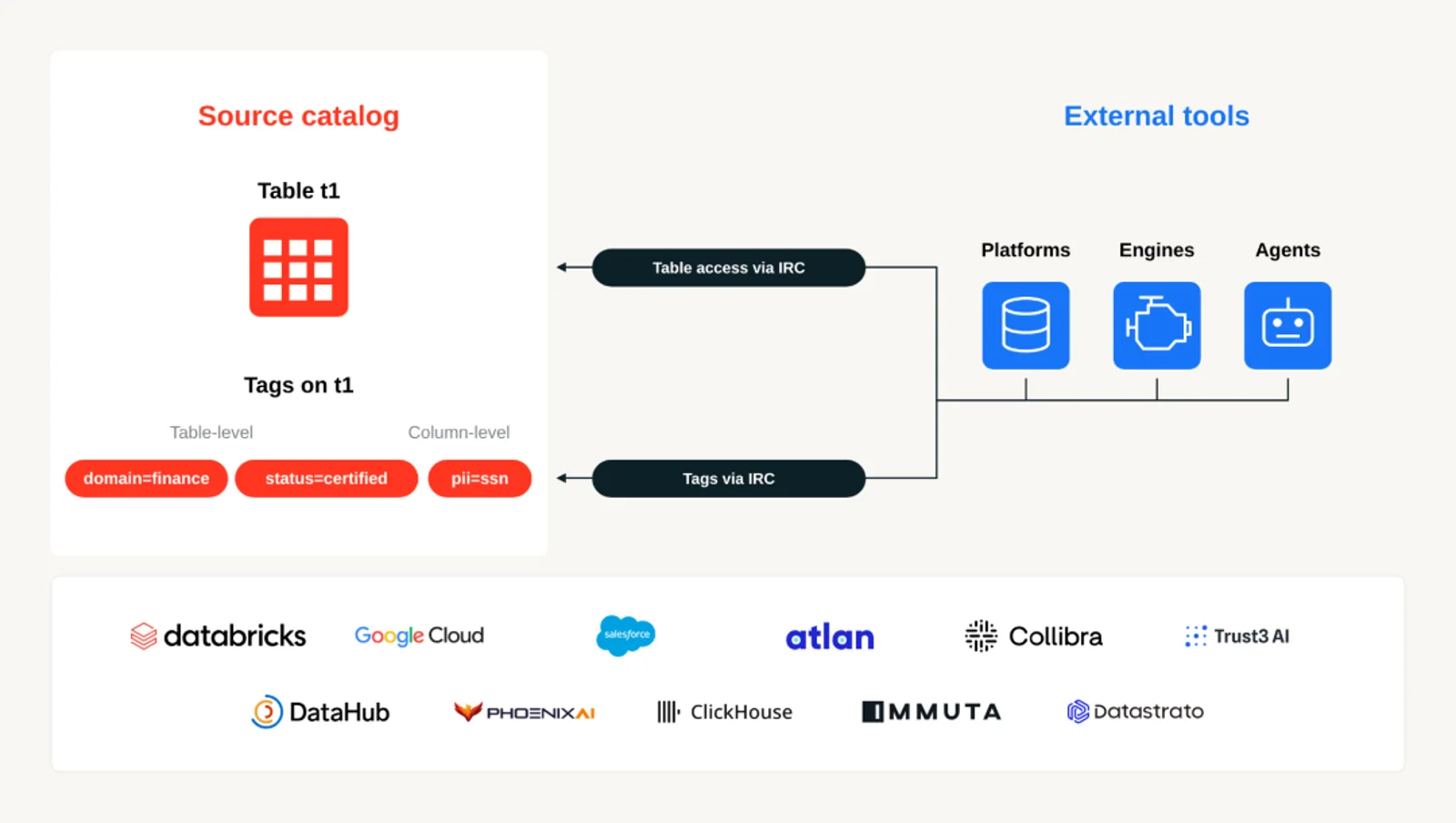
Databricks approached the problem via the communication protocol between data catalogs and compute engines. Collaborating with the Iceberg open-source community, they added an optional labels field to the Apache Iceberg REST Catalog API's LoadTableResponse, giving external platforms, compute engines, and agents a standard interface to read table-level and column-level context.
Previously, compute engines used Iceberg REST Catalog to fetch table structure, metadata file locations, and other access information. With Catalog Labels, the same table-load operation can carry business classification and governance tags. For instance, a customer table can be tagged domain=finance at the table level, and a Social Security Number column tagged pii=ssn at the column level. The interface uses object-labels for table-level tags and fields for column-level tags.
Column-level tags link to actual columns via Iceberg Field IDs. Since schemas evolve — columns renamed or reordered — relying on positional matching risks misalignment. Catalog Labels inherit Iceberg's field identity management: clients parse Field IDs from the returned current Schema to locate the tagged columns. These tags are maintained by the catalog and returned via the API; they are not written into Iceberg's metadata.json and are not part of the table's snapshot state.
Databricks has implemented this standard through Unity Catalog's Tag Exchange feature, currently in Beta. Once enabled, any client supporting the Iceberg Labels API can read the tags. Unity Catalog also supports table-level tag inheritance: when Catalog, Schema, and Table share a tag name, Table overrides Schema, which overrides Catalog. Column-level tags come from direct assignment on the top-level field. Apache Iceberg 1.12.0 includes the interface, and PyIceberg's changes (PR #4321) are merged, slated for release 0.13.
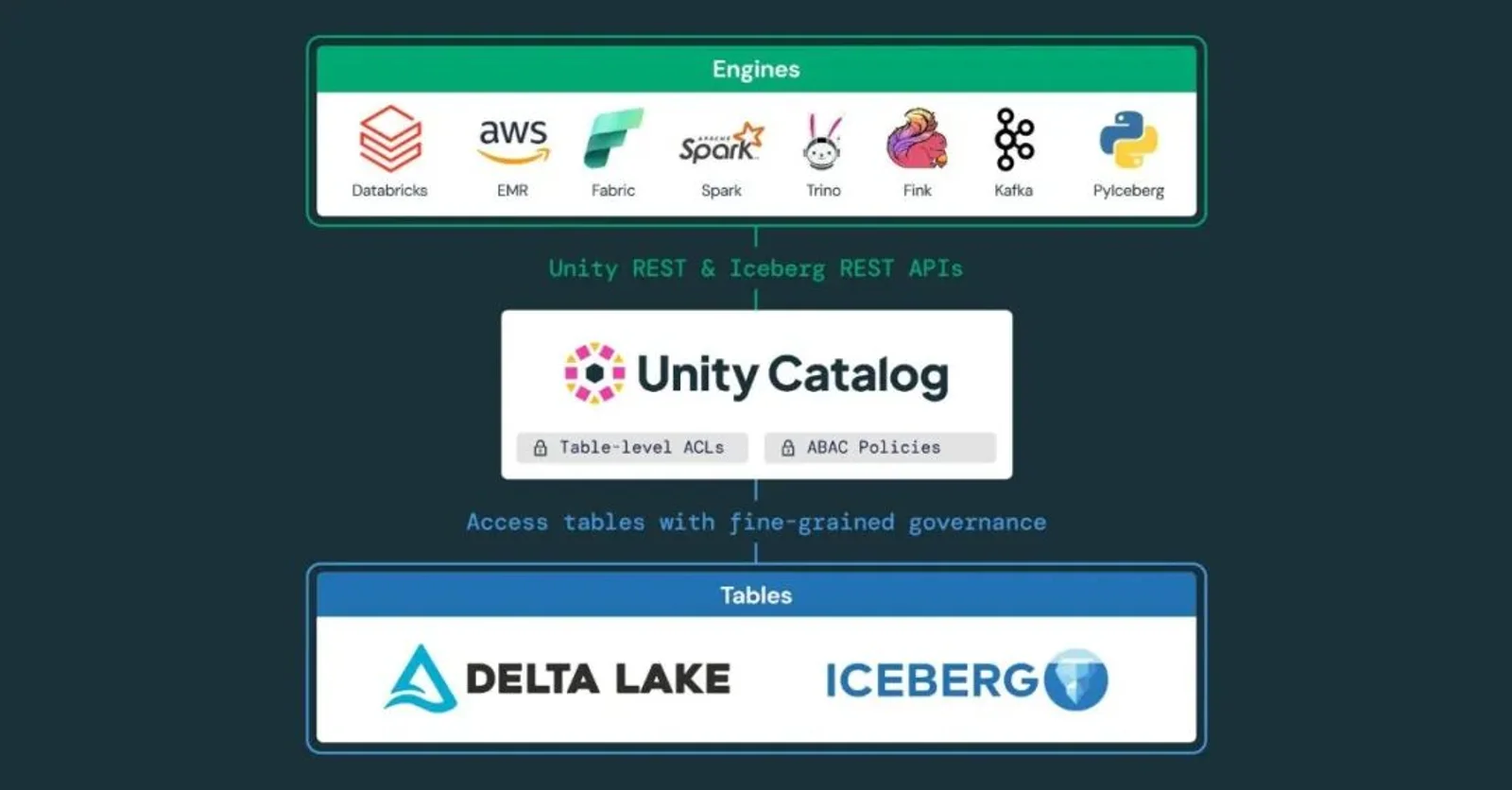
Catalog Labels is deliberately lightweight. It defines the tag transmission format but does not mandate a unified vocabulary or require identical governance systems across platforms. Each catalog retains its own classification mechanisms and business definitions; external systems retrieve information via the standard interface. Enterprises no longer need to build a separate unified data governance platform just to exchange metadata.
03 Tags Reuse Across Platforms, Permission Decisions Stay Local
Data governance complexity lies in deciding who can read what, which content needs masking, and which operations require auditing — based on requester identity, business scenario, and runtime environment. Different platforms have distinct identity systems, permission models, and policy languages, so governance of the same data can differ entirely.
To address this, the Iceberg community advanced two specifications: Read Restrictions and Catalog Labels. Combined with Databricks' existing centralized governance, three cross-platform governance modes emerge in the open lakehouse:
Centralized Enforcement — Source platform performs policy evaluation and enforcement; suited for untrusted external engines.
Read Restrictions — Source platform evaluates policy and returns row filters, column masking, etc., for trusted engines to execute; suited for trusted compute engines accessing across platforms.
Catalog Labels — Share governance tags; receiving platform interprets and enforces policies using its own identity system and rules; suited for catalog federations with independent governance systems.
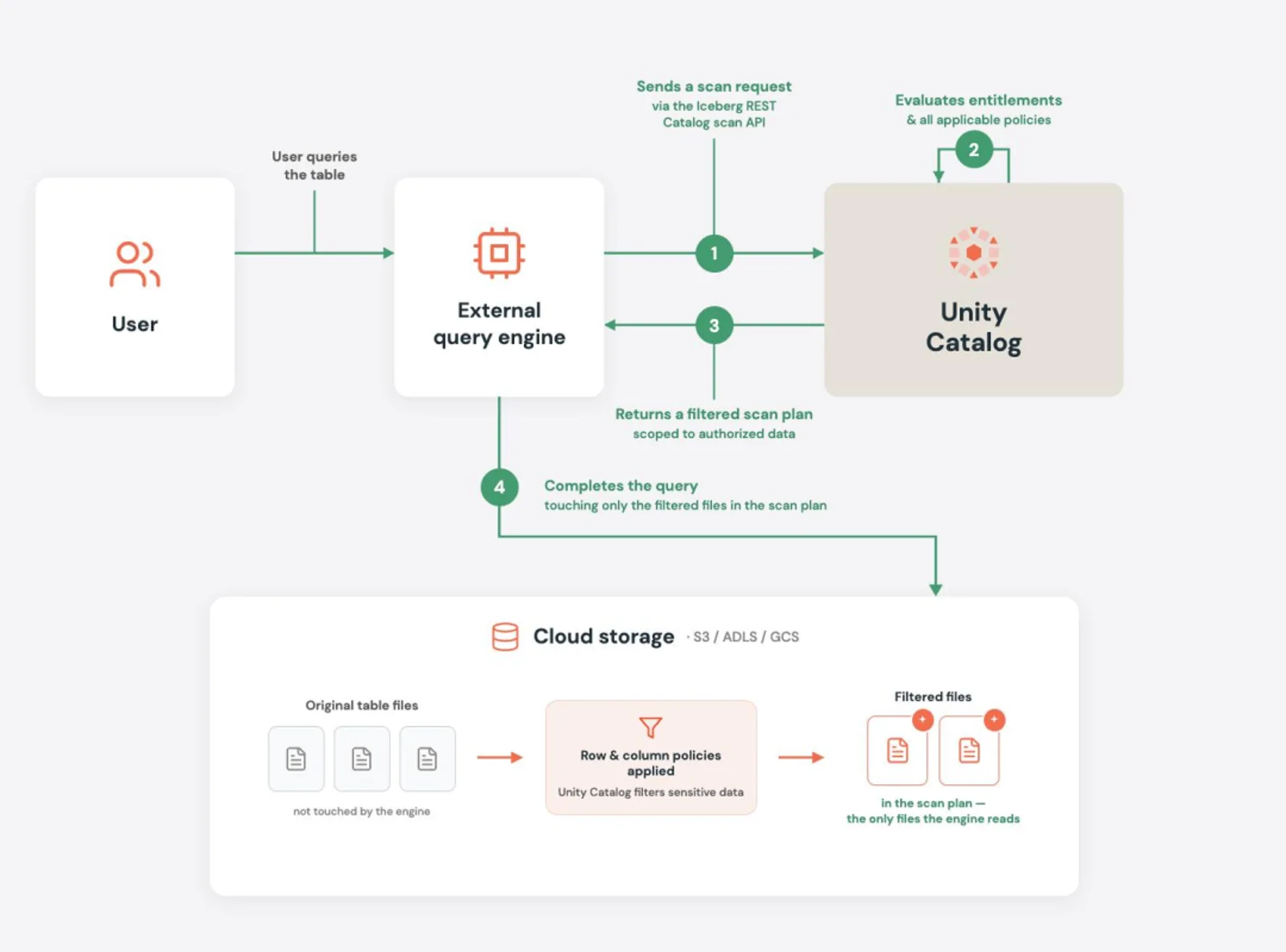
In Centralized Enforcement, permission judgment and data filtering stay inside the source platform; external engines receive only authorized data. Read Restrictions similarly let the source catalog decide policy, then pass concrete restrictions (row filters, column masking) to trusted engines for execution — transmitting decisions, not full policies. Catalog Labels confines exchange to metadata like data classification; the receiving platform combines its own identity system and policies to govern.
For example, a source catalog tags a column pii=ssn. The receiving platform maps this tag to its own sensitive data classification, then applies masking based on local user identity and business rules. In this federation model, the receiving platform need not request permission judgments from the source for every query, nor translate its entire access control logic into another policy language. Data classification information is reusable; permission enforcement and auditing remain within each system's governance boundary.
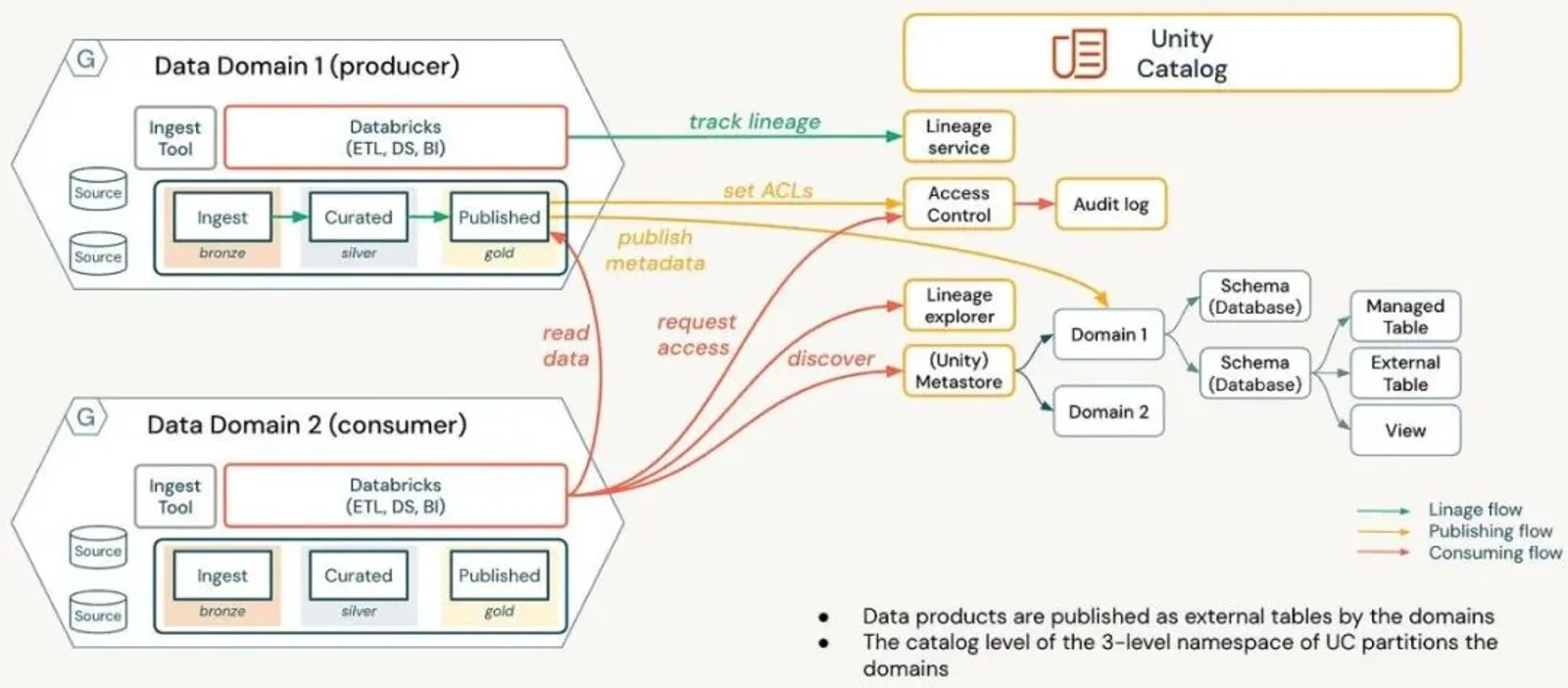
Tag exchange has strict permission limits. Unity Catalog requires external principals to hold USE CATALOG, USE SCHEMA, SELECT, and EXTERNAL USE SCHEMA privileges. If the current query principal is constrained by row filters or column masking policies, Tag Exchange will not return tags. Moreover, Iceberg does not standardize tag semantics; enterprises must still maintain classification standards, tag mapping, refresh mechanisms, and policy validation workflows. Tags can cross platforms, but that does not mean different platforms will automatically enforce consistent governance policies.
04 Correct SQL Is Useless If Agents Pick Wrong Data
Large enterprise catalogs contain raw business tables, cleaned detail tables, certified metric tables, temporary analysis tables, and historical archives. They often share similar names and schemas but differ in applicability, quality, and trustworthiness. With only table names and schemas, agents struggle to select accurately.
Consider a customer-support analysis agent tasked with finding recent complaint root causes. The agent must locate relevant datasets, assess reliability, identify complaint-content fields, and analyze within authorization. Even with perfectly generated SQL, choosing the wrong table, misinterpreting field meaning, or using uncertified data leads to conclusions that deviate from business reality.
Databricks provides a concrete example: on a support_cases table, add table-level tags domain=customer_support and system.certification_status=certified; on the issue_summary column, add content_type=support_case_summary. Agents can use these to filter relevant business data, identify certified datasets, and pinpoint the field containing case summaries. Business knowledge once scattered in the catalog now enters the agent's data discovery flow via a standard interface.
However, tags express limited business context. Catalogs describe asset ownership, classification, and basic purpose; semantic layers add business metrics, calculation logic, and analytical dimensions; ontologies capture business entities, relationships, constraints, and richer domain knowledge. Agent execution also needs task goals, user permissions, and historical state. Together these form the enterprise agent's runtime context.
In a Context Engineering architecture, Catalog Labels handle basic metadata transport across platforms; semantic layers and ontologies supply deeper business knowledge; permission systems constrain agent actions. Engineering teams can inject relevant context at runtime per task. Compared to stuffing all business knowledge into prompts, layered management reduces duplicate maintenance and clarifies knowledge provenance and governance responsibility.
05 Storage-Compute Barriers Ease; Metadata Becomes New Competitive Focus
Open table formats lowered data migration and engine-switching costs, but enterprises switching platforms still face the question: can years of accumulated catalog assets — business classifications, permission rules, metric systems, governance experience — be reused? These assets, built over years of business and engineering effort, impose extra migration costs if not portable. Platform competition now extends to portability of business knowledge and governance assets.
Different vendor types see distinct benefits. Google Cloud and ClickHouse reduce onboarding friction for external data assets. Atlan, Collibra, DataHub, and other catalog/governance platforms can cut proprietary metadata adapter costs. Salesforce and similar business platforms can explore feeding more business context into data and AI workflows. Integration progress varies, but open metadata provides a common technical interface.
For enterprise tech teams, there's no need to rebuild existing governance from scratch. Start by unifying basic tags — business domain, data ownership, certification status, sensitivity level — assign maintenance ownership, then gradually establish cross-catalog mapping and permission verification. Agent data discovery services can ingest this metadata, supplemented by semantic layers and business knowledge bases for richer context.
Catalog Labels currently solves standardized transmission of table-level and column-level tags . Tags are string key-value pairs; the protocol defines no unified business vocabulary and provides no cross-platform tag lineage. Full business semantic interoperability, policy consistency, and complex rule sharing still require more standards and engineering practice. Enterprises can read another platform's tags, but accurately understanding and using them demands mutual business conventions.
From open table formats to catalog federation to Catalog Labels, the set of assets enterprises can reuse across platforms grows. Previously, a customer table could be read by different engines but might lose its sensitive data classification. Now classification tags have a standardized channel, and receiving platforms have the technical means to reuse them.
For enterprise agents, accessing the same data is only step one. Enabling agents on different platforms to form a consistent business understanding of the same data and use it within correct permission boundaries is the next architectural challenge.
References: Databricks: Sharing catalog metadata across data platforms, engines, and agents Databricks: Access table and column tags from external engines Databricks: Advancing Catalog Interoperability with Unity Catalog and Google Cloud's Borderless Lakehouse Databricks: Unifying governance across engines and catalogs in the open lakehouse Apache Iceberg: REST Spec: add labels field for catalog metadata enrichment (PR #15750) Apache Iceberg: Apache Iceberg 1.12.0 Release PyIceberg: Expose catalog labels on Table (PR #4321)
For questions about attribution, corrections or content rights, please contactand we will review it promptly.