

DeepSeek Harness vs. Codex, Claude Code & WorkBuddy: Which AI Agent Architecture Wins?
This article compares DeepSeek Harness, OpenAI Codex, Anthropic's Claude Code, and Tencent's WorkBuddy across product positioning, architecture, key features, and selection criteria to help developers and enterprises choose the right AI agent platform for coding, automation, or office productivity.
Reading font
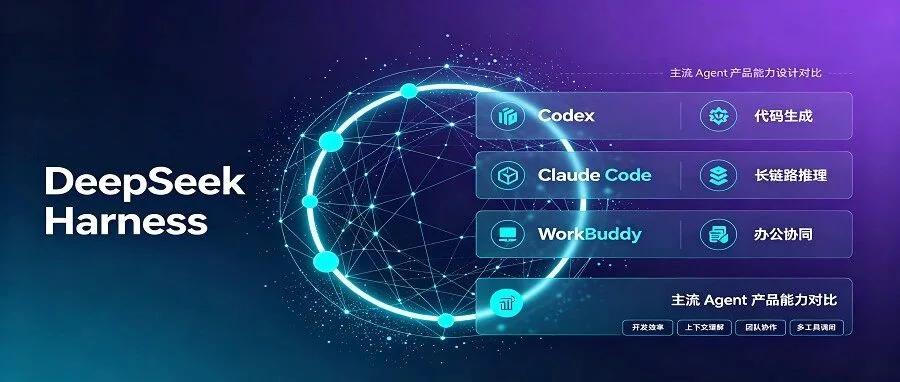
1. Product Positioning and Technology Stack Level
Although all four products are broadly called "AI Agents," they operate at different technical layers:
DeepSeek Harness (dsh) is an Agent runtime foundation . It does not directly provide Q&A or coding capabilities; instead it supplies the full infrastructure for agents to run: model access, tool scheduling, security sandbox, session management, sub-agent orchestration, observability, and Web UI — all as plugins. The official formula is Model + Harness = Agent; think of it as an "Agent operating system" or "Lego chassis." Released August 13, 2026 under MIT license as a developer preview, built on the Cordis plugin framework with the core philosophy "Everything is a Plugin."
OpenAI Codex and Claude Code are productized Coding Agents . They are "install-and-use" terminal/IDE assistants delivering code generation, debugging, refactoring, and code review directly to developers. Both are tightly bound to their vendors' models — Codex uses GPT series (CLI written in Rust, shell open-sourced under Apache 2.0 but core capability depends on OpenAI services), Claude Code uses Claude series (proprietary, closed-source, CLI free). They are essentially "vertical products built on top of a Harness."
WorkBuddy is a desktop AI office agent for non-technical users . Developed by Tencent Cloud's CodeBuddy team, launched March 2026, based on Tencent's Hunyuan LLM. Its role is not writing code for programmers but letting non-technical users issue natural-language tasks that the AI executes on the local computer: file organization, document generation, PPT creation, poster design, etc. It is a "consumer-grade Agent application" emphasizing out-of-the-box usability and multi-agent parallel delivery.
From application layer → product layer → framework layer, lower layers are closer to infrastructure and can support upper layers, but upper layers cannot replace lower layers. DeepSeek Harness is a "tool for producing Agents"; Codex/Claude Code/WorkBuddy are "already productized Agents." Theoretically, one could assemble a Codex-like or WorkBuddy-like product using DeepSeek Harness, but not vice versa.
2. Architecture Analysis
2.1 Fully Plugin-Based Microkernel Architecture — DeepSeek Harness
The entire system sits on the Cordis microkernel with zero hard-coded fixed functions. Models, tools, skills, sessions, sandboxes, storage, loops, scheduling, and UI all exist as plugins, combined via configuration-layer stacking and overriding.
Native Security Layer : Linux Landlock kernel sandbox, syscall-level fine-grained isolation, millisecond startup; agent code/command execution automatically enters the sandbox.
Plugin Kernel Layer : Cordis runtime handles plugin registration, dependency resolution, lifecycle scheduling, event bus; contains no business logic.
Core Services Layer : Official capability plugins — model access, tool execution, session management, sandbox scheduling, observability — all mounted as plugins.
Application Access Layer : Web console (:3080), CLI, HTTP API, client SDKs — multiple entry points, all plugins.
2.2 Three-Endpoint Unified Cloud Agent Architecture — OpenAI Codex
Codex is OpenAI's unified entry point for productized coding capability; core design is "the same Agent, everywhere you code." Via a ChatGPT account it connects Web, IDE, and CLI contexts, task history, and configuration, letting users start a task on one endpoint and continue on another.
Access Layer (Three-Endpoint Unified) : ChatGPT Web (cloud tasks / Code Review), IDE extensions (VS Code / JetBrains local assist), Codex CLI (Rust, npm global install, local task execution). All three share ChatGPT account system and task context.
Agent Service Layer : OpenAI-cloud-hosted agent orchestration service handling task planning, tool calls, context management, multi-agent parallel scheduling. GPT-5-Codex is the default reasoning model for Cloud tasks and Code Review; local tasks can enable it via CLI/IDE.
Execution Layer : Cloud mode runs in OpenAI cloud sandbox (suitable for long tasks, multi-agent parallel); Local mode runs commands and file ops in the user's local environment (suitable for accessing local codebases / private dependencies).
2.3 MCP-Driven Agentic Coding Architecture — Claude Code
Claude Code centers on an "Agentic" command-line tool that not only completes code but autonomously reads codebases, plans tasks, edits files, runs commands, observes results, and iterates. Its architectural differentiators are the Model Context Protocol (MCP) open protocol and the CLAUDE.md project memory mechanism, giving it strong extensibility and context persistence.
CLI Core (Local Execution) : Node.js CLI, main entry point. Drives the agent loop (plan → execute → observe → correct), local file ops, shell command execution, subprocess management. Proprietary, closed-source, CLI free to use.
Claude Model Layer (Cloud Inference) : Defaults to Claude Opus/Sonnet series, supports 1 million token context window (can load an entire medium-sized project at once). Users may swap in other models.
MCP Protocol Extension Layer : Connects external tools and data sources — databases, APIs, filesystems, third-party services — via Model Context Protocol. MCP Servers can be developed by community or enterprises, vastly expanding capability boundaries.
Project Memory Layer : CLAUDE.md file acts as project-level "memory" storing coding standards, architectural decisions, common commands; Claude Code auto-reads and follows. Supports global and project-level config overlay.
Ecosystem Integration Layer : Beyond CLI, integrates IDE plugins, desktop app, browser automation, Slack notifications, GitHub PR Review, CI/CD pipeline triggers, scheduled workflows (Scheduled Tasks).
2.4 Desktop Multi-Agent Office Orchestration Architecture — WorkBuddy
WorkBuddy aims to let non-technical users "get the job done" via natural language. Unlike developer-focused coding agents, its architecture centers on "desktop local operation permissions + cloud multi-agent parallel orchestration + scenario-specific expert roles." Users don't need code; they issue a task, AI auto-decomposes, assigns to multiple professional agents running in parallel, and delivers finished documents, PPTs, posters.
Desktop Client Layer : Windows/Mac app, sole user interaction entry. Provides natural-language chat UI, task creation panel, execution visualization, result preview/export. Client obtains user authorization to operate local computer (filesystem, apps, clipboard); each step explained and user-confirmable.
Multi-Agent Orchestration Layer (Cloud) : Core scheduling engine decomposes natural-language tasks into subtasks, assigns to 100+ built-in expert roles (document expert, PPT expert, designer, data analyst, researcher, etc.) running in parallel. Manages task dependencies, progress sync, result aggregation. Each role has dedicated system prompts and toolsets.
Model & Tool Layer : Inference and content generation via Tencent Hunyuan LLM. Toolset covers file read/write/organize, document generation (Word/Excel), PPT creation, poster/image design, web browsing, data processing, multi-language translation. Content generation runs in cloud; file ops run locally.
Ecosystem Integration Layer : Deep ties to Tencent office ecosystem — WeChat (file transfer/messages), Tencent Docs (online collaboration), Tencent Meeting (minutes summarization). Also supports enterprise deployment with team workspace, permission management, task auditing, investment tracking.
3. Multi-Dimensional Comparison
3.1 Capability Visualization
Evaluation dimensions: open-source freedom, model flexibility, coding ability, office scenarios, security isolation, extensibility/customization.
3.2 Key Feature Comparison
Compared across eight facets: open-source degree, model flexibility, coding ability, office scenarios, security isolation, extensibility, out-of-the-box readiness, multi-agent orchestration.
3.3 Architecture Philosophy Comparison
Architecture Type : DeepSeek Harness uses a fully plugin-based microkernel; Codex / Claude Code / WorkBuddy use fixed product architectures.
Model Layer : DeepSeek Harness is pluggable, supporting 20+ models; the other three are bound to single vendor models with limited replacement.
Toolset : DeepSeek Harness tools are all plugins, freely add/remove/replace; the other three have product-built-in fixed toolsets with limited extension.
Agent Loop : DeepSeek Harness loop is plugin-based and user-customizable; the other three have vendor-defined loops that users cannot modify.
Interaction Entry : DeepSeek Harness provides Web/CLI/API/SDK all as plugins; the other three have fixed entries (Web/IDE/CLI or desktop).
Security Capability : DeepSeek Harness has Landlock kernel-level sandbox built-in; the other three rely on cloud isolation or direct local execution.
Runtime Extension : DeepSeek Harness supports dynamic plugin loading and agent self-extension; the other three do not support runtime self-extension.
4. Selection Recommendations
1) Choose DeepSeek Harness when:
Building an enterprise-grade / private Agent platform
Need flexible multi-model switching, avoid vendor lock-in
Require deep customization of toolchains, workflows, security policies
Operating in Xinchuang (信创) environments, air-gapped deployment, high compliance/audit requirements
Want to study Agent runtime internals or do secondary development
2) Choose OpenAI Codex when:
Daily coding, debugging, test writing as primary tool
Already in ChatGPT ecosystem, want three-end linkage
Need full-cycle engineering assist (requirements → code → review)
Team collaboration scenarios, unified code quality baseline
Prefer weekly-quota-reset subscription model
3) Choose Claude Code when:
Handling large codebases, complex refactoring tasks
Need ultra-long context (1 million tokens)
Value MCP ecosystem and CLAUDE.md project memory
Require CI/CD, GitHub Review, Slack integration
Long document / solution decomposition and generation scenarios
4) Choose WorkBuddy when:
Non-technical users' daily office automation
Batch file organization, document/PPT/poster generation
Deep usage of Tencent office ecosystem (WeChat / Tencent Docs)
Want AI to directly operate computer and deliver finished artifacts
Multi-task parallel processing to reduce repetitive office labor
Data sources: DeepSeek official, OpenAI official, Anthropic official, Tencent Cloud WorkBuddy official, and public technical communities · Evaluation based on publicly available information as of August 2026.
For questions about attribution, corrections or content rights, please contactand we will review it promptly.