

DiDi's HelixHarness: Open-Source AI Coding Harness for Stable Team Delivery
DiDi open-sources HelixHarness, an AI coding harness that provides standardized workflows, structured engineering context (Knowledge, Harness, Specs, Hooks), observability, and evaluation loops to enable stable, measurable AI-assisted development across teams, currently used in 10+ departments and hundreds of modules.
Reading font
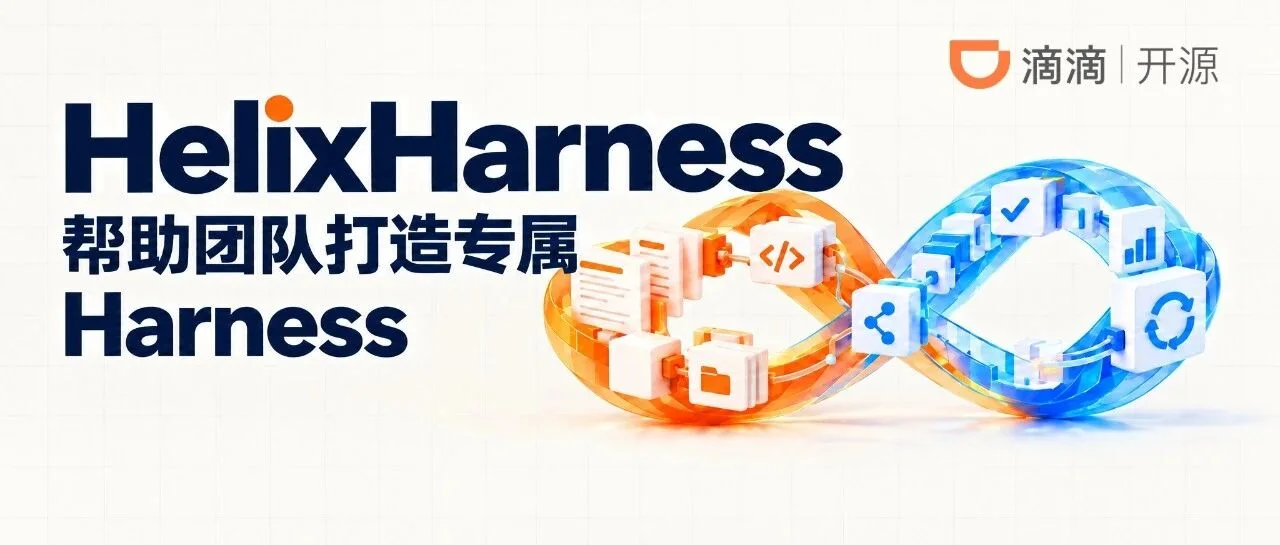
DiDi's Financial Technology team has open-sourced HelixHarness, an AI Coding Harness designed to move AI-assisted development from individual productivity to stable, measurable team-scale delivery. The project originated from the internal OpenHarness project and has been adopted across more than 10 departments and hundreds of business modules within DiDi.
Background and Challenges
As AI Coding expanded from code completion to requirements understanding, design, and testing, the team identified four core challenges in real engineering environments:
Insufficient engineering support: AI lacks complete understanding of project knowledge, business logic, and engineering standards, and lacks a unified workflow spanning requirements, development, and verification.
Unobservable process data: Tool calls, code modifications, and rework paths during AI development are not effectively recorded, making efficiency analysis and root-cause diagnosis difficult.
Missing evaluation for framework iterations: Knowledge, rules, skills, and workflows evolve continuously, but without a unified evaluation system, improvement effects cannot be objectively measured.
Framework-team misfit: Different teams have varying tech stacks, engineering norms, and R&D processes; generic harnesses are hard to adapt directly, leading to high customization costs and poor experience reuse.
The central problem became: how to make AI complete R&D tasks more stably, controllably, and measurably in real engineering environments.
Core Workflow Design
HelixHarness abstracts key stages of daily R&D into standardized commands that drive an end-to-end workflow:
Initialization – project setup and context loading
Design – requirement analysis and solution design
Execution – code implementation and modification
Archiving – verification, documentation, and knowledge沉淀
These commands constrain the Coding Agent to operate within engineering guardrails, ensuring orderly task completion.
Engineering Context Management: Four-Layer Structure
Project knowledge is often scattered across repositories, docs, standards, and developer experience. HelixHarness structures this into four layers within a standardized directory ( docs/) alongside business code:
business-project/          # Business repo root
├── src/                   # Business source (example)
├── tests/                 # Business tests (example)
├── config/                # Business config (example)
├── docs/                  # HelixHarness context & artifacts
│   ├── harness/           # Engineering constraints & indexes
│   ├── knowledge/         # Project knowledge & indexes
│   ├── specs/             # Requirement specs, tasks, verification artifacts
│   └── hooks/             # Check rules
└── AGENTS.md              # Host context entry
The four layers work together during execution:
Knowledge – project architecture, module responsibilities, business logic, historical constraints
Harness – engineering standards, security requirements, coding conventions
Specs – requirement contracts, task definitions, verification criteria
Hooks – automated check rules that enforce quality gates
This turns fragmented tribal knowledge into managed, reusable, continuously updatable project assets.
Observability, Evaluation, and Self-Evolution Loop
As teams use the framework, they accumulate execution data, feedback, and experience. HelixHarness establishes a closed loop for continuous framework improvement:
Observable → Form Hypothesis → Candidate Changes → Unified Evaluation → Controlled Adoption → Continuous Iteration
Example trade-offs cited: adjusting a Rule may constrain AI behavior but add execution overhead; adding a Skill may boost efficiency in one scenario but not generalize. Every framework change must have data backing, effect verification, and risk control rather than relying on intuition.
Differentiation from Similar Frameworks
While existing tools provide code understanding, task planning, skills/MCP mechanisms, or process specifications, HelixHarness focuses on organizing the engineering capabilities required by real teams: project knowledge, team norms, R&D workflows, and verification/evaluation mechanisms. It enables each enterprise team to build and evolve its own dedicated Harness atop the existing AI Coding ecosystem.
Future Roadmap
Extend Agent support: Research and adapt to other popular Agents, gradually covering mainstream tools so more teams can use HelixHarness in familiar environments.
Customizable workflows: Provide configuration for workflow sequence to accommodate different enterprise R&D processes.
Project repository:
https://github.com/didi/helixharnessFor questions about attribution, corrections or content rights, please contactand we will review it promptly.