

Envy-Free Rent Splitting for Three Roommates: A Simple Bidding Algorithm
This article presents a step-by-step bidding method for three roommates to split rent envy-free, where each person privately values rooms, averages set initial prices, and iterative adjustments ensure no one wants to swap, backed by mathematical proofs from fair division theory.
Reading font

Three roommates share a three-bedroom apartment for 6000 per month. The master bedroom is larger and south-facing; the small bedroom is smaller and north-facing. Splitting equally by headcount ignores room quality differences, while splitting by area ignores subjective preferences like light or proximity to the bathroom. Both methods impose an external price that the occupants never agreed to.
01 Three Common Splitting Methods and Their Flaws

Equal headcount split: each pays 2000. This assumes all rooms are equally desirable, letting the small-room occupant subsidize the master bedroom's extra 8 square meters and south window.
Area-based split: master 2700, second 1800, small 1500. This appears objective but reduces a room to its square footage, ignoring that some people value light more, others value bathroom proximity, others just want the cheapest option. Using a single ruler for everyone makes the decision for them.
Both methods share a flaw: the price is calculated by an outsider, not agreed upon by the people living there. A better approach reverses the process: let each person state their own valuation first, then derive a fair split.
02 The Bidding Method: Let Everyone Set Their Own Prices
The method has three steps:
Each person privately writes down what they think each room is worth, with the three numbers summing to the total rent.
Average the three bids for each room to get a first-round price.
Each person picks a room. If anyone wants to switch, adjust prices until no one wants to switch.
Example (illustrative):
A bids: master 2600, second 1800, small 1600.
B bids: master 2300, second 2000, small 1700.
C bids: master 2400, second 1900, small 1700.
Averages: master ~2433, second 1900, small ~1667. A takes master, B takes second, C takes small.
This allocation has a desirable property: after the split, no one would trade their room-and-price bundle for anyone else's. In mathematics this is called envy-freeness . Once achieved, arguments essentially disappear.
03 No One Wants to Swap Is Not Enough
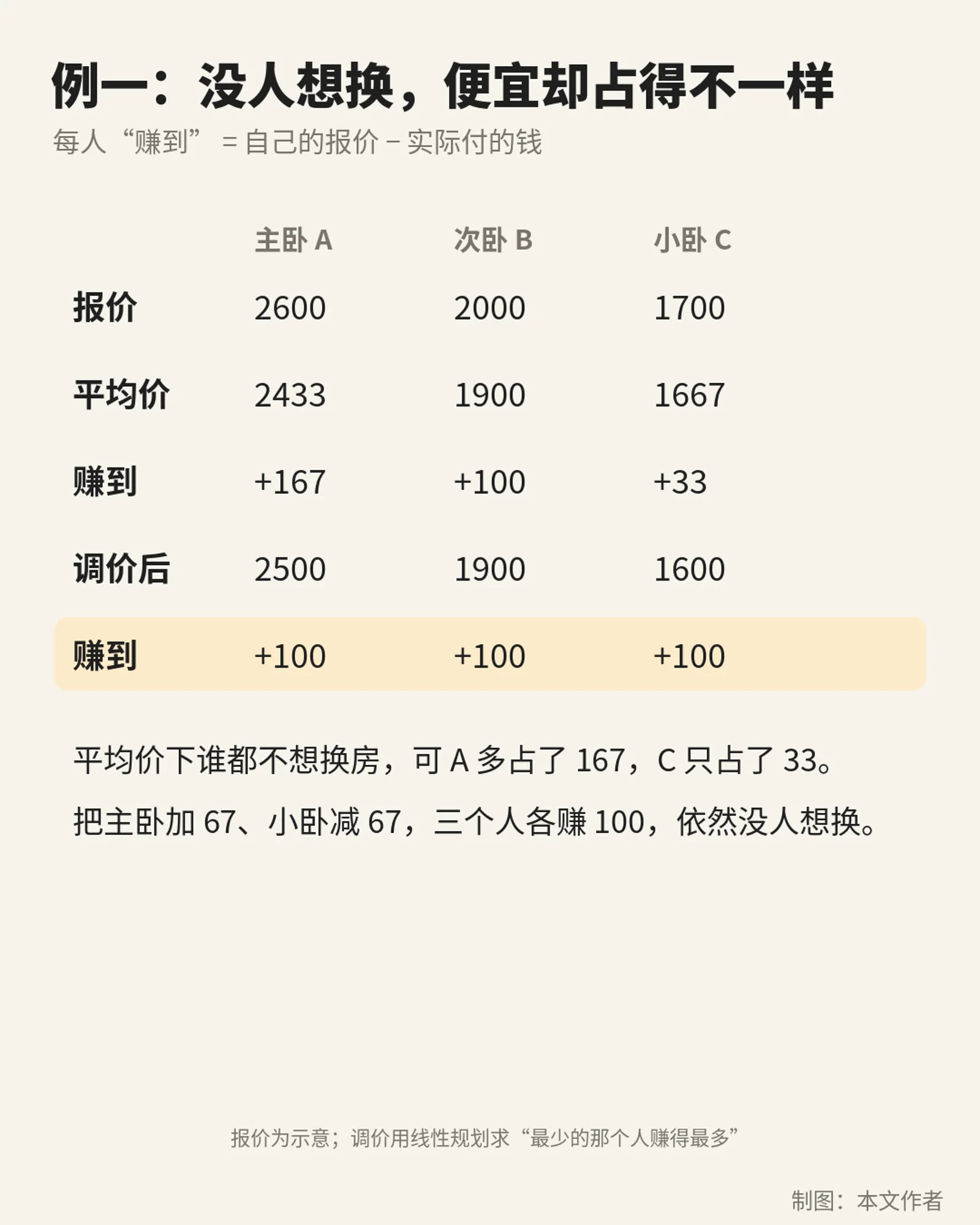
We can measure each person's "gain" as their private valuation minus what they actually pay.
A valued master at 2600, pays 2433 → gain 167.
B valued second at 2000, pays 1900 → gain 100.
C valued small at 1700, pays 1667 → gain 33.
No one wants to swap, but the gains are unequal. Can we make it fairer? Yes. Raise the master by 67 to 2500, lower the small by 67 to 1600 (second stays 1900). Now each person gains exactly 100, and still no one wants to swap.
The principle: among all envy-free allocations, choose the one that maximizes the minimum gain. This rule was formalized by computer scientists in 2017 (Gal, Mash, Procaccia, Zick, Journal of the ACM ) and is used in their online rent-division tool.
04 When Average Prices Fail to Produce an Envy-Free Allocation

If two people both strongly prefer the master bedroom, the average prices may not be envy-free. Example: average prices master 2500, second 1900, small 1600. A gets master (gain 200), B gets second (gain 0). But B would gain 100 by switching to master, so B envies A.
Solution: adjust prices. Raise the contested room (master +100 to 2600), lower the unwanted room (second -100 to 1800). Now A gains 100, B gains 100, C gains 200. No one envies anyone.
The rule is simple: if someone wants to switch, that room is underpriced → raise its price; if a room is unwanted, it is overpriced → lower its price. This is exactly how market pricing works, except the "market" consists of only three people.
05 Does an Envy-Free Allocation Always Exist?
Yes. In 1999, mathematician Francis Su proved (using Sperner's lemma) that as long as a very weak condition holds — for each person, a free room is always preferable to a room that costs money — an envy-free allocation exists. In other words, if a room were free, someone would be willing to live in it. The proof is combinatorial; the practical takeaway is that an envy-free split is guaranteed to exist, and for three people the iterative price-adjustment process will find it.
06 Handling a Couple Sharing the Master Bedroom
A common variant: a couple shares the master bedroom, two singles take the other two rooms — four people total. Splitting by headcount lets the couple pay for only one room while using two people's worth of common space; splitting by room lets them pay for only one share of common space while two people use the kitchen and bathroom.
A better approach: separate the rent into two components:
Common areas (living room, kitchen, bathrooms) split equally per person.
Bedrooms split among the three rooms using the bidding method described above.
Both accounts balance independently.
07 Dealing with Strategic Misreporting or Complexity Aversion
The bidding method has a vulnerability: bids are private, so a person could manipulate them. For instance, if C knows A insists on the master, C could inflate the master bid to 3000, lowering the average price of the small room and reducing C's payment. Collusion between two people could harm the third.
Economic theory (Green & Laffont, 1977) shows that no mechanism can simultaneously guarantee budget balance, envy-freeness, and truthful reporting. We can only make manipulation unprofitable.
Two practical safeguards:
All three reveal their bids simultaneously — no one sees others' bids before finalizing their own.
Bids are binding. If you bid 3000 for the master, you might end up paying 3000 and living there, so overbidding carries the risk of being stuck with your own high price.
The second safeguard is essentially an auction. Auction the master and second bedrooms; the third room's price is the remainder. The rules are simple, but wealthier bidders gain an advantage.
If everyone finds the process too tedious, use the "you cut, I choose" extension: one person sets prices for all three rooms, the other two pick first, the price-setter gets the last room. Knowing they pick last, the price-setter will make the three bundles as equal as possible in their own eyes. If the first two pick the same room, add a small premium and let them choose again.
08 Four Steps to Remember

Each person privately submits bids for the three rooms, summing to total rent.
Average the bids per room to get initial prices.
Everyone picks a room. Ask "Want to switch?" If yes, adjust prices.
When no one wants to switch, look at who gains the least and shift a little money toward them.
The strength of this method is that the prices emerge from the participants' own valuations. People rarely resent a price they helped create.
In practice, the hardest part is often not the algorithm but human behavior: one roommate says "whatever, you decide," then six months later complains they conceded too much. Whatever method you use, finalize the split before moving in. A number all three agreed to eliminates the later "I let you have it" complaint.
References:
[1] Su F E. Rental harmony: Sperner's lemma in fair division. The American Mathematical Monthly , 1999, 106(10): 930–942.
[2] Gal Y, Mash M, Procaccia A D, Zick Y. Which is the fairest (rent division) of them all? Journal of the ACM , 2017, 64(6): 39.
[3] The bids, areas, and rents in the article are illustrative; "adjusted" prices were obtained via linear programming: maximize the minimum gain subject to envy-freeness.
[4] Green J, Laffont J J. Characterization of satisfactory mechanisms for the revelation of preferences for public goods. Econometrica , 1977, 45(2): 427–438.
For questions about attribution, corrections or content rights, please contactand we will review it promptly.