

Event Sourcing Explained: How Systems Rebuild State from Immutable Event Logs
This article explains Event Sourcing, a pattern that stores state changes as an append-only sequence of events rather than current state, detailing event creation, storage, state reconstruction with snapshots, and trade-offs like auditability versus storage overhead.
Reading font
Event Sourcing
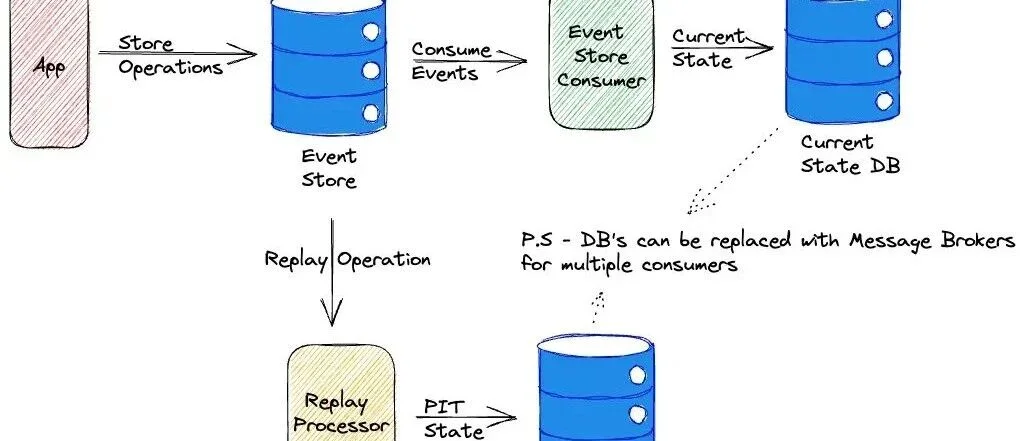
In traditional data storage, systems persist only the current state of an entity — for example, an e-commerce order record containing its items, quantities, and shipping address. Event Sourcing takes a fundamentally different approach: it does not store the current state directly. Instead, it preserves the series of events that led to that state. Each event represents a real operation that occurred in the system, analogous to a bank ledger that records every transaction. Events are appended to an event store and are never modified or deleted. The current state of any entity can be derived by replaying its events in chronological order, just as a bank balance is computed by replaying all transactions.
This approach is especially suited for applications with strict audit and traceability requirements.
How Event Sourcing Works
In an Event Sourcing system, every state change is captured as an event object and persisted in a dedicated event store — a database optimized for event data. The typical flow involves three steps:
Event Creation: When a user performs an action (e.g., submitting an order), the application creates an event object describing that operation.
Event Storage: The event is appended to the event store. The store is append-only; events cannot be updated or deleted, guaranteeing historical integrity.
State Reconstruction: When the application needs an entity's current state (e.g., an order), it reads all events related to that entity from the store and replays them in time order to rebuild the final state.
For example, in an e-commerce cart, instead of saving the cart's snapshot (items, quantities), the system records events such as "Item X added to cart," "Item Y removed from cart," "Quantity of Item Z updated." Replaying these events in sequence yields the cart's latest state at any point in time.
State Reconstruction in Event Sourcing
State reconstruction means reading all events for a given entity from the event store, applying them sequentially in chronological order, and obtaining the entity's current state. In other words, the system re-enacts every change the entity has undergone to reproduce its present condition.
Consider an order that transitions through states: "Created," "Paid," "Shipped." To determine its current state, the system typically:
Retrieves all events associated with that order from the event store.
Initializes an empty order object.
Applies each event to the order object in the order they occurred.
After this process completes, the order object reflects the latest state.
Using Snapshots in State Reconstruction
Over time, an entity may accumulate a large number of events. Replaying from the very first event on every reconstruction becomes inefficient. To address this, a snapshot mechanism is commonly introduced.
A snapshot captures the complete state of an entity at a specific point in time. During reconstruction, the application loads the most recent snapshot and then replays only the events that occurred after that snapshot, significantly reducing the number of events that must be processed.
Pros and Cons Analysis
Advantages
Auditability: Event Sourcing retains the full change history of the system, enabling clear tracking of an entity's state at any past point in time — ideal for audit and traceability scenarios.
Debuggability: By replaying events, developers can reproduce an entity's state at any moment, making it easier to diagnose issues and debug the system.
Flexibility: Because state is derived from events, new features or logic adjustments can be added without modifying historical data, simplifying extension and refactoring.
Disadvantages
Complexity: Event Sourcing increases system design and implementation complexity. Developers must model the domain around events and handle state reconstruction and snapshot management.
Storage Pressure: All events must be retained long-term. For long-running, high-volume systems, storage costs can become significant.
Data Privacy: Preserving every historical event may introduce privacy risks, especially when sensitive data is involved. Additional measures are required to ensure security and compliance.
For questions about attribution, corrections or content rights, please contactand we will review it promptly.