

FDE Capability Gaps Can't Be Fixed by Training Alone: Four Background-Specific Paths
This article outlines a framework for Field Development Engineers to close capability gaps through controlled project slices rather than training, detailing three readiness states, four background-specific verification paths, a project-slice evidence matrix, a completion record template, and pairing-review practices that separate individual contribution from team outcomes.
Reading font
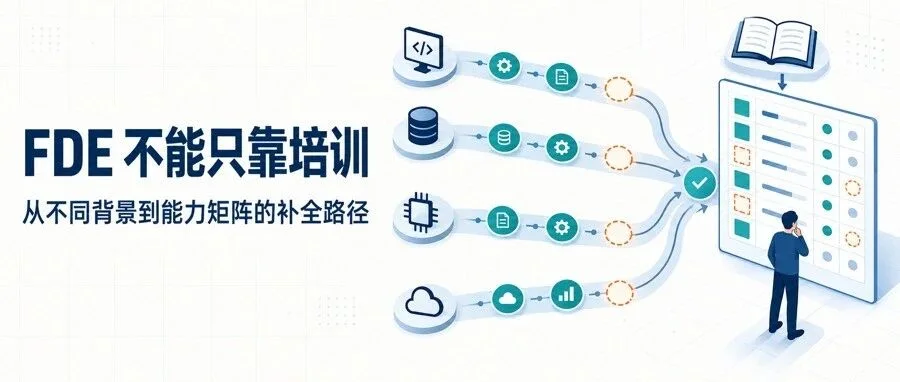
The article opens with a synthetic abnormal-order Agent scenario: a backend engineer quickly wires query, analysis, and task-creation APIs, but the business stakeholder asks which date — contract date or planned date — determines a delay. The interface works, yet the decision basis remains unconfirmed. An implementation consultant may know why dates differ and whom to ask, but may not judge whether to retry, query, or stop when task creation times out and the source-system state is unknown. The previous article ("FDE Needs What Capabilities: Deriving Capabilities from Artifacts, Not from Qualities") provided a capability checklist; this article continues by answering where people from different backgrounds should start filling gaps and how to verify progress.
Inventory First: Map What You Have Done Before Deciding What Is Missing
Labels like "I am a backend developer, so I lack business capability" or "I am an implementation consultant, so I understand the customer" are only clues to be checked. A long-time architect who has done on-site discovery, modeling, and handover may already have evidence; an engineer titled FDE may only receive pre-split development tasks. The inventory must return to personal artifacts.
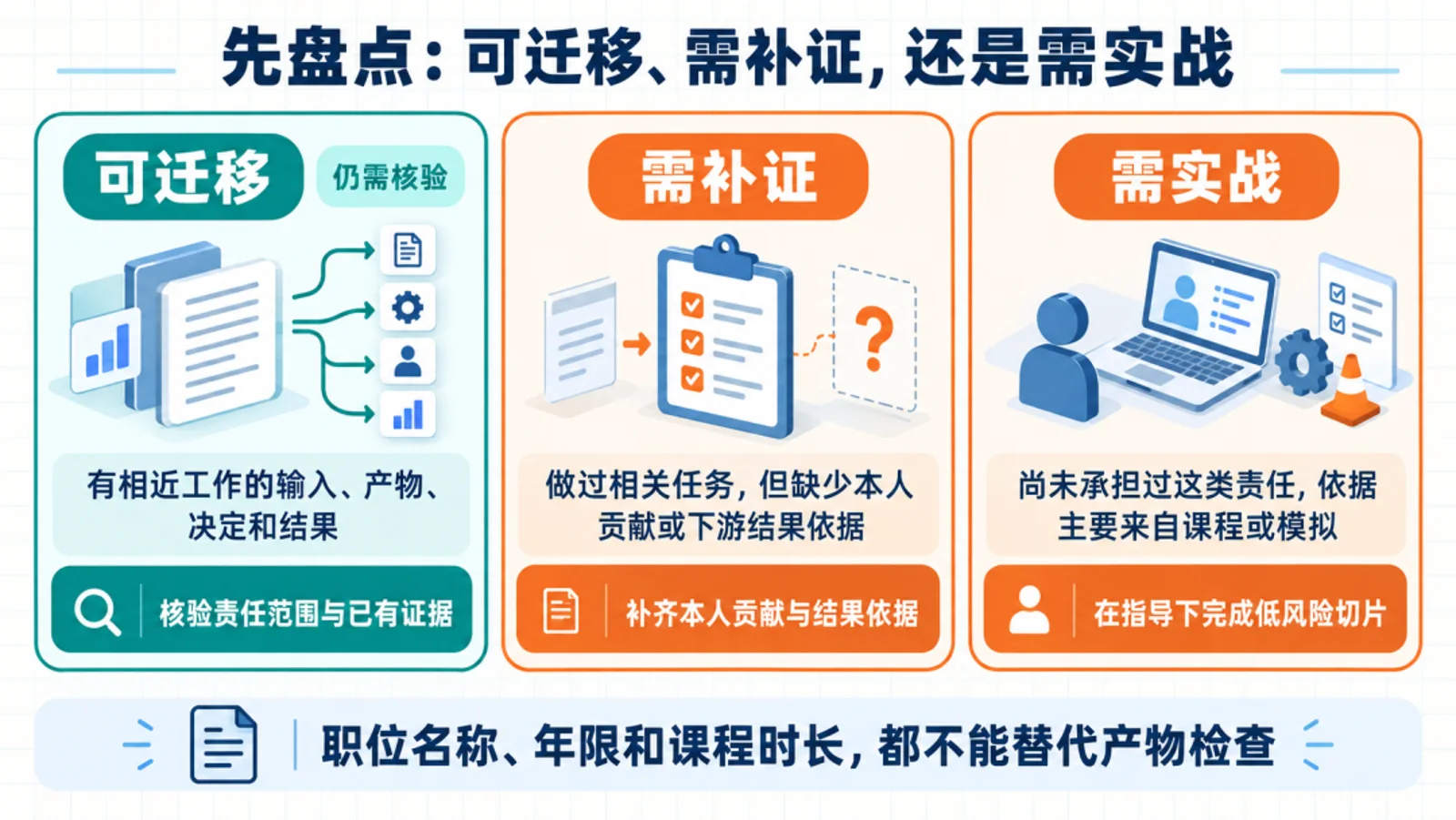
Using an approved internal retrospective project, mark each capability dimension (from the previous article) with one of three states:
Transferable — Similar work inputs, personal artifacts, decisions, and results exist, and the responsibility scope aligns. Next action: verify applicability scope and retain established evidence.
Needs Evidence — Related tasks done, but personal contribution, key decisions, or downstream results lack traceable records. Next action: retrieve verifiable records or complete verification in the next real task.
Needs Real Practice — Never borne this type of responsibility; existing evidence comes mainly from courses, observation, or simulation. Next action: select a low-risk slice and complete it under guidance and review.
These states describe completion actions, not a new scoring system. "Transferable" still requires verification; "Needs Evidence" must distinguish original records from later recollection — post-hoc explanations cannot substitute for contemporaneous evidence. For example, training records only support knowledge transfer; handover requires evidence of actual responsibility fulfillment. Existing verification need not be recalculated from zero just because the role wasn't called FDE at the time.
Completion order is driven by the responsibilities you are preparing to assume: read-only discovery first checks fact sources and semantic confirmation; write-back integration first adds permissions, transaction state, and failure handling. You can fill gaps while participating, but the current task's blockers must be resolved first — other strengths cannot offset them.
Four Backgrounds: Where Each Starts Filling Gaps
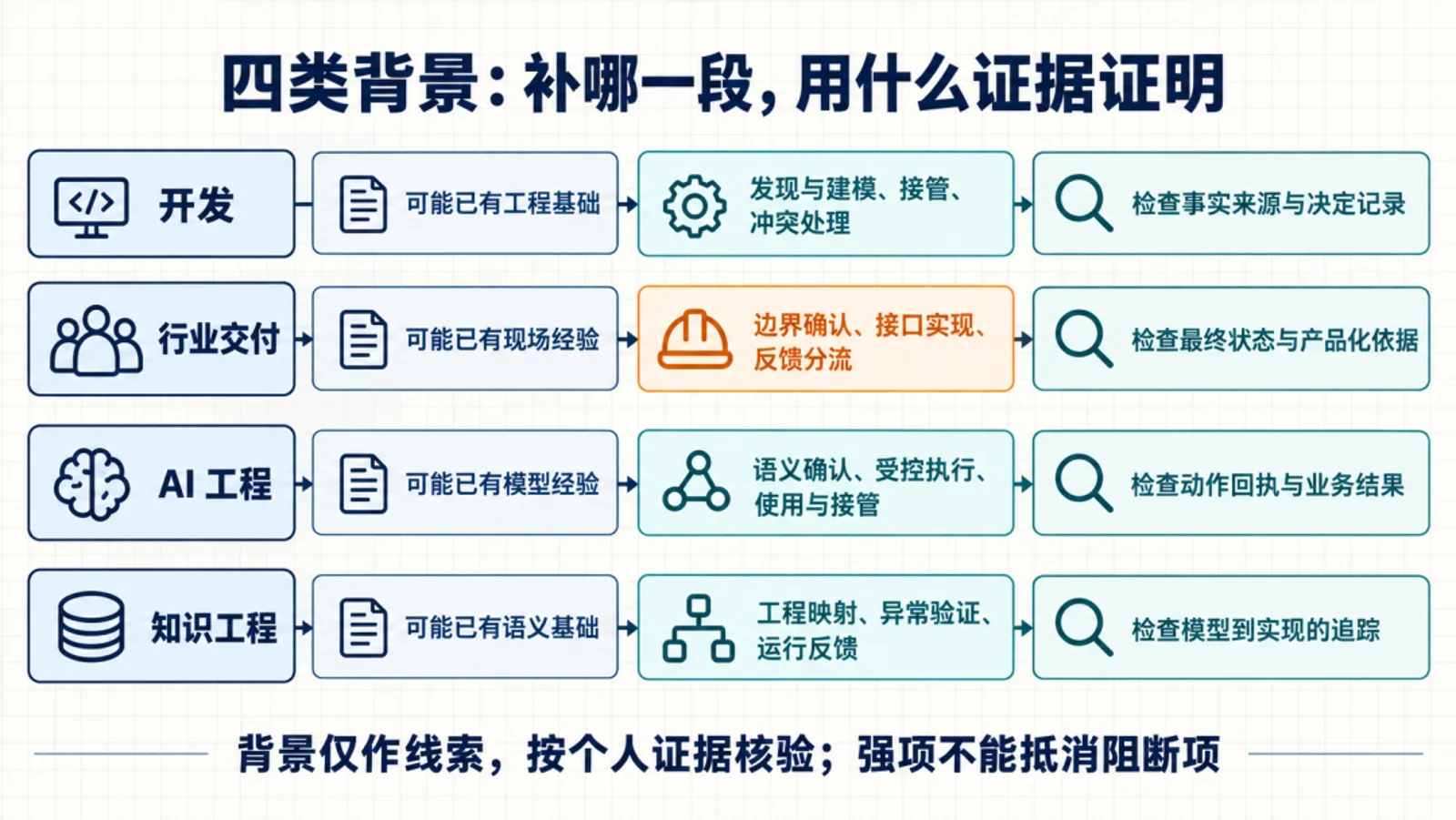
The four paths below are task-selection references, not labels pinned to job titles. A person may have multiple foundations and can skip already-verified parts.
Development Background: Move the Starting Point Toward the Field, Extend the Endpoint Toward Handover
API, database, testing, and deployment experience form the engineering base. Developers should prioritize the two ends: before requirements enter development, who confirms facts; after code delivery, who actually uses and operates the system.
First, pick a read-only scenario with a relatively clear process but real friction. With material-access approval and business participation for confirmation, personally walk through one abnormal order end-to-end, organizing date conflicts, original records, decision-makers, and open items.
Two artifacts result: (1) the field-discovery evidence package described in Article 02 ("Don't Rush to Draw Architecture Diagrams: How FDEs Discover Engineerable Problems from the Real Field"), and (2) the role boundary for this slice — which facts are confirmed by whom, which decisions need whose approval. Check whether key premises trace back to evidence, conflicts are preserved, unknowns limit development scope, and the responsibility matrix (Article 10: "FDE Is Not a New Full-Stack: How Frontline Squads Assign Responsibility to the Right People") leaves no unattended blanks.
Next, connect facts to business models and concrete architectural choices: why create a risk task for human handling instead of directly modifying the schedule? Personally produce candidate models, interface contracts, and Architecture Decision Records (ADRs) documenting alternatives and trade-offs. The passing standard is the ability to explain rule confirmers, authoritative systems, failure handling, and costs/risks requiring authorized decisions. Model co-creation method is in Article 03 ("Business Experts Should Not Face Technical Standards Directly: How FDEs Turn Field Knowledge into Runnable Business Models").
Finally, verify handover after the project is approved for real use: when the original developer no longer operates, can the agreed handover party perform changes, troubleshooting, and recovery within their responsibility? In hosted mode, infrastructure may be the vendor's duty — check each party's responsibilities per agreement. If the system still relies on the original developer privately patching data or tweaking configs, continue filling handover verification.
Developers should also check scope/schedule/quality conflict handling. If evidence is missing, use a real change request: faced with "code change is quick," produce a record containing options, impacts, decision-maker, and re-verification conditions. The key is converting technical feasibility into choices an authorized stakeholder can confirm and tracking post-decision outcomes.
Industry Delivery Background: Turn Field Understanding into Engineering Implementation
Industry delivery experience may provide domain language, customer collaboration, and knowledge-transfer foundations. The focus is converting field understanding into verifiable implementation and constraining ever-growing customizations.
Select an integration problem that exceeds standard configuration but has controllable scope. The product team states existing capabilities; the business side confirms priority. Then distinguish standard capability, customer-specific exception, to-be-verified commonality, and out-of-scope items — forming a scenario boundary while marking roles: who confirms business priority, who approves customization scope, who owns post-integration operation.
When asked to "automatically adjust the schedule while you're at it," explain the new business decisions, permissions, and verification costs; offer scope-reduction or phased options; record the responsible party's decision.
Then pair with engineers and personally own a slice of interface or data-flow implementation and verification. Start from risk-task creation, complete field mapping, config or code, failure handling, and tests; verify the source system's final state.
Passing condition: able to explain and verify why a request is allowed to execute, how duplicate business results are avoided, and who reconciles when state is unknown.
After implementation, review identity/permission/manual-confirmation division, which special rules stay in customer config, which anonymized experience enters product review — leaving judgment traces. Even if the product team ultimately rejects a specific exception, exposing maintenance cost, guarding reuse rights, and driving scope convergence still count as capability evidence.
AI Engineering Background: Connect Model Effectiveness to Real Actions and Consequences
AI/algorithm experience may provide data pipelines, model evaluation, and tool integration foundations, but engineering involvement depth varies widely. Crucially, check whether past proof covers offline model metrics or controlled results inside business processes.
First, run one real task with approved materials, working with the business-rule interpreter to separate rules, model inferences, and items needing human confirmation. This slice must produce traceable field evidence and business models. Example: when no valid evidence confirms a fulfillment commitment, retain "to be confirmed" — do not tweak the prompt to make the model pick a date more confidently. Check that model boundaries obey confirmed business semantics.
Next, in a test or controlled environment, connect candidate suggestions to identity, approval, and source-system receipts. Personally implement action validation, post-confirmation execution, and state verification; verify failure paths like unauthorized access, timeout, duplicate submission. Example: tool reports success but source-system state is unknown — stop blind retries, enter state reconciliation and escalation. This judgment needs corresponding implementation and verification records.
Finally, observe usage, shutdown, and handover in an approved pilot. The business owner confirms the original handling method, observation window, and quality guardrails; record manual review cost, task completion, and concurrent changes. Offline accuracy cannot directly convert to saved hours; business improvement must note attribution boundaries. This slice must verify that the agreed operations team can identify anomalies, shut down the capability, and fall back to manual handling — covering operational responsibility beyond model evaluation.
Ontology & Knowledge Engineering Background: Put Semantic Assets Through Implementation and Runtime Feedback
Ontology/knowledge engineering experience may provide concepts, relations, rules, and domain abstraction foundations. Priority is verifying what happens after the model enters the system.
Start from a concrete action, e.g., "create fulfillment-risk task when evidence satisfies conditions." Prerequisite: business model confirmed, source-system owner can explain state and interface boundaries.
Personally trace objects, rules, evidence, and state changes to data mapping, interfaces, and tests: which model conditions block task creation, who confirms conflicts, where final task status comes from. Passing condition: downstream personnel can achieve consistent implementation on the same baseline and trace test failures back to specific model elements.
Then jointly complete a slice with dev and ops, owning a clear implementation piece. Verify stale source data, model version mismatch, duplicate triggers — check alerts and rehearse recovery. Ontology defines action semantics; transaction execution and permission approval remain with respective authoritative systems and stakeholders.
Interface mapping and failure handling are the verification focus here; model consistency checks cannot replace them.
Next, observe whether semantic capability improves the task: reduced repeated verification or added confirmation burden? Need model fix, data mapping fix, or usage change? Feed feedback into next model version or engineering artifact.
Before reuse, check rights and information boundaries — avoid turning one customer's special commitment rule into the default for all customers.
One Project Slice Can Verify Multiple Capabilities, But Not All at Once
The paths above unfold in reading order; real projects need not follow strict sequence. A date conflict may simultaneously expose field discovery, modeling, and customer expectation issues; a single task-creation timeout may test architecture, implementation, and collaboration together.
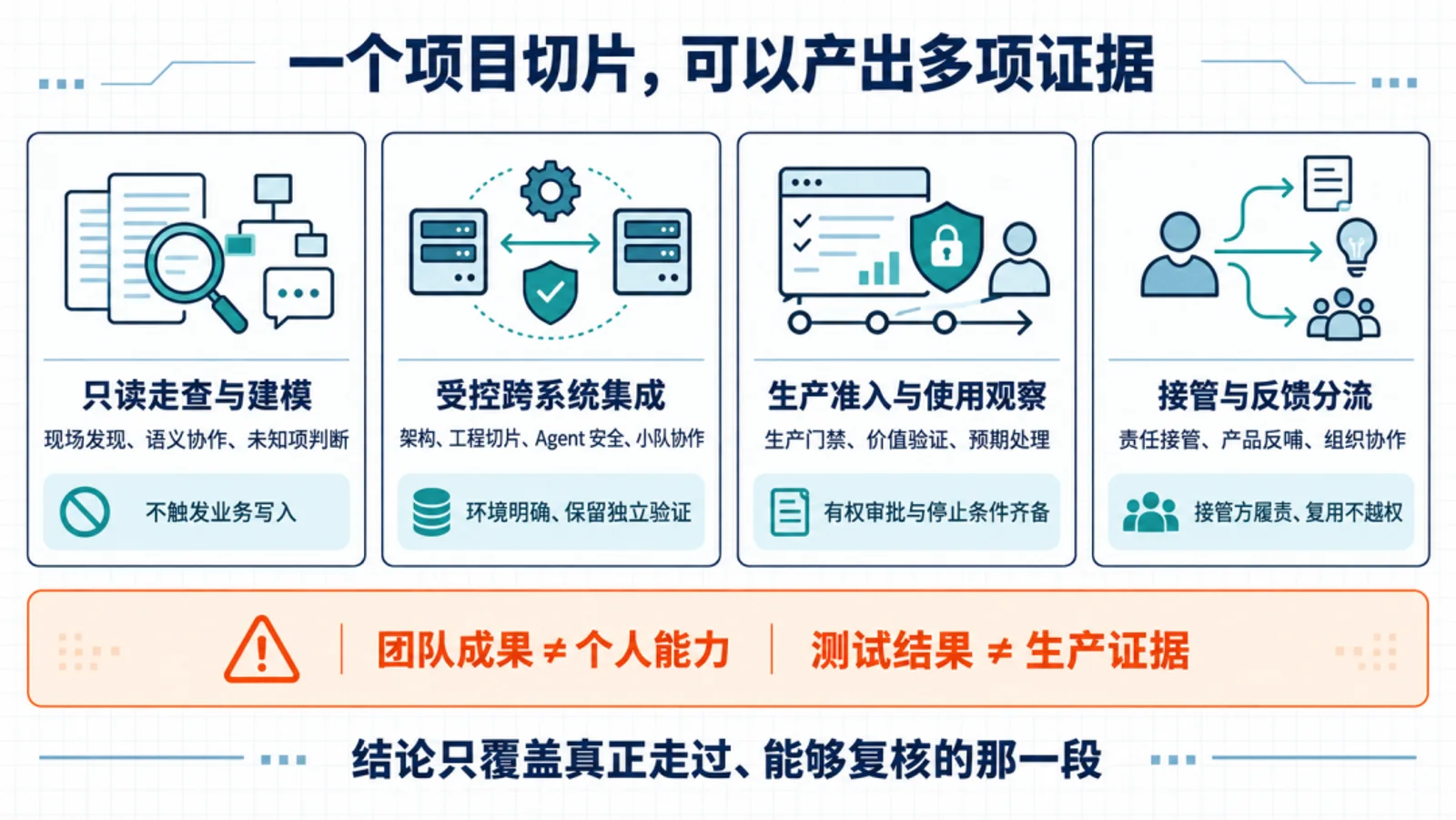
Therefore, you don't need twelve separate projects for twelve capabilities. Organize four verification types around the same business slice, but specify per capability what you personally undertook.
The following matrix shows how a slice can combine verifications and what boundaries each phase must hold:
Read-only Walkthrough & Modeling — Verifies role boundaries, field discovery, semantic collaboration, unknown-item judgment. Boundary: no business writes; material access still requires authorization.
Controlled Cross-System Integration — Verifies architecture, engineering slice, Agent safety, squad collaboration. Boundary: environment and action scope explicit; retain independent verification.
Production Admission & Usage Observation — Verifies production gate, value validation, expectation handling. Boundary: authorized approval, stop conditions, and recovery plans in place.
Handover & Feedback Split — Verifies responsibility handover, product feedback, organizational collaboration. Boundary: handover party fulfills duty within agreed scope; reuse does not overreach.
All paths must distinguish test results from production evidence: only after passing gates and entering production can production-run evidence be obtained; high-risk decisions remain with authorized principals.
Key is separating team outcomes from individual contribution. Business expert confirming rules does not count as engineer independently completing business confirmation; senior colleague fixing an incident does not prove the observer has incident-handling capability. Personal evidence must land on artifacts you produced, judgments you made, corrections you completed, and their results.
Conversely, a project not reaching production doesn't invalidate all learning. If a developer finds date basis unconfirmable, proactively narrows scope, and pushes to stop auto-write, that supports field-judgment and boundary-handling capability — but cannot claim production-operation and handover verification.
Capability verification does not require every project to go to the end; it requires each conclusion to cover only the segment truly walked and verifiable.
Write a Completion Record for the Next Responsibility Segment
Paths must land on the next concrete work. Instead of writing "improve business understanding capability," agree in the abnormal-order project: you own date-conflict evidence organization and candidate model mapping; business owner confirms meaning; tester verifies downstream constraints.
Use the following record. It's a work agreement within the project, not an extra paperwork burden; existing tickets, version records, and review artifacts can be referenced directly.
Current Gap & Target — Which capability, what evidence is missing, which responsibility segment you're preparing to own this time.
Scenario & Preconditions — Business slice, environment, data and action scope; whether access, review, and support are in place.
Your Role Split — Observe, co-complete, or own within authorization; which artifacts and judgments you personally produce.
Inputs & Artifacts — Facts and version baselines; locatable models, code, test or run records.
Key Decisions & Outcomes — What alternatives were ruled out, who confirmed; success, failure, or stop at which layer.
Review & Next Steps — Who checks, applicability scope; pass, supplement evidence, or shrink responsibility, and re-review triggers.
In the synthetic case, a learning feedback loop can be designed: developer first treats "latest date" as valid commitment; reviewer points out missing approval basis. Developer then traces source, keeps unconfirmed items as "to be confirmed," updates model mapping and tests, asks business owner to confirm meaning, tester to re-verify constraints.
Next time a similar but different conflict appears, observe whether they proactively trace basis, preserve unknowns, and find the confirmer without waiting for reviewer prompting. That connects one correction to capability completion; if still dependent on prompting, continue guidance and evidence-filling, retaining corresponding supervision.
Passing standard: conflicts traceable, unconfirmed commitments not treated as definite inputs, downstream constraints verified. When industry rules, system versions, or responsibility scopes change, re-check whether old evidence still applies.
Review results can reuse the E0–E3 single-evidence maturity levels from Article 11; they must not be merged into a personal total score, and capability records must not substitute for production authorization.
Pairing & Review: Avoid Turning Into Observation and Proxy Work
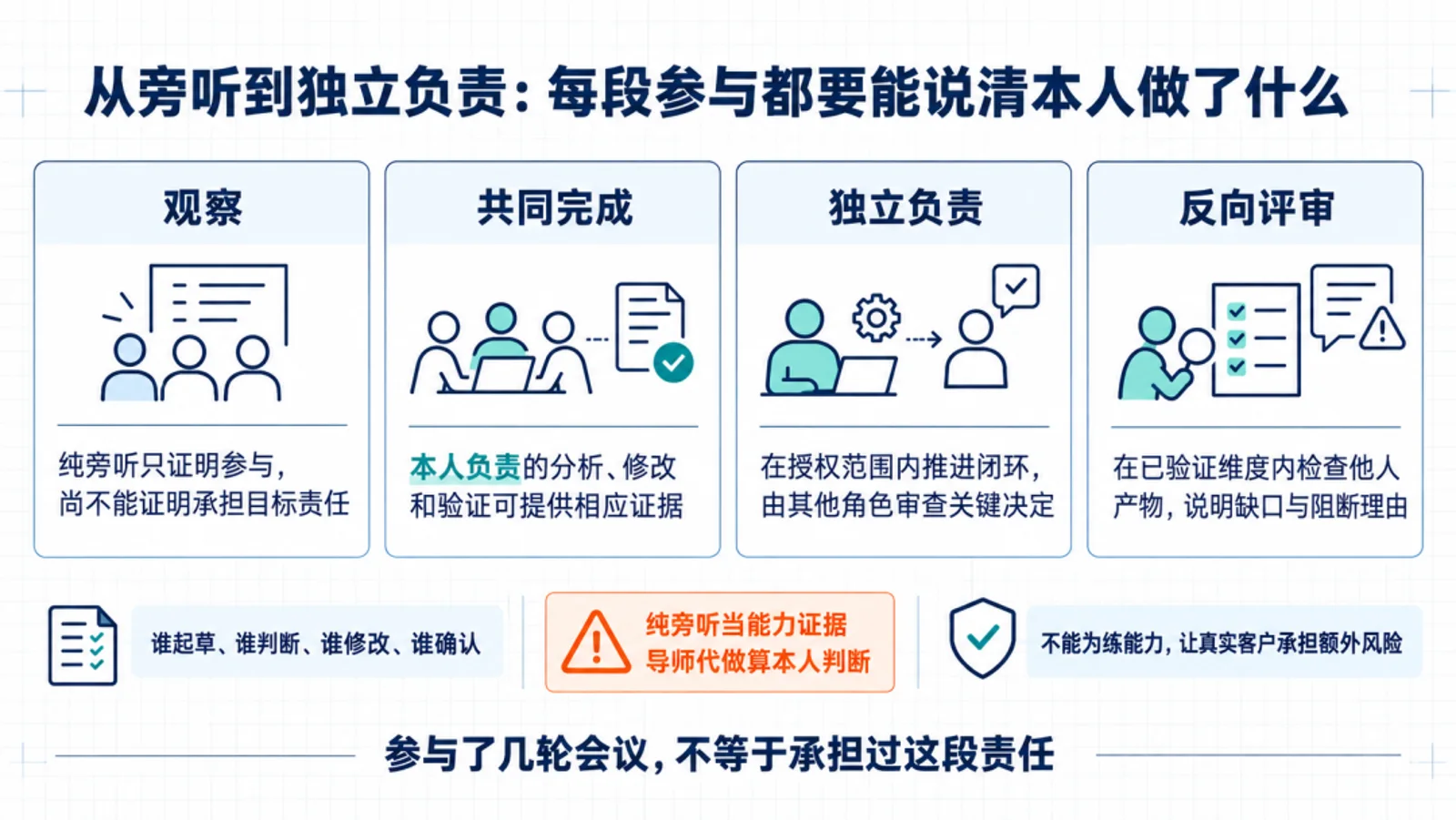
When entering unfamiliar work, start with observation, then co-complete an artifact slice, then own a more complete loop within authorization. But the basis for expanding scope must be evidence left from the previous step, not the number of meetings attended.
During pairing, record who drafted, judged, modified, and confirmed. If the mentor supplies all key judgments and the learner only organizes documents, at most it proves document-organization capability. To prove the target capability holds under guidance, you must see the learner personally undertake analysis, modification, and verification.
Owning within authorization doesn't mean working alone or self-approving. Business confirmation, security authorization, independent testing, and risk acceptance each have their own principals. Being able to proactively request expert support and expose undecidable parts is part of closed-loop work.
Further verification can be reviewing others' artifacts within mastered dimensions: spotting unknown state miswritten as failure, pointing out missing escalation paths in handover materials, and explaining why it blocks. Review capability also has scope — ability to check model traceability doesn't automatically qualify for production safety review.
These arrangements need real cost: business people invest walkthrough time, engineering teams provide usable environments, reviewers examine evidence. If a project lacks these conditions, first shrink responsibility, practice with simulations or historical materials, then wait for a suitable real task; practice results must be honestly kept as practice evidence.
For irreversible, high-impact production actions, never manufacture a "real-practice opportunity" to prove personal capability. Rehearse in approved environments, and let people with corresponding responsibility and capability own production work. Customer projects must first achieve business goals; personal growth is subordinate to that boundary.
The Next Responsibility Segment Is Worth Deciding Before the Next Course
To move toward FDE work style, first pick a responsibility segment that lacks evidence but can be owned under control. Define inputs, your artifacts, reviewers, and stop conditions; then decide what knowledge to supplement and whom to pair with. Capability growth should show as clearer scope you can own and more sufficient basis for pushing results.
The next article will discuss: when AI accelerates artifact generation and engineering execution, how does this capability-completion path change, and which judgments and decisions still require human FDEs and authorized customer stakeholders to own.
For questions about attribution, corrections or content rights, please contactand we will review it promptly.