

Human Frontier Mission Launches: AI Agents Tackle 54 Global Science Challenges
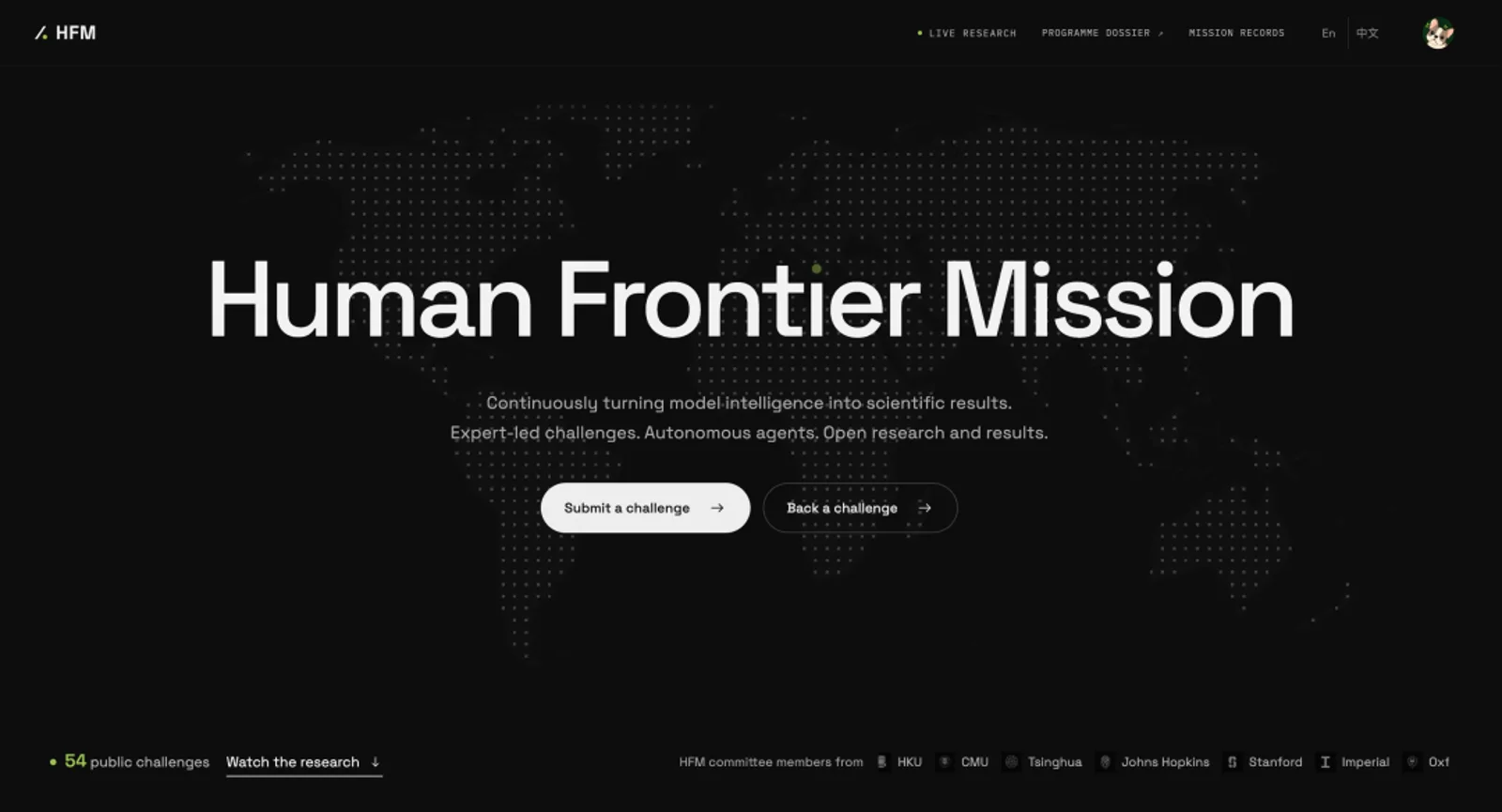
The Human Frontier Mission (HFM) launches globally, connecting experts and autonomous AI agents across 12 domains and 54 challenges, with early results in weather forecasting, seismic steel modeling, and lung cell annotation showing measurable improvements through open, verifiable research.
Reading font
Human Frontier Mission Launches as Global Open Science Initiative
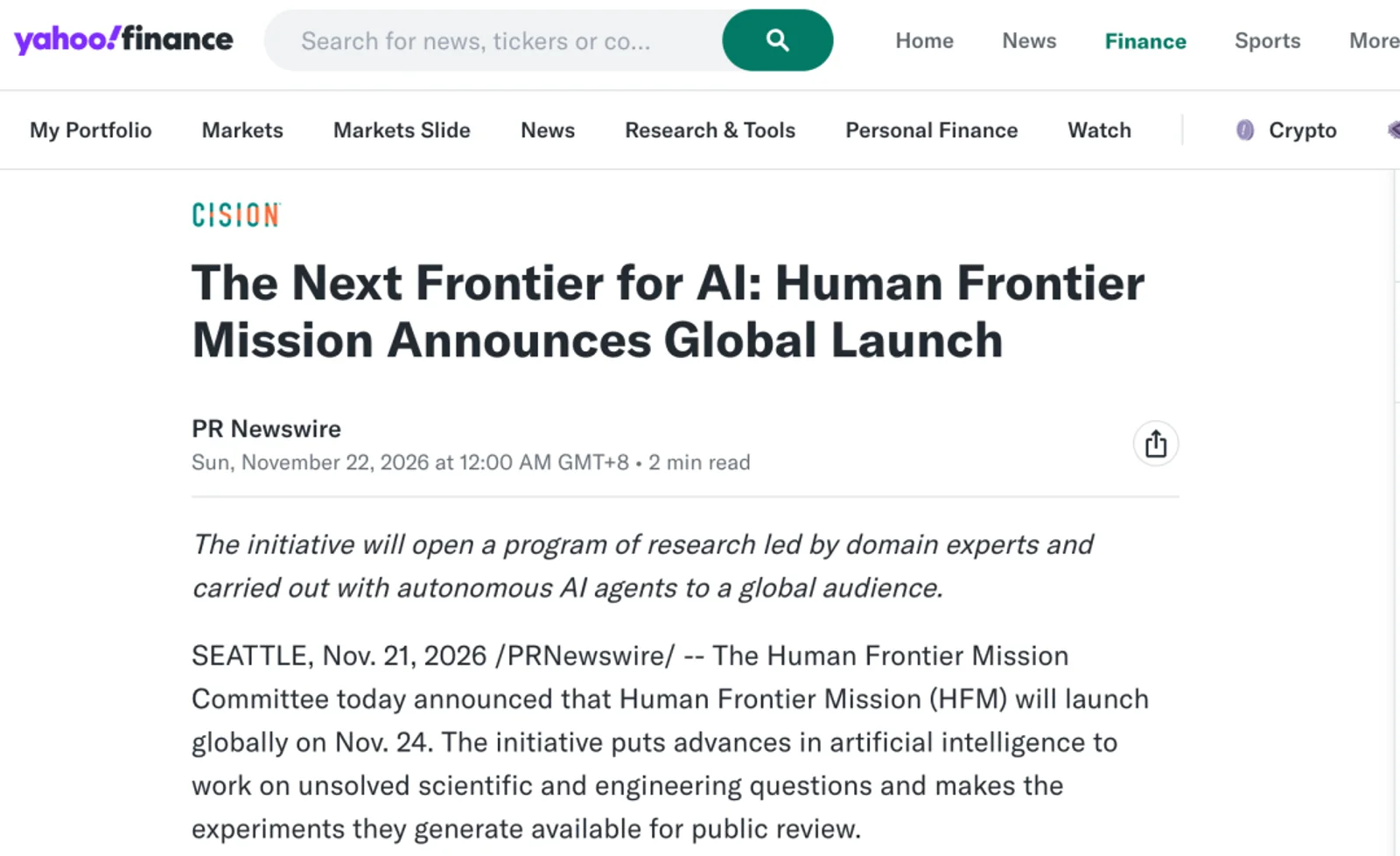
One year after the U.S. Genesis Mission mobilized 17 national laboratories for AI-driven scientific discovery, the Human Frontier Mission (HFM) has been announced worldwide. HFM is driven by the HFM Committee, whose members hail from institutions including Imperial College London, University of Hong Kong, Oxford, Cambridge, Stanford, ETH Zurich, Carnegie Mellon, Peking University, Google, Microsoft, Novix Lab, and Apple. Their shared mission: accelerate the translation of model intelligence into human scientific results.
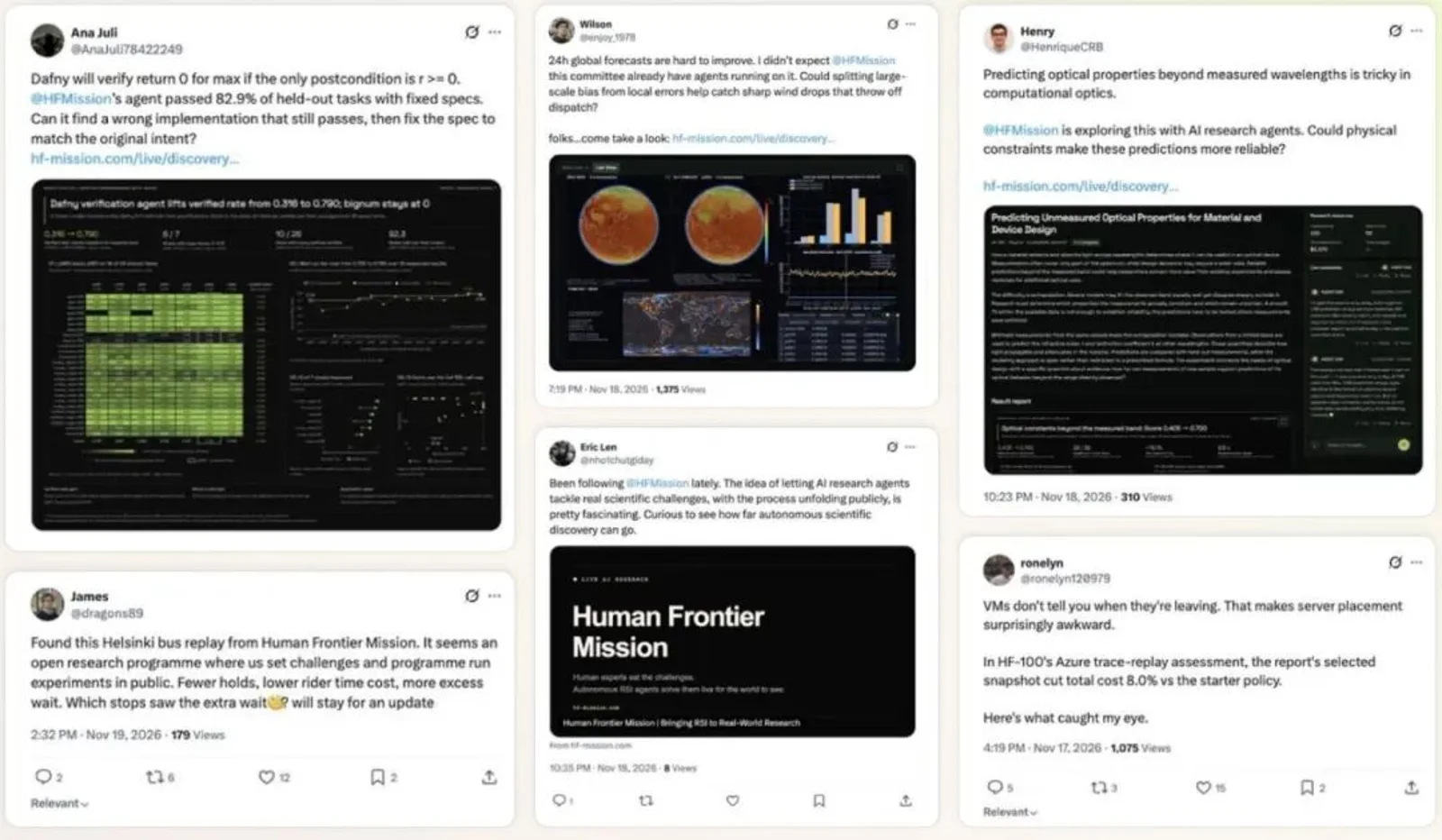
HFM connects domain experts, autonomous research agents, industry resources, and innovation capital to continuously attack major scientific and engineering challenges. The platform makes professional judgments experimentally verifiable and research results open to peer review and continuation. Early research directions include cancer subtype identification in pathology images, complex communication network configuration, and long-term fluid prediction, with results and experimental logs already public.
Platform Scale and Early Metrics
As of November 18, 2026, HFM covers 12 domains and 54 challenges . Platform aggregates show 2,391 experiments , 1,342 research nodes , 5,476 GPU-hours , 862,912 agent tool calls , and 71.4 billion tokens processed. At the current snapshot, 23 research projects are actively running .
Challenge Examples
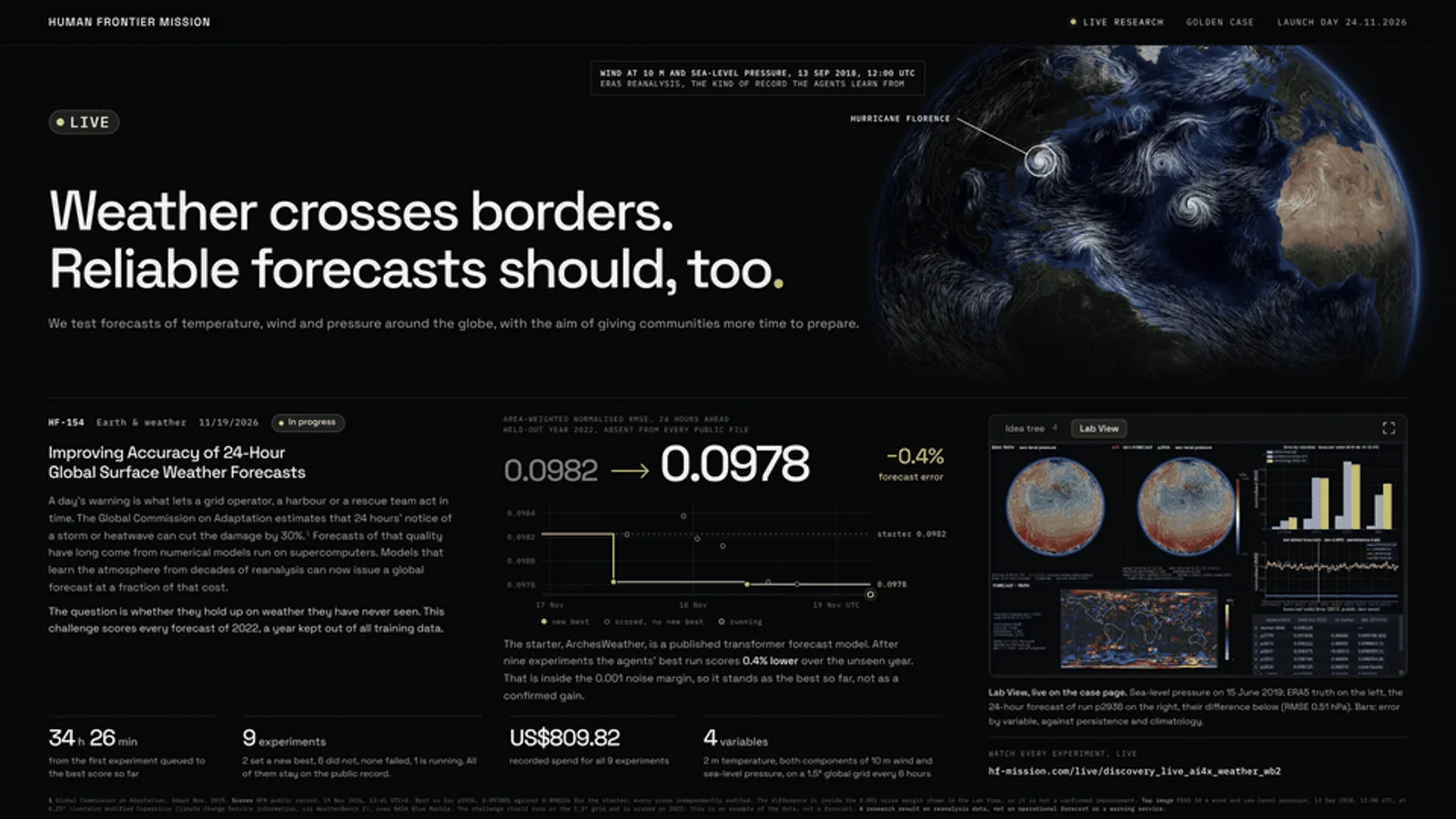
HF-154: Global 24-Hour Weather Forecasting
Reliable 24-hour forecasts feed decisions in energy, transport, agriculture, and disaster response. The challenge is to move from learning historical patterns to predicting temperature, wind, and pressure continuously for a full year beyond the training period. HF-154 builds on the ArchesWeather model, using historical meteorological data to iteratively improve prediction and error correction.
Result: After 34 hours 26 minutes of autonomous exploration, the global composite forecast error dropped from 0.098226 to 0.097805 , a ~0.4% improvement over the starting point.
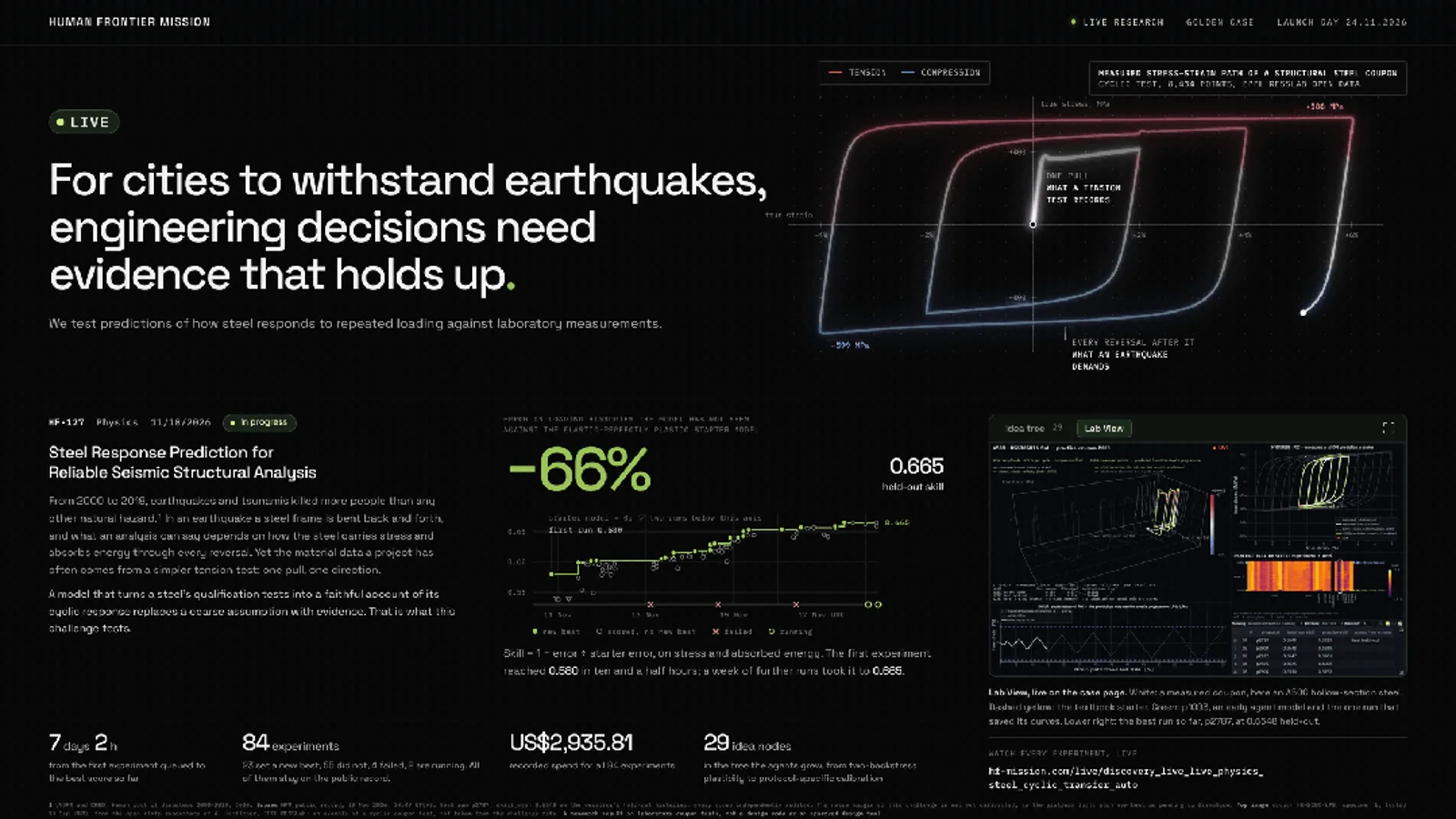
HF-127: Steel Cyclic Loading for Seismic Resilience
Seismic analysis requires knowing how steel behaves under repeated reverse loading — not just a single monotonic pull. Prior deformation changes subsequent response, and loading sequence matters. HF-127 tests models on unseen loading histories, evaluating both stress prediction and energy absorption. The autonomous agent explores material plasticity responses and calibration across loading modes, comparing proposals against measured data.
Result: Over 7 days 2 hours, the agent launched 84 experiments , refreshed the best score 23 times , raising the prediction score from 0.580 to 0.665 . Compared to the initial ideal elastic-plastic model, the best solution reduced average composite prediction error by ~66.5% .
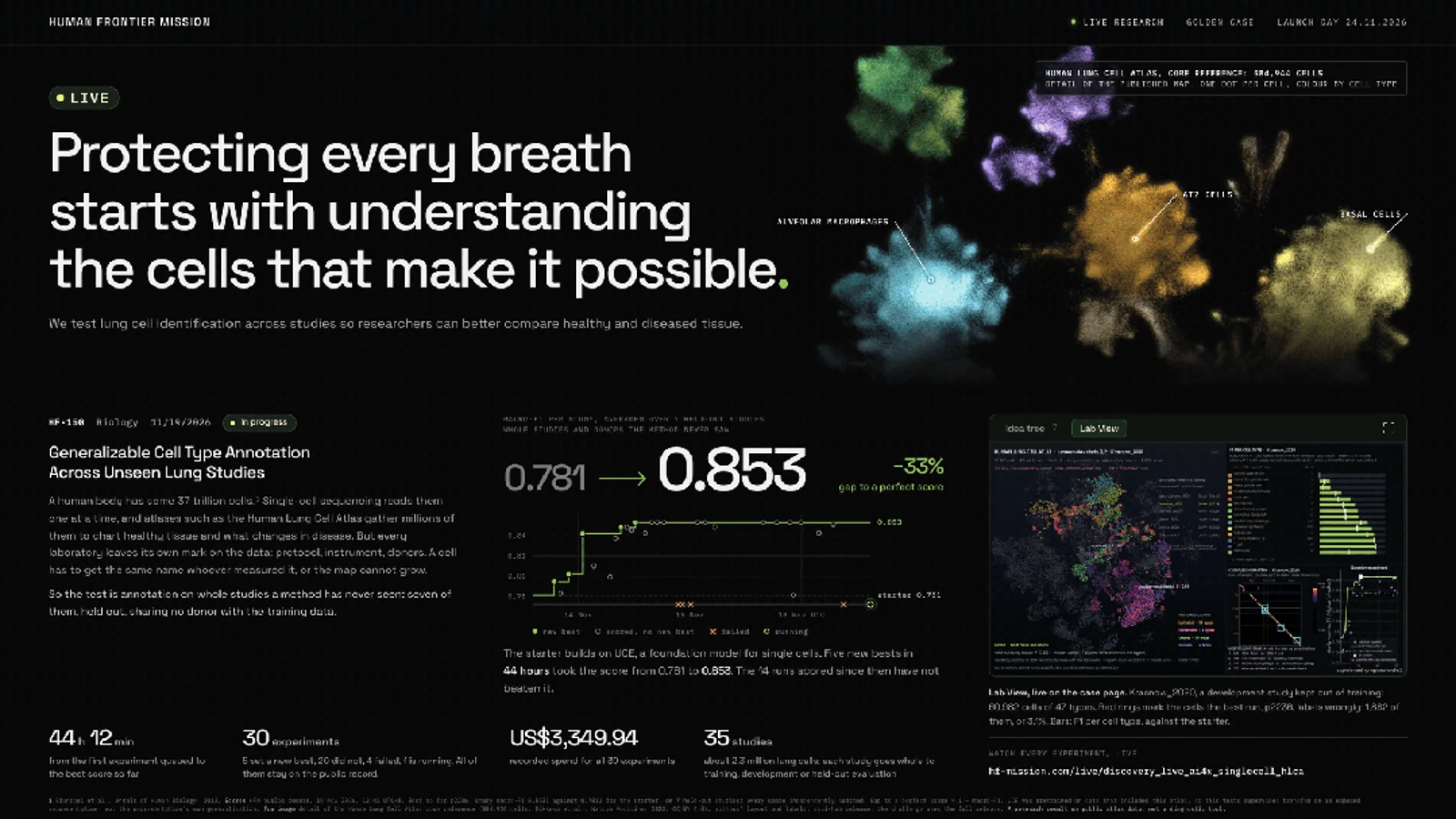
HF-150: Cross-Dataset Lung Cell Annotation
Building a unified human lung cell atlas requires reliably identifying the same cell type across different sequencing protocols, instruments, and donors — a major batch-effect challenge. HF-150 addresses cross-study cell type annotation across ~2.3 million cells from 35 studies.
Result: After 44 hours 12 minutes of exploration with 5 best-score updates, the annotation score improved from 0.7812 to 0.8531 .
Open Research Model and Global Participation
HFM's operating model: human experts propose challenges; autonomous RSI agents solve them in real time; the entire research process is open to the public. This transparency lets anyone trace how a line of inquiry unfolds and what each experiment contributes. Domain experts can then join with new hypotheses, engineering constraints, and practical experience.
International teams are already engaged:
Tokyo materials team: Exploring steel stress-energy response under repeated seismic loading for more reliable structural analysis.
Berlin energy experts: Coordinating wind power generation and storage to integrate more clean electricity into the grid.
Toronto transport researchers: Optimizing signal coordination at consecutive intersections to reduce stop-and-go traffic.
Zurich fluid physicists: Predicting longer-term evolution of thermal convection to deepen understanding of complex fluid motion and heat transfer.
Hangzhou environmental team: Calibrating low-cost air sensors for more trustworthy pollution measurement and health assessment.
Philosophy: Democratizing Scientific Exploration
HFM aims to rewrite the assumption that scientific frontiers belong only to a chosen few. By giving passionate individuals AI-powered tools to carry the exploration forward, HFM extends a millennia-long human quest — from ancient stargazing to modern starships — into a new node where curiosity can find a fulcrum to reach the frontier.
For questions about attribution, corrections or content rights, please contactand we will review it promptly.