

Orca Bots Beta: Persistent Coding Agents That Work Across Slack, GitHub, and Mobile
Orca v1.4.265 introduces Bots beta, giving programming agents persistent responsibilities that accept tasks from Slack, GitHub, Linear, and mobile, execute in isolated Git worktrees, and resume after interruptions, with 24 templates for recurring work like bug investigation and CI failure analysis.
Reading font
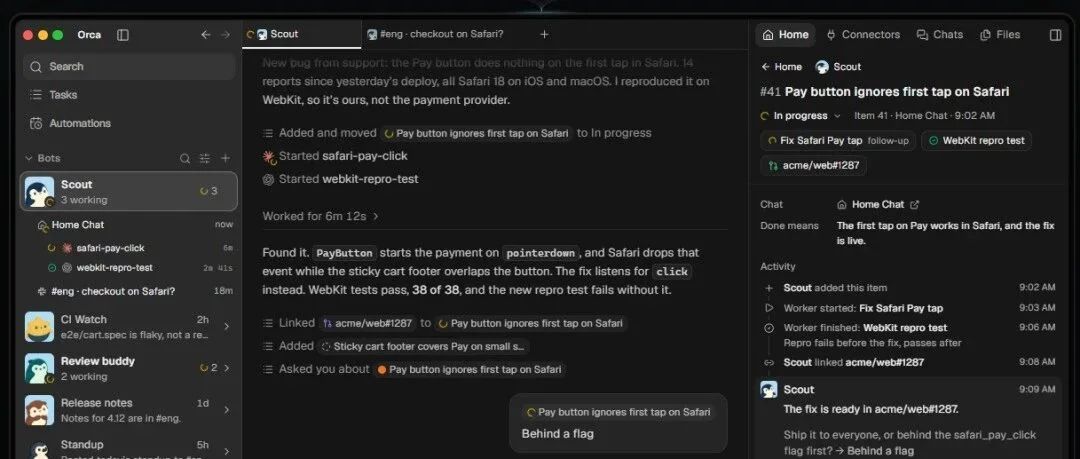
On November 20, the open-source agent development environment Orca released version 1.4.265, introducing a Bots beta that extends its existing multi-agent orchestration into daily workflow entry points. The announcement was low-key: a single X post at 08:31 stating, "See what's new in today's Orca update." When asked whether the feature was Bots or a mobile app icon, the team replied simply, "Bots!".
Early user feedback highlighted the capability gap: X user @Hank_agli wrote that Orca Bot outperforms Grok Bot, Muse, and even the anticipated Claude Duo.
Three days later, version 1.4.272 added interruption recovery, Slack retry, and task-waiting states , addressing the engineering challenge of preserving work across upgrades and crashes.
Core Concept: Bots Inside Your Agent IDE
Orca positions Bots as "Bots inside your agent IDE" with the workflow motto "Start anywhere. Finish in the IDE." Tasks can be dispatched from a phone, Slack, GitHub, or Linear, and the final review and handoff happen inside the Orca IDE.
When a Bot receives a coding task, it spins up an execution agent (Claude Code, Codex, etc.) in an independent Git worktree , performs the work, and returns results to the originating channel.
Bot Configuration and Templates
Creating a Bot requires a name, a responsibility description, a choice of execution agent, and a target machine. Users can also start from 24 built-in templates covering bug investigation, PR review, CI failure analysis, release notes, and documentation maintenance. Each template can be triggered on a schedule or by events such as new issues, check failures, or review requests. Scheduled tasks are initially disabled until configuration is complete.
Every Bot maintains its own role, memory, and automated tasks . Identity and memory are stored as Markdown files, editable by the user and importable from OpenClaw or Hermes. Models and tools reuse the user's existing agent login and subscription; consumption counts against the respective plan, and existing MCP services and Skills can be attached.
End-to-End Example: Safari Checkout Bug
The official documentation demonstrates a full cycle: a team member reports a Safari checkout failure in Slack. The Bot launches the execution agent in an isolated workspace, reproduces the bug, records steps, and identifies the cause. Following the template, it asks for confirmation before fixing, then modifies code, runs tests, and opens a pull request. The developer can jump from the Slack thread back into Orca, open the agent's Git worktree, and inspect the editor, terminal, and browser state left exactly as the agent left them.
Mobile and Cross-Agent Orchestration
The mobile companion solves the "person not at computer" problem: view pending tasks, answer agent questions, approve steps, or start new work.
This builds on Orca's earlier cross-agent orchestration (announced November 14), where Codex writes backend code while Agy builds UI, or Claude implements while Codex reviews. Bots add persistent roles, memory, and external task entry points.
Rapid Expansion of Supported Agents and Features
November 21: Added support for Kimi Code, Gemini CLI, MiMo Code; enabled Bots to hand off work by mentioning group members.
November 22: Introduced cross-paired-computer Bot groups and Qwen Code support.
Founder Background and Product Evolution
Orca is built by Stably AI, co-founded by Liang Jinjing , a former Google Chrome senior engineer (Cornell CS BS/MS, ~5 years at Google building Chrome's test and release infrastructure for billions of users), and former Uber tech lead Neil Parker. After a prior venture (wedding livestreaming platform Lovecast) struggled with low-frequency usage, Liang pivoted to enterprise software. Stably AI entered Y Combinator Winter 2022 with an AI automated testing focus. As general coding agents improved, the team repurposed their session-management expertise into Orca, launched in March 2024, now at ~135k GitHub stars.
Liang's own heavy usage — over 400 worktrees, 200+ for recurring automation — directly shaped Orca's emphasis on session persistence and state recovery . She noted that if upgrades lose terminal and agent sessions, users hesitate to upgrade; therefore, preserving work state is a core engineering requirement. The Bots update continues this line: tasks enter from outside, execution state survives, and work can resume after interruption.
For questions about attribution, corrections or content rights, please contactand we will review it promptly.