

OSS Tables Lance Beta: Managed Lakehouse for Autonomous Driving & Embodied AI
Alibaba Cloud's OSS Tables launches managed Lance table service in public beta, offering zero-ops maintenance, high-bandwidth training reads via OSS accelerator, and open Iceberg/Lance catalog integration to accelerate multimodal data pipelines for autonomous driving and embodied AI.
Reading font
Overview
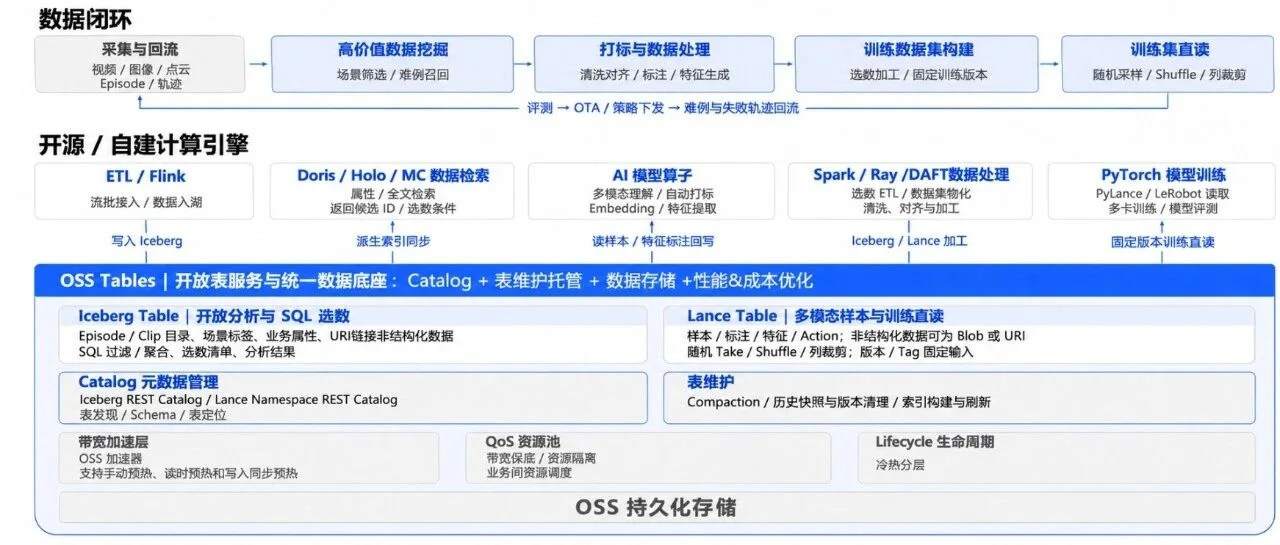
Alibaba Cloud's OSS Tables has officially released its Lance table format and entered public beta. Designed for autonomous driving, embodied intelligence, and foundation model workloads, OSS Tables combines open table formats with cloud-managed capabilities to provide a unified data foundation for data filtering, training set construction, and training reads. The service aims to reduce the maintenance and procurement costs of using Lance while accelerating model iteration.
Architecture: Dual-Format Managed Table Service
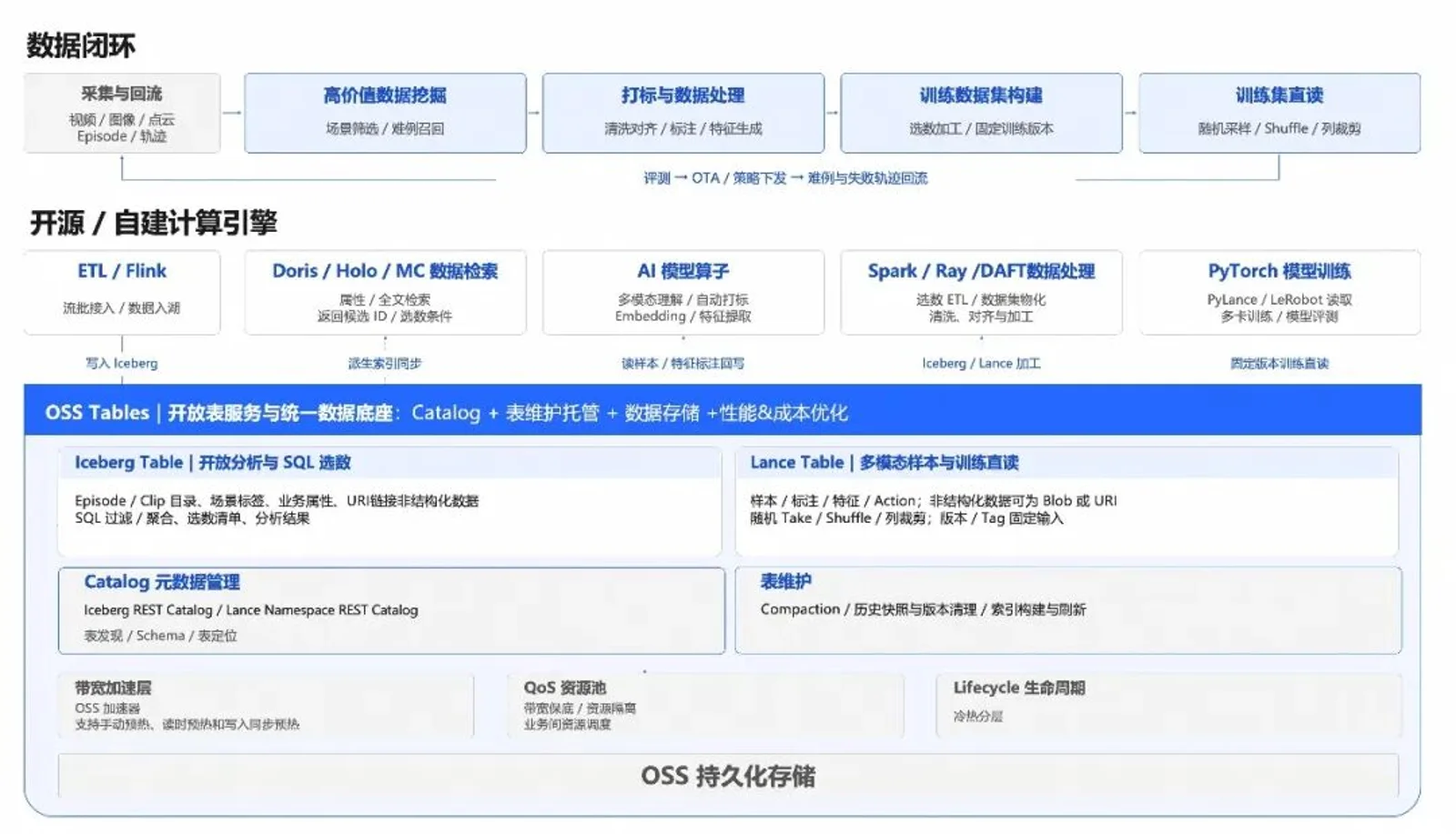
OSS Tables is a managed service for both Iceberg and Lance table formats, organizing data through Table Bucket, Namespace, and Table abstractions. It integrates storage, catalog management, and table maintenance. Iceberg handles analytical data such as sample manifests, scenario labels, and evaluation metrics. Lance organizes multimodal samples, annotations, and vector features. Together they support both analytical and AI data workflows.
Advantage 1: Managed Table Maintenance for Near-Zero Operations
Continuous writes and data iteration generate small files, historical versions, and pending index updates. Self-managed Iceberg or Lance deployments typically require stitching together catalog management, maintenance compute, and scheduling scripts, with operational burden growing alongside data scale.
OSS Tables offloads catalog and table maintenance to the service. For Lance tables, developers can submit on-demand compaction, scalar and vector index building, index optimization, and historical version cleanup tasks. The service executes these tasks without requiring users to deploy maintenance clusters. Enterprises still control maintenance timing and version retention policies while reducing self-managed compute and daily ops effort.
Advantage 2: High-Performance Access Decoupling Maintenance from Business
Maintenance tasks like compaction consume significant read/write bandwidth. In self-managed setups, they contend with data selection, processing, and training for compute and network throughput.
Bandwidth isolation: OSS Tables' managed maintenance read/write bandwidth and QPS do not consume the customer's bucket quota, reducing contention with business throughput budgets.
Compute offload: Maintenance compute runs on the OSS service side, lowering the network burden on customer compute clusters for maintenance data reads/writes.
Training read acceleration: For Lance tables' high-bandwidth direct training reads, OSS Tables can combine with OSS Accelerator, using hotspot caching and extra read bandwidth to support repeated reads and concurrent sample loading. Combined with Lance's columnar reads and random access, this provides an efficient data supply path for multimodal training, mitigating GPU underutilization caused by data waiting.
Advantage 3: Open Ecosystem Integration Preserving Compute Choice
OSS Tables' Catalog provides standard Iceberg REST Catalog and Lance Namespace REST interfaces. Iceberg tables integrate with open-source ecosystems including Spark, Flink, Trino, and PyIceberg. Lance tables integrate via Python SDK and connectors into custom AI data processing pipelines.
The service supports both customer self-managed compute engines and Alibaba Cloud managed engines, allowing businesses to choose per workload. It also supports in-place upgrade of customer-owned Lance tables stored in object buckets to OSS Tables, reducing migration cost.
Application Scenarios: High-Value Data Loops for Autonomous Driving & Embodied Intelligence
Autonomous Driving
Video, point clouds, annotations, and scene attributes accumulate continuously. Enterprises can use Iceberg to manage sample manifests and evaluation metrics, while Lance associates samples or raw file references with scene labels, quality scores, and vector features. Combined with external processing engines, this enables long-tail scenario mining, hard example mining, and training set construction. Managed maintenance reduces engineering overhead from frequent updates, and accelerated reads support multi-epoch training on the same high-value samples.
Embodied Intelligence
Robot operation trajectories contain video, state, action, and task results. Lance tables organize these correlated elements around trajectories and samples, supporting data selection by task, success rate, and failure type. Annotations and features can be reused, and data versions can be fixed for training and evaluation. OSS Tables handles storage, catalog, and maintenance, sitting between data processing/training frameworks to help teams continuously convert collected data into usable, traceable training assets.
Conclusion
OSS Tables Lance tables deliver managed maintenance, high-performance access, and open ecosystem integration to accelerate multimodal data management and model development for autonomous driving and embodied intelligence. The public beta is open for participation to jointly build an open data foundation for these domains.
For questions about attribution, corrections or content rights, please contactand we will review it promptly.