

Recursive Collective Intelligence: Multi-Agent LLMs Self-Evolve Without External Teachers
Fei-Fei Li and Yi Ma's team introduces Recursive Collective Intelligence (RCI), a framework where multi-agent LLM systems improve themselves through collaboration and recursive training without external teacher models or human annotations, using an equal-budget ladder to measure genuine collective gains.
Reading font
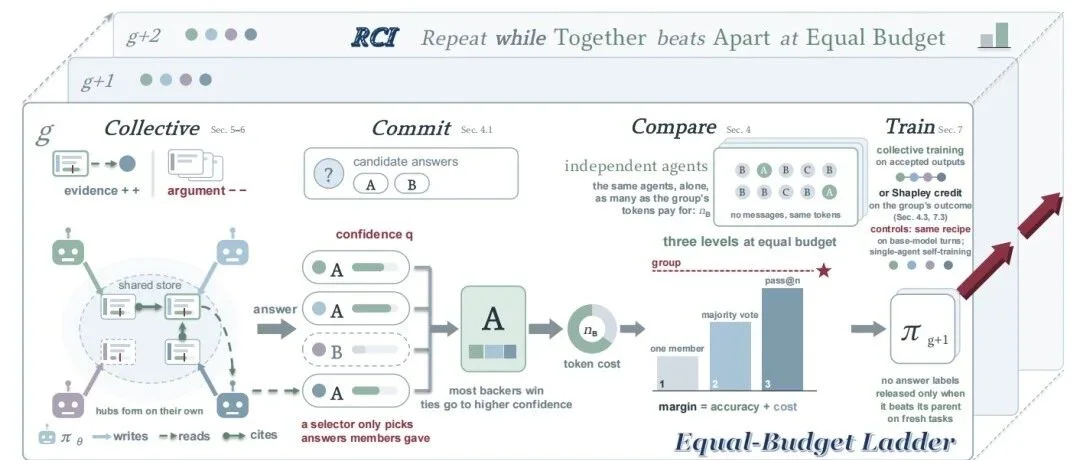
The paper Recursive Collective Intelligence: Emergence on an Equal-Budget Ladder in Multi-Agent LLM Systems (arXiv:2611.32606) extends recursive self-improvement from single models to multi-agent teams. The authors propose an Equal-Budget Ladder to fairly evaluate whether agent collaboration yields real benefits under the same token budget.
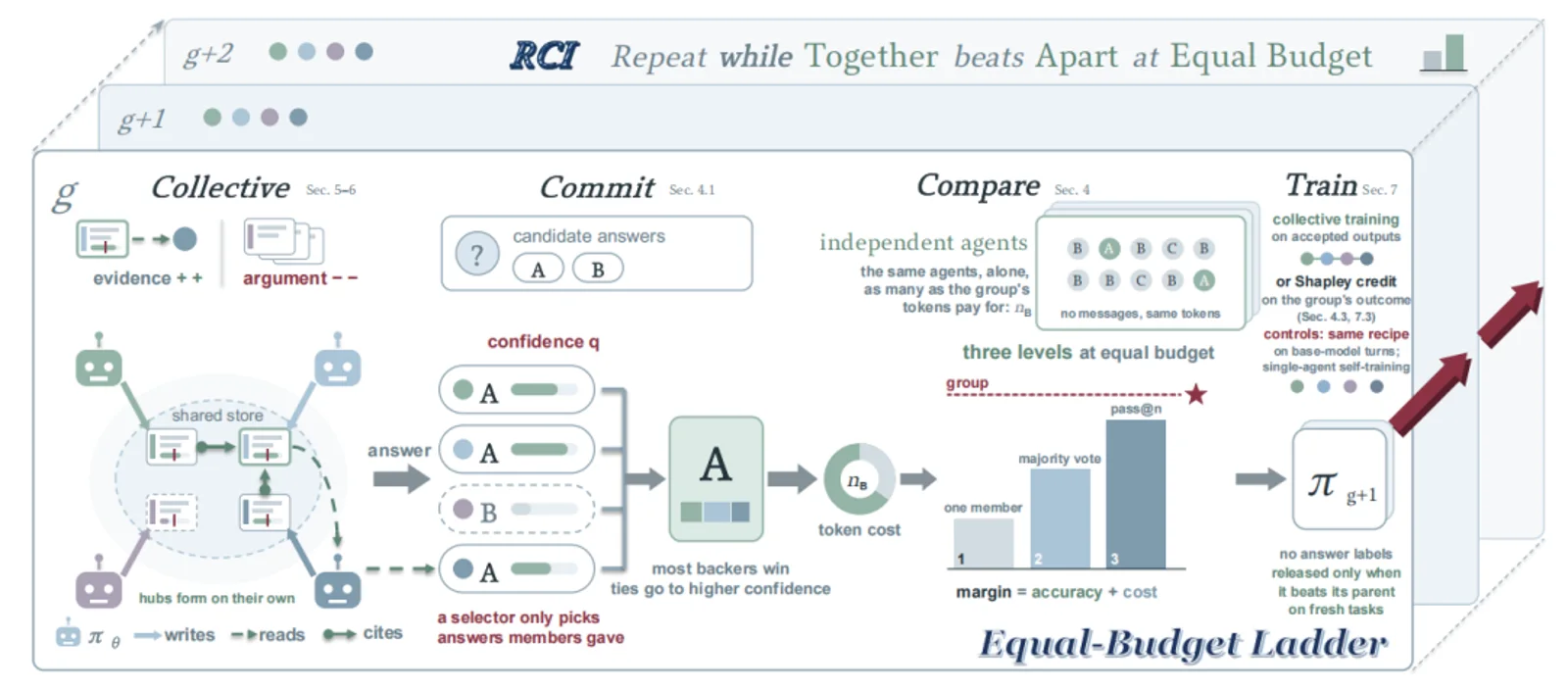
Equal-Budget Ladder: Three Levels of Collective Intelligence
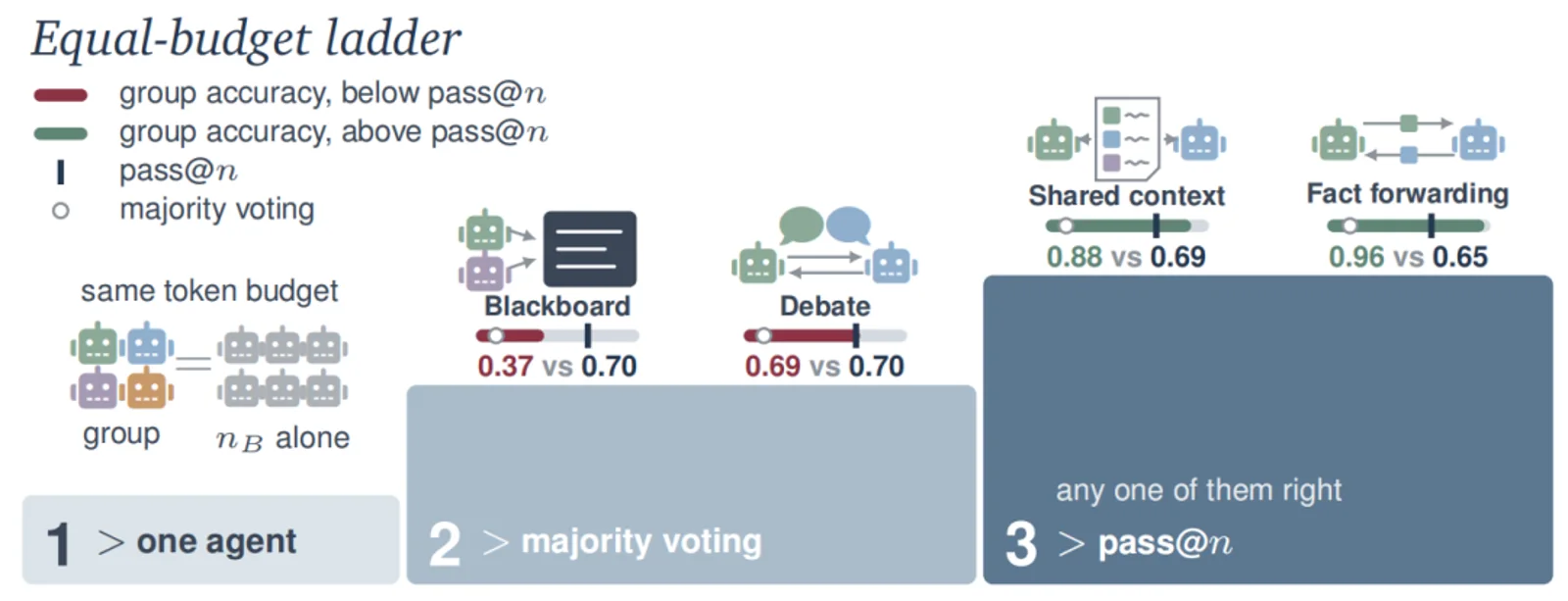
The ladder defines three increasingly stringent levels:
Level 1 : Multi-agent team accuracy exceeds a single independent agent.
Level 2 : Team accuracy exceeds majority voting of n independent agents (where n = total team tokens / average single-agent tokens).
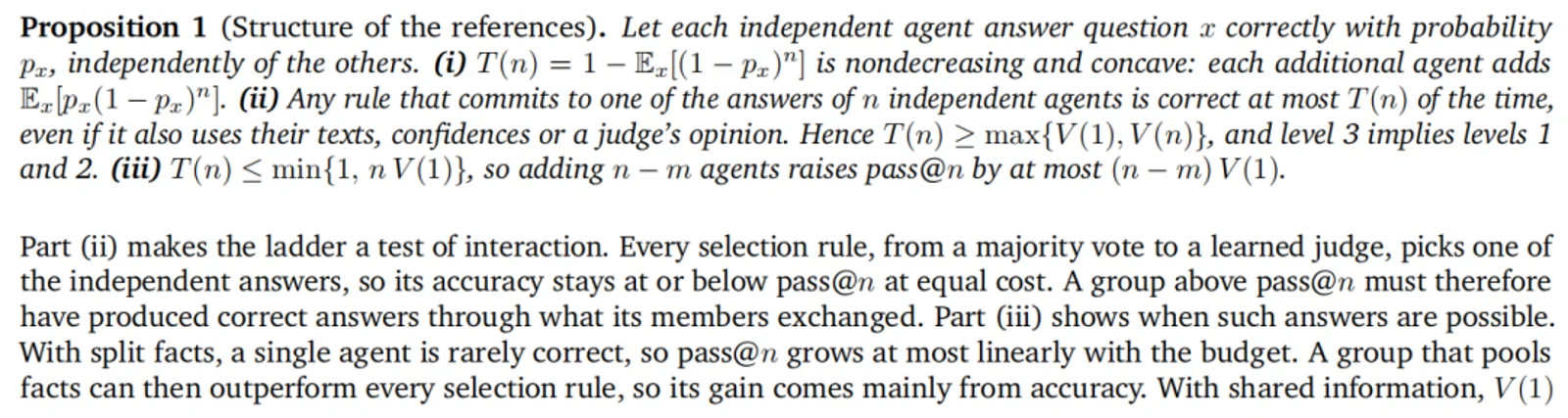
Level 3 : Team accuracy exceeds pass@n of n independent agents — the probability that at least one agent gets the answer right. The paper proves any mechanism that only selects from existing agent answers (voting, confidence, reviewer models) cannot surpass pass@n ; reaching Level 3 means the team generated new knowledge through interaction.
The authors further decompose the advantage over pass@n into accuracy gain (better information exchange) and cost gain (fewer tokens used).
RCI Four-Stage Loop
The Recursive Collective Intelligence process iterates four stages:
Collective Collaboration : Agents share a message space, explore information-exchange protocols.
Answer Submission : Each agent submits a candidate answer with confidence; the team picks the most-supported answer (ties broken by confidence).
Equal-Budget Evaluation : Team performance is judged against the three ladder levels.
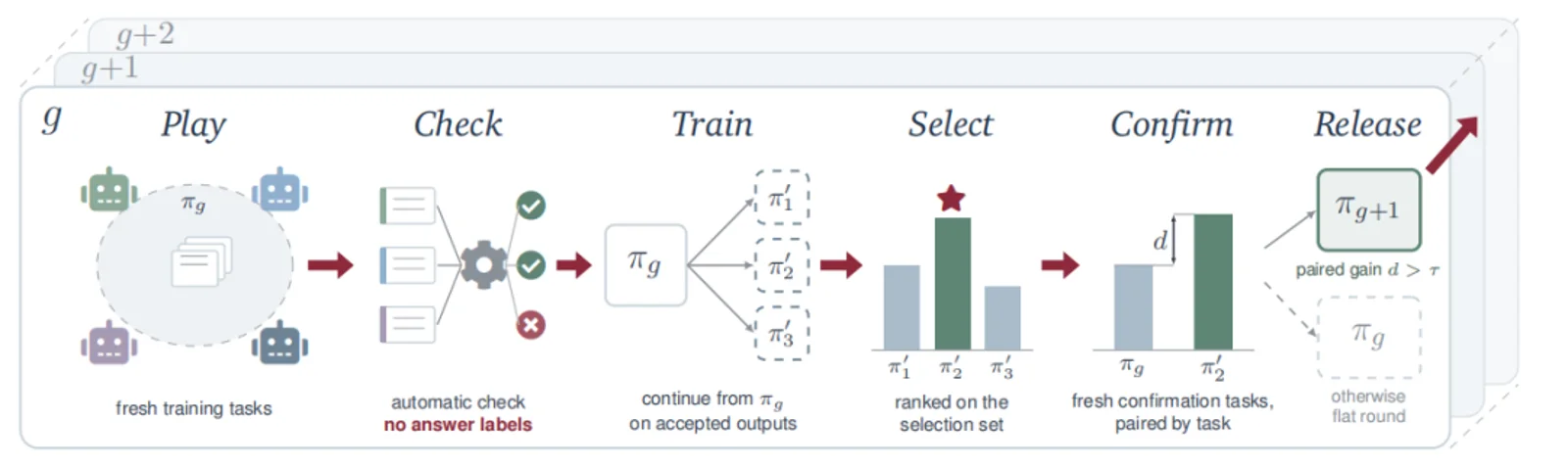
Recursive Training : Verified team outputs train the next generation — no external teacher or human labels needed.
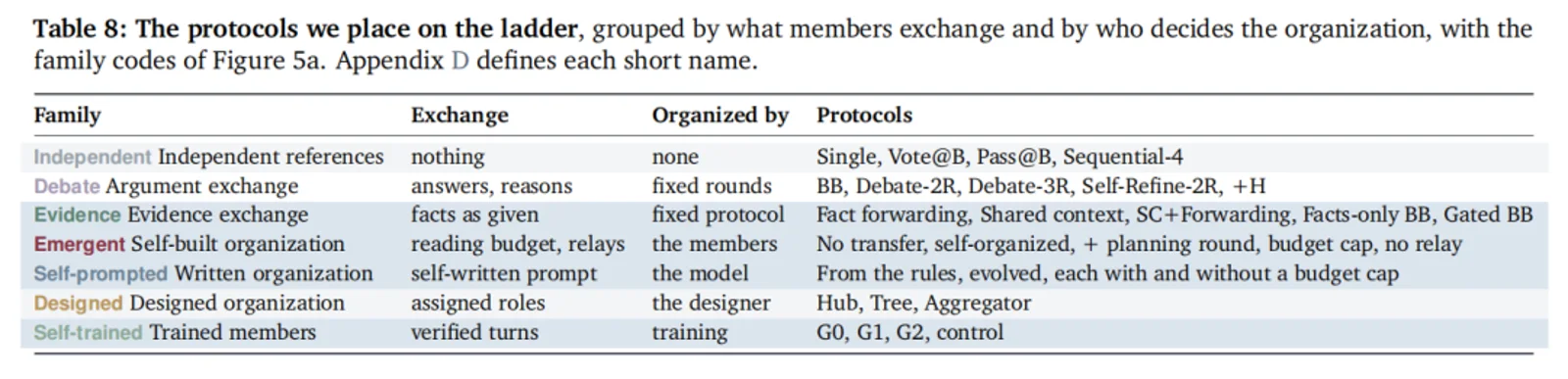
Seven Multi-Agent Organization Protocols
The team categorizes collaboration protocols into seven types:
Independent : No communication; baseline via majority vote or pass@n .
Debate : Free-text multi-round discussion.
Evidence : Direct fact passing (Fact Forwarding, Shared Context).
Emergent self-built topology : Agents allocate message-read quotas, forming Hub or Relay structures.
Self-prompted : Model writes its own collaboration rules.
Designed : Human-specified roles (Hub, Tree, Aggregator).
Self-trained : Next generation trained on verified interaction logs.
Emergent self-built topology is highlighted: each agent starts with one read quota, can transfer quotas to others. An agent collecting enough quotas becomes a Hub reading all facts; limiting per-agent quotas forces a Relay chain. An optional planning phase lets agents negotiate roles beforehand.
Key Experimental Findings
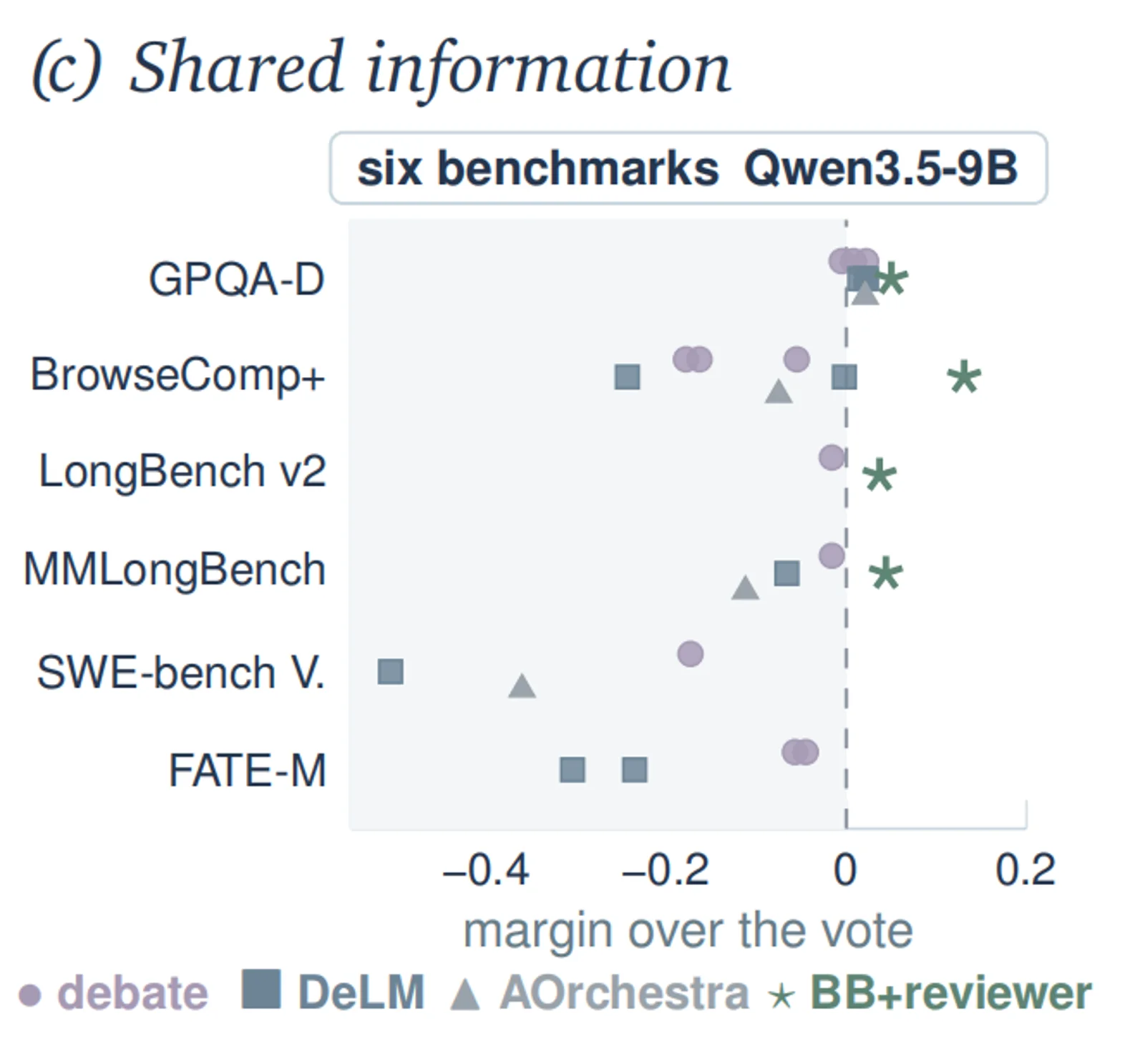
Existing Methods Fail to Beat Equal-Budget Voting
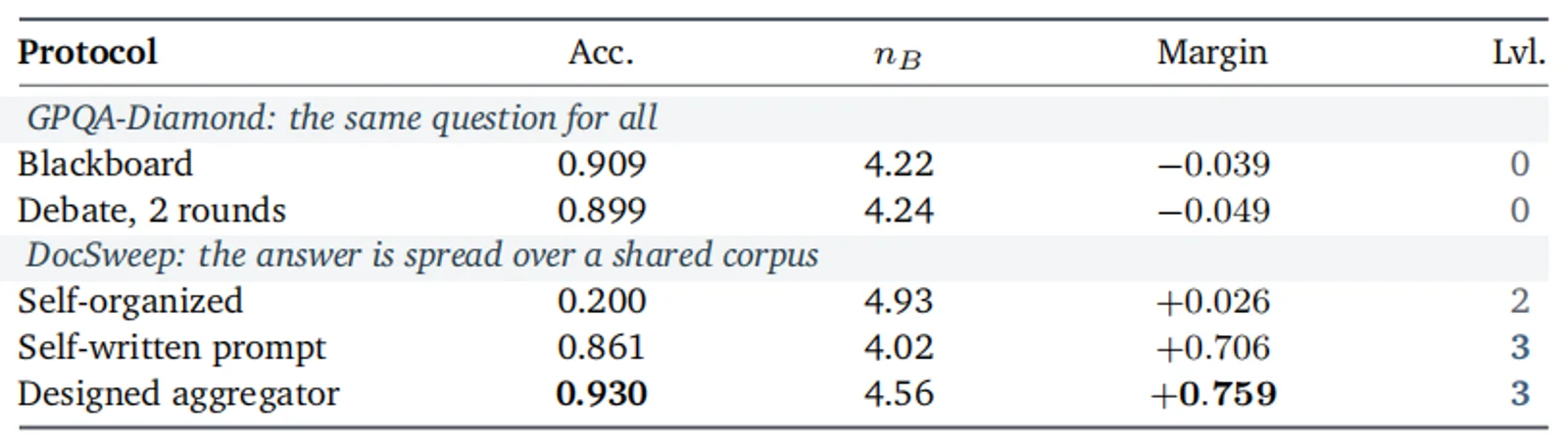
On six benchmarks with Qwen2.5-9B, three popular methods (Multi-Agent Debate, DeLM, AOrchestra) did not surpass the equal-budget majority-voting baseline. With four Qwen2.5-27B agents on GPQA-Diamond (all agents see full problem), Blackboard and two-round Debate scored 90.9% and 89.9% — below Level 1. However, on DocSweep (information scattered across documents), Self-written Prompt (86.1%) and Designed Aggregator (93.0%) exceeded pass@n , reaching Level 3. Conclusion: when agents already share identical information, extra discussion adds little; when facts are distributed, proper task allocation and aggregation yield genuine collaborative gains.
Fact Forwarding Achieves Level 3 on HiddenBench
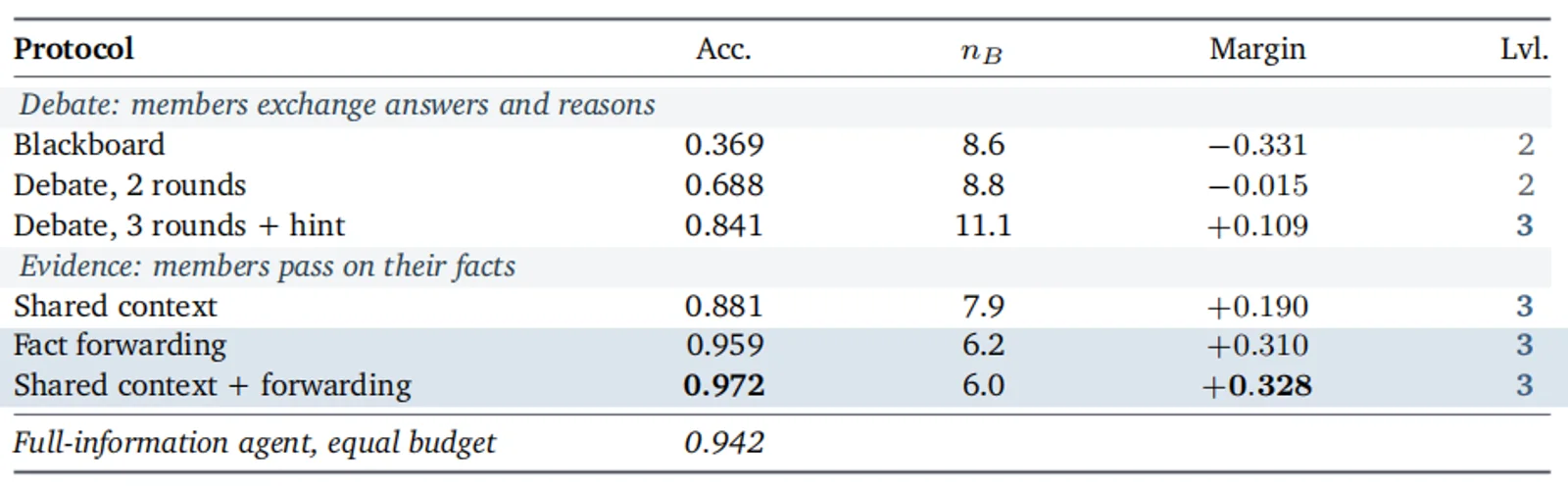
Four Qwen2.5-27B agents each held partial facts. Two-round Debate reached 68.8% (Level 2). Fact Forwarding — agents pass raw facts instead of conclusions — achieved 95.9% , surpassing pass@n (94.2%) and even the full-information single-agent baseline (94.2%). Shared Context scored 88.1%. This shows transmitting original facts is more effective than exchanging reasoning summaries.
Self-Organized Hub/Relay Structures Reach Level 3
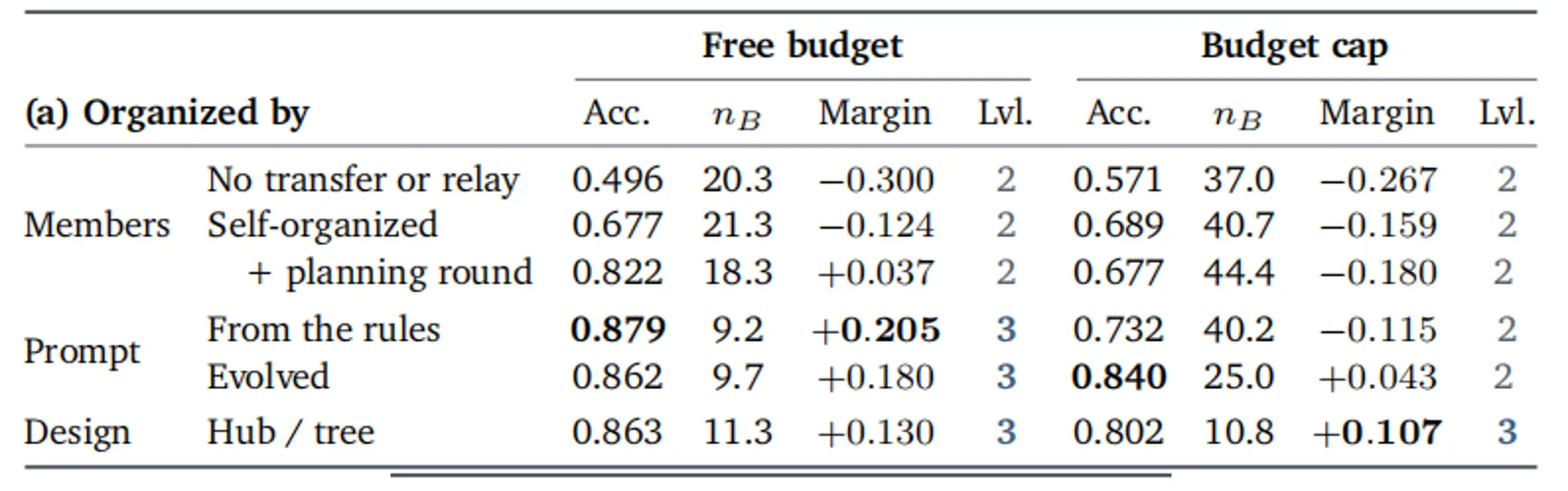
On HiddenBench with four Qwen2.5-27B agents: allowing quota transfer lifted accuracy from 49.6% to 67.7%; adding a planning phase raised it to 82.2%. When agents wrote their own prompts ( Self-prompted ), accuracy reached 87.9% (equivalent to 9.2 independent agents), achieving Level 3. Constraining quotas forced Relay structures, improving from 57.1% to 68.9%. The paper notes ~2/3 of tokens in self-organized teams are spent on coordination (quota transfers, waiting).
Recursive Training Experiments
SplitBench: Sustained Improvement Over Generations
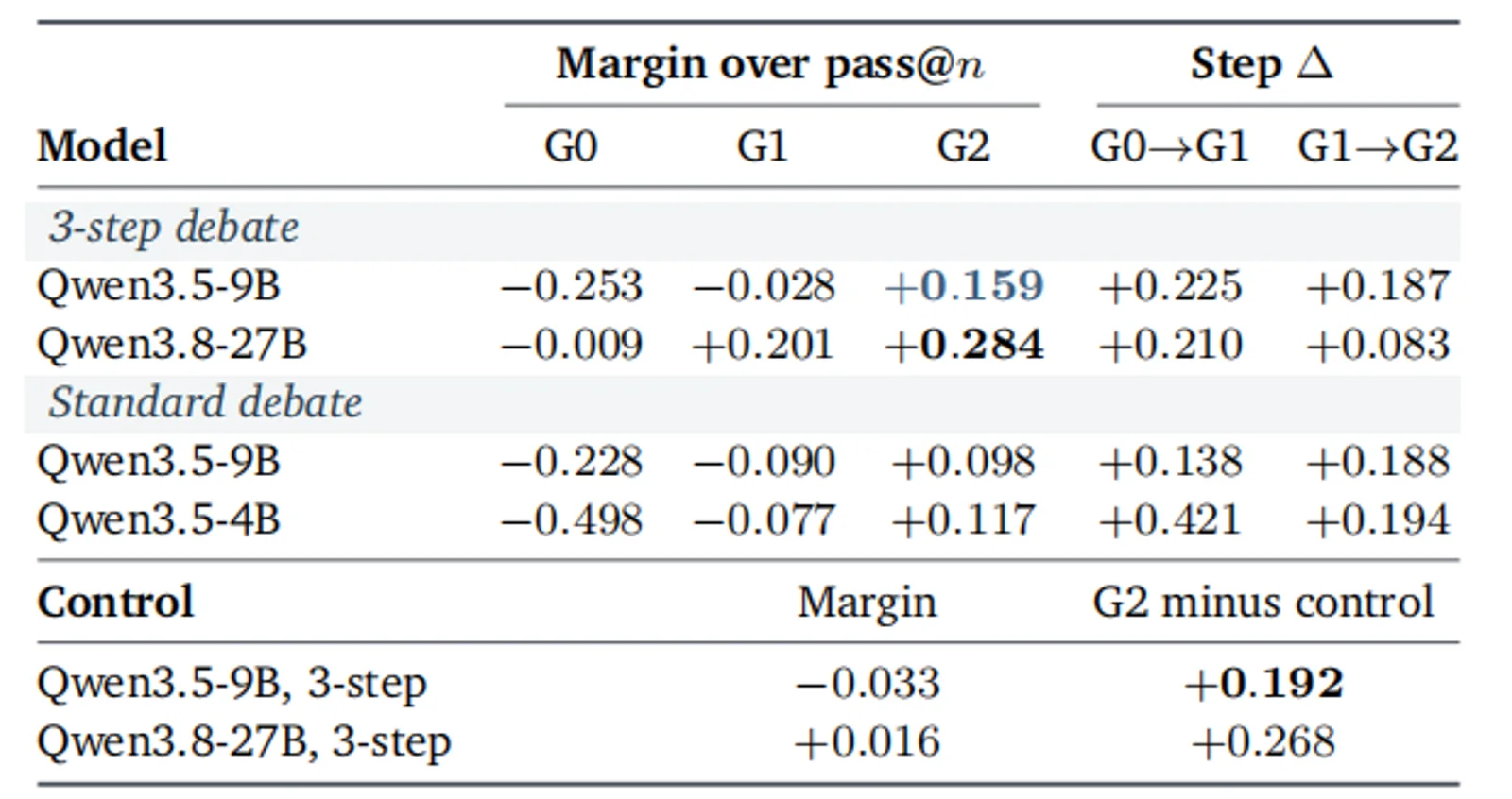
Using three-round Debate, Qwen2.5-9B teams improved their advantage over base-model pass@n from -0.253 to +0.159 after two generations; Qwen2.5-27B went from -0.009 to +0.284. A control group trained on single-agent outputs showed a 19.2 percentage-point smaller gain for Qwen2.5-9B, confirming the boost comes from collaborative data, not just self-training.
Shapley Value Credit Assignment for Opaque Tasks
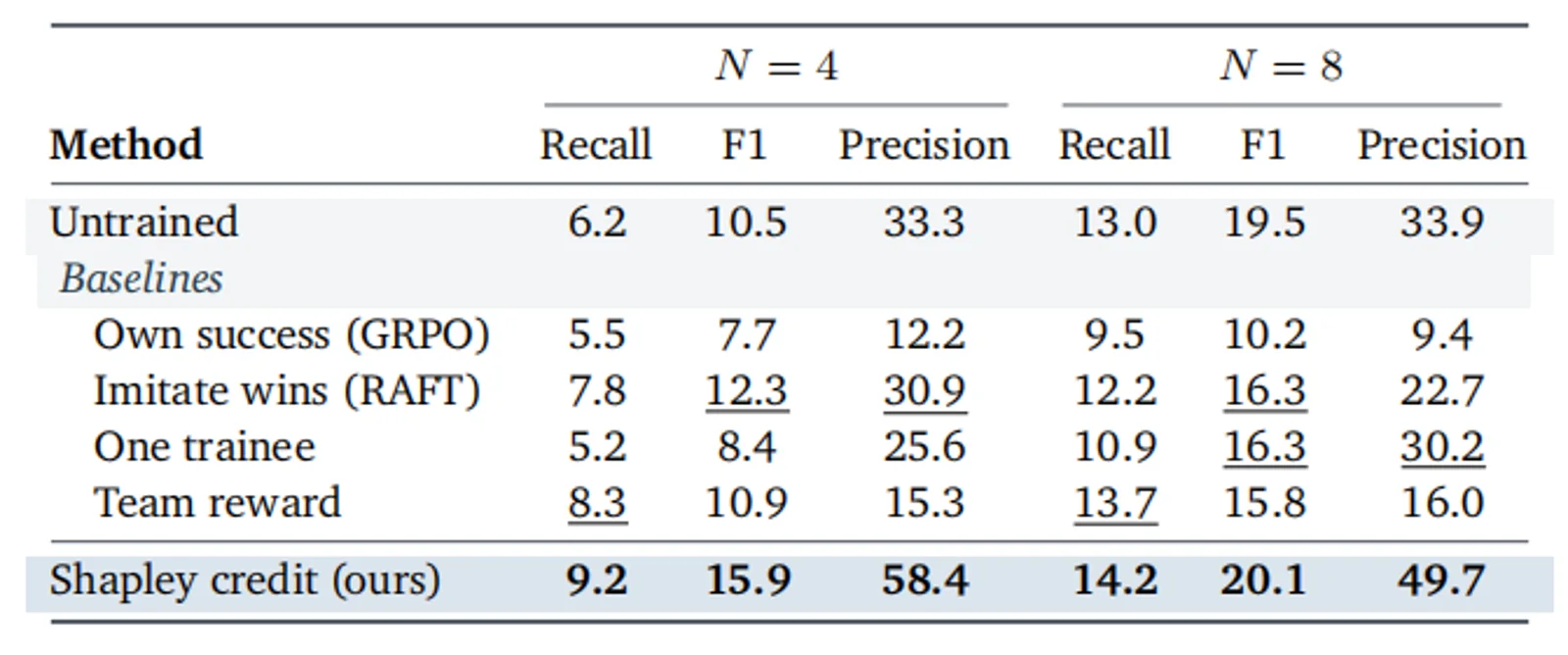
On a shared-document contradiction detection task (only final team outcome verifiable), Shapley value allocation raised precision from 33.3% to 58.4% (4 agents) and from 33.9% to 49.7% (8 agents), outperforming other credit-assignment baselines.
Multi-Benchmark Multi-Generation Runs
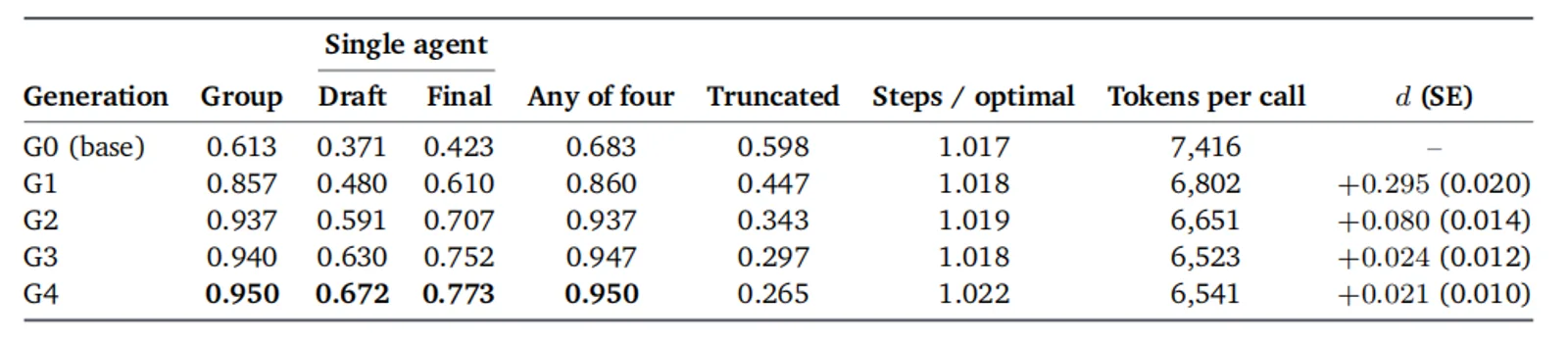
PlanBench (planning): Four Qwen2.5-9B agents, four generations — accuracy 61.3% → 95.0% .
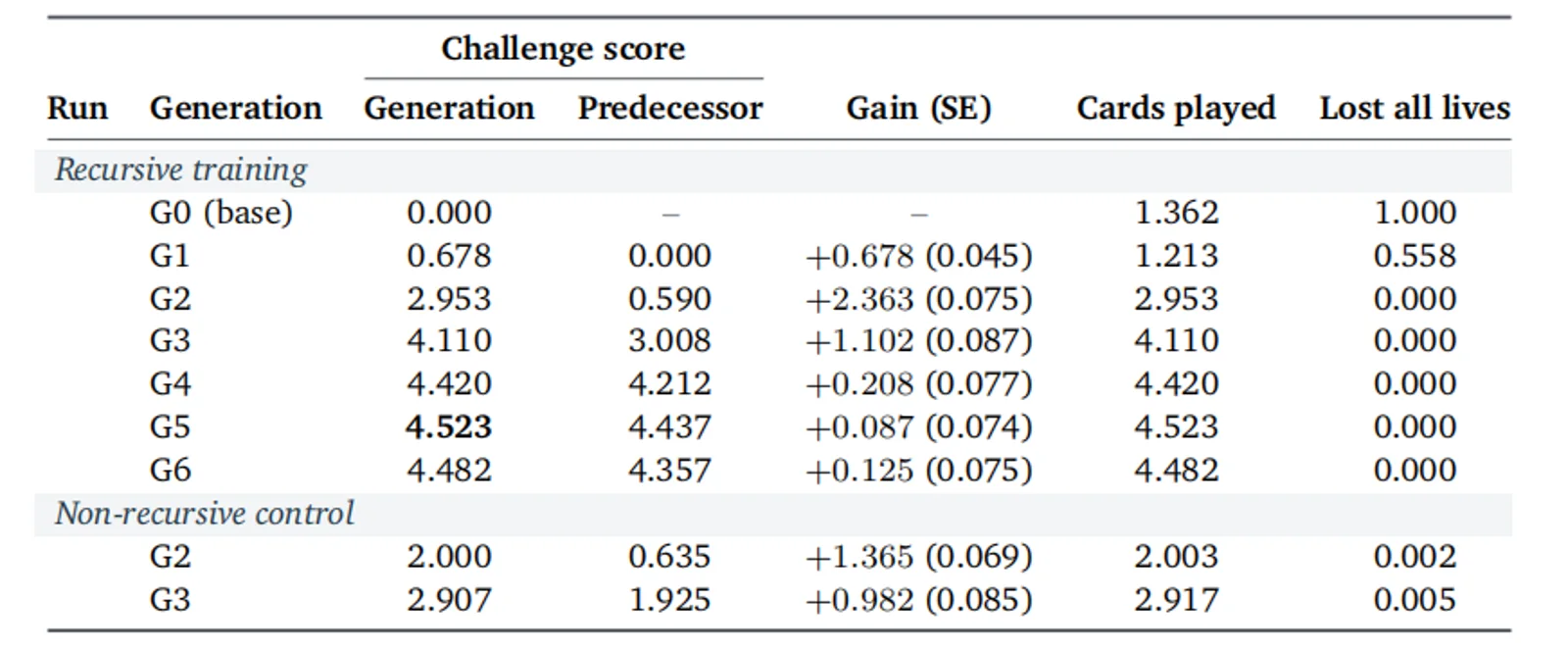
Hanabi (cooperative card game): Six generations — team score 0 → 4.523 (max 25); non-recursive control reached ~2.9 after two generations.
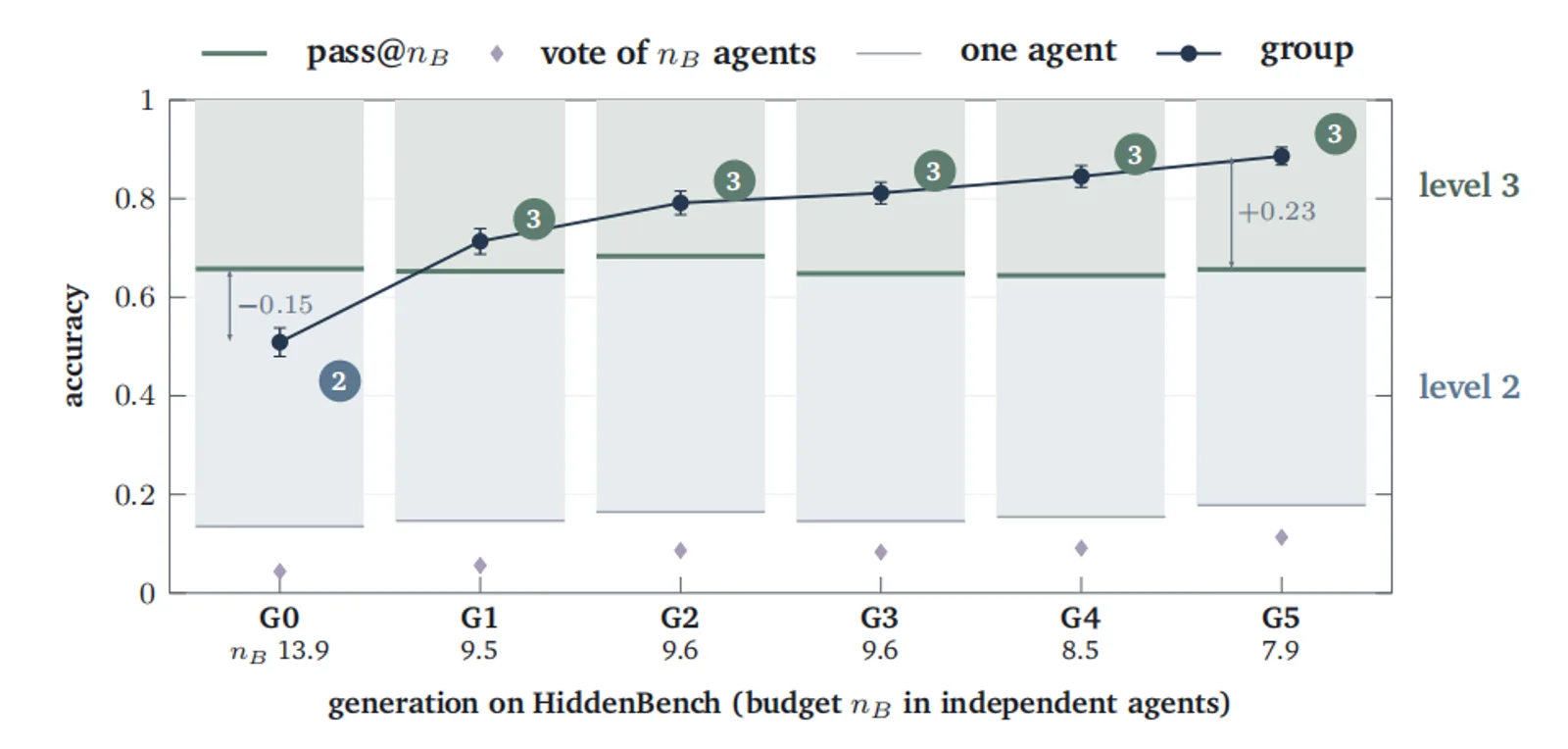
HiddenBench : Recursive teams progressed from Level 2 to Level 3; equivalent independent-agent count dropped from 13.9 to 7.9 ( 43% token-budget reduction ).
A cross-generation gating mechanism prevents regression: each iteration starts with fresh tasks, auto-verified (PlanBench via simulator, HiddenBench via consistency with three base models, Hanabi via game score). Candidate models are trained on verified outputs, ranked on a held-out selection set, then must pass a health check against the base model (token budget, format, control-task accuracy) and a paired comparison on unseen test tasks — only if improvement exceeds a threshold does the candidate become the new generation.
Conclusion
The experiments demonstrate that multi-agent teams can not only leverage interaction to exceed single-agent and voting baselines under equal token budgets, but also recursively train successive generations using their own verified collaborative data , achieving continuous improvement across diverse reasoning, planning, and coordination tasks without any external supervision.








For questions about attribution, corrections or content rights, please contactand we will review it promptly.