

RocketMQ's Real Value: Native Delayed Messages, Transactions & Built-in Retry/DLQ
This article explains why RocketMQ is chosen for its native delayed messages, transaction messages, and built-in retry/dead-letter queues rather than throughput, covering architecture, Docker deployment, Spring Boot integration, delayed message patterns for order cancellation, transaction message flow with half-messages and broker check-back, and seven common pitfalls with solutions.
Reading font
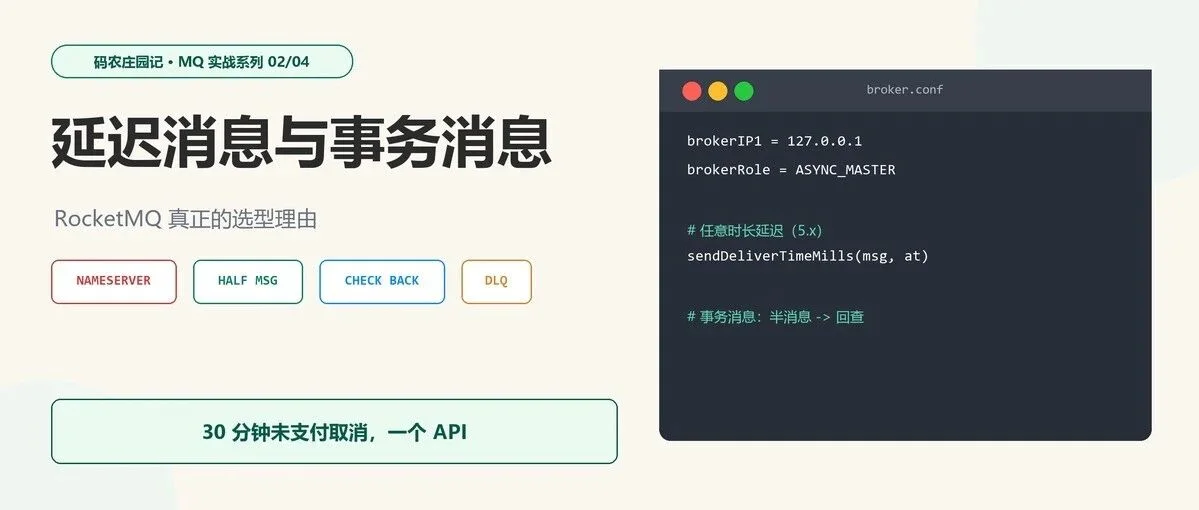
Why RocketMQ? Not for Throughput, But for Business Semantics
The article opens with a common requirement: cancel an order if not paid within 30 minutes. It compares implementations: RabbitMQ needs a TTL queue plus a dead-letter exchange and suffers from head-of-line blocking when queues grow; Kafka lacks delayed messages entirely, forcing consumers to pull messages and sleep while holding threads; RocketMQ solves it with a single API. This establishes RocketMQ's position: throughput loses to Kafka (hundreds of thousands vs millions), deployment is heavier than RabbitMQ (NameServer + Broker), but delayed messages and transaction messages are native — and these are exactly what business systems need most.
Architecture: Two Components, No Exchange
Producer → Broker (stores messages, master-slave deployment) ←→ Consumer
                 ▲
                 | reports routing info every 30s
                 NameServer (stateless registry, clusterable)
Core concepts:
NameServer : lightweight registry recording which topic resides on which broker (analogy: phone book).
Broker : actually stores and forwards messages (analogy: courier station).
Topic : logical message classification (analogy: courier category).
Tag : secondary label under a topic for consumer-side filtering (analogy: sub-category).
Consumer Group : a group of consumers sharing a topic (analogy: a team dividing work).
Two mental-model differences vs RabbitMQ:
No Exchange . Producers send directly to a topic using topic:tag syntax for simple filtering. Routing is simpler but less flexible: to route one event to five downstreams by different rules, RocketMQ needs five topics or five consumer groups, while RabbitMQ needs only one exchange. This is a limitation.
Retry and dead letter are built-in . On consumer exception, the broker auto-retries (default 16 times with increasing intervals), then moves the message to a dead-letter queue named %DLQ%consumerGroup. No manual dead-letter exchange config like RabbitMQ, no DefaultErrorHandler + dead-letter topic like Kafka. Value: less custom code, fewer production incidents.
Run a Stack with Docker Compose
Docker Compose for NameServer, Broker, and Dashboard:
services:
  namesrv:
    image: apache/rocketmq:5.3.1
    container_name: rmqnamesrv
    command: sh mqnamesrv
    ports:
      - "9876:9876"

  broker:
    image: apache/rocketmq:5.3.1
    container_name: rmqbroker
    command: sh mqbroker -n namesrv:9876 -c /home/rocketmq/conf/broker.conf
    depends_on:
      - namesrv
    ports:
      - "10911:10911"
      - "10909:10909"
    volumes:
      - ./broker.conf:/home/rocketmq/conf/broker.conf

  dashboard:
    image: apacherocketmq/rocketmq-dashboard:latest
    container_name: rmqdashboard
    depends_on:
      - namesrv
    ports:
      - "8180:8080"
    environment:
      - JAVA_OPTS=-Drocketmq.namesrv.addr=namesrv:9876
Key broker.conf settings:
brokerClusterName = DefaultCluster
brokerName = broker-a
brokerId = 0
fileReservedTime = 48
brokerRole = ASYNC_MASTER
flushDiskType = ASYNC_FLUSH
# Critical: tell clients the reachable broker address
brokerIP1 = 127.0.0.1brokerIP1is the most common local-debugging pitfall. Without it, NameServer returns the broker container's internal IP, causing client timeouts; the dashboard shows topics but sends fail. For local debugging use 127.0.0.1; for LAN use the host's real IP. After startup, visit http://localhost:8180 for topic view, message trace, and consumer lag.
Spring Boot Minimal Loop
Maven dependency:
<dependency>
  <groupId>org.apache.rocketmq</groupId>
  <artifactId>rocketmq-spring-boot-starter</artifactId>
  <version>2.3.1</version>
</dependency>
YAML config:
rocketmq:
  name-server: 127.0.0.1:9876
  producer:
    group: order-producer-group  # required
    send-message-timeout: 3000
Producer:
@Service
public class OrderProducer {
  @Autowired
  private RocketMQTemplate rocketMQTemplate;

  public void send(OrderDto order) {
    Message<OrderDto> message = MessageBuilder.withPayload(order)
      .setHeader(RocketMQHeaders.KEYS, order.getOrderNo())  // business unique key
      .build();
    SendResult result = rocketMQTemplate.syncSend("order-topic:order-create", message);
    if (result.getSendStatus() != SendStatus.SEND_OK) {
      throw new RuntimeException("Send failed: " + result.getSendStatus());
    }
  }
}
Note the "topic:tag" syntax — RocketMQ-specific, not a string concatenation error.
Consumer:
@Component
@RocketMQMessageListener(
  topic = "order-topic",
  consumerGroup = "order-consumer-group",
  selectorExpression = "order-create"  // consume only this tag
)
public class OrderCreateConsumer implements RocketMQListener<OrderDto> {
  @Override
  public void onMessage(OrderDto order) {
    // business logic
    // throwing exception = triggers broker built-in retry (default 16 times), then DLQ
  }
}
No try-catch needed to decide retry; throwing an exception triggers retry. Caveat: non-retryable errors (e.g., invalid parameters) will also be retried 16 times — handle them in code without throwing.
Delayed Messages: One API for "30 Minutes Unpaid"
RocketMQ 5.x supports arbitrary delay via timestamp (milliseconds):
// 5.x: arbitrary duration, specify delivery timestamp (ms)
long deliverAt = System.currentTimeMillis() + 30 * 60 * 1000L;
rocketMQTemplate.syncSendDeliverTimeMills("order-topic:order-timeout", message, deliverAt);

// 4.x: only 18 fixed levels (1s, 5s, 10s, 30s, 1m ... 2h), level 14 = 10 minutes
rocketMQTemplate.syncSend("order-topic:order-timeout", message, 3000, 14);
Consumer:
@RocketMQMessageListener(topic = "order-topic", consumerGroup = "timeout-group",
  selectorExpression = "order-timeout")
public class OrderTimeoutConsumer implements RocketMQListener<OrderDto> {
  @Override
  public void onMessage(OrderDto order) {
    // 30 min later: check current status, cancel only if still UNPAID
    Order db = orderMapper.selectById(order.getId());
    if (db != null && db.getStatus() == OrderStatus.UNPAID) {
      // cancel order, rollback inventory
    }
    // already paid/cancelled -> skip — natural idempotency
  }
}
The re-check is critical: the user may have paid seconds before the delayed message arrives. This re-check also serves as idempotency protection. Comparison: RabbitMQ requires TTL + dead-letter exchange and worries about head-of-line blocking; Kafka has no delayed messages at all. This section alone justifies choosing RocketMQ.
Transaction Messages: Half Message + Check-back
Solves: local transaction succeeds but message send fails, or message sent but local transaction rolls back. Both must succeed or both fail.
Flow (high-frequency interview topic):
1. Producer sends "half message" to Broker — invisible to consumers
2. Broker acks, then Producer executes local transaction (e.g., order persist)
3. Local transaction success -> commit half message (consumers see it)
   Local transaction failure -> rollback half message (discard)
4. If Producer crashes after transaction but before commit/rollback —
   Broker periodically checks back: "Did your local transaction succeed?"
Code in three steps:
// 1. Send half message (third arg passed to listener)
rocketMQTemplate.sendMessageInTransaction("pay-topic:pay-success", message, orderId);
// 2. Local transaction + check-back
@Component
@RocketMQTransactionListener
public class PayTxListener implements RocketMQLocalTransactionListener {
@Autowired
private OrderMapper orderMapper;
@Override
public RocketMQLocalTransactionState executeLocalTransaction(Message msg, Object arg) {
Long orderId = (Long) arg;
try {
orderMapper.updateStatus(orderId, OrderStatus.PAID);
return RocketMQLocalTransactionState.COMMIT;
} catch (Exception e) {
return RocketMQLocalTransactionState.ROLLBACK;
}
}
@Override
public RocketMQLocalTransactionState checkLocalTransaction(Message msg) {
// check-back: reverse-query using local transaction result
Long orderId = Long.valueOf((String) msg.getHeaders().get(RocketMQKeys.KEYS));
Order order = orderMapper.selectById(orderId);
return (order != null && order.getStatus() == OrderStatus.PAID)
? RocketMQLocalTransactionState.COMMIT
: RocketMQLocalTransactionState.ROLLBACK;
}
}Check-back logic must be able to reverse-query. If it returns UNKNOWN, the broker retries then discards the message — the most common transaction-message failure, usually because the local transaction left no traceable record (e.g., only wrote to cache).
Critical clarification: Transaction messages only guarantee atomicity between the local transaction and message send, not downstream consumption success. Downstream failures are handled by retry + dead letter; duplicates by idempotency. Assuming transaction messages solve the entire distributed transaction is a fifth anti-pattern.
Seven Pitfalls
Missing brokerIP1 : dashboard shows topics but sends time out. Fix: set brokerIP1 to host-reachable IP.
Producer group not configured : startup error producerGroup can not be empty. Fix: set rocketmq.producer.group.
Duplicate consumer group : two projects use same consumerGroup, messages stolen. Fix: unique group per business.
Transaction check-back finds nothing : returns UNKNOWN, message discarded after retries. Fix: check-back must query local table via keys.
4.x arbitrary delay : non-standard level ignored. Fix: 4.x only has 18 fixed levels; need 5.x for arbitrary delay.
Message ordering : same-order messages processed concurrently. Fix: syncSendOrderly + select queue by business key.
Duplicate consumption : payment callback processed twice. Fix: built-in retry causes duplicates; must implement idempotency.
Checklist
Architecture: NameServer (registry) + Broker (storage), no Exchange concept.
Minimal loop: syncSend("topic:tag", message) + @RocketMQMessageListener.
Delayed messages: 5.x syncSendDeliverTimeMills arbitrary duration; 4.x only 18 fixed levels.
Delayed cancellation must re-query status , never trust message content alone.
Transaction messages: half message (invisible) -> local transaction -> commit/rollback -> crash triggers broker check-back.
Retry & dead letter built-in: throw exception retries 16 times, then goes to %DLQ%group; non-retryable errors must be filtered in code.
Local debugging two must-configs: brokerIP1 and unique consumerGroup naming.
One-liner: RocketMQ sells business semantics, not performance. If your requirements don't include "delayed" and "transaction", it may not be more cost-effective than RabbitMQ.
For questions about attribution, corrections or content rights, please contactand we will review it promptly.