

SkillCycle: Co-Evolving Agent Skills via Internalization and Revision Loops
SkillCycle introduces a closed-loop framework where agents internalize external skills into parameters while continuously revising the skill library through paired validation, demonstrating improved performance on ALFWorld and WebShop benchmarks over static skill libraries and one-time refresh approaches.
Reading font
Problem: Skills Expire, Not Quantity
Existing approaches stop at two extremes: skill augmentation (retrieve skills at runtime, relying on external guidance) and skill internalization (distill skills into parameters to reduce retrieval dependency). However, as the model grows stronger, old rules may become redundant, misleading, or fail to cover new states. The real maintenance target is not the number of skills but the match between skills and current capabilities.
Core Method: Train Policy, Also Revise Teacher
SkillCycle alternates two phases each round:
Skill Internalization : Freeze skill library and router. Teacher and Student share parameters; Teacher sees skills, Student does not. The system trains the skill-less Student using token probability differences and environment rewards.
Skill Revision : Freeze policy. Use distillation gaps, routing logs, and success/failure trajectories to locate issues, then apply keep, rewrite, delete, or add operations on rules.
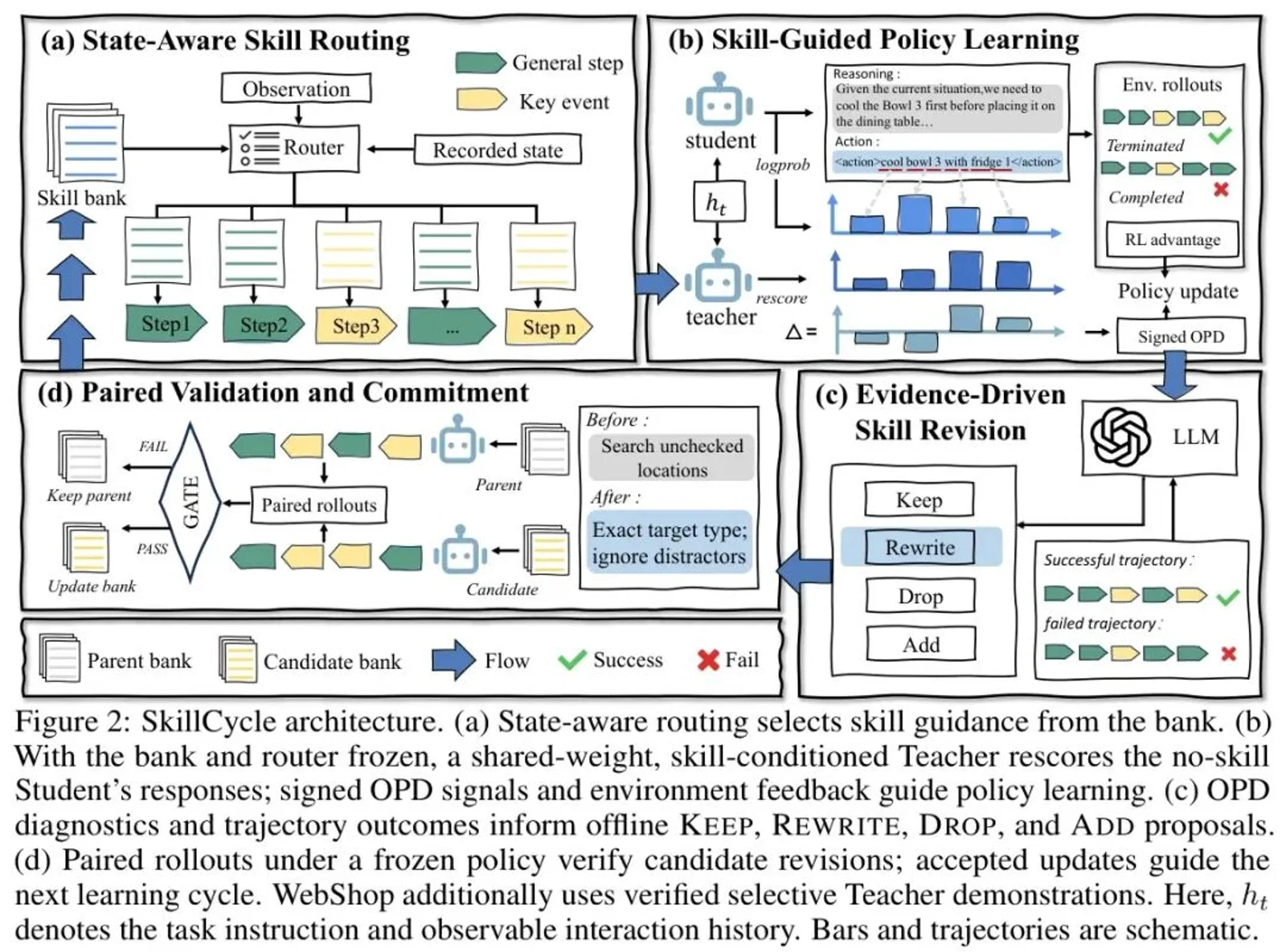
Candidate revisions must pass single-rule paired validation and full-library validation . Thus distillation feedback serves dual purpose: supervising learning and diagnosing the supervision material itself.
Case Study: Tomato Cleaning in ALFWorld
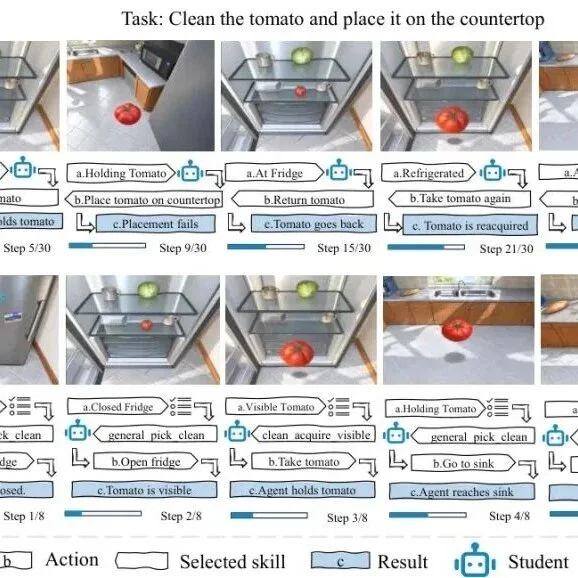
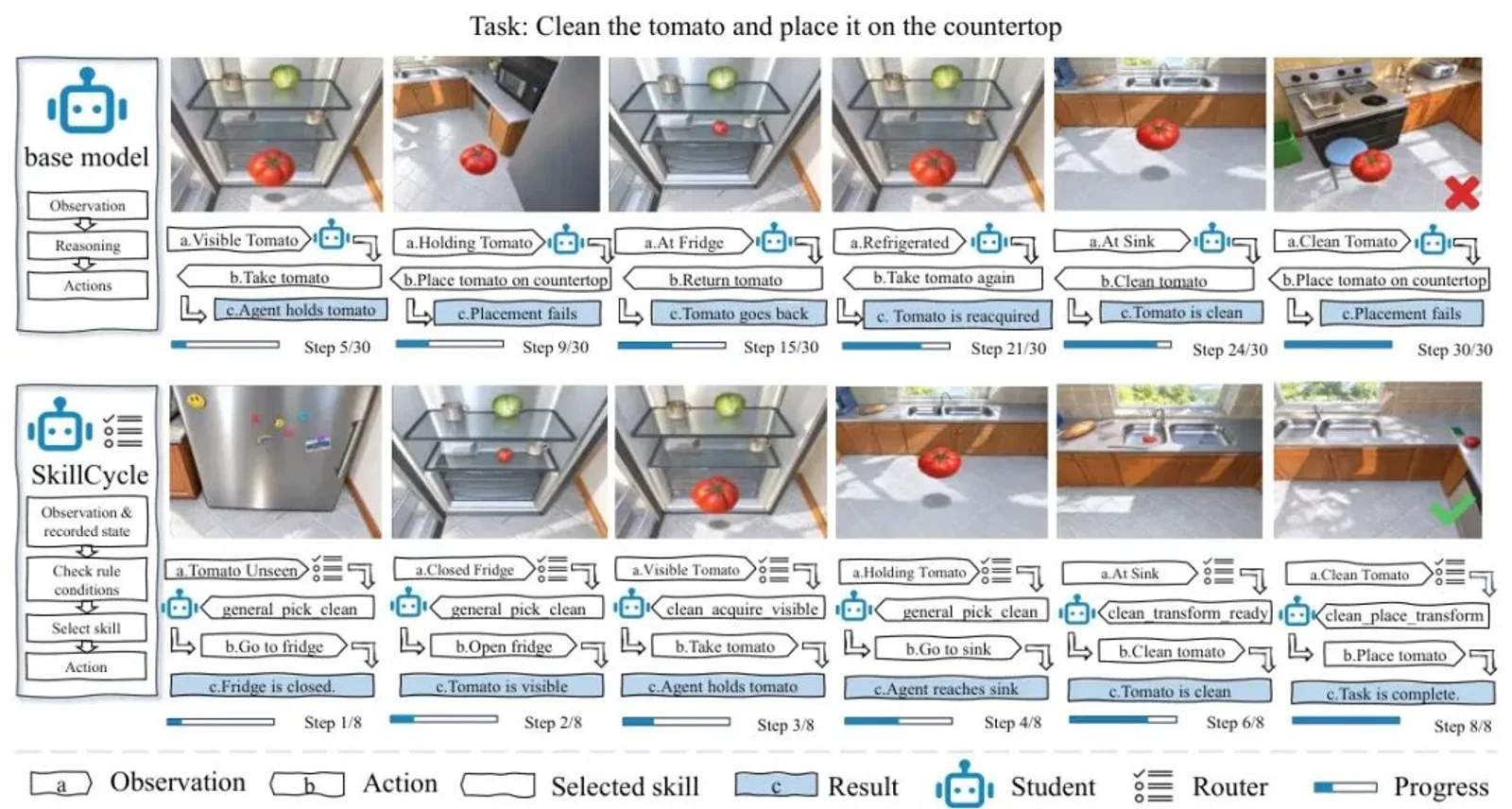
Without skills, the base model repeatedly picks up and puts down the tomato, failing after 30 steps. With SkillCycle's routed skills, the same model completes the task in 8 steps. The key is not longer prompts but state-conditioned skill switching: detect tomato, pick up tomato, complete cleaning, place tomato — each phase invokes a different rule. Note this shows execution with skills, not proof of internalization; internalization must be verified by the skill-less Student experiments.
Experimental Results: Continuous Revision Beats One-Time Refresh
On WebShop, the 3B skill-less Student achieves 74.74% success rate and 88.37 score , surpassing OPID's 74.20% and 85.00. The third-round ablation reveals:
vs. static skill library: ALFWorld and WebShop Student success rates improve by 4.95 and 11.46 percentage points .
vs. one-time refresh: further gains of 1.26 and 1.82 percentage points .
On ALFWorld, static skill library lags behind pure outcome RL (GiGPO); the revision mechanism recovers most of the gap.
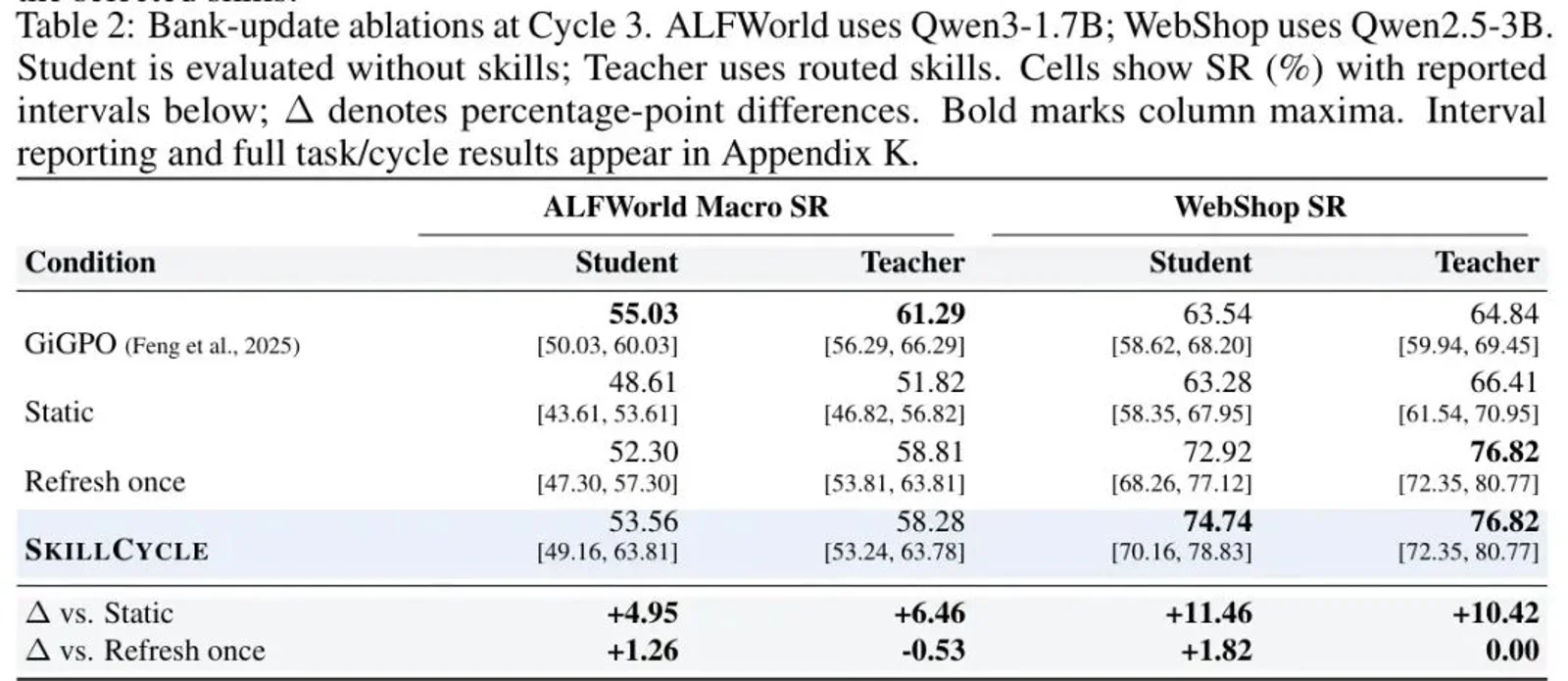
One revision yields the main gain; continuous revision adds further improvement. This supports allocating revision budget across learning stages rather than a one-time pre-training cleanup.
Key Insight: Make Rule Changes Rejectable Experiments
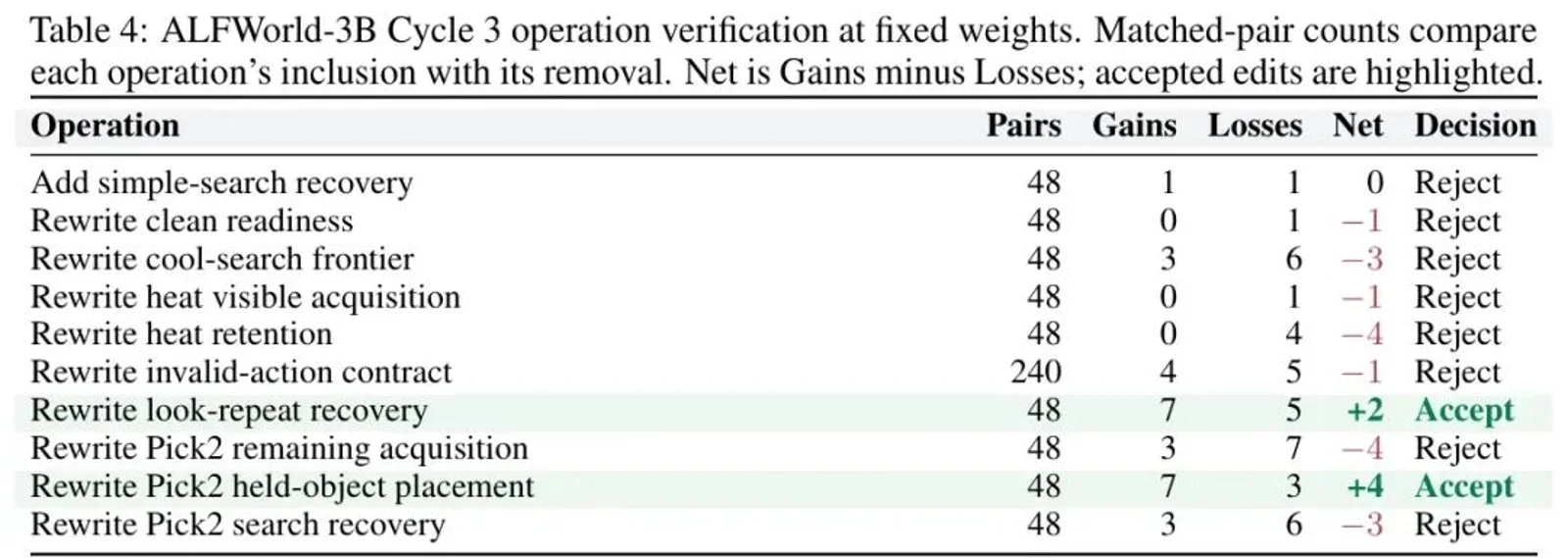
The most valuable takeaway is not automatic rule editing but turning rule modifications into rejectable experiments. In ALFWorld-3B, only 2 of 10 candidate operations were accepted; a cooling-search rewrite that produced 3 success conversions was rejected because it also caused 6 failure conversions. SkillCycle essentially transforms the skill library from a static knowledge base into a trainable, verifiable, rollback-capable memory system — closer to long-term agent capability evolution than endless prompt accumulation.
SkillCycle: Evolving Skills through Internalization
arXiv:2610.09430v1For questions about attribution, corrections or content rights, please contactand we will review it promptly.