

Software Configuration Management vs. Maintenance: Lifecycle Differences and Collaboration
This article compares software configuration management (SCM) and software maintenance, explaining that SCM spans the entire software lifecycle managing versions and changes, while maintenance begins after delivery and includes corrective, adaptive, perfective, and preventive activities, with both disciplines collaborating closely to ensure stable software delivery and operations.
Reading font
Software Configuration Management vs. Software Maintenance: Core Differences
In software engineering, software configuration management (SCM) and software maintenance are both critical for stable software operation, yet practitioners often confuse their boundaries. Simply put, software maintenance begins after delivery to the customer, while SCM starts at the development initiation phase and continues until the software is retired.
Software Configuration Management (SCM)
SCM focuses on software configuration items, which include requirements documents, design specifications, source code, test cases, installation packages, release notes, and all other artifacts. Its core goal is to control changes, ensuring every artifact is versioned, traceable, identifiable, and rollback-capable. Activities such as requirements review, code commits, branch management, version tagging, and baseline establishment all fall under SCM. During development and testing, teams use SCM tools to lock baselines, guaranteeing that testing runs against a fixed version and avoiding issues like "version chaos" or "modified code cannot be located." After release, SCM continues: patch archiving, historical version retention, and change logging persist until the software is decommissioned.
Software Maintenance
Software maintenance starts only after the software is delivered and put into use. Following classic software engineering classification, maintenance comprises four types:
Corrective maintenance – fixes defects reported by users in production.
Adaptive maintenance – adapts the software to new operating systems, hardware, or third-party interface changes.
Perfective maintenance – enhances functionality based on new user requirements.
Preventive maintenance – proactively refactors aging code to avert future failures.
The focus of maintenance is on live usage scenarios, addressing problems exposed in real business environments.
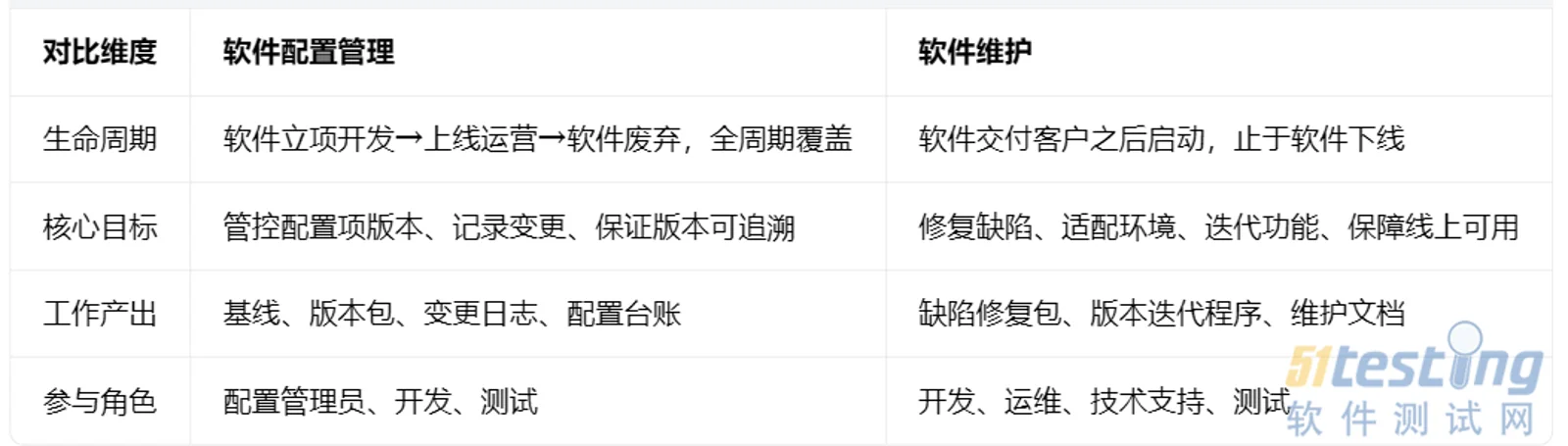
Comparison Table
The article includes a visual table comparing the two disciplines across dimensions such as lifecycle phase, core objectives, work content, and typical roles.
Collaboration Between SCM and Maintenance
The two activities are tightly coupled. Every code change and patch version produced during maintenance must enter the SCM system. When a maintainer fixes a bug, they must commit code, tag a version, and archive the new release — all SCM actions. Without SCM support, maintenance faces problems: multiple patch versions intermix, it becomes unclear which version fixed which issue, rollback becomes impossible, and production troubleshooting costs rise sharply. Conversely, SCM does not directly fix production bugs or handle customer-reported functional issues; it serves as the version-control foundation.
Practical Implications
In many small-to-medium teams, testers or developers may perform SCM duties part-time, but this should not blur the conceptual distinction. SCM leans toward "asset management and change control," providing continuous underlying assurance. Maintenance leans toward "post-delivery operational fixes and iterations," a business activity in the latter half of the lifecycle. Clarifying these boundaries helps teams establish standardized software engineering processes, reduce version-related incidents, and improve both delivery and production operations efficiency.
For questions about attribution, corrections or content rights, please contactand we will review it promptly.