

Why AI Always Picks 17: Fine-Tuning Sharpens Human Biases
Research shows instruction-tuned language models consistently pick numbers like 17 when asked for a random number between 1-30, because fine-tuning amplifies human preferences for 'random-looking' numbers into a sharp peak, unlike base models which produce near-uniform distributions.
Reading font
Two Meanings of "Random"
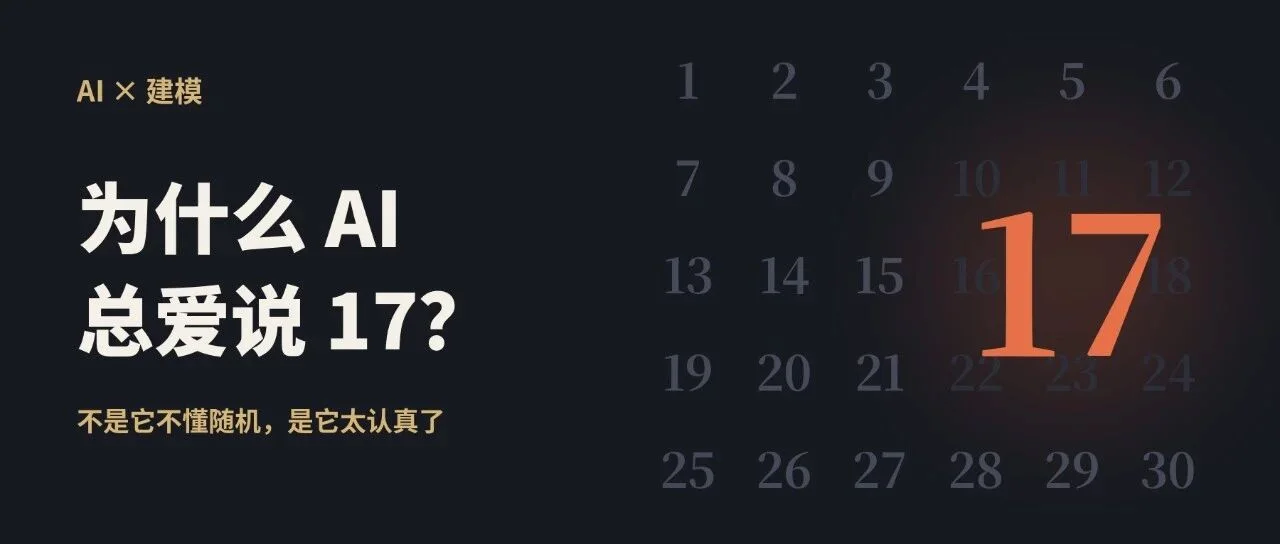
When users ask a chatbot to "say a random number between 1 and 30," the model often replies 17. This is not a fluke; a 2024 paper titled "3, 7, 14, 17, 42" (arXiv:2610.36178) tested 15 pairs of open-source models — each pair consisting of a base model (pre-trained only) and its instruction-tuned counterpart. Across 33 test conditions for the 1–30 range, the tuned version most frequently output 17 in 14 conditions. For 1–10 the peak was 7; for 1–20 it was 14; for 1–100 it was 42.
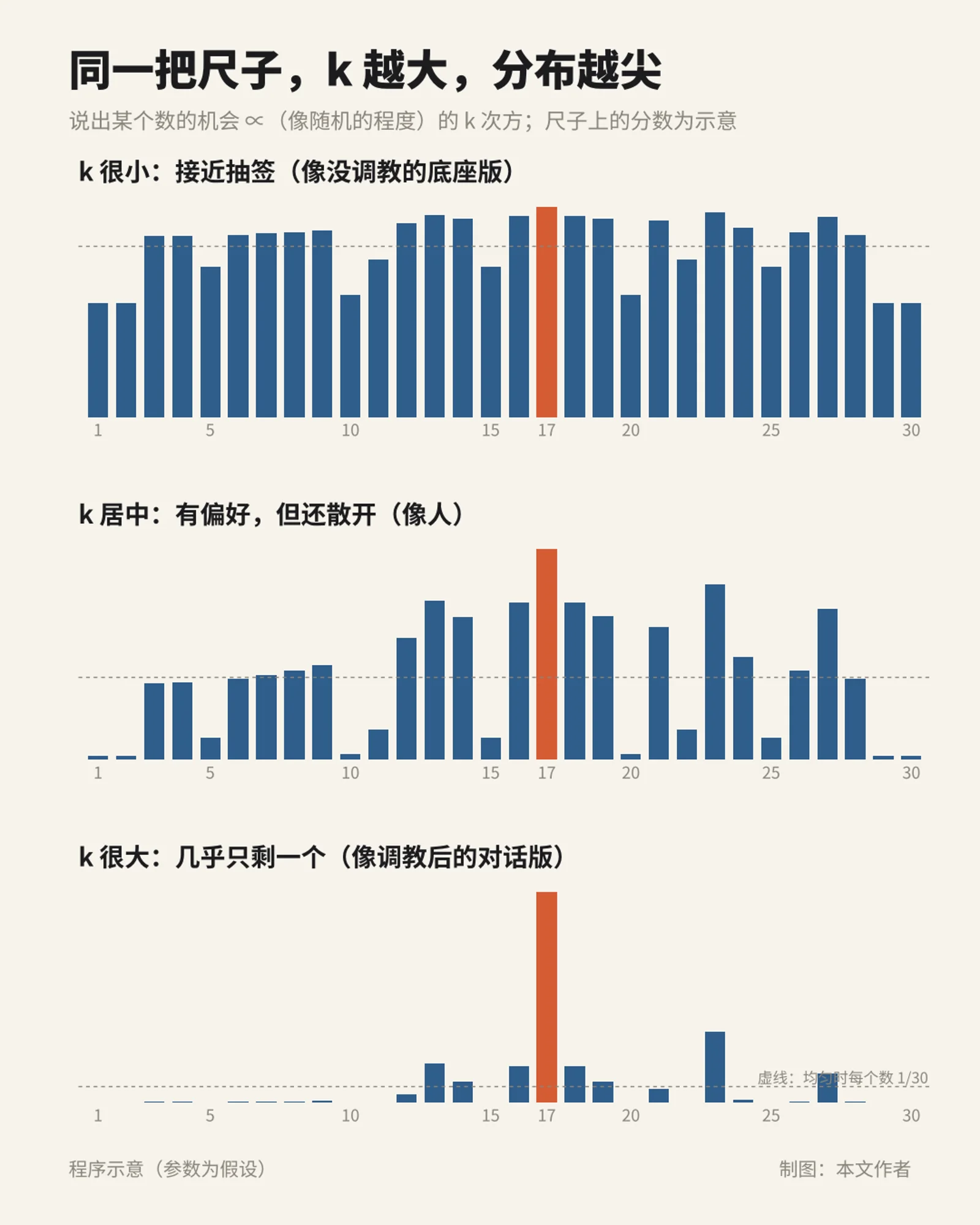
If the distribution were uniform, each number would appear about 3.3% of the time. The tuned models deviate sharply from uniformity, while base models remain close to uniform.
Human Number Preferences
This bias is not invented by AI. A 1976 study by Kubovy and Psotka (Journal of Experimental Psychology) asked 558 passersby to name the first digit 0–9 that came to mind. If choices were truly random, each digit would be chosen ~10%; instead, 7 was chosen 28% of the time. When the range was expanded to the 20s, 27 was chosen 27.7% — numbers ending in 7, not at the edges, not round, not symmetric. Mentioning "e.g., 7" in the prompt reduced 7's selection to ~17%, showing people avoid numbers that feel "too obvious."
Humans already pick "numbers that look random," but individual differences keep the overall distribution spread out.
Changes After Fine-Tuning
The paper's key finding: base models choose numbers nearly uniformly — some distributions are statistically indistinguishable from dice rolls. They simply mirror the diverse numbers present in their training corpus.
After instruction tuning, the same models become highly biased: they almost never pick endpoints (1, 30) or round numbers (10, 20), which drop to roughly one-tenth of their uniform share. In one extreme case, a model assigned 100% probability to 17 under a specific prompt.
Intuitively, a more capable model should be better at randomness; empirically, the better it is at following instructions, the worse it is at drawing lots.
How the Distribution Gets Sharpened
The process can be summarized by a simple formula: P(number) ∝ (how random this number looks)^k The term in parentheses represents the human "ruler": numbers like 17 or 23 score high; 1, 30, 20 score low. The exponent k controls how "seriously" the model takes this ruler.
This formula reveals two properties: (1) k does not change the ranking, only the gaps. (2) Small k → probabilities are similar → near-uniform sampling. Large k → top-ranked number dominates → distribution collapses to a needle.
Instruction tuning effectively increases k. For tasks with a correct answer this is desirable; for "pick a random number" it is pathological because there should be no single correct answer. The weak human preference is amplified into a near-deterministic choice.
Different models converge on slightly different peaks (17 is most common but not universal), consistent with each model having a slightly different internal ruler; once k is large, whichever number tops that model's ruler captures the entire probability mass.
Another Application: "AI Flavor"
The same mechanism explains the "AI flavor" in generated text. When asked to write copy or headlines, models produce the "most plausible good version" — safe, competent, but nearly identical across runs. This is again k turned up: the safest style monopolizes the output.
To get diversity, don't repeatedly ask "give me another." Instead, ask the model to list 20 candidates at once, then select programmatically. The former samples repeatedly from a needle; the latter spreads the distribution.
Limitations of This Explanation
Two caveats: (1) The paper only tested open-source models ≤8B parameters; proprietary chatbots (e.g., GPT-4, Claude) were not included, though they exhibit the same 17 phenomenon. (2) The "human-likeness" ruler and exponent k are a simplified conceptual model introduced by the author, not a formal component of the paper. The paper reports the phenomena — strengthened avoidance of endpoints, new avoidance of round numbers — and the ruler+k formulation is a pedagogical abstraction.
When You Really Need a Random Number
If you need a random number for lotteries, grouping, or scheduling, do not ask the model to speak one. Have it write a line of code that calls a proper random function. Spoken numbers are answers; computed numbers are draws. AI excels at the former, which is exactly why it fails at the latter.
References
[1] 3, 7, 14, 17, 42: Instruction Tuning Installs and Sharpens Number-Choice Heuristics in Language Models. arXiv:2610.36178, 2026.
[2] Kubovy M, Psotka J. The predominance of seven and the apparent spontaneity of numerical choices. Journal of Experimental Psychology: Human Perception and Performance, 1976, 2(2): 291–294.
For questions about attribution, corrections or content rights, please contactand we will review it promptly.