

Why You Focus at Work But Procrastinate Learning: Hack Your Brain's Feedback Loops
This article explains why professionals focus intensely at work but procrastinate on self-study, revealing how the brain calculates motivation using four missing scaffolds — immediate consequences, clear task boundaries, external accountability, and dense feedback — and provides a four-step engineering approach to build a self-sustaining learning loop with micro-tasks, instant verification, commitment devices, and flow-triggering progress.
Reading font

One: The Brain Isn't Lazy — It Calculates Using Four System Parameters
Putting "company work" and "self-directed learning" under the same analytical lens reveals that the difference lies not in task difficulty but in the surrounding constraint structures and feedback loops.
1. Delayed Punishment: Long-Term Rewards Lose to the Immediate Denominator
Behavioral scholar Piers Steel's 2007 Temporal Motivation Theory breaks immediate willingness to act into a ratio of four variables:
Motivation = (Expectancy × Value) / (1 + Impulsiveness × Delay)
The numerator represents "I think I can do it" and "this task is worth doing"; the denominator is "personal distractibility" multiplied by "how long until reward or consequence." Many wonder: learning a hard technology or mastering professional English has far higher long-term value than fixing a peripheral module at work, so why zero drive?
The answer sits entirely in the denominator's delay . At work, the deployment deadline is this Friday 5 PM; the punishment for non-delivery is imminent, delay approaches zero, denominator shrinks to near 1, and motivation maxes out. Self-study rewards hang on a job switch six months later or a capability leap a year out — delay measured in weeks and months — so even huge future value divided by a massive denominator yields negligible immediate drive.
2. Task Boundaries: Work Is Direct Problem-Solving; Self-Study Requires Writing the Exam First
When assigned a task at work, upstream cognitive cost is largely digested by process: what the goal is, which environment to use, what counts as done, when to hand over — tickets and meetings have already laid the track. Your brain only needs to enter "execution mode" and follow prescribed steps.
Self-study often leaves only a highly abstract slogan — "learn system architecture," "improve English listening," "study open-source code." Each sit-down forces the brain to simultaneously play product manager (pick materials), architect (break steps), foreman (decide today's quota), and acceptance officer (define mastery). The vaguer the task boundaries, the more cognitive resources the prefrontal cortex burns on decisions before learning even starts , often exhausting half your energy just debating "which chapter first."
3. Enforcement Cost: The Company Shows No Mercy; You Keep Issuing Yourself Pardons
Psychologists Dan Ariely and Klaus Wertenbroch's 2002 deadline experiment compared two student groups: one with externally set evenly spaced hard deadlines, another with self-set deadlines, against a no-intermediate-deadline control. Results showed that while self-set deadlines outperformed no deadlines, self-set deadlines still consistently lost to externally imposed evenly spaced hard deadlines in overall grades and procrastination control.
Reason: when you are both defendant and judge, postponing an hour tomorrow or skipping a week's notes carries near-zero breach cost, so the brain instinctively stamps a "not this time" pardon.
A deeper biological mechanism comes from fMRI studies by Hal Hershfield et al.: when thinking about "current self," the medial prefrontal cortex (mPFC) — responsible for self-referential processing — lights up; when thinking about "self ten years later," the activation pattern closely resembles thinking about a stranger . Neurally, the brain easily treats the future self as another unfamiliar person. Offloading tonight's study pain to "tomorrow's self" or "six-months-later self" triggers almost no present empathy; at work, today's missed delivery means today's you gets blamed, owns the fallout, loses performance pay — zero transfer space.
4. Feedback Density: Long-Term Goals Plant Flags; Instant Feedback Decides Whether You Stay
Why do many learning plans start fired up but quietly die by day four? University of Chicago scholars Kaitlin Woolley and Ayelet Fishbach's 2017 five-study series gave the key clue: people choose to start a long-term goal based on delayed rewards ; but what actually determines whether someone stays in a single session and persists long-term is almost entirely whether the process contains immediate rewards .
At work, high-frequency feedback hits the brain every few minutes: unit tests pass, integration APIs connect, colleague confirms, Kanban card moves to Done. Each micro-signal tells the brain "investment effective, one step closer." Contrast solo reading or video courses: after an hour of grinding, you close the book unable to articulate what real capability you gained — the brain only senses cost, hears no echo, and quickly judges "this trade isn't worth it."
Observe the side-by-side alignment in the figure below: the left blue channel shows how the work environment uses near-term deadlines, clear acceptance, external hard constraints, and high-frequency feedback to "scaffold" focus; the right coral channel shows self-study simultaneously losing weight on all four dimensions.
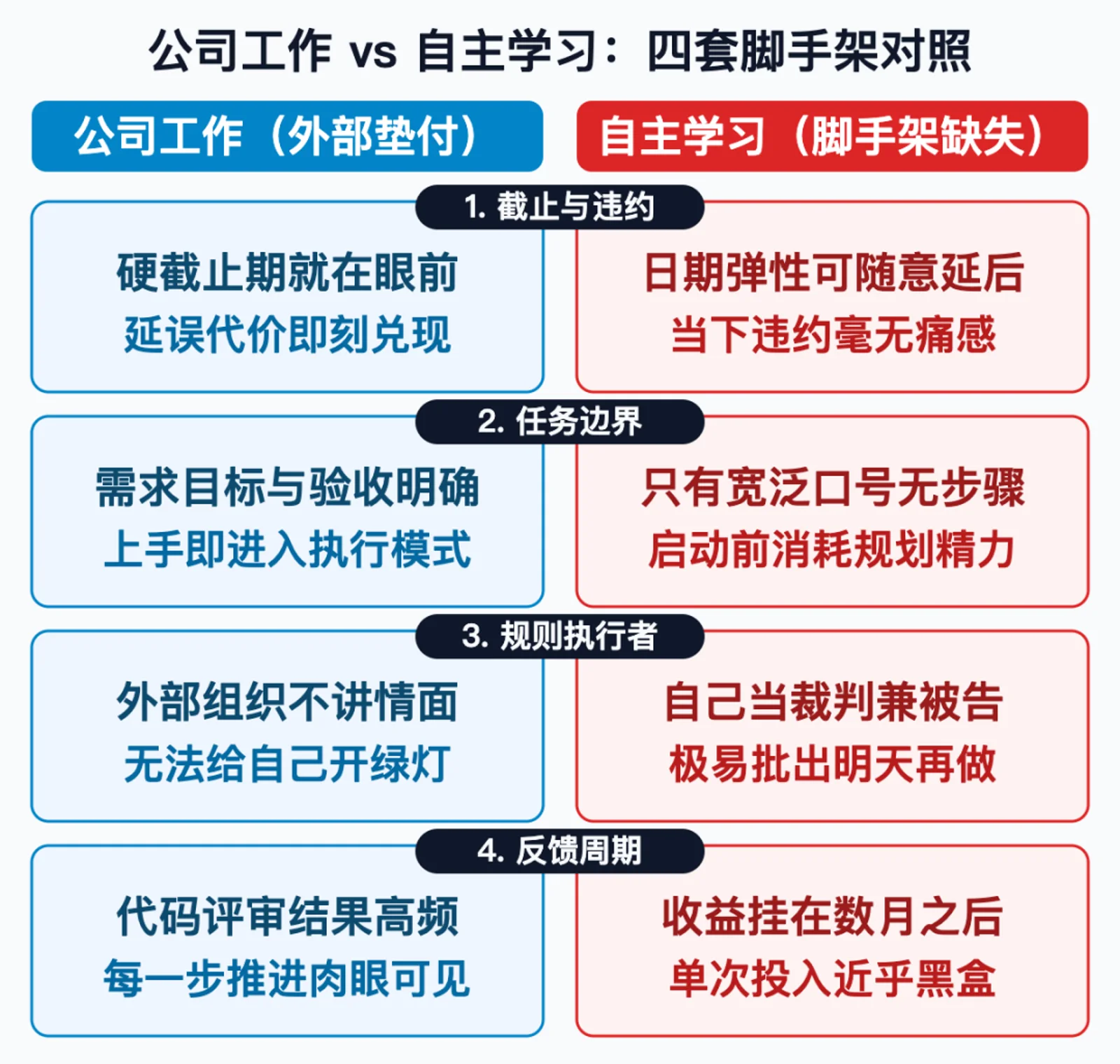
Figure 1: Self-study procrastination is not weak willpower but simultaneous loss of four external execution scaffolds across four dimensions
Two: Why the Harder You Try to Muscle Through With Willpower, the Deeper You Fall Into Avoidance
After seeing the four missing scaffolds, a more painful phenomenon needs explaining: knowing learning is good for you, why does sitting at the desk doing nothing make you increasingly agitated, finally caving to short videos?
Carleton University's Timothy Pychyl and Sheffield University's Fuschia Sirois's 2013 review highlighted a counter-intuitive fact: procrastination is fundamentally not a time-management failure but a self-regulation strategy that prioritizes "short-term mood repair" over "long-term goal pursuit."
From the emotion-alert and execution-control perspective, when a learning task simultaneously features "unclear boundaries, non-trivial difficulty, half-day with zero feedback," the brain's threat-detection hub, the amygdala , tags the ensuing boredom, confusion, and self-doubt as genuine discomfort threats. The prefrontal cortex — responsible for long-range planning — knows "skip today, regret later," but once emotional discomfort spikes, escaping to scroll feeds, tidy the desk, or endlessly pick study tools brings instant relief. This immediate emotional painkiller rapidly reinforces the avoidance loop, eventually forming a conditioned reflex: approach desk → want to flee → flee → guilt → guilt raises psychological resistance for next return.
Understanding this mechanism clarifies why "company pressure" uniquely works: when an external deadline looms and concrete consequences of non-delivery become vivid, the crisis from "not working" instantly outweighs the drudgery of "working," forcing the brain to shut out distractions and sprint.
But there is an important cost and counter-example : focus bought by crisis and external pressure, while pushing tasks over the line short-term, carries high energy drain and cognitive narrowing. Long-term reliance on "being chased" leaves you limp the moment external urgency vanishes, and under high-pressure threat it's hard to do deep understanding, transfer, or creative learning that requires relaxed exploration.
Contrast the state-transition paths in the next figure: the left red dashed loop shows "vague task → discomfort avoidance → painkiller guilt" self-lock; the right blue-green solid loop illustrates the breakout point lies not in hiring a scarier mental boss but in switching the engine to "clear micro-action → same-day verifiable feedback → competence reinforcement" positive loop.
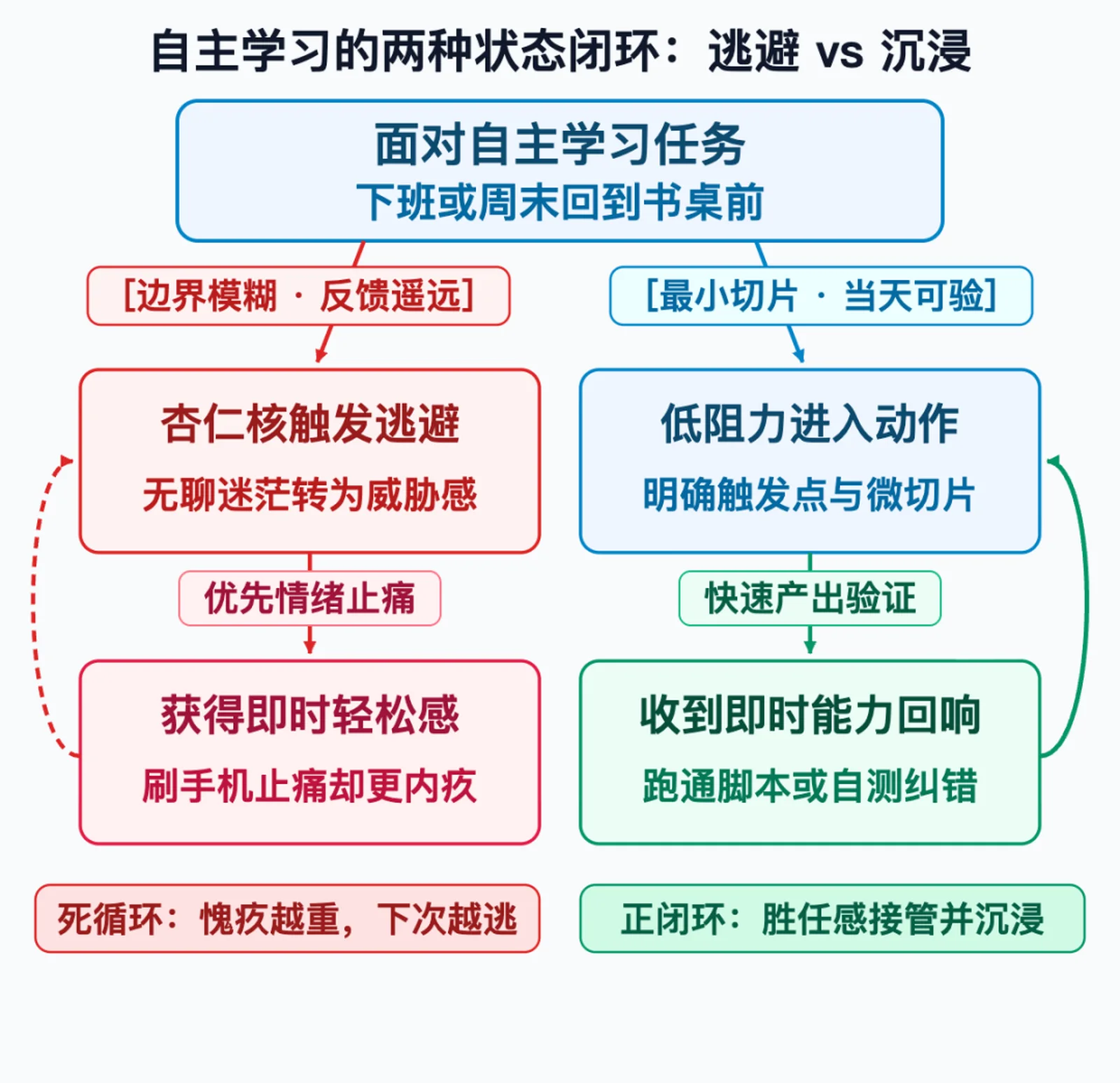
Figure 2: Breaking the emotional painkiller death spiral with 'minimum slice + same-day verifiable feedback' to switch into a competence immersion loop
Three: From External Management to Self-Control — Rebuilding the Four-Step Self-Study Loop
Since neither phantom willpower nor perpetual external whipping works, the viable path borrows the company's scaffolding engineering mindset: first use lightweight external structure to cross the cold start, then gradually switch the drive fuel to intrinsic competence and flow experience. The transformation progresses in four steps.
Step 1: Demote "Learning Plan" Into "Single-Session Verifiable Slice + Trigger Condition"
Many self-study efforts die in the first minute because the plan reads like an annual vision, not a ticket you can pick up today. To lower startup friction, you must completely separate "planning" from "execution": spend ten minutes daytime or weekend slicing the next few days' minimum pieces, then during the learning block just execute mindlessly.
Psychology's heavily validated Implementation Intentions (If-Then plans) are the tool for this step. Peter Gollwitzer and Paschal Sheeran's 2006 meta-analysis of 94 independent tests showed that pre-specifying "in what situational cue, do what concrete action" yields a medium-to-large overall effect size on goal attainment (d = 0.65), with similarly robust effect on the specific "starting action" hurdle (d = 0.61).
In practice, every nightly or morning learning task must satisfy two hard conditions:
Explicit situational trigger : bind concrete time and physical anchor, e.g., "Weekday 7:30 AM after coffee, sit at desk and open designated repo," not "tonight find time to study an hour."
25-to-45-minute binary acceptance artifact : replace time metrics with verifiable outcomes. Don't write "watch two course modules"; write "close tutorial, from scratch write a minimal retry script that runs and passes 3 edge cases." Don't write "memorize English words"; write "using the 5 newly learned sentence patterns, deliver a 90-second technical incident explanation off-script into recorder, playback and correct."
When slices are small enough and acceptance criteria are strictly "pass/fail," the prefrontal cortex no longer hesitates at the door "where to start," and startup friction drops noticeably.
Step 2: Rewrite "Delayed Payoff" Into "Same-Day Visible Instant Feedback"
Slices alone aren't enough; if slice internals remain one-way input (only watch videos, only read articles, only highlight), the brain still gets zero positive echo after 30 minutes, and within days the "emotional painkiller avoidance" retriggers. Per Woolley and Fishbach, immediate reward must be embedded directly into the learning process.
The most direct tactic: flip the default habit from input-first to output-and-verification-first :
Micro self-test before learning : before reading technical docs or a course, spend 5 minutes listing three questions you want answered based on current knowledge, or attempt to hand-write the relevant config. Reading with explicit gaps means every resolved sticking point gives the brain an instant "problem unlocked" micro-reward.
Let code, tests, or AI act as instant adversarial reviewer : for engineering skills, learn in environments that give immediate right/wrong feedback — write a segment, run a test; change a line, watch log changes. For concepts or foreign-language expression, immediately after learning close materials and write a 200-word mechanism breakdown, or orally explain to AI asking it to specifically flag logical holes and unnatural phrasing.
When you close the laptop each session holding a genuinely running script, a corrected recording, or a sketched causal chain you truly grasped, the brain's signal shifts from "suffered half an hour" to "today I actually captured this small piece of ground."
Step 3: Cold-Start Phase Uses Lightweight "Commitment Devices" as Proxy External Enforcement, Spaced at Even Intervals
For those habituated to "no mercy, then effort" at work, the first two to three weeks most easily stall at "nobody's watching, I'm tired, skip today." Before habits automate, deliberately borrowing behavioral economics' Commitment Devices as transitional scaffolding often beats empty self-discipline.
Economists Gharad Bryan, Dean Karlan, and Scott Nelson's 2010 review categorizes commitment devices into two types:
Hard commitments : use real costs to constrain future self from reneging. Examples: pre-purchase a certification exam slot two to three months out at a fixed venue; book non-refundable offline one-on-one practice sessions; during study blocks use tools to lock entertainment sites on computer and phone.
Soft commitments : leverage social visibility and reputation to raise psychological breach cost. Core is not a hollow "I'll check in 100 days" on social media, but finding one or two peers on the same wavelength, agreeing on a fixed weekly day to exchange each other's week's small tool, source-code notes, or practice recordings, with the partner actually reading and giving one concrete feedback.
Crucially, apply Ariely and Wertenbroch's other experimental conclusion: don't set only a single three-month macro deadline; break the big goal into evenly spaced weekly nodes . A distant macro deadline invites the same last-two-weeks panic; a weekly lightweight delivery is like planting a milestone every stretch on flat ground, keeping "breach pain" in a mild but tangibly real zone.
Must emphasize: commitment devices are "training wheels for learning to drive" — purpose is to stabilize launch rhythm and bank first visible wins in the initial weeks, not to wear electronic handcuffs for life.
Step 4: Complete the Fuel Switch — Let "Visible Competence" Take Over From "External Pressure"
This is the most critical step: if you forever rely on fines, exams, and others pushing, you've just replicated another "mental company" in your spare time; once constraints lift, enthusiasm zeros out again. The state that needs no external management yet stays immersed is called Flow in psychology, dependent on three conditions: clear goals, immediate feedback, and difficulty precisely matched slightly above current level .
After your learning loop runs roughly two to three weeks, consciously watch for a switch signal: if on a weekend you planned a 30-minute slice, but after cracking a key sticking point you curiously add an extra hour exploring "what if boundary conditions change," even starting to ponder next steps without reminders — fuel has begun shifting from "fear-of-breach external pressure" to "I can control this and I'm getting stronger" intrinsic competence.
At that point you can gradually retire overly rigid external penalties, keeping only "clear micro-slices + same-day verifiable output + fixed rhythm nodes" — three low-cost structures. Conversely, if after three weeks every sit-down still feels strong resistance, only moving when external deadline looms, don't rush to self-doubt; immediately diagnose two points: either the single slice is too large/hard triggering frustration defense, or the learning format remains passive listening lacking real output and feedback stimulation.
The transformation comparison table below aligns the four dimensions: middle column gives directly actionable moves; right column flags the most common failure pits that cause mid-way flameout, for pre-launch checklist.

Table 1: Self-study four-scaffold transformation plan and common failure pits
Four: Four Reality Boundaries — When This Method Fails
Any behavioral engineering method has applicability boundaries; selling it as a panacea only invites a new round of self-blame. Before deploying this loop, four real constraints must be faced:
When physiological energy is utterly depleted, structural redesign cannot push : if daytime work involved continuous high-intensity firefighting, long contentious meetings, or deep coding, after 9 PM the prefrontal cortex is in clear fatigue. Forcing high-difficulty hard knowledge in low-battery state almost inevitably binds learning with pain. More pragmatic fix: move high-difficulty self-study slices to the morning 35 minutes before work when energy is most intact , or keep weeknights for ultra-low-friction review and slicing, reserving chunky hard attacks for weekend mornings.
"Pseudo learning needs" driven by false anxiety withstand no feedback : some plans refuse to stick no matter how you slice, not because method is wrong but because the goal stems from external anxiety not your genuine use-case — e.g., seeing others discuss a hot framework, buying a course you'll never use in six months. Without real problem traction, the brain quickly detects the lack of actual value. Instead of forcing persistence, ask: if three months post-completion there's zero place to apply it, should this plan be cut outright?
Treating "metrics and check-ins" as the end itself : once you obsess over consecutive check-in days, cumulative study hours, or note word-counts, instant feedback degrades into self-soothing performance. Real feedback must bind to "I solved a problem I couldn't before" or "I built a runnable thing," not the numbers themselves.
Opening three-plus fronts simultaneously causing scaffold overload : maintaining one clear slice-and-verification loop itself consumes attention. If you parallel-run English, algorithms, open-source project, and certification, energy fragments and collapses. Cold-start phase locks only one main line ; after two consecutive weeks of smooth muscle memory, decide whether to add a second line.
Returning to the opening puzzle: being able to focus deeply at work thanks to pressure and deadlines doesn't prove you're a "won't move without a whip" person; it proves your brain operates very honestly — as long as task boundaries are clear, time discounting stays in controllable range, and every step yields real echo, you inherently possess strong focus and delivery capability.
What truly needs changing isn't moralizing your brain, but stopping the naked run in a vacuum of no boundaries, no feedback, zero cost. First use minimal slices, same-day verifiable output, and gentle transitional constraints to build self-study into something "the brain understands and can touch progress"; once competence feeling sustainably returns, external urging naturally becomes irrelevant.
For questions about attribution, corrections or content rights, please contactand we will review it promptly.