

Zhipu's GLM-5.5 Targets 100% Recursive Self-Improvement with 100T Token Dataset
The article analyzes Zhipu's GLM-5.5 development clues, revealing a research goal of 100% recursive self-improvement (RSI) and a 100 trillion token data target, while detailing post-training merging, Coding Sandbox environments, HarnessPro runtime optimization, scaled correctness checks, and the need for independent evaluation infrastructure.
Reading font
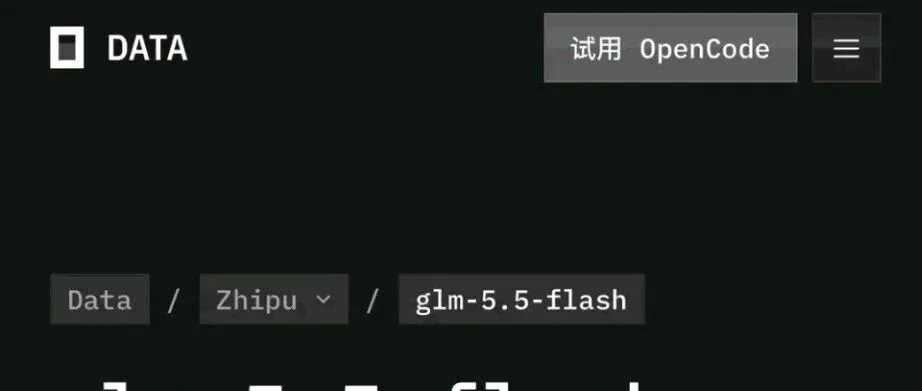
Multiple Models Post-Trained Then Merged into Next-Generation Base
Previous large model upgrades were often described as "swapping in a larger base model." Leaked R&D records show Zhipu places greater emphasis on post-training multiple internal models separately, then consolidating their experience and capabilities into the next-generation base model.
The post-training phase can establish environments for different tasks: coding, financial analysis, tool use, long-horizon planning, and error recovery. Trajectories, failure records, and repair results produced in these environments can further optimize training data and reward strategies.
This approach offers clearer task objectives, but evaluation difficulty increases. Metrics across environments may conflict: a model more aggressive at code repair might take more risks on safety boundaries; a model that saves tokens might stop prematurely in complex reasoning. Therefore, before merging post-trained models, per-capability and safety metrics must be retained — a single aggregate score cannot decide promotion.
Coding Sandbox Enables Learning in Real Tasks
The appearance of a Coding Sandbox in GLM-5.5 R&D records indicates training environments are approaching real software engineering: the model must read code, run commands, modify files, execute tests, and handle errors — not just generate code from a static snippet.
Moving from code generation to long-horizon tasks requires recording at least four data categories:
Task goals and repository state;
Every tool call and its return result;
Code diffs before and after modifications and test results;
Failure causes, retry counts, and final delivery status.
These records serve both training and evaluation. Without failure trajectories, the model only sees successful samples; without versioning and tests, training data cannot prove which modification was effective.
The quantitative finance environment provides another task shape: data time-series, constraints, backtest results, and risk metrics must all enter the feedback loop. A strategy's higher return does not mean the task is complete — drawdown, stability, and data leakage must be checked.
"100% RSI" Remains a Research Target
Leaked materials list "100% RSI" as a research goal, planning to first close the loop with a Coding Agent, then extend to a Medical Agent, and explore having programming agents generate their own training data.
This does not mean the model has achieved full recursive self-improvement. True RSI requires solving at least three links:
The model can propose modifications to its own system.
The system can execute modifications in an isolated environment and measure results.
An independent, stable judging mechanism can confirm the change actually yields improvement.
The third step is the hardest. If the model both modifies and judges itself, it can easily mistake a local metric gain for overall progress. The judge needs independent data, fixed baselines, large-scale regression, and safety gates.
HarnessPro Shows the Runtime Itself Is an Improvement Target
Zhipu previously proposed HarnessPro, letting an agent review execution logs, analyze failures and waste, and automatically modify the runtime framework; this improved task performance while reducing single-task cost by 26.1%. An earlier Infra Agent participated in the design, debugging, and optimization of the GLM-5.3-Flash inference infrastructure.
This means model improvement occurs not only in parameters and training data, but also in the harness, tool routing, prompt templates, retry strategies, and context management. A model may not become stronger, yet reducing invalid calls in the runtime improves task completion rate and cost; conversely, model capability gains can be negated by a poor toolchain, leaving user experience unchanged.
When enterprises deploy agents, they can version the model, harness, and evaluation set separately. Every change should record "what the model changed, what the runtime changed, what the data changed" to avoid attributing all gains to model parameters.
Scaled Correctness: The Brake System for Self-Improvement
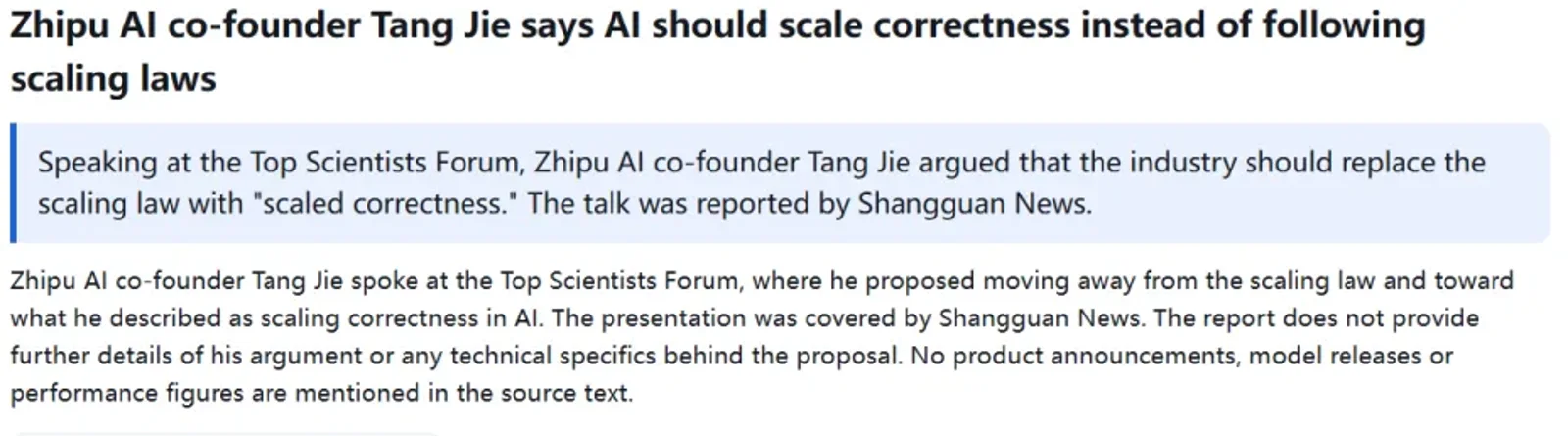
Tang Jie proposes "scaled correctness," emphasizing verification that conclusions from small-scale experiments hold when scaled up, and using curves across scales to improve prediction of large-scale training performance.
This is critical for RSI. A small-scale experiment may show performance gains, but expanding to more tasks, more agents, and longer runtimes can reveal cost explosion, error propagation, reward hacking, or safety degradation.
Enterprises can implement scaled correctness as three checks:
Horizontal scaling : Whether success rate and cost remain stable as task count increases
Vertical scaling : Whether capability continues to improve as model size and training steps increase
Scenario scaling : Whether safety and reliability hold when transferring from coding to medical, finance, and other domains
Only when curves, boundaries, and failure modes are clear should model improvement be automated further.
100T Token Target: Bottleneck Is Effective Data, Not Volume
Zhipu discloses a next-phase data target of 100 trillion tokens, roughly 3.5× the 28.5T used for GLM-5. However, materials note high-quality public text supply is under 30T tokens, making effective data scale the key challenge for subsequent training.
This implies data engineering importance will keep rising. Web pages, documents, books, code, video, and audio are not ready-to-train; they require quality filtering, layout restructuring, code execution testing, and speech transcription. Truly valuable data is verifiable, deduplicated, and matched to task objectives — not merely stacked token counts.
For enterprise agents, internal data likewise needs versioning, quality, and permission tags. Feeding raw uncleaned logs directly to a model may add noise, leak privacy, and distort evaluation results.
How Developers Can Prepare Evaluation Infrastructure for the RSI Era
Regardless of when GLM-5.5 launches, developers can build evaluation infrastructure independent of any single model: fixed task sets, versioned data, isolated tool environments, independent judges, cost monitoring, and safety gates.
After each model-generated modification, the same tests and control groups must run; when evaluation improves, check whether the model merely learned to game the metrics. For long-horizon agents, simultaneously record task completion rate, tool call volume, human takeover count, failure recovery, and data exfiltration events.
Only then will model self-improvement avoid becoming a closed-loop illusion of "self-modify, self-score, self-declare-success."
Domestic teams accessing GLM, Claude, GPT, etc. via API can use channels like Code80 (https://code.ai80.vip/home) to reduce integration friction, but must still build their own model routing, evaluation sets, data permissions, sandboxes, and audit logs.
Frequently Asked Questions
Has GLM-5.5 already achieved 100% RSI?
No. Public information shows "100% RSI" is a research goal; related models, environments, and data loops remain at the R&D clue stage.
Why is Coding Sandbox important for model training?
It lets the model learn in real code, command, test, and error environments, rather than only generating results from static code snippets.
How does a model know if it has become stronger?
It needs an independent judge, fixed baselines, large-scale regression, and safety gates. The model cannot rely solely on its own output to judge overall capability improvement.
Will 100T tokens directly yield a stronger model?
Not necessarily. Data quality, deduplication, coverage, task relevance, and verification methods all affect training outcomes; total token count is only a scale metric.
What is the practical significance of RSI for enterprise agents?
It reminds teams to version the model, harness, data, and evaluation system together, continuously recording capability, cost, and safety changes from each modification.
How can domestic developers access GLM-5.5 capabilities?
They can use API channels like Code80 to lower integration friction, but must still manage model routing, evaluation sets, data permissions, sandboxes, and audit logs themselves.
For questions about attribution, corrections or content rights, please contactand we will review it promptly.