When a production outage forces a midnight investigation across five services, the lack of log standards turns a quick debug into an all‑night forensic hunt; the article explains how structured logs, a unified schema, level semantics, trace_id linking, and field‑level masking enforced by SDK, Lint and CI can eliminate these five walls and make logging scalable, searchable, and compliant.
The article outlines five practical principles for implementing log masking in large development organizations, emphasizing legal compliance as a non‑negotiable red line, advocating aggressive over‑masking, avoiding long‑term technical debt, driving top‑down adoption, and redefining the architect’s role to ensure effective, sustainable data protection.
This article explains how to protect sensitive user data in e‑commerce chatbot logs by routing all service logs through LoongCollector, pushing them to Alibaba Cloud SLS, and applying built‑in and keyword‑based mask functions so that privacy is preserved without breaking business logic.
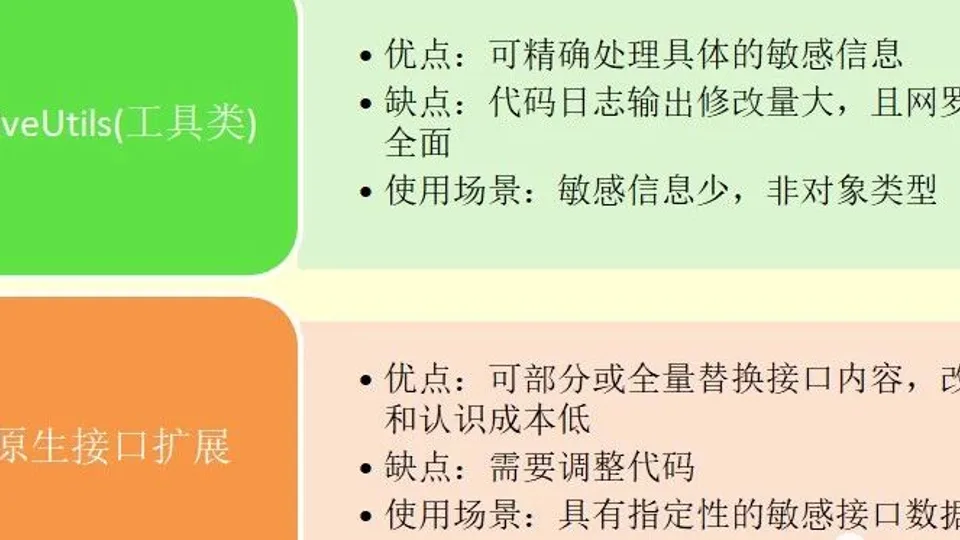
This article analyzes the growing risk of personal data leakage, defines data masking, compares common log‑masking techniques, and presents a comprehensive Java‑Spring solution that combines annotation‑based marking, custom Jackson serializers, and extended SLF4J methods to achieve precise, low‑overhead log masking.
This article explains how to mask sensitive fields in Java logs, demonstrates the pitfalls of shallow‑copying nested Maps during masking, and shows a robust solution using Guava's Maps.transformEntries to perform lazy, view‑based deep transformation without mutating the original data structures.
This article explains how to employ custom Java annotations together with reflection to mask sensitive fields in logs, define flexible desensitization rules, and dramatically reduce repetitive code when building fixed‑length, signed bank API requests, improving maintainability and extensibility of backend services.