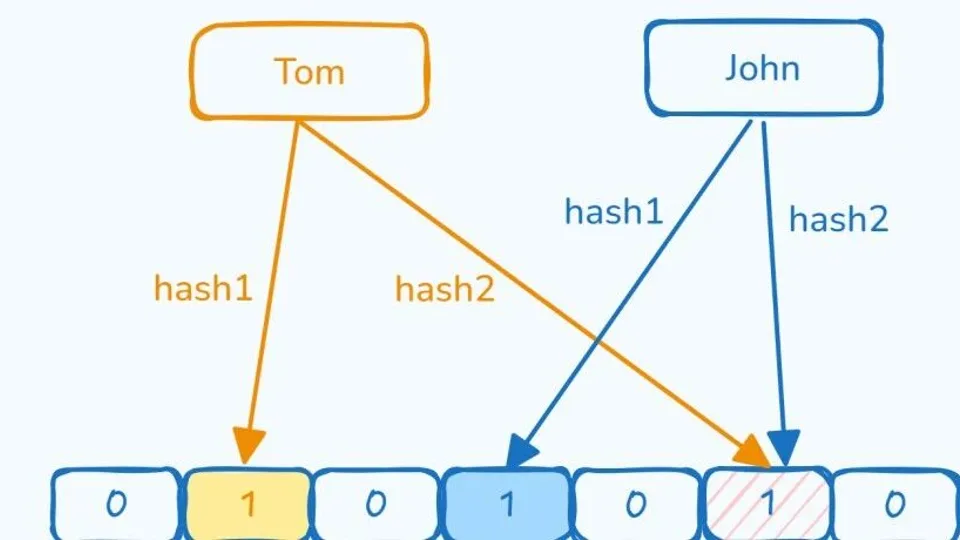
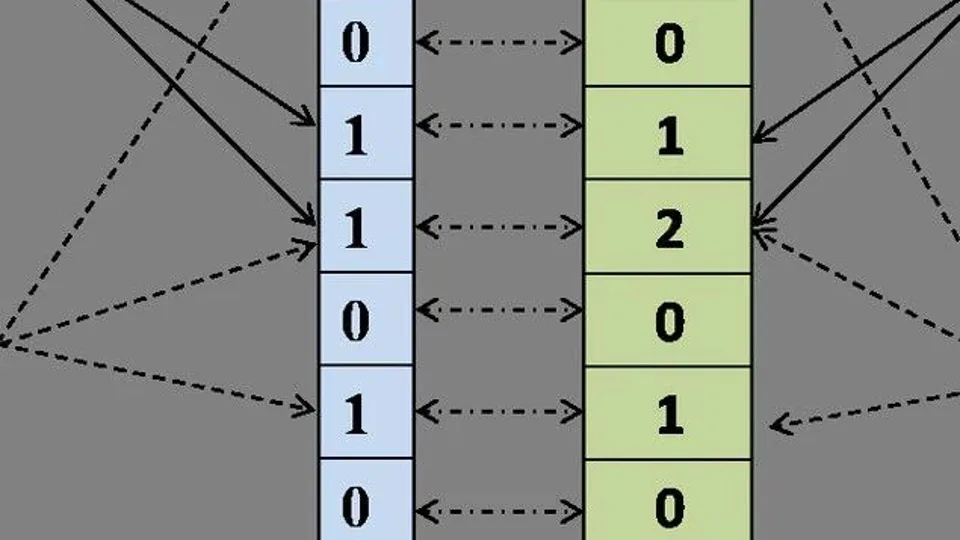
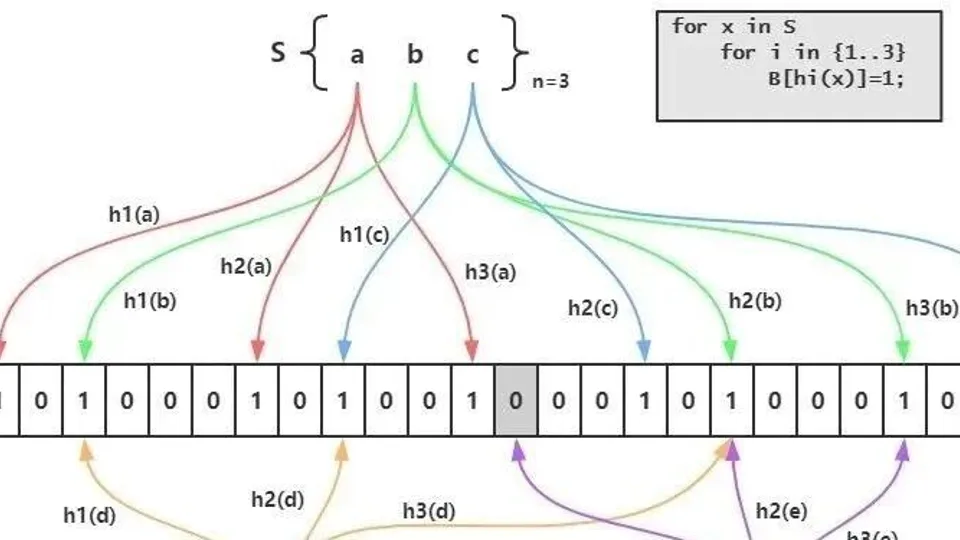
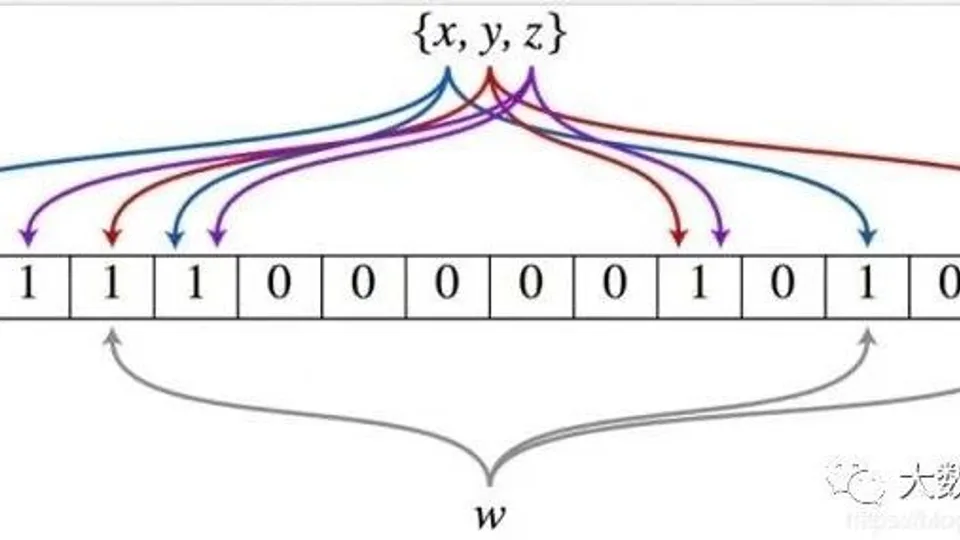
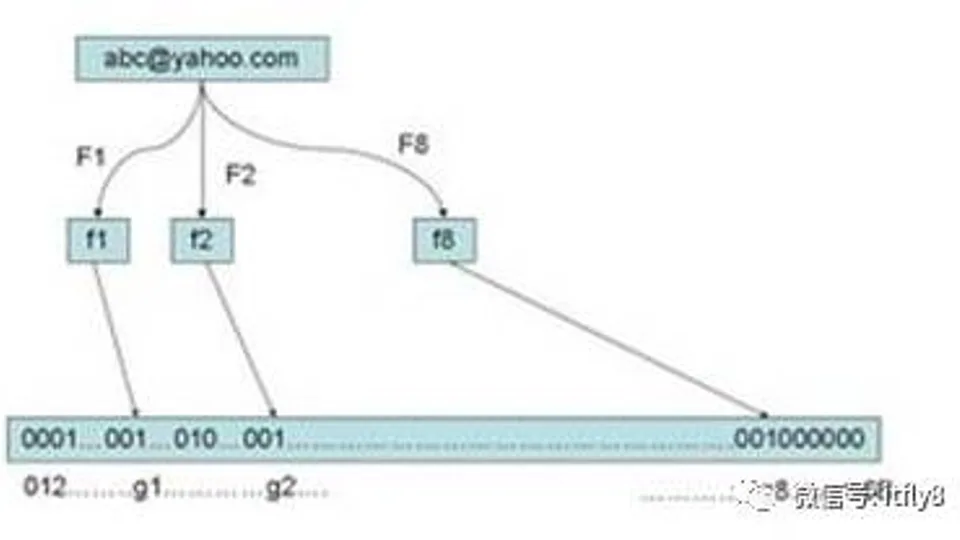
A Bloom filter is a probabilistic data structure that answers set‑membership queries with guaranteed no false negatives but possible false positives, using a bit array and multiple hash functions; the article demonstrates its mechanics with examples and shows its use in preventing cache penetration, URL de‑duplication, accelerating distributed databases, and handling blacklists, while noting drawbacks like no deletion and limited scalability.
The article explains the probabilistic Bloom filter data structure, its initialization, hash‑based insertion and query process, illustrates collisions with concrete examples, and shows how Redis (via Redisson) supports Bloom filters with Java code to efficiently block cache‑penetration attacks.
This article explains the probabilistic Bloom filter data structure, its characteristics and typical use cases such as cache‑penetration prevention, details its simple implementation steps, demonstrates how Redis (via Redisson) provides built‑in Bloom filter support with Java code examples, and summarizes its practical benefits.
This article introduces Bloom filters and Cuckoo filters, explains their probabilistic nature, false‑positive behavior, space‑time trade‑offs, provides Go and Java implementation examples, and discusses practical use cases such as Redis extensions and high‑traffic e‑commerce scenarios.
Bloom filters are space‑efficient probabilistic structures that answer “definitely not” or “maybe” membership queries, with a controllable false‑positive rate derived from bit array size, element count, and hash functions, and can be implemented via Guava’s Java library, Redisson’s Redis wrapper, native Redis modules, or custom bitmap code, dramatically reducing memory usage and latency in large‑scale systems such as URL deduplication or user‑product checks.
This article introduces Bloom filters, explains their probabilistic principles, advantages and drawbacks, details how to add and query elements, derives false‑positive formulas, provides Guava, Redisson, Redis‑module, and custom bitmap implementations with code samples, and showcases real‑world business scenarios and performance benefits.
This article explains the Bloom filter data structure, its mathematical foundations and false‑positive analysis, demonstrates how to implement it with Google Guava and Redisson in Java, and discusses practical considerations such as cache‑penetration mitigation, deletion strategies, and periodic rebuilding.
This article provides a comprehensive, formal introduction to skip lists, covering their probabilistic foundations, structural design, detailed C implementations for creation, search, insertion, deletion, random level generation, space and time complexity analyses, and extensions such as fast random access and span maintenance.
The article explains Bloom filters—a probabilistic, space‑efficient data structure using multiple hash functions on a bit array to answer set‑membership queries with controllable false‑positive rates, detailing their construction, query process, optimal parameters, and common uses such as URL deduplication, cache protection, and spam filtering.
This article explains the theory behind Bloom filters and provides a step‑by‑step guide to integrate a Bloom filter into a Spring Boot 2.3.8 application using Redis, Guava, and custom configuration, including code samples, optimal parameter calculations, and testing of false‑positive rates.
This article explains Bloom filters, their core principles, typical use cases like cache penetration and large‑scale membership testing, and demonstrates practical Java implementations using Guava and Redis, including code examples, performance analysis, and discussion of their advantages and limitations.
This article explains the concept, principles, implementation details, and practical applications of Bloom Filters, including formulas for optimal bit array size and hash count, Java code examples using Guava, and common use cases such as deduplication, web crawling, and spam filtering.
This article explains the concept, typical use cases such as preventing database misses and cache penetration, the underlying hash‑based implementation with examples, and shows how to deploy a Bloom filter using RedisBloom, providing a practical guide for handling huge data sets.
This article explains the principles of Bloom filters, their false‑positive behavior, and demonstrates how to implement them using Google Guava in Java and Redis ReBloom via Docker, including code examples and a practical membership‑filtering use case.
Bloom filters are highly space-efficient probabilistic data structures that quickly test set membership using multiple hash functions, guaranteeing no false negatives while allowing a small false positive rate, making them ideal for large-scale applications such as email blacklists and massive URL deduplication.