

AgentOnto: Ontology as Verification Checklist Cuts Silent Errors to 5.5%
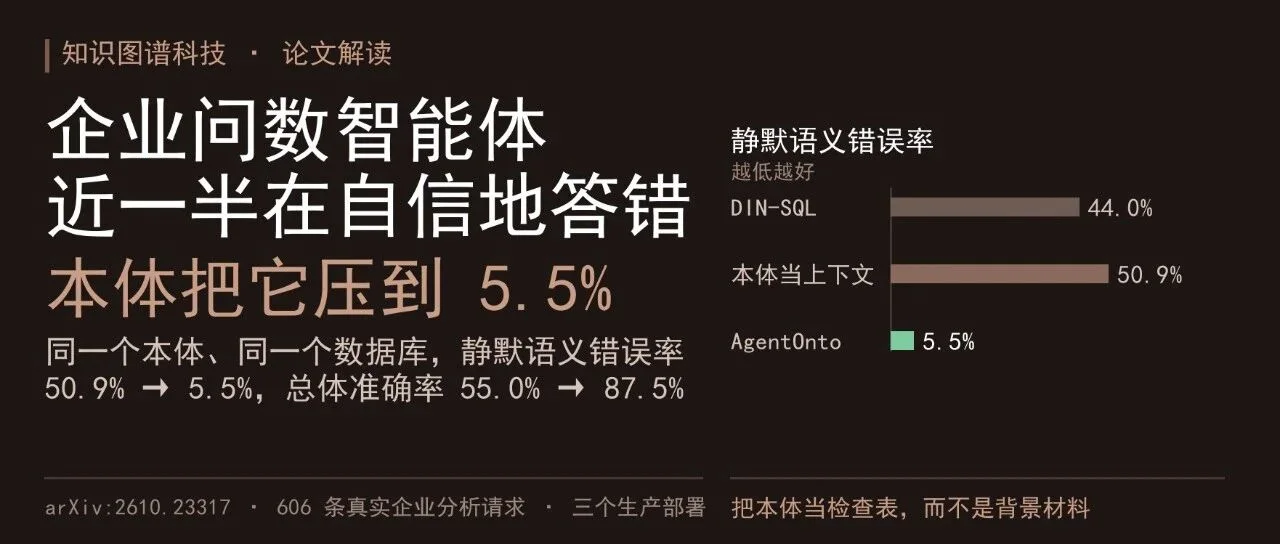
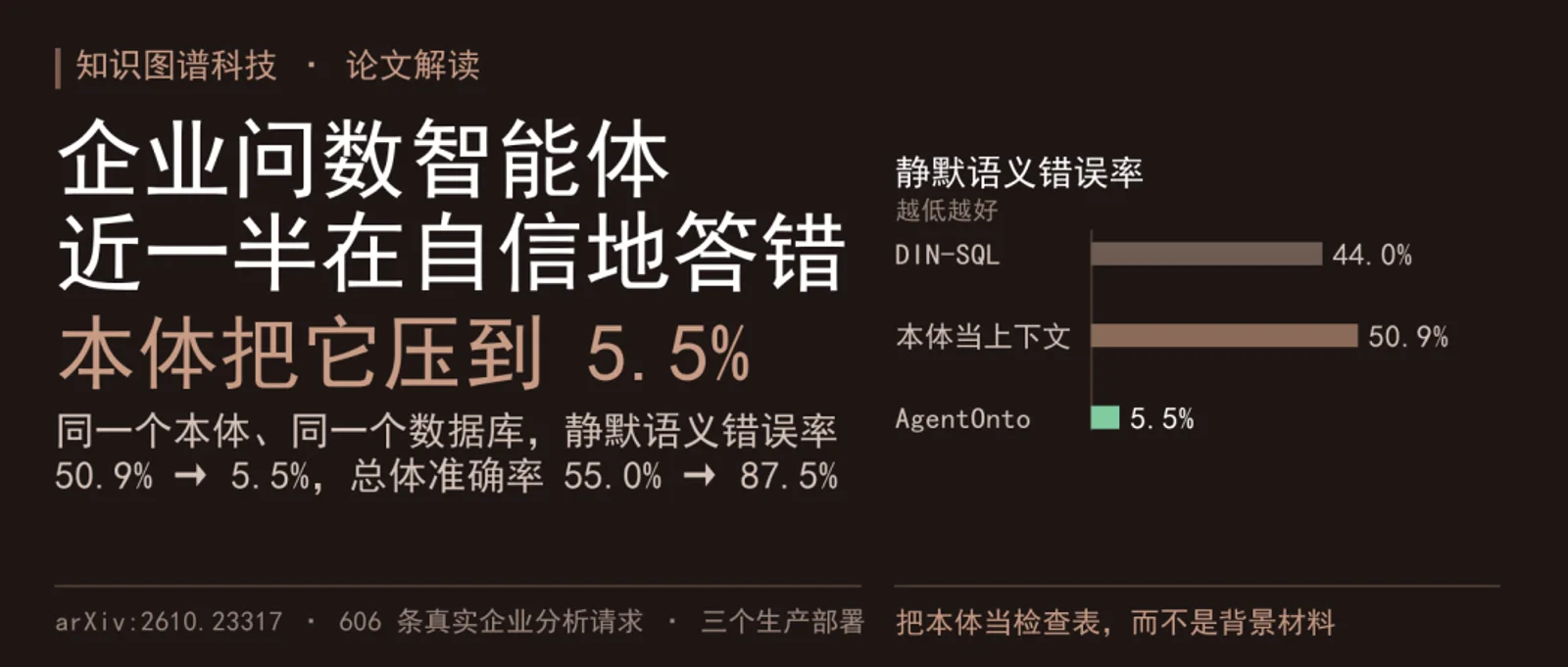
AgentOnto, an ontology-guided LLM agent system for enterprise data analytics, reduces silent semantic errors from 50.9% to 5.5% by using ontology as a verification checklist during planning rather than as context, achieving 87.5% overall accuracy across benchmarks and real deployments.
Reading font
Introduction
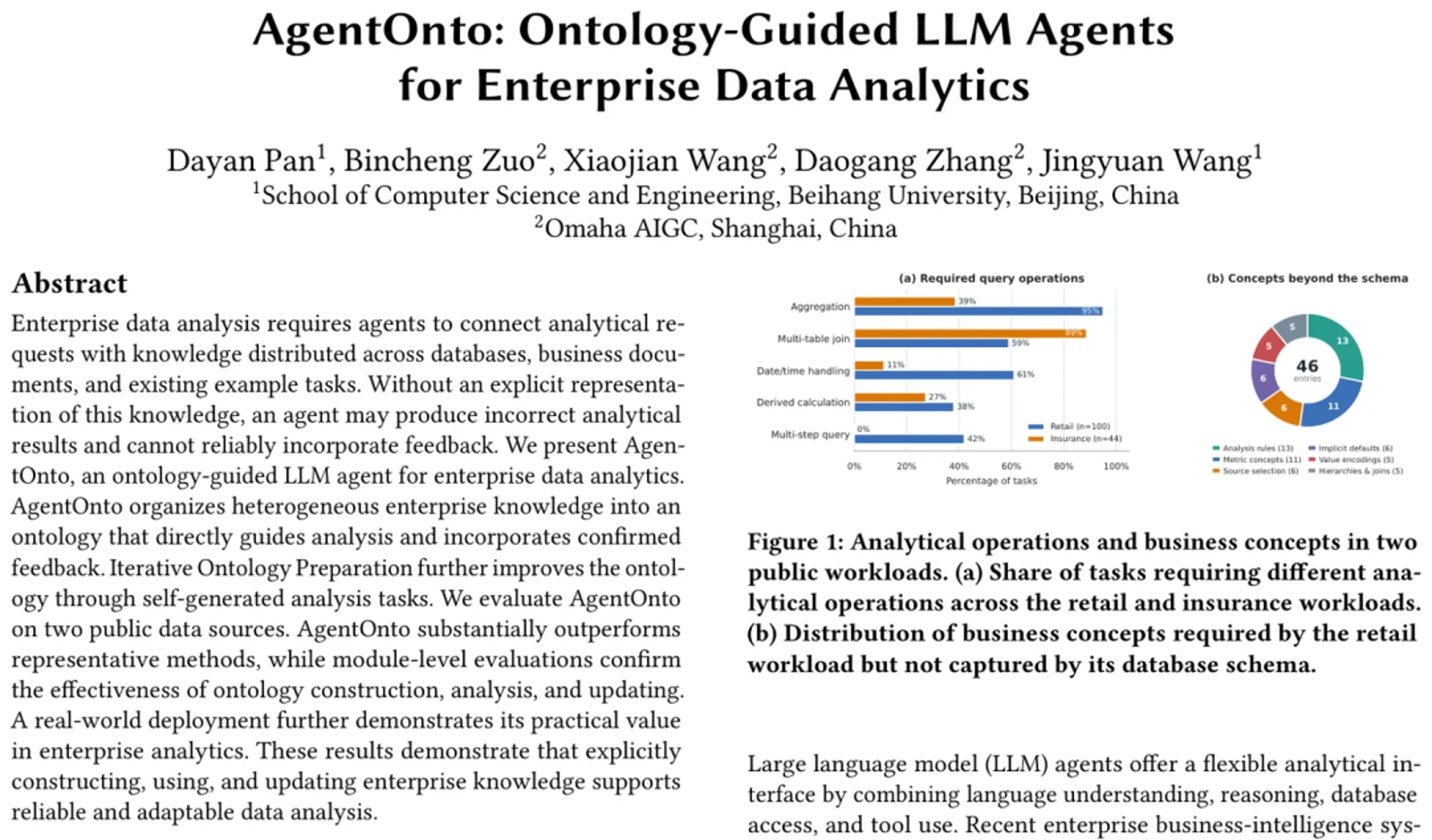
Enterprise data analytics often suffers from silent semantic errors : queries execute successfully but return results that are semantically wrong. Researchers from Beihang University and Omaha AIGC propose AgentOnto , an ontology-guided LLM agent system submitted to KDD '27 (arXiv:2610.23317). The key insight: treat the ontology as a verification checklist during planning and validation, not merely as background context fed to the model.
Problem: High Coverage but High Silent Errors
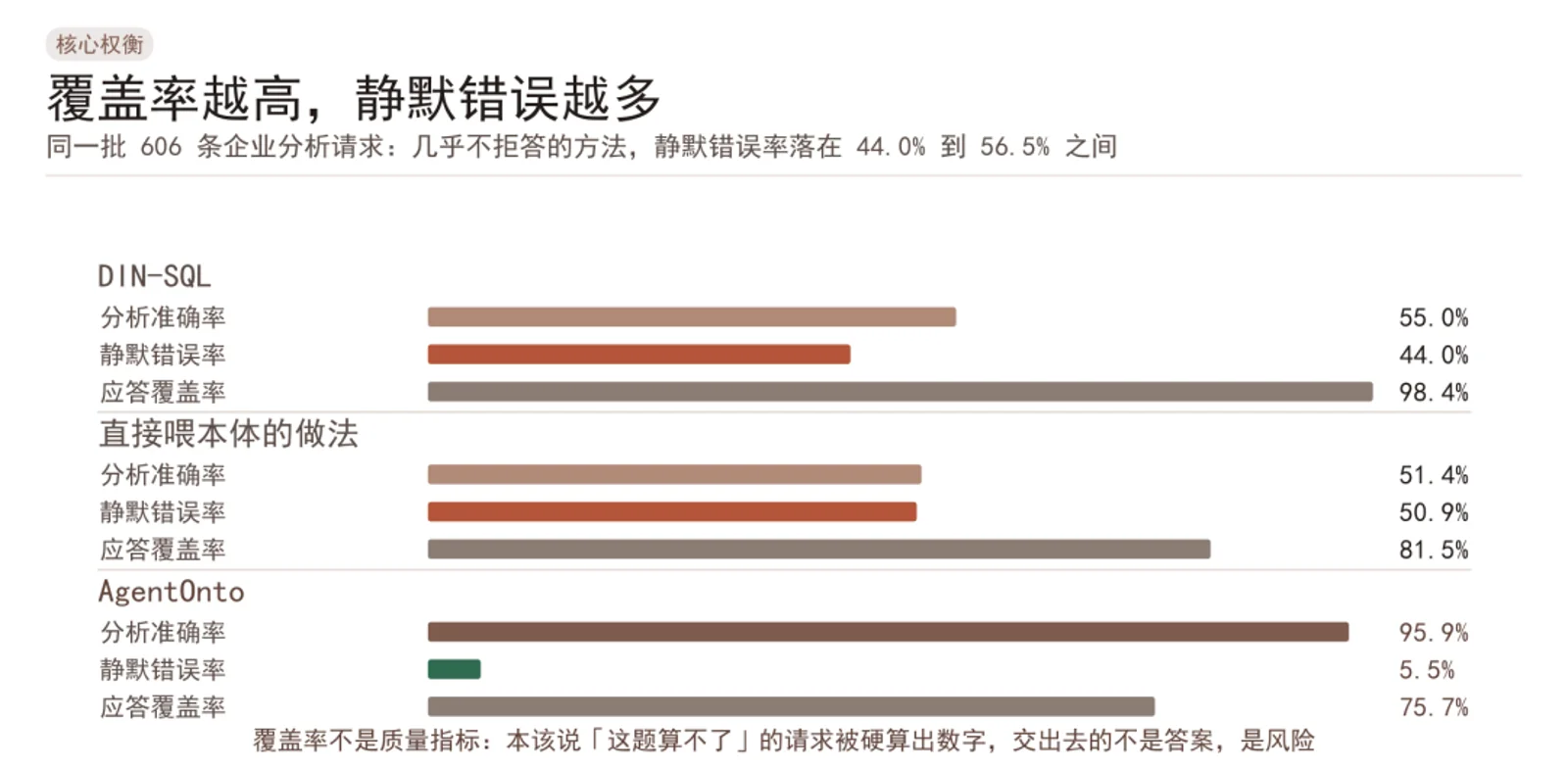
On 606 real analytical requests (282 from World Bank WDI, 324 from EPA AQS), four mainstream methods (DIN-SQL, ReFoRCE-v8, MAC-SQL, Vanna) achieve >92% response coverage, yet their silent semantic error rates range from 44.0% to 56.5% . AgentOnto deliberately lowers coverage to 75.7% but reduces silent errors to 5.5% . The paper argues coverage is not a quality metric; a system that forces answers for unanswerable questions injects risk.
Ontology Design: Three Components
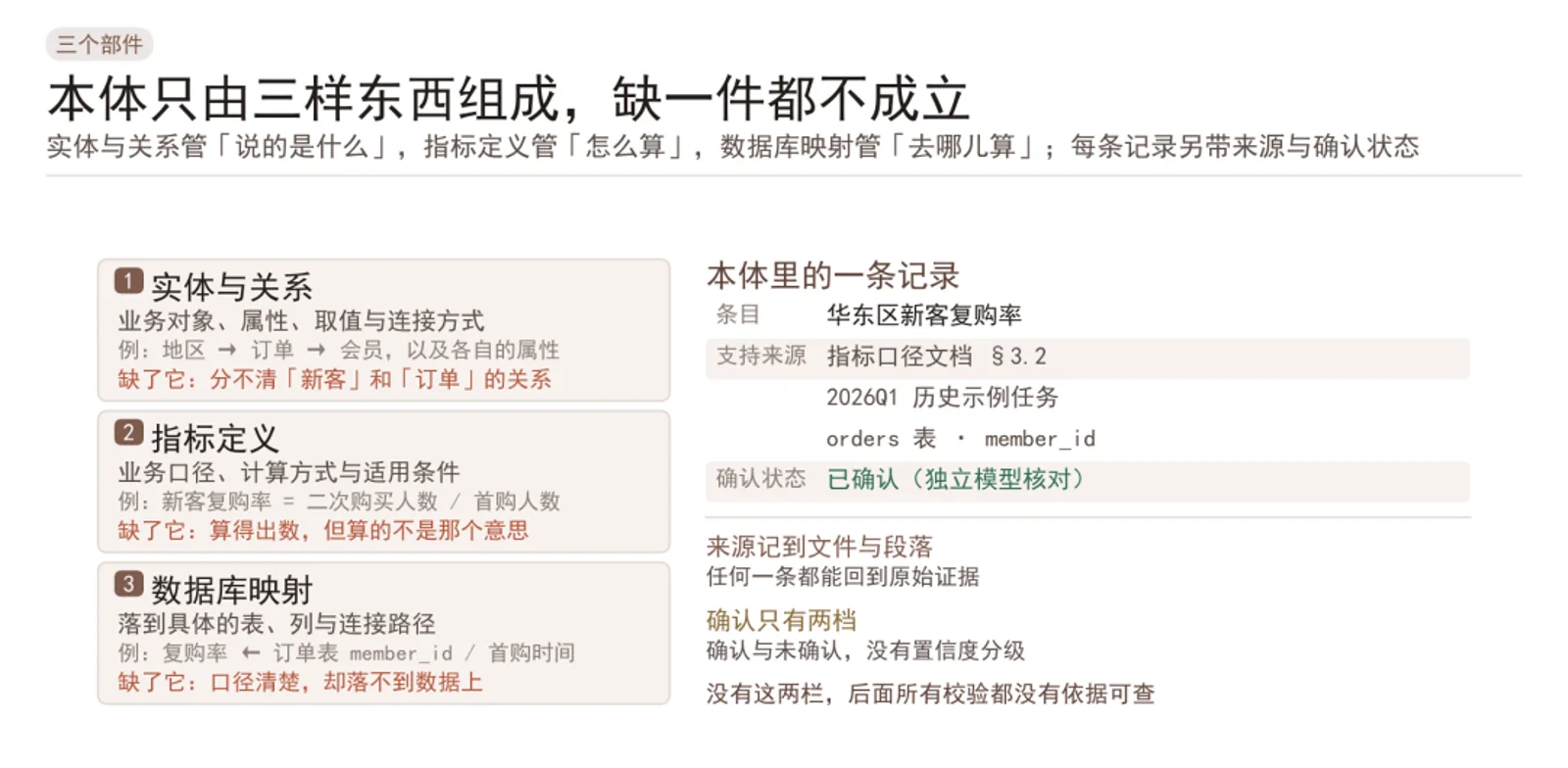
AgentOnto's ontology comprises three tightly coupled parts:
Entities & Relations – business objects, attributes, values, and connections.
Metric Definitions – business formulas with applicability conditions.
Database Mappings – links from the above to concrete tables, columns, and join paths.
Each entry carries provenance (source document, table, or example) and confirmation status (verified/unverified). Ablation shows removing any component collapses performance: entity/relation F1 drops to 2.9–6.5%, analysis accuracy to 16–22%.
Four-Stage Pipeline with Verification
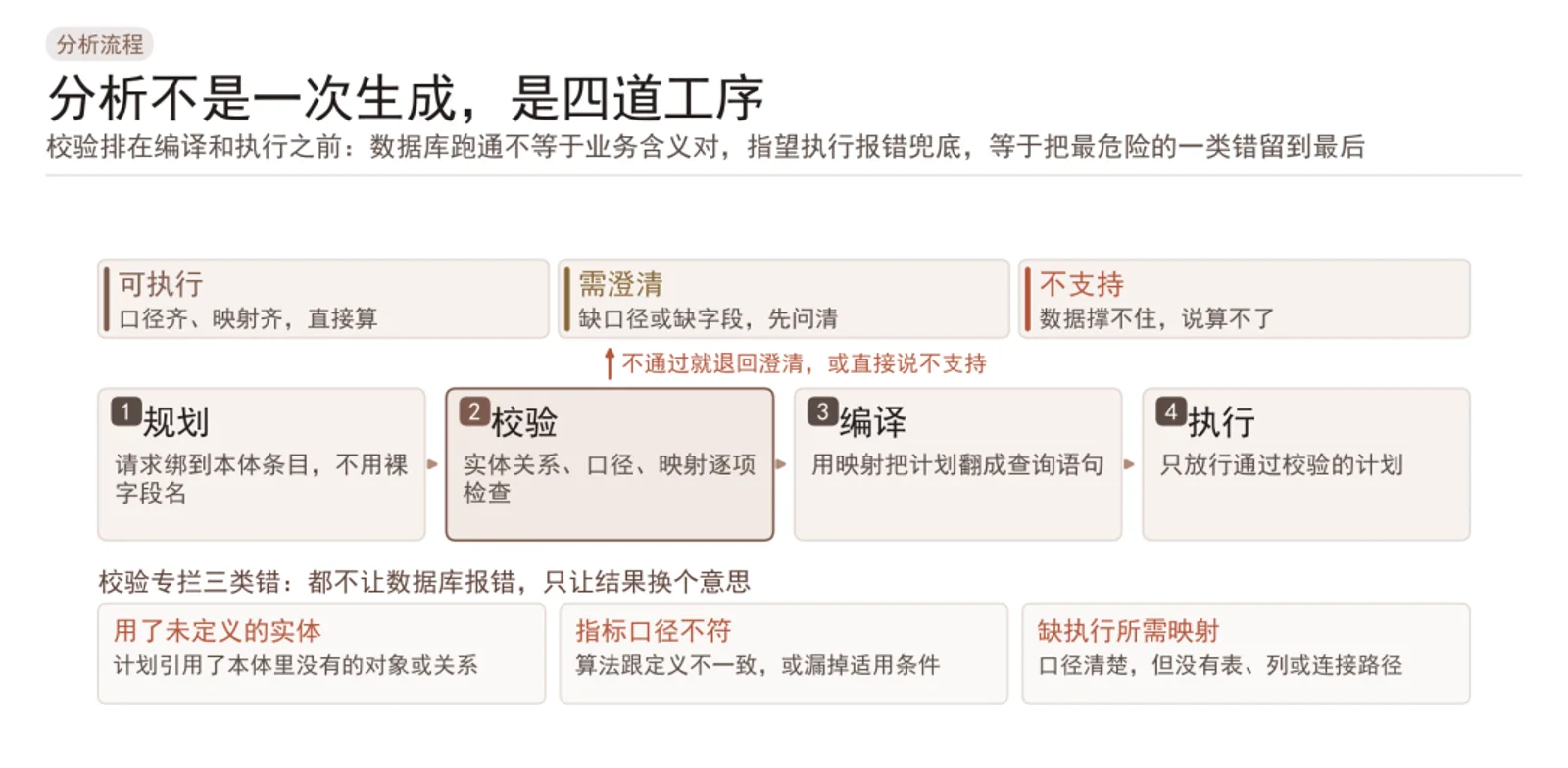
Unlike typical text-to-SQL agents that generate queries directly, AgentOnto inserts two gates:
Planning – decompose the request into an analysis plan referencing ontology entries (not raw column names).
Verification – check every plan item against the three ontology components: entities/relations exist, metric definitions match, required mappings are present.
Compilation – translate the verified plan into executable SQL using the mappings.
Execution – run the query.
Verification happens before execution, catching errors that databases would not flag (valid syntax, non-empty results, but wrong business meaning). Using the same ontology as context (Direct Ontology baseline) yields only 51.4% accuracy and 50.9% silent errors; using it for planning+verification yields 95.9% accuracy and 5.5% silent errors — a 44-percentage-point gap.
Three-Action Routing
Every request is classified before planning:
Executable – all required ontology entries exist and are confirmed.
Clarify – missing information on the user side (undefined metric, unspecified filter, missing time range).
Unsupported – missing data-side support (absent column, insufficient granularity, missing years).
On WDI, executable requests are 206/282 (73.0%); AgentOnto returns 73.4%. On AQS, 250/324 (77.2%); AgentOnto returns 78.1%. The <0.9 pp deviation shows the system reliably identifies unanswerable questions.
Experimental Results
Overall accuracy (domain average): AgentOnto 87.5% vs. best baseline DIN-SQL 55.0% (+32.5 pp). Per domain: WDI 79.1%, AQS 96.0%. The gap reflects WDI's complex multi-criterion, multi-year macro indicators vs. AQS's regular station-level time series.
Analysis-only accuracy (excluding ontology construction): 95.9% domain average, showing the reasoning engine is strong; the 8 pp gap is due to ontology construction effort.
Ablation: Ontology as Context vs. Verification
Direct Ontology (ontology as context): 51.4% accuracy, 50.9% silent errors. Direct Schema (schema only): 23.3%. Direct Documents (docs only): 40.1%. The verification-centric design is the primary driver of improvement.
Update Mechanism with Preservation Checks
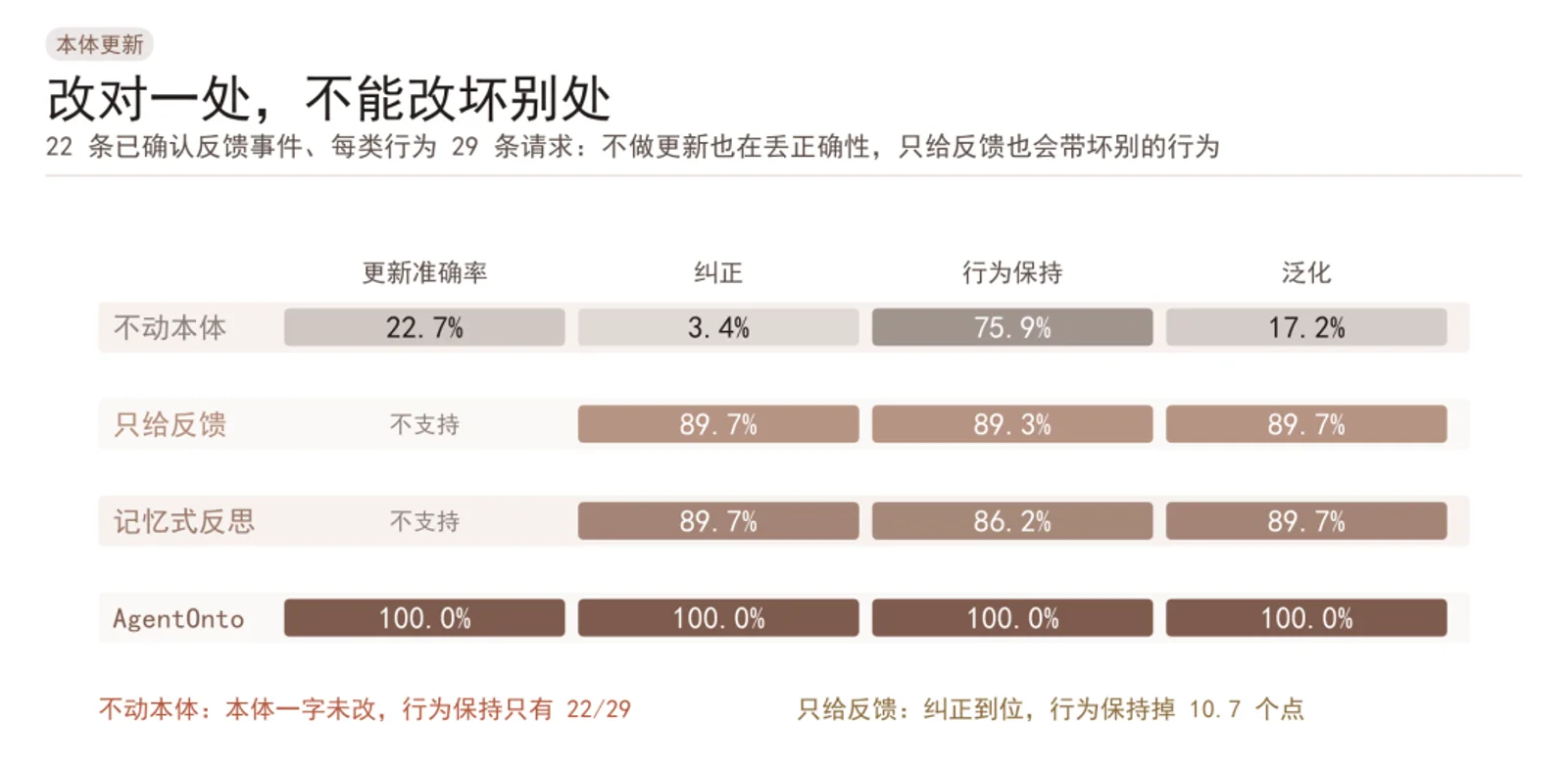
Ontology updates undergo dual checks:
Correction checks – verify the target issue is fixed.
Preservation checks – verify previously correct analyses remain correct.
On 22 confirmed feedback events (AQS), AgentOnto achieves 100% on update accuracy, correction, preservation, and generalization. Baselines that only add feedback without structured checks fix the issue (89.7%) but break preservation (89.3% and 86.2%). Even no update loses 7/29 previously correct answers due to model stochasticity.
Self-Generated Stress Testing Before Deployment
Before going live, AgentOnto runs two rounds of self-generated tasks: from schema, docs, examples, and current ontology, it generates analysis tasks, answers them, and an independent model verifies the answers. Verified tasks become correction/preservation checks for the next round. This catches latent issues (e.g., cross-entity metrics, conditional mappings) before real users encounter them.
Real-World Deployments
Three production deployments:
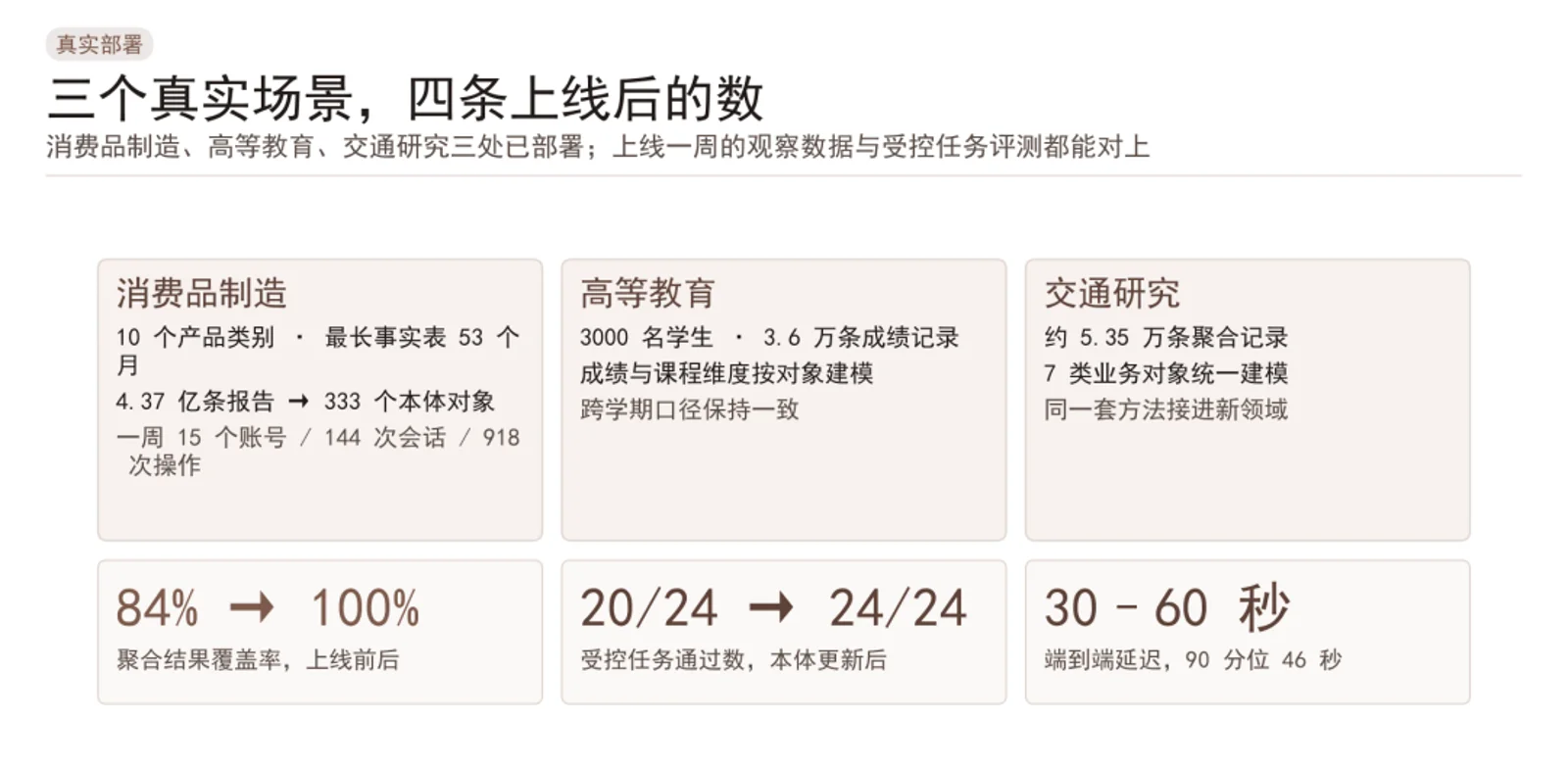
Consumer goods : 437M device reports from 96 models → 333 ontology objects; 10 product categories, 53 months.
Higher education : 3,000 students, 36K grade records.
Transport research : 53.5K aggregated records, 7 business objects.
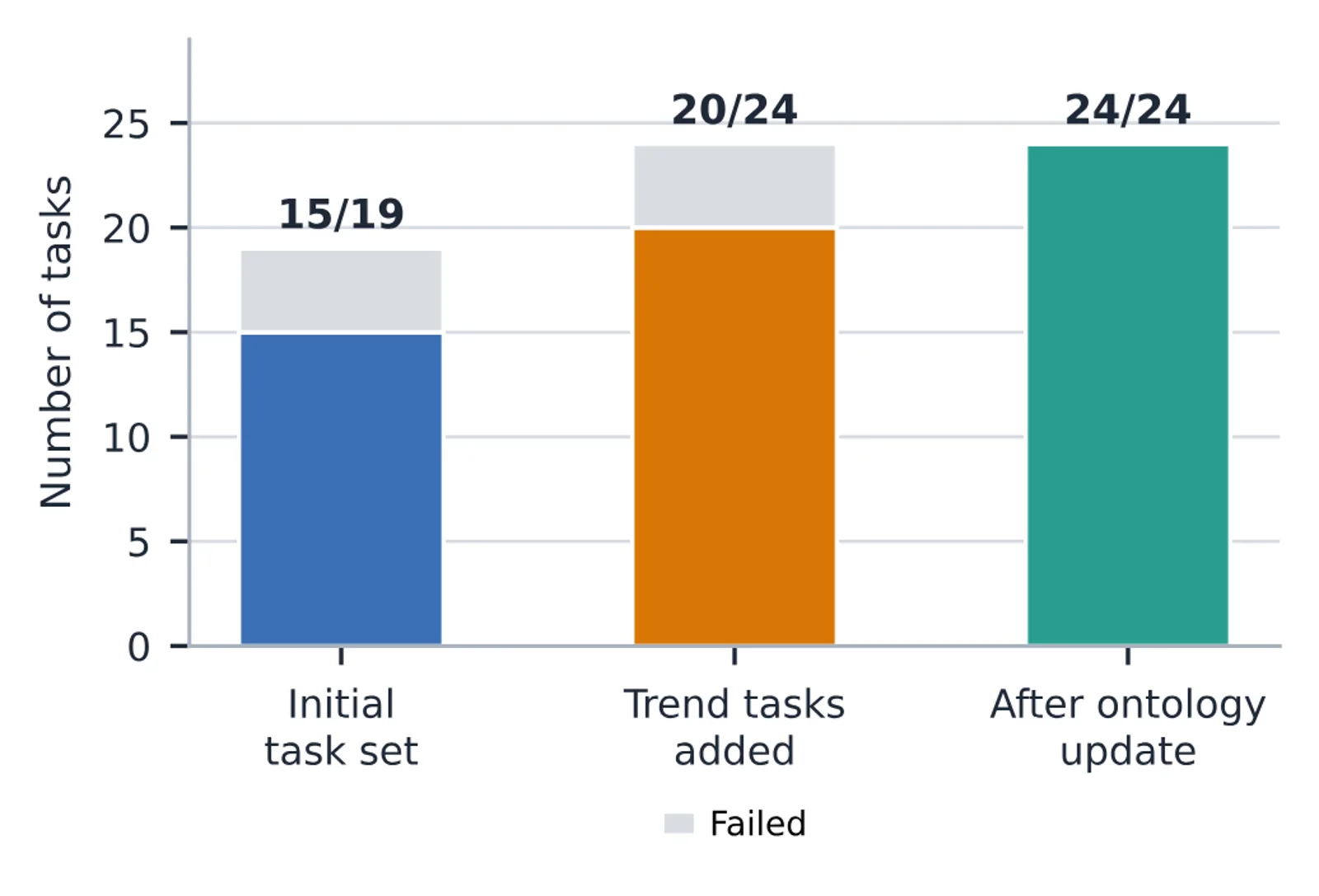
After one week: 15 accounts, 144 sessions, 918 operations. Aggregation coverage rose from 84% (test) to 100% (production). End-to-end latency 30–60s (p90 46s). Controlled task suite: 15/19 → 20/24 → 24/24 after adding one cross-price-band share rule.
Limitations and Takeaways
Benchmarks are structured tabular data; multimodal/unstructured or poor-quality data untested.
Model is closed-source gpt-5.6-terra; changing base model requires full re-evaluation.
Ontology construction relies on LLM generation; errors propagate. Confirmation status is binary (confirmed/unconfirmed), no confidence scores. Human verification remains essential.
Cold start requires business docs, historical example tasks, and accessible DB — all three are prerequisites.
The system enforces consistency with defined metrics; it does not automate metric definition.
Key takeaway: The 5.5% silent error rate is an engineering achievement. Trust in enterprise text-to-SQL comes not from larger models but from verifiable, provenance-tracked, checklist-enforced knowledge entries.
For questions about attribution, corrections or content rights, please contactand we will review it promptly.