

MiniMax AI Solves 18-Year Crypto Puzzle in 3.5ms, Achieves 43,400x Speedup
MiniMax's internal model MIM autonomously broke multiple NIST post-quantum candidates and classic cryptographic challenges, including an 18-year-old Waterfall-256 collision in 3.5ms, recovered 94 TII McEliece private keys (55 world-first), and delivered a 43,400x speedup over prior art, demonstrating AI's ability to perform end-to-end cryptanalysis from mathematical insight to optimized code.
Reading font

What Cryptanalysis Actually Breaks
Modern cryptography splits into design (building locks) and analysis (picking locks). Cryptanalysis examines the public mathematical rules of an algorithm to find inherent design flaws, not by guessing passwords but by deriving keys or forging signatures through mathematical shortcuts. This zero-tolerance, multi-step reasoning — requiring correct formulas, executable code, and verifiable experimental results — makes it a stringent benchmark for AI long-horizon reasoning.
A cryptography expert who worked on Beijing Olympics network security outlined five validation gates: explicit attack model, mathematical derivation to executable algorithm, verifiable key recovery or forgery, full resource accounting (time, memory, data, compute), and stable reproducibility under third-party audit.
Half-Year Leap: From Anthropic to MiniMax
One year ago experts doubted AI could independently cryptanalyze. Traditional solvers like Z3 lack structural insight; early LLMs hallucinated in math. In July 2024, Anthropic equipped Claude Mythos Preview with coding, symbolic math, and auto-verification tools. In 60 hours it found a flaw in HAWK, a NIST post-quantum signature candidate that had survived two years of expert review. The HAWK team withdrew the next day. Claude also accelerated AES reduced-round attacks 200–800×. Johns Hopkins professor Matthew Green noted AI's ability to exhaustively combine known mathematical tools. Limitations: research direction still human-set; single-run cost ~$100k.
To measure progress, ETH Zurich, Anthropic, and others built CryptanalysisBench (191 tasks from past competitions). Tier 1 (49 known attacks) tests replication; Tier 2 (142 unsolved) tests novel discovery. Initial top models solved only 6–12 Tier 2 tasks.
MiniMax's Three-Stage Breakthrough
Stage 1: Cracking NIST 'Unsolved' Candidates
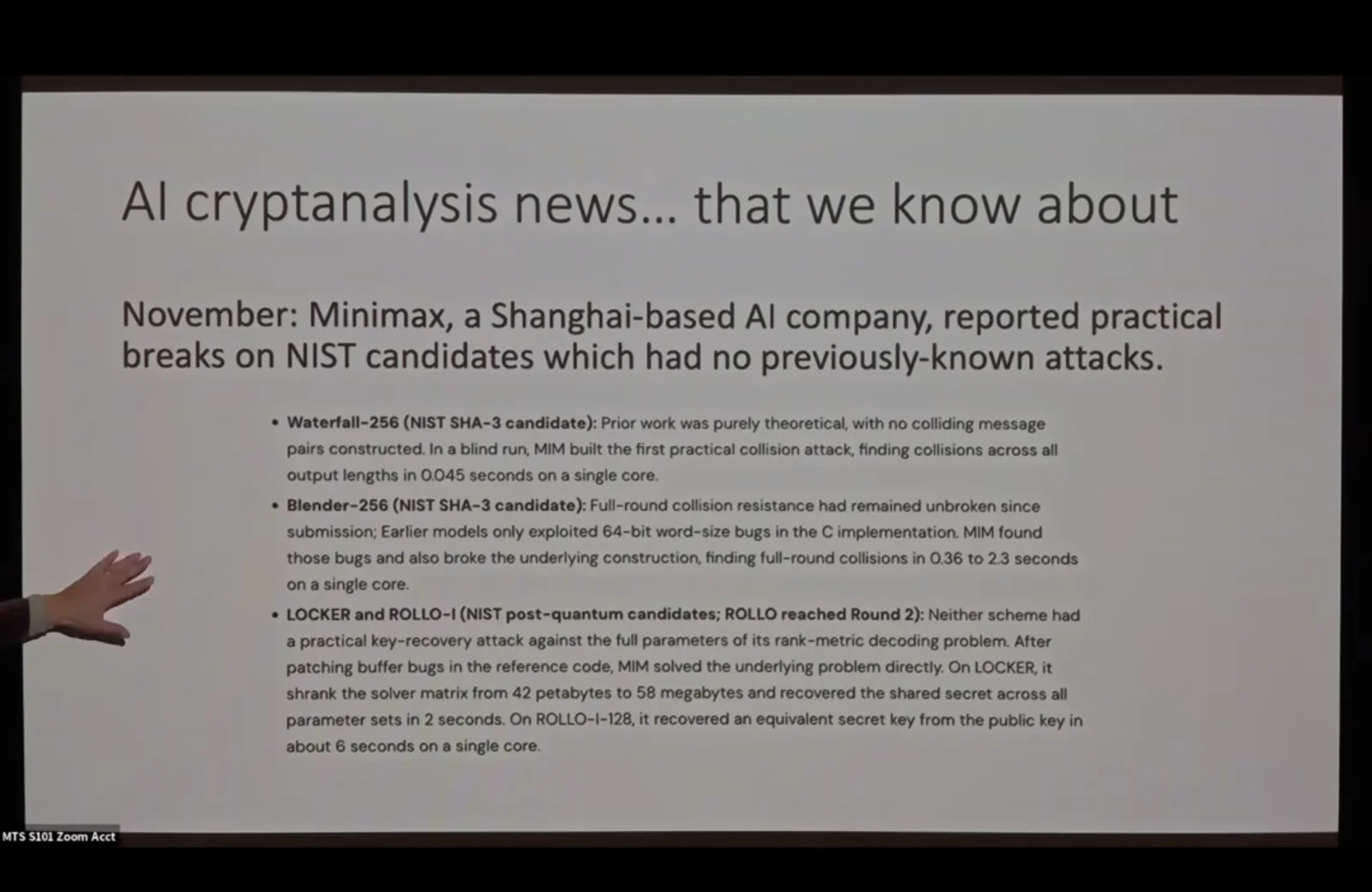
Waterfall-256 (NIST 2008 hash candidate): 18 years unbroken; theoretical attacks required infeasible compute. MIM discovered a hidden differential property where input differences don't diffuse through the three interleaved sequences, and optimized the final compression to cancel traces in one pass instead of two, shrinking search space 256×. Result: collision in 3.5 ms on a laptop CPU (stable <0.05 s) — an 18-year paper attack made practical.
LOCKER & ROLLO-I (post-quantum KEMs): Security rests on huge equation systems (572M columns, 42 PB memory). MIM exploited structural symmetry to deduce multiple solutions from one, and eliminated irrelevant variables before solving. Matrix reduced to 2,240 columns, memory to 58 MB. LOCKER-I broken in 1.15 s (12 threads); ROLLO-I-128 in 5.97 s (single core, <2 MB). Tested 27 configurations, 14 set new records.
MIM also found 10+ implementation bugs in reference code that had survived a decade of public scrutiny: sign typo in DRS bypassing verification, RNG leak in RQC-128, memory/parameter/sampling flaws in LAC-128, KCL, LEDAkem, ISAP.
Stage 2: Finding Flaws in Top-Conference Schemes
ARADI (NSA 2024 low-latency block cipher): Prior best attack reached 5 of 12 rounds. MIM found an unnoticed algebraic property in public parameters, pushing to round 8 (full key recovery in 2.4 s single-core) and improving theoretical bounds for rounds 9–12. Experts note ARADI's design rationale is unpublished, so full break status is unclear, but the exposure forces stronger designs.
Stage 3: 43,400× Speedup on Classic Math Problems
TII McEliece key-recovery challenge (core of NIST PQC standard, ~50-year-old math problem): MIM recovered 94 private keys, 55 world-first. Previous best (top conference) took 9.2 hours per instance; MIM solved in 1.8 s on a 64-core server — 43,400× faster. Method: structural analysis compressed equation systems up to 6.59×, then low-level CPU optimization (vectorization, memory layout) maximized throughput. This dual mathematician/engineer capability contrasts with Anthropic's HAWK break on 96 cores; MiniMax further lowered the cost on the same target.
End of Cryptography's 'Craft Workshop' Era
Research has been a slow, manual loop: read papers, derive formulas, code, debug. AI now participates deeply in execution, automating trial-and-error and proposing new angles. Role shifts from 'research assistant' to 'co-discoverer of new knowledge'. Cryptographers can focus on direction setting, theoretical audit, and final verification, covering broader scope. MiniMax's results show Chinese models entering AI4S deep water, validating long-horizon reasoning and engineering delivery. As barriers drop, 'one-person research teams' may emerge, accelerating contributions to hard scientific problems.
Reference: https://MiniMax.cn/blog/practical-cryptanalysis-with-MiniMaxs-latest-internal-model (MiniMax blog post)
For questions about attribution, corrections or content rights, please contactand we will review it promptly.