

Alibaba Cloud AgentCore Unveils Unified Context Engineering for Enterprise Agents
Alibaba Cloud AgentCore introduces a unified context engineering solution comprising memory, knowledge base, and data connectors, enabling enterprise AI agents to access business context, retain cross-session preferences, retrieve documents, and query real-time data through a three-step integration process.
Reading font
Alibaba Cloud AgentCore Introduces Unified Context Engineering
Alibaba Cloud's AgentCore platform now offers a one-stop context engineering solution built around three core resources: Memory, Knowledge Base, and Connectors. These resources allow enterprise AI agents to access scattered business information, query changing data, and reuse experience across tasks.
Why Context Engineering Matters for Enterprise Agents
Enterprise agents often need to combine product manuals, contracts, order records, and historical communications to complete tasks. For example, an operations assistant might be asked: "How were yesterday's Shanghai warehouse orders? Summarize exceptions in our agreed format." The order data lives in business systems, exception rules in manuals, and the report format in prior conversations. Context engineering delivers the right information at the right time.
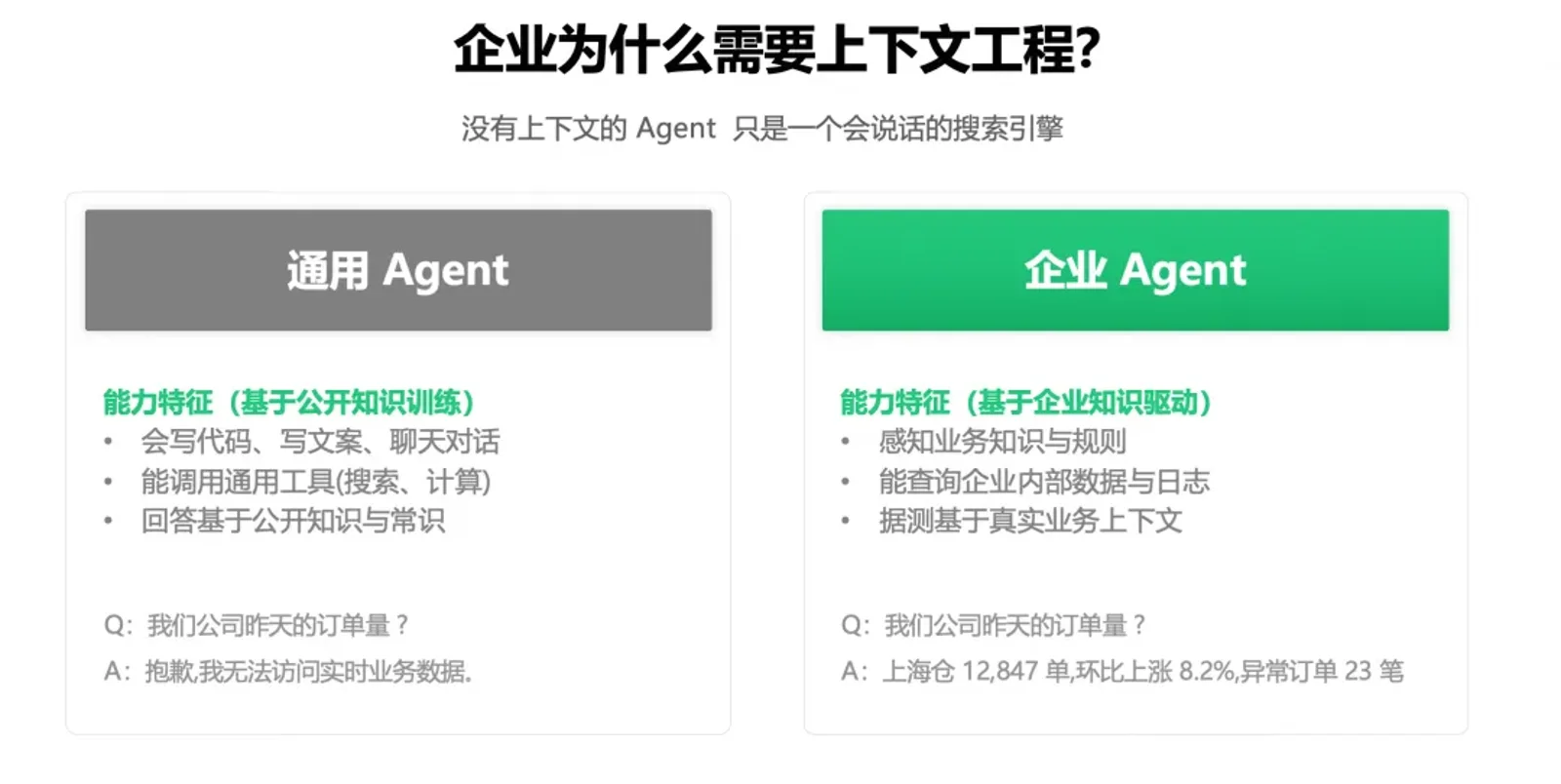
Three Pillars of Context
Memory : Stores interaction history and extracts reusable preferences, facts, and skills. Supports session summaries, semantic memory (facts/concepts), user profiles (stable preferences), and skill memory (procedures). Developers can use intelligent policies or custom extraction instructions. Memories are scoped by user, agent, or session and can be inspected and corrected.
Knowledge Base : Manages documents (PDF, Word, Markdown) with parsing, chunking, vectorization, and retrieval. Supports uploads, OSS and DingTalk batch import. Offers hybrid full-text and vector search with optional reranking. Developers can test recall with real questions and cite sources in answers. Also supports connecting existing OTS and Bailian knowledge bases.
Connectors : Provide read-only access to structured data (MySQL, PostgreSQL) and logs (SLS) via Zero ETL architecture — data stays in source systems, queried on demand. Includes metadata browsing, sample preview, and query testing. Access is controlled by business permissions; responses include time range and filter conditions for verification.
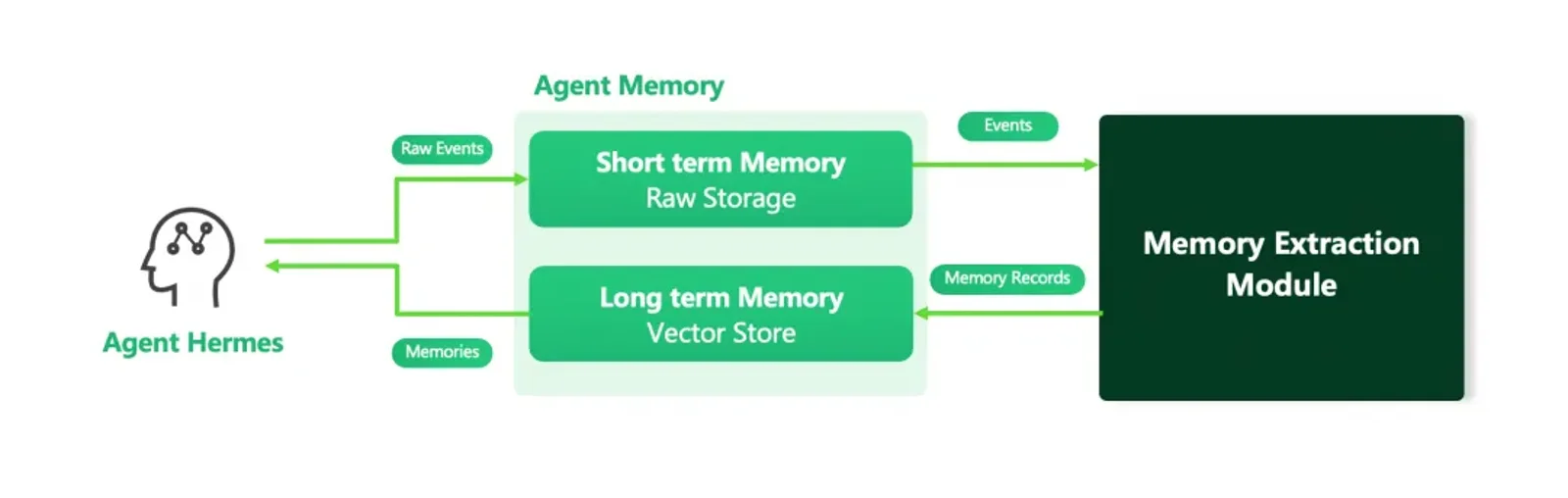
Memory: Cross-Session Experience Reuse
User preferences such as "weekly report: risks first, then progress" become long-term formatting rules. Verified troubleshooting steps from one session turn into reference material for future tasks. AgentCore provides session history and long-term memory management. Applications save interaction events, then apply extraction rules to distill durable information; users can also explicitly write to long-term memory.
Extraction methods are selectable per business need: session summary for discussion points, semantic memory for facts and concepts, user profile for stable preferences, skill memory for procedures. Developers may use intelligent policies or write custom extraction instructions specifying what to retain and under which conditions. For instance, an operations assistant can be configured to extract only confirmed exception-order verification steps along with their applicable business scenarios, enabling the agent to retrieve that experience for similar future tasks.
Memory value lies in cross-session reuse. When a user starts a new session, the application can still query preferences under the same user scope, continuing the prior collaboration style. For multi-user applications, memory supports ownership fields (user, agent, session). The application server combines authentication and authorization to restrict each read/write scope. Developers can inspect memory content, source metadata, and extraction history to correct outdated preferences or facts.
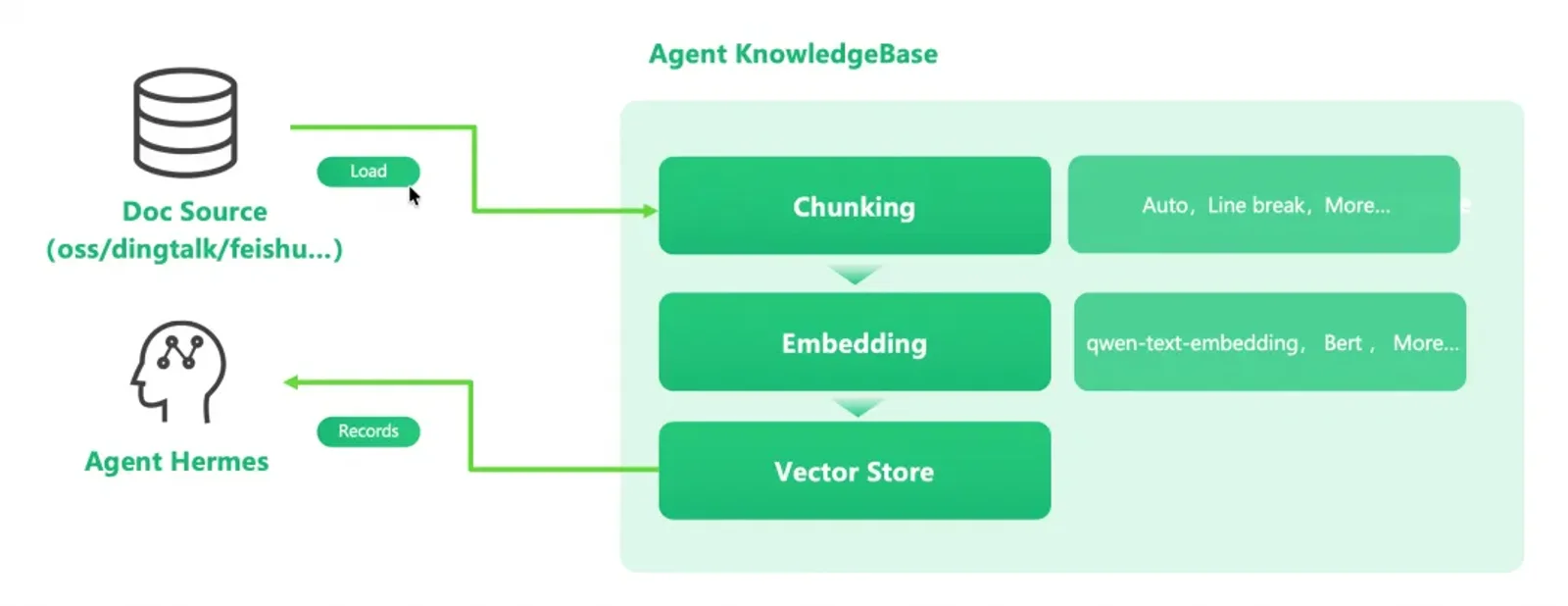
Knowledge Base: Grounding Answers in Enterprise Documents
Questions like "Who handles this type of exception order?" require consulting the enterprise's operating procedures. AgentCore Knowledge Base integrates document parsing, chunking, vectorization, and retrieval, helping developers feed business资料 into agents. Supported formats include PDF, Word (DOCX), and Markdown; bulk import from OSS and DingTalk documents is available.
Retrieval combines full-text search (suitable for product models, proper nouns, explicit clauses) and vector search (suitable for natural-language questions). Hybrid search with optional reranking adjusts the order of candidate chunks. Developers can test recall with actual business questions, inspect chunk content, and tune chunking and retrieval parameters. The application generates answers from returned chunks and cites sources at relevant conclusions for user verification.
For internal Q&A, product support, and business consulting, this means agents answer based on the enterprise's own policies and materials. When资料 update, developers replace documents, maintain chunks and metadata, keeping the knowledge base aligned with current business.
External knowledge base connection is also supported. Existing OTS Knowledge Base and Bailian Knowledge Base can be used to fulfill knowledge base requirements, offering more business choices.
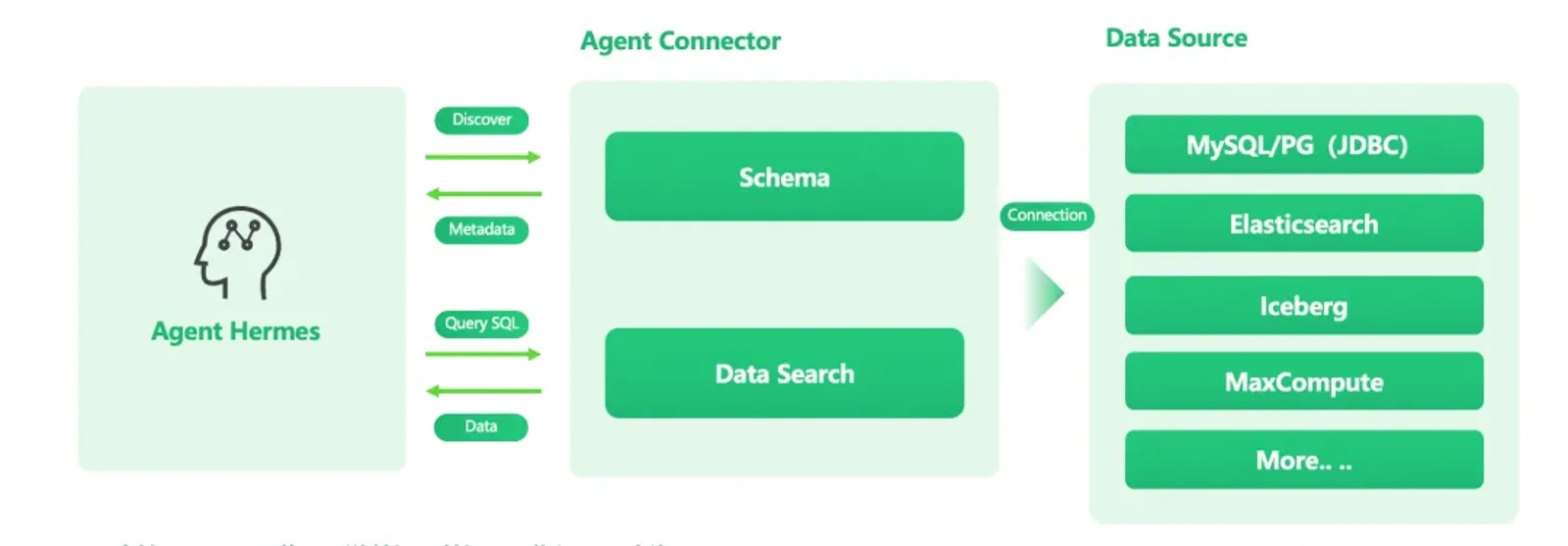
Connectors: Querying Real-Time Business Facts
Questions such as "What is the total amount of paid orders this week?" require live data from business systems. AgentCore Data Connectors support MySQL, PostgreSQL, and SLS, providing metadata browsing, sample preview, and read-only query capabilities. After configuring connection and access permissions, developers can explore tables and columns, test query logic, and bind the resulting tools to the agent.
The Zero ETL architecture keeps business data in its original systems; queries run on demand during task execution, eliminating the need to export and maintain separate data copies for the agent. An operations assistant can query orders for a specific time, warehouse, and status to compile exceptions; an ops assistant can query logs from a failure window to aid troubleshooting. The application enforces query scope via business permissions and includes time range and filter conditions in responses for user verification.
Three-Step Integration Guide
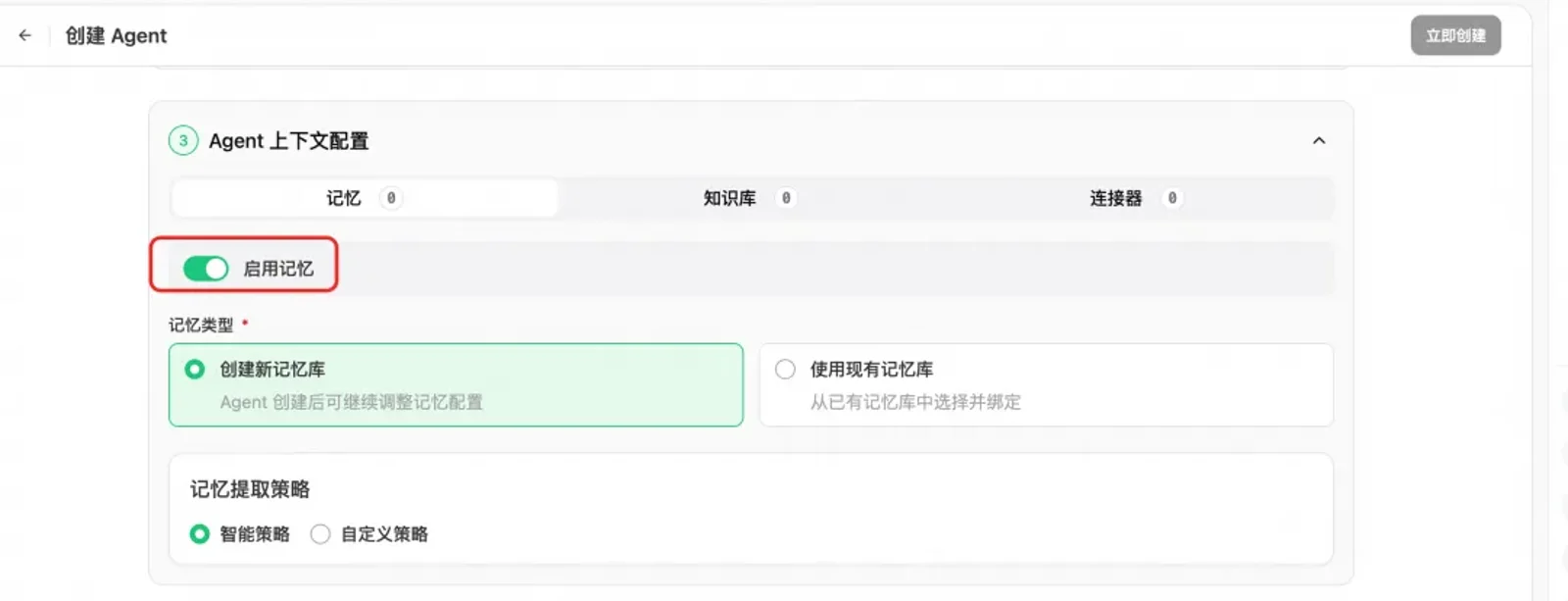
Enable Memory : In "Agent Context > Memory", create a memory resource and define extraction rules in "Memory Extraction". Start with session summary to preserve discussion points; add semantic memory, user profile, or custom extraction instructions for finer granularity. Then enable memory in the managed Harness agent's context configuration, add the memory store, and turn on session history collection.
Connect Knowledge Base : Upload business documents (product manuals, operating procedures) in PDF, Word, or Markdown, or batch-import from OSS and DingTalk. Run hit-testing, create a knowledge base connection in AgentCore, add it to the agent's tool configuration, and test recall with real business questions.
Connect Business Data : Create a connector pointing to the MySQL/PostgreSQL database holding orders and inventory, or to SLS for logs. Inspect schema and sample data in the overview, confirm data definitions, bind the connector in the agent's context configuration, and restrict query scope on the server side per business permissions.
End-to-End Example
After completing the three steps, the agent can handle the opening scenario: it retrieves exception-handling rules from the knowledge base, queries yesterday's Shanghai warehouse orders via the connector, and formats the report using the saved reporting preference from memory. New preferences and confirmed experiences are saved for future tasks.
About AgentCore
AgentCore is Alibaba Cloud's unified platform for building and governing enterprise intelligent agents, covering the full lifecycle with build/run, collaboration/governance, and observation/evaluation capabilities. It manages self-developed, open-source Harness, and commercial SaaS agents under one platform with unified authentication and team collaboration.
For questions about attribution, corrections or content rights, please contactand we will review it promptly.