

Why Enterprise AI Agent Infrastructure Requires Ontology: Fixing Semantic Misalignment
This article argues that ontology is essential for enterprise AI agent platforms because it provides a unified semantic foundation that prevents misalignment across RAG, agents, and knowledge graphs, enabling cross-departmental collaboration rather than isolated productivity tools.
Reading font
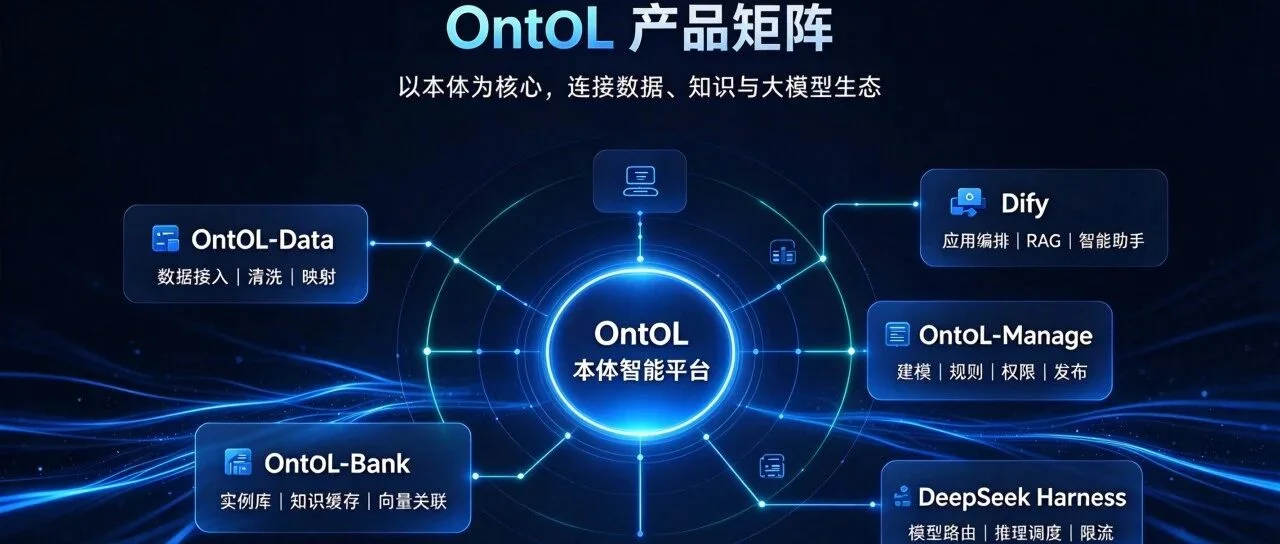
Many teams building enterprise AI and agent platforms face a critical choice: whether to invest in ontology. A common shortcut relies on large language models plus vector databases and prompts for rapid deployment, but this approach hits a ceiling — semantic inconsistency.
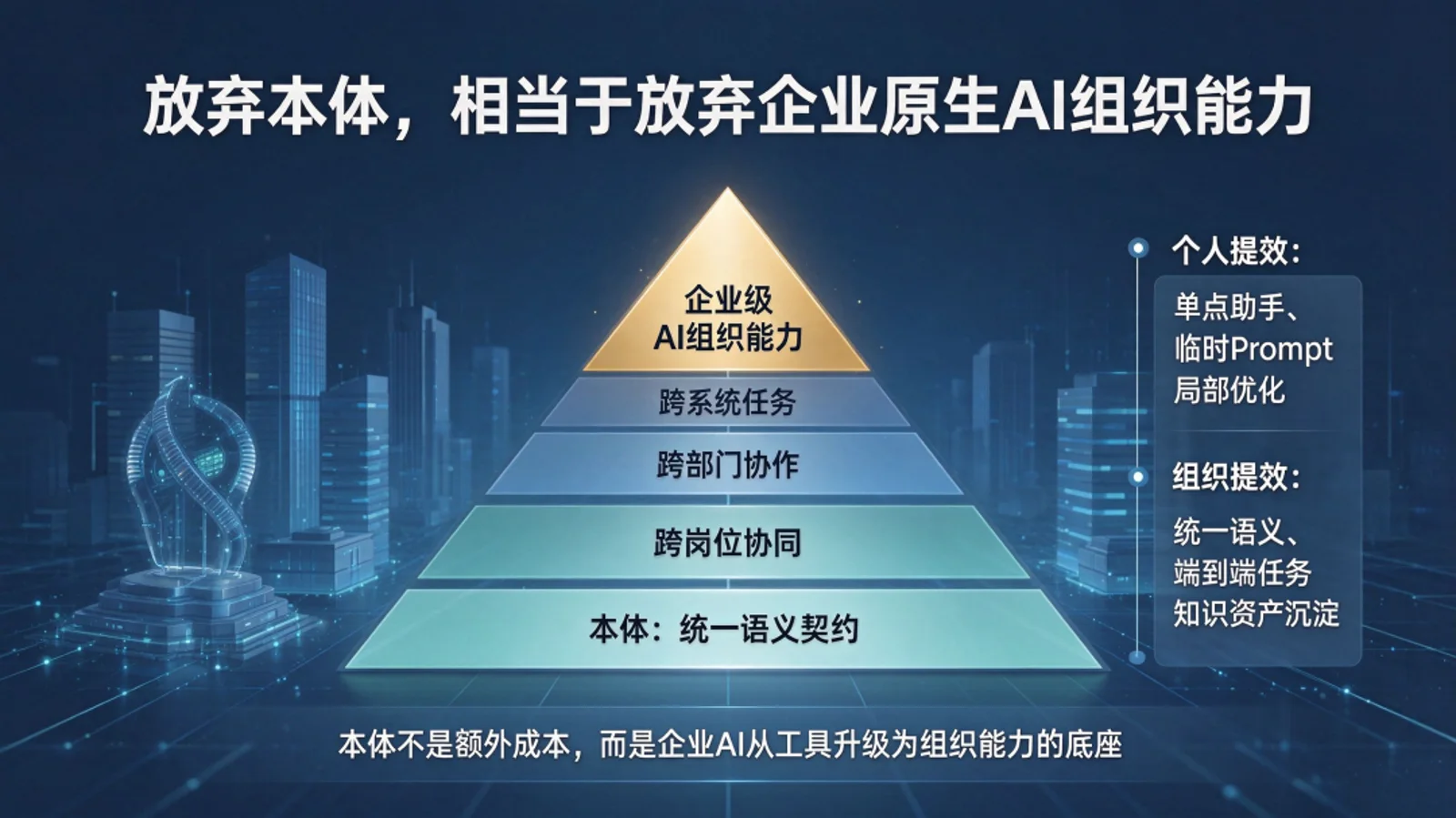
Abandoning ontology is equivalent to abandoning a standardized enterprise AI infrastructure platform. Without it, organizations can only achieve individual productivity gains, not organizational-level AI productivity.
Current hot AI technologies — RAG, agents, graph databases, and text-to-SQL — all stall in later stages due to semantic misalignment. RAG uses vector similarity to retrieve documents, judging only textual resemblance, unable to distinguish homonyms or synonyms. Agents depend on prompt-based temporary agreements that break across sessions or agents. Native graph databases store entities and relationships without business semantic constraints; the same edge can mean completely different things in different business workflows. Text-to-SQL across multiple business databases suffers from divergent field definitions — the same field name in ERP, MES, and WMS carries vastly different meanings, causing models to query wrong tables or compute wrong metrics. These technologies solve retrieval, orchestration, storage, and query problems, but none define a unified business consensus at the system level. Semantic deviation risks persist, forcing engineers to pile up manual rules and prompt patches, with maintenance costs growing exponentially.
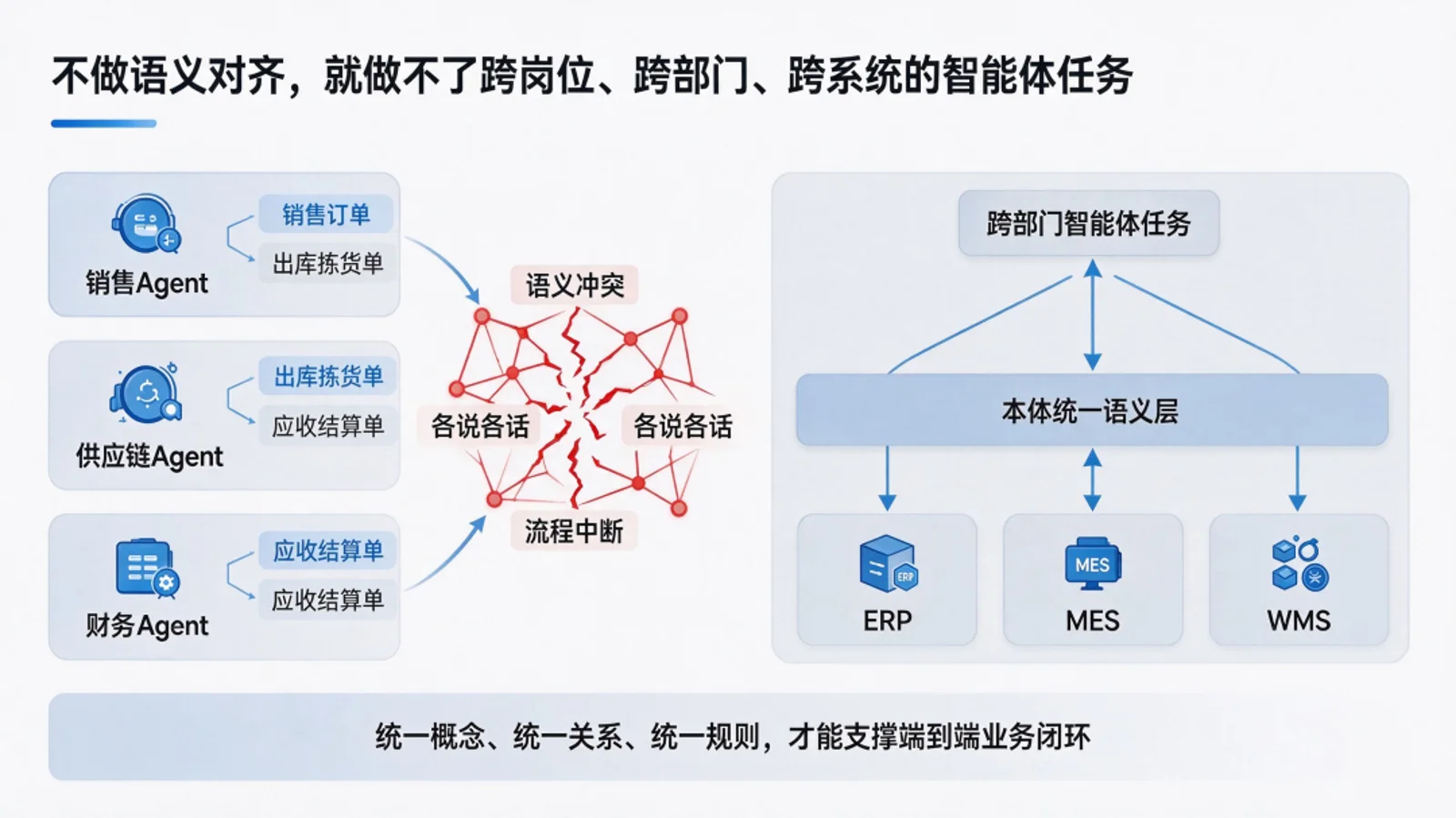
Core conclusion: without semantic alignment, cross-role, cross-department, cross-system agent tasks are impossible. Single-scenario, single-role assistants may work for personal efficiency, but once multiple roles and business systems must be orchestrated for organizational-level tasks, semantic conflicts cause agent failures.
Real-World Pain Points
Example 1: Text-to-SQL — "Production Volume" Definition Chaos
The production department's agent defines "production volume" as qualified finished goods warehoused; the planning department's agent means planned production quantity from work orders; the quality department's report includes rework output. Without unified ontology, a business user asking "query this month's production volume" gets three completely different answers. Engineers must write per-department prompts and special-case logic; each new department or system adds more adaptation rules that eventually conflict and become unmaintainable. Ontology can pre-define three distinct concepts — planned production volume , warehoused production volume , rework production volume — each bound to its data source and calculation logic. All text-to-SQL components share these definitions, automatically disambiguating at query time, eliminating definition conflicts at the source, and enabling unified data dialogue across departments.
Example 2: RAG + Cross-System Agent Collaboration — "Order" Understanding Mismatch
The sales RAG knowledge base's "order" points to sales orders linked to customers, contracts, and payments. The supply-chain agent connected to WMS treats "order" as a picking list. The finance agent recognizes "order" as an accounts-receivable settlement document. When a composite agent must "track order end-to-end", it traverses three departments and three systems, easily confusing the three document types: using a sales order to check warehouse inventory, or a picking list to reconcile with finance, breaking the reasoning chain. Pure vector retrieval and prompt hints only constrain a single conversation; swap the knowledge base or agent and the constraint vanishes. Ontology defines sales order, picking list, and settlement document as distinct subclasses, annotating inheritance relationships, associated systems, and flow rules. RAG retrieval, agent orchestration, and graph queries all reuse this semantic definition, enabling consistent understanding and smooth processes during multi-agent cross-department collaboration, achieving organizational-level end-to-end business closure.
Modern Ontology: Conversational Generation Lowers the Barrier
Many still associate ontology with heavy, tedious manual modeling requiring ontology engineers and business experts to spend months defining concepts, relationships, and axioms — long cycles, high costs, no immediate business payoff, earning labels of "heavy, slow, impractical." This is why projects skip ontology.
But today's ontology products have changed. Next-generation tools enable conversational ontology generation . Business users describe business objects, rules, and upstream/downstream relationships in natural language; the system generates an initial ontology model, followed by light validation and correction. The modeling barrier drops dramatically, making the ontology route the lowest total cost of ownership for enterprise agent platforms.

Ontology as Semantic Contract, Not Patch
The fundamental difference between ontology and the aforementioned technologies is that ontology solves semantic misalignment at the source , not by patching afterward. It solidifies enterprise business concepts, attributes, relationships, and constraints into a machine-readable semantic contract that all roles adhere to. RAG knowledge bases, agents, knowledge graphs, data warehouse metrics, and business databases all mount onto the same ontology framework. Instead of letting LLMs "guess business meaning," ontology explicitly defines: what an object is, its relationships to other objects, and mandatory business rules. The same term has a single, deterministic semantic definition across the entire platform, natively eliminating homonyms, synonyms, and metric definition chaos. This unified semantic contract is the foundation of enterprise AI organizational capability.
When Ontology Is (and Isn't) Necessary
Ontology is not a silver bullet. Conversational generation still requires business expert review and calibration. Simple single-point chat assistants or short-term throwaway AI apps can indeed skip ontology for rapid validation and personal efficiency gains. But for long-term, iterable, multi-system integration, multi-agent collaboration, and knowledge asset accumulation in enterprise AI infrastructure, relying solely on vectors, prompts, native graphs, and isolated query scripts leads to compounding semantic debt. AI applications remain siloed, unable to interoperate or reuse, forever stuck as "personal small tools."
Lightweight ontology provides a stable, unified semantic base for all upper-layer AI applications: business participates in modeling at low cost; RAG, agents, text-to-SQL, and graph applications share the same understanding standard; enterprise knowledge assets continuously accumulate, govern, and reuse — truly upgrading AI from personal assistant to organizational capability. Building agents, you can bypass ontology for short-term speed and point efficiency; but to build a long-term evolvable, trustworthy, controllable, cross-system collaborative enterprise AI infrastructure platform — forging the enterprise's own AI organizational capability — ontology is the indispensable cornerstone.
For questions about attribution, corrections or content rights, please contactand we will review it promptly.