

Anthropic Agent Skills: Modular Domain Knowledge for AI Agents
Anthropic's Agent Skills framework enables AI agents like Claude to dynamically load domain-specific knowledge and executable scripts through a standardized directory structure, using a three-layer progressive disclosure mechanism to balance context window limits with comprehensive expertise, complementing MCP for complex workflow automation.
Reading font
What Are Agent Skills?
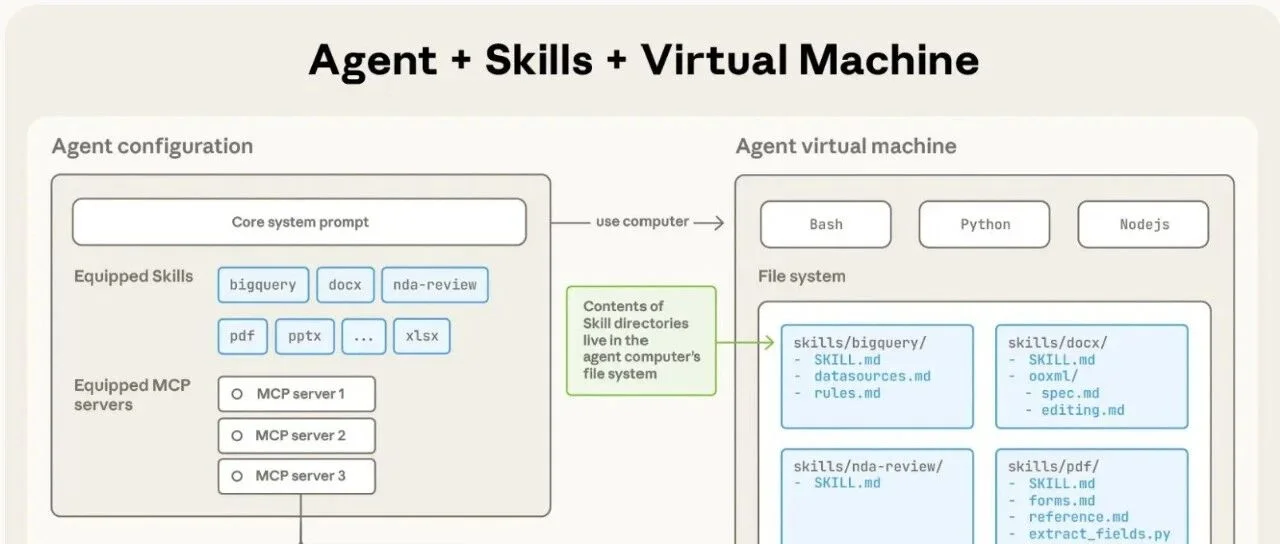
As large language models evolve, AI is transitioning from pure conversationalists to agents capable of executing tasks in complex computing environments. However, general-purpose LLMs often lack domain-specific procedural knowledge and organizational context. To address this, Anthropic introduced Agent Skills — a standardized file and folder structure that equips agents like Claude with domain expert knowledge.
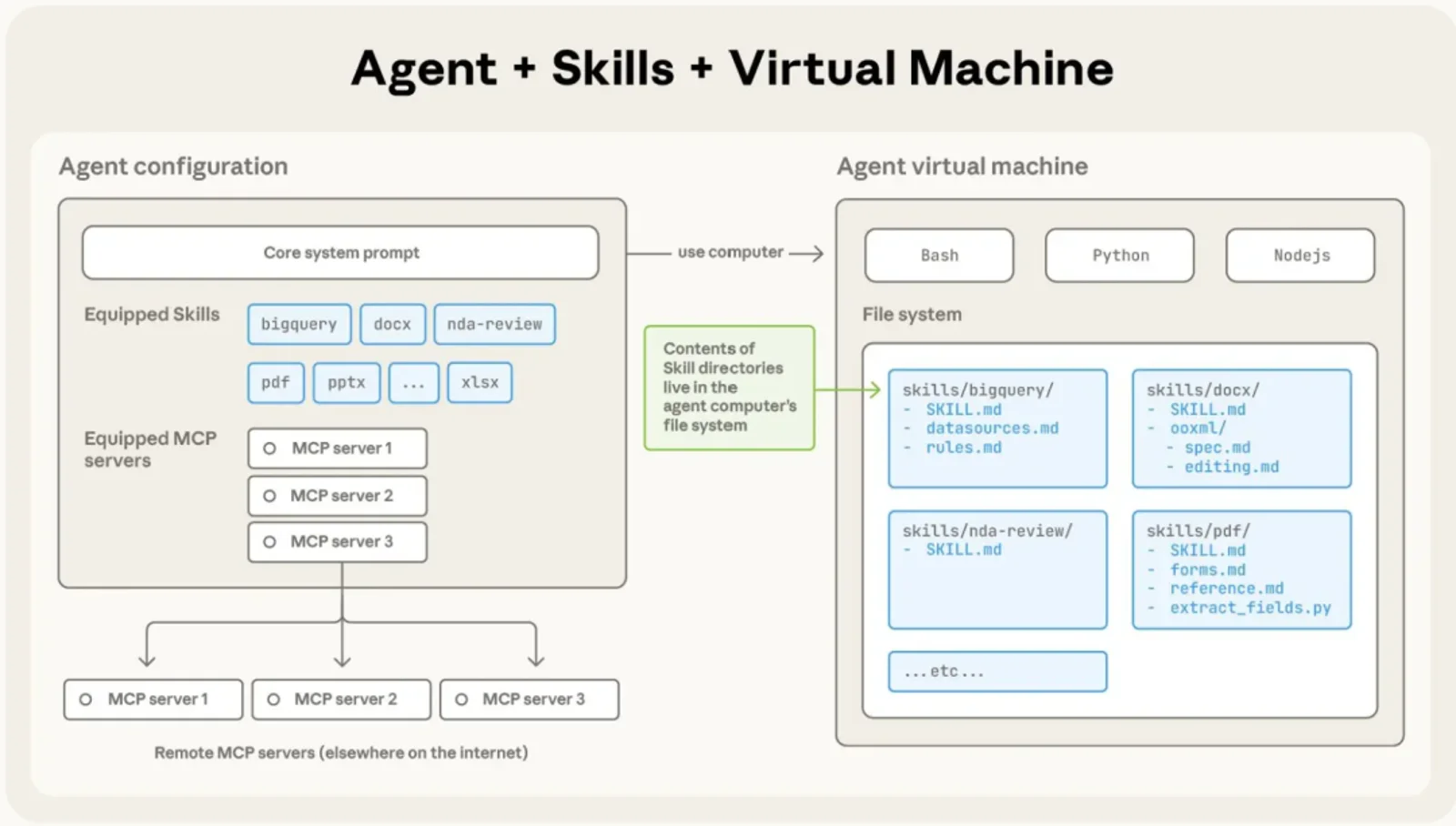
At its core, an Agent Skill is a structured directory containing not only instructions but also scripts and resource files. This allows developers to package complex business logic and operational procedures so that Claude can dynamically discover and load these capabilities. The philosophy is akin to preparing an "onboarding guide" for a new employee: instead of building fragmented custom agents for each use case, expertise is modularized for composition, extension, and cross-platform portability.
Technical Structure
Core Component: SKILL.md
A standard Agent Skill must include a SKILL.md file at the root. Its structure follows the principle of progressive disclosure . The file begins with YAML frontmatter metadata:
name : Unique identifier for the skill.
description : Brief summary of the skill's functionality.
Three-Layer Information Disclosure Architecture
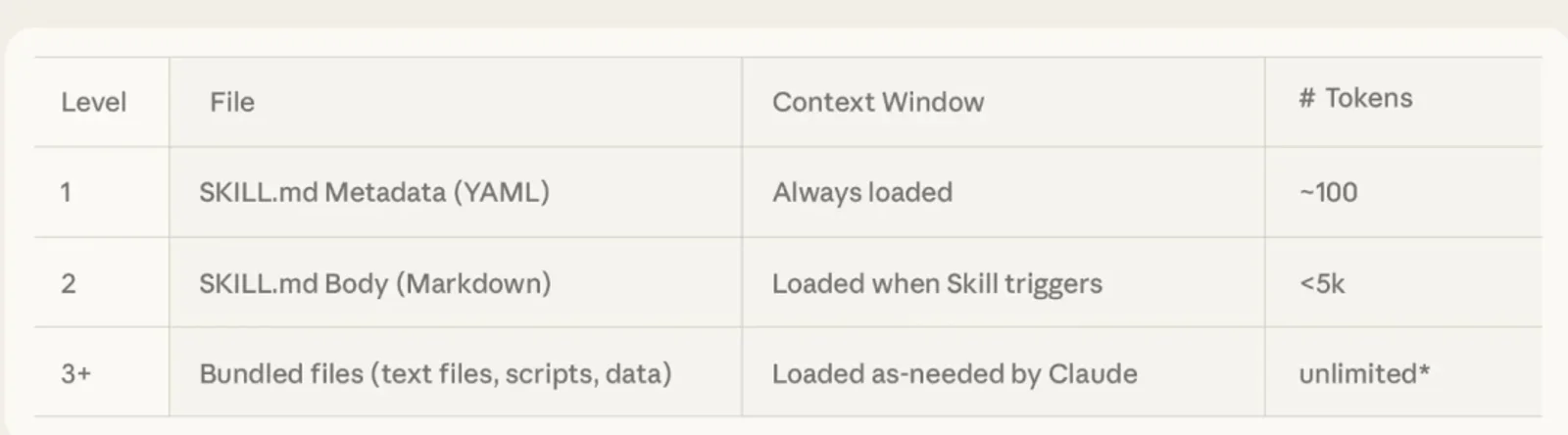
To balance model comprehension with context window constraints, Agent Skills employ a three-layer loading mechanism:
Layer 1 — Metadata (Name/Desc)
Granularity : Metadata only (name and description)
Trigger Mechanism : Loaded into system prompt at startup
Purpose : Lets Claude know the skill exists and its applicable scenarios without consuming excessive context.
Layer 2 — SKILL.md body
Granularity : Full Markdown content of SKILL.md Trigger Mechanism : Claude triggers proactively based on task needs
Purpose : When Claude judges a task relevant, it invokes a tool to read the full Markdown content.
Layer 3 — Associated files & scripts
Granularity : Referenced files and scripts (e.g., forms.md, utils.py)
Trigger Mechanism : Claude navigates and discovers on demand
Purpose : Files referenced in SKILL.md load only when specific subtasks require them.
Runtime Mechanism
Dynamic Loading Flow
When a user sends an instruction, Claude does not load all skills. The internal logic proceeds as follows:
Identify : Claude scans installed skill descriptions in the system prompt.
Trigger : If a match is found, Claude calls the Bash tool to read SKILL.md.
Deepen : If SKILL.md points to deeper resources (e.g., PDF processing specifications), Claude continues reading child files.
Code Execution
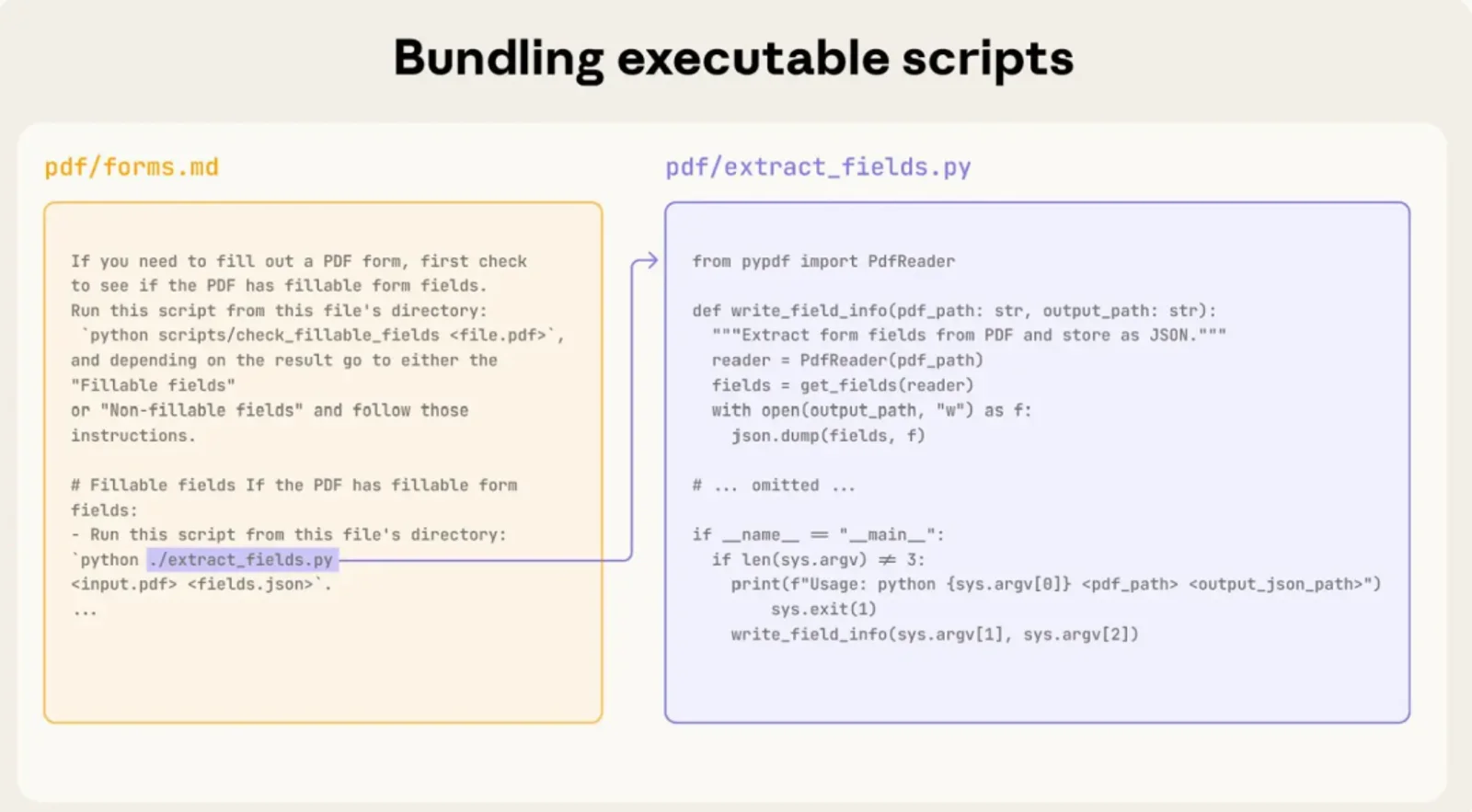
Agent Skills are not merely static documents; they can contain executable scripts (Python, Bash, etc.).
Determinism : For tasks like sorting or data extraction, traditional code execution is cheaper and more reliable than token generation.
Seamless execution : Claude can run scripts inside the environment without loading the entire script or large datasets into context, retrieving only the results.
Example : A PDF processing skill may include a Python script to extract form fields. When Claude identifies the need, it directly invokes the script, ensuring operational precision.
Developer Guide: Best Practices
Official recommendations for building high-quality skills:
Start with evaluation : Observe where the agent underperforms or lacks context, then write skills targeting those gaps.
Structure for expansion : When SKILL.md grows too large, split into child files. Separate mutually exclusive or rarely co-used information to save context.
Adopt the model's perspective : Polish name and description — these are the sole basis for Claude deciding whether to activate the capability.
Iterate and evolve : During conversations, ask Claude to summarize successful operation paths or error-avoidance lessons directly into the skill's code or documentation.
PowerPoint Skill Demo
Using the PowerPoint skill to create a renewable energy presentation. The skill is specified via the Messages API:
import anthropic

client = anthropic.Anthropic()

# Create a message with the PowerPoint Skill
response = client.beta.messages.create(
    model="claude-sonnet-4-5-20250929",
    max_tokens=4096,
    betas=["code-execution-2025-08-25", "skills-2025-10-02"],
    container={
        "skills": [
            {
                "type": "anthropic",
                "skill_id": "pptx",
                "version": "latest"
            }
        ]
    },
    messages=[{
        "role": "user",
        "content": "Create a presentation about renewable energy with 5 slides"
    }],
    tools=[{
        "type": "code_execution_20250825",
        "name": "code_execution"
    }]
)

print(response.content)
When the user requests a presentation, Claude automatically matches the task to the PowerPoint skill, loads its full instructions (Layer 2 progressive disclosure), then executes the skill code to create the slides.
Security & Ecosystem Integration
Security Considerations
Because skills can contain executable code, Anthropic emphasizes:
Trusted sources : Only install skills from trusted origins.
Audit mechanism : Before installing third-party skills, inspect dependencies, network request behavior, and script logic.
Future Ecosystem: MCP Complement & Self-Evolution
Agent Skills currently support Claude.ai , Claude Code , and the Claude Agent SDK .
MCP complementarity : Skills will collaborate with the Model Context Protocol (MCP), teaching agents how to handle complex workflows involving external tools and software.
Self-evolution : The vision is for agents to autonomously create, edit, and evaluate skills, codifying their own behavioral patterns into reusable capabilities.
Summary
Agent Skills decouple procedural "how-to" knowledge from the model itself, transforming it into pluggable directory structures. This lowers the barrier to building high-performance agents and establishes a foundation for sharing and standardizing AI capabilities.
For questions about attribution, corrections or content rights, please contactand we will review it promptly.