

Claude's Agent OS: How Prompts, Skills, Projects, MCP & Subagents Work Together
This article analyzes Anthropic's Claude agent architecture, explaining how Prompts, Skills, Projects, Subagents, and MCP form a layered system for scalable AI agents, with a comparison table and a competitive research agent example showing component integration.
Reading font
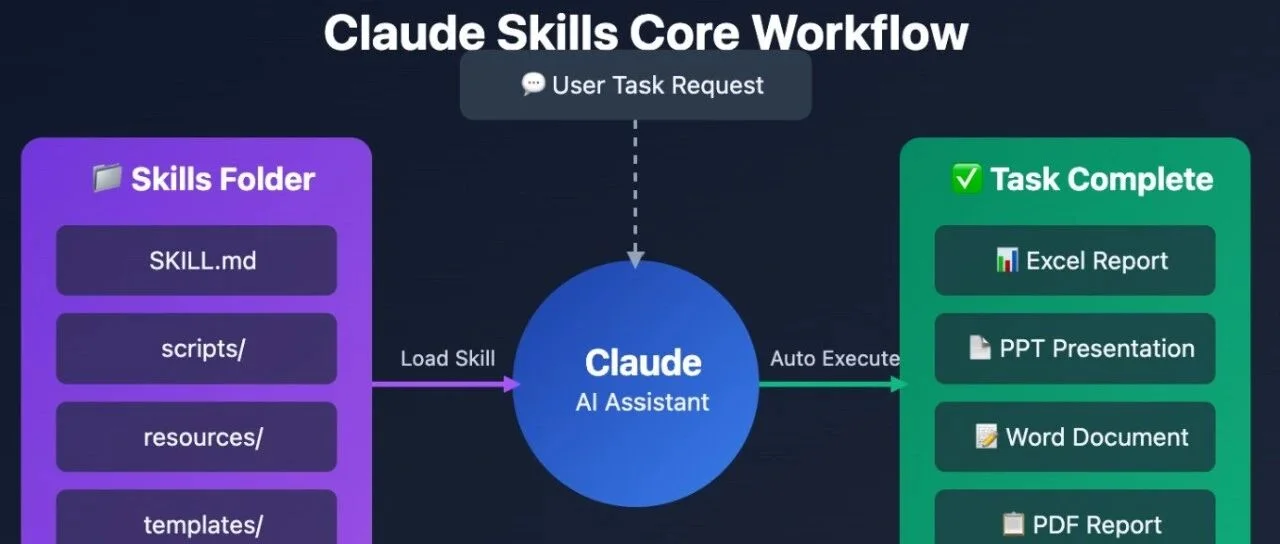
Anthropic's late-2025 introduction of Skills prompted developers to explore how Claude's ecosystem components — Prompts, Skills, Projects, MCP, and Subagents — fit together. Based on Anthropic's official "Skills explained" document, this analysis examines the architecture from a software engineering perspective.
Why Prompts Alone Cannot Scale
In early LLM applications, Prompts carried all responsibilities: task context, steps, output format, and even control logic. This works for demos but fails in production. A Prompt is an ephemeral input valid only for the current session; repeating the same instructions across conversations is inefficient. Complex Prompts become super-long documents that consume context windows. Claude deliberately limits Prompt responsibility to "what you want the Agent to do right now," not "who the Agent is, what it knows, or how it should work." This boundary enables the subsequent component design.
Skills: Turning Repeated Instructions into Reusable Capabilities
Skills represent capability engineering . If a Prompt is an ad-hoc instruction, a Skill is a pre-written operating manual, work specification, or professional guide that lets Claude permanently master a way of working . The rule of thumb: if you repeatedly paste the same prompt across conversations, create a Skill.
A Skill is a folder containing instructions, scripts, and resources. Claude dynamically discovers and loads relevant Skills. From an engineering view, Skills solve capability reuse — avoiding copy-paste of instructions. Crucially, Skills use Progressive Disclosure : the system loads only minimal metadata first to judge relevance, then loads full content only when needed. This embodies a mature design principle: capabilities are resident, but context is consumed on demand .
Projects: Long-Lived Workspaces with Persistent Context
If Skills answer "how the Agent works," Projects answer "what context the Agent relies on." A Project is a self-contained workspace with its own chat history and knowledge base. Each Project provides a 200k context window where you can upload documents, supply context, and set custom instructions for all conversations within that Project.
Projects supply long-term context for a specific work object — a codebase, research project, or client engagement — while Skills teach "how to do things." Example: a Project holds all product-launch background; a Skill teaches the team's writing style or code-review process. If you copy the same instructions across multiple Projects, that signals those instructions should become a Skill. Projects package "knowledge base + conversation history + instruction constraints" into a persistent workspace . When context nears the limit, Claude automatically switches to RAG mode to extend capacity , making Projects practically scalable.
Subagents: Parallel Execution Units with Isolation
Unlike systems where "multi-agent" is only a logical distinction sharing context and permissions, Claude's Subagents are true parallel execution units . Each Subagent has:
Independent context window
Independent system Prompt
Explicit tool-access permissions
This suits well-scoped, risk-contained subtasks like code review, security analysis, or test generation. Engineering value is twofold: (1) solves context pollution — the main Agent keeps high-level logic clean while delegating details; (2) provides natural permission isolation — e.g., a review Agent gets read-only code access. Subagents are not for shared general capabilities ; knowledge needed by multiple Subagents should be encapsulated as a Skill, not duplicated in each system Prompt.
MCP: The Universal Data Connection Layer
No matter how clever the internal Agent design, without stable access to real data and tools it remains a chat assistant. MCP (Model Context Protocol) is neither a capability nor knowledge, but a connection layer . Via MCP, Claude can uniformly access:
Internal document systems
Code repositories
Databases
Local development environments
Various business systems
Architecturally, this means Agents no longer depend on one-off file uploads but can continuously, dynamically perceive real-world changes . MCP and Skill division is clear: MCP handles "can we connect to the system," Skill handles "how to use it correctly once connected."
A Complete Agent Operating System
Together these components form a near Agent OS structure :
Prompt : Instant control interface
Skill : Capability module
Project : Stateful workspace
Subagent : Parallel execution & responsibility isolation
MCP : I/O layer for real-system interaction
This layered design transforms an Agent from "one big Prompt" into a system that can run long-term, evolve continuously, and be managed with engineering rigor.
Component Comparison
The article provides a detailed comparison across five dimensions:
Content provided : Skills = procedural knowledge (how-to); Prompts = immediate/sentence-level instructions; Projects = background knowledge (known information); Subagents = task delegation (autonomous execution); MCP = tool/data connectivity.
Persistence : Skills persist across conversations; Prompts last only a single conversation; Projects persist within the Project; Subagents persist across sessions; MCP provides persistent connections.
Elements included : Skills contain instructions + code + resources; Prompts are natural language; Projects hold documents + context instructions; Subagents encapsulate full Agent logic; MCP defines tools and interfaces.
Load timing : Skills load on-demand (dynamic); Prompts load every turn; Projects stay active within the Project; Subagents load when invoked/triggered; MCP is always available.
Contains code : Skills yes; Prompts no; Projects no; Subagents yes; MCP yes.
Best-fit scenarios : Skills for domain expertise (e.g., specific analysis models, coding standards); Prompts for quick one-off requests (e.g., polishing, short summaries); Projects for centralized context (e.g., product roadmap, team doc library); Subagents for specialized independent tasks (e.g., code review, automated testing); MCP for data access (e.g., connecting Google Drive, GitHub, databases).
Wiring the Components: Competitive Research Agent Example
The article walks through building an automated competitive-research Agent:
Set up Project (knowledge base) : Create "Competitive Intelligence" Project, upload existing industry reports and product roadmaps.
Connect MCP (data access) : Enable Google Drive MCP (read internal research) and Web Search MCP (fetch latest real-time info).
Load Skill (analysis model) : Load a Competitive-Analysis Skill defining standard SWOT format and company-specific evaluation dimensions.
Orchestrate Subagents (execution) : market-researcher: searches market-share data. technical-analyst: uses code-search tools to analyze competitors' open-source repos.
Instant Prompt (fine-tune) : In conversation, input: "Re-evaluate the above analysis for enterprise healthcare clients."
This demonstrates how each component plays a distinct role: Project holds long-term context, MCP fetches live data, Skill encodes the analytical framework, Subagents execute specialized subtasks in isolation, and Prompt steers the immediate focus.
Conclusion
Claude's Skills, Projects, Subagents, and MCP address inevitable real-engineering problems : context management, capability reuse, task division, and system integration. For teams building enterprise AI Copilots, internal intelligent assistants, or next-gen automation workflows, this architecture offers a reference answer:
Don't stuff everything into the Prompt; design the Agent like you design a software system.
For questions about attribution, corrections or content rights, please contactand we will review it promptly.