

Apache Jena Reasoning in Production: Choosing Forward, Backward, RETE & Hybrid Strategies
This article analyzes Apache Jena reasoning strategies (forward, backward, RETE, hybrid) for enterprise knowledge graphs, using manufacturing scenarios to illustrate trade-offs in performance, caching, persistence, and Agent integration, with concrete rules, configuration parameters, and deployment steps.
Reading font
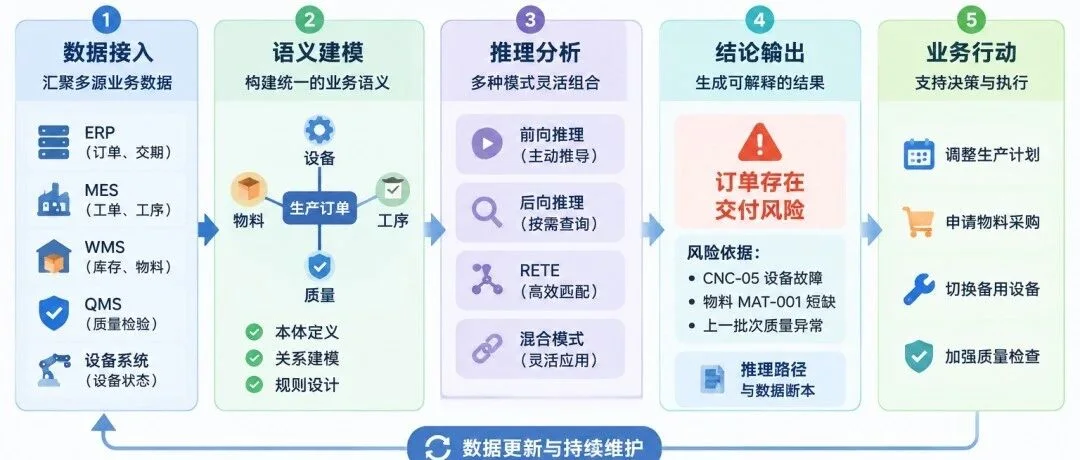
Core Concepts: RDF, OWL, Rules, and SPARQL
The article begins by distinguishing the roles of RDF, OWL, rules, and SPARQL in a manufacturing knowledge graph. RDF captures facts as triples (e.g., CNC-001 belongsTo Workshop-01, Order-1001 usesMaterial Material-A). OWL defines class hierarchies and property constraints (e.g., CNC machine ⊑ machining equipment ⊑ production equipment). Rules encode business logic, such as flagging an order as risky when it requires a faulty machine. Jena's rule syntax example:
[risk1: (?o eg:status eg:InProduction) (?o eg:requiresMachine ?m) (?m eg:status eg:Fault) -> (?o eg:hasRisk eg:EquipmentFailureRisk)]SPARQL queries the graph. Jena unifies RDF modeling, SPARQL querying, and rule reasoning in one stack.
Pitfall: Jena's built-in OWL reasoners cover only a useful but incomplete subset of OWL/Lite; for full OWL DL reasoning, external reasoners like Pellet, Racer, or FaCT are required. Verify needed semantic features are supported before starting.
Reasoning Strategies: Forward, Backward, RETE, Hybrid
Forward Chaining
From known facts, repeatedly fire matching rules, adding new conclusions to the result set. Example: given facts that CNC-001 is faulty and Order-1001 requires it, the rule derives Order-1001 hasRisk EquipmentFailureRisk. Benefits: pre-computes conclusions for frequent reads (e.g., production dashboards). Costs: more rules and complex relationships increase materialized conclusions; every data change triggers incremental maintenance. Jena's forward mode treats all rules as forward, even those written with backward syntax ( <-), enabling easy performance comparison across modes.
Backward Chaining
Starts from a query goal (e.g., "Does Order-1001 have equipment failure risk?") and recursively seeks supporting facts. Jena uses a tabled Datalog engine (Prolog-like). Suits explicit, limited queries over large rule scopes (e.g., quality engineer tracing one batch). Drawback: recursive traversal or repeated fact access increases latency; high query volume compounds cost. Table caching reuses subgoal results across queries; reset() clears caches, trading memory for slower subsequent queries. Any model add/remove triggers internal reset, rebuilding from scratch. Hard limit: backward rules may have only one head (conclusion).
RETE Algorithm
Optimizes forward matching by building a discrimination network that retains partial match state. New facts reuse existing matches, avoiding full re-scan. Jena's default forward engine is based on Forgy's 1982 RETE paper, targeting incremental change. Example: many rules checking workshop, machine status, and order-machine links benefit from incremental matching. Trade-off: RETE consumes more memory for the network and intermediate state; performance depends on data scale, rule structure, and update frequency. Jena retains a non-RETE forward implementation that can be faster in some cases.
Hybrid (Default)
Combines forward pre-computation with backward query-time reasoning. Forward engine runs first, materializing deductions in a deductions store. Forward rules that assert backward rules are instantiated and passed to the backward LP engine. Queries are answered by merging supplied rules, generated rules, raw data, and inferred data. Critical: no cycles between phases; forward matching never invokes backward rules. Design implication: premises needed for forward pre-computation must be reachable by forward rules (e.g., RDFS subPropertyOf chains). In manufacturing, stable relations (device classification, process hierarchy) are pre-computed; per-order risk is derived at query time.
Timing: When to Compute
Three engineering choices:
On write: Trigger reasoning immediately after data changes (e.g., device status flip). Good for high timeliness, controllable rule scope; risk of heavy write latency if change cascades.
Scheduled batch: Periodic full recomputation (e.g., nightly). Easier resource control, suits non-real-time analytics; results have staleness — consumers must know data snapshot timestamp.
On query: Real-time reasoning per request. Fits infrequent, well-scoped queries (e.g., ad-hoc quality trace). Latency grows with recursive data access.
Real projects mix them: stable relations pre-computed, business-state-dependent results updated by frequency, complex traces left to query time.
Caching: What It Solves and What It Doesn't
Hierarchy cache: Jena's PROPenableTGCCaching inserts a TransitiveReasoner to cache transitive closure of subClass and subProperty (e.g., CNC ⊑ machining ⊑ production). RDFS reasoner does this natively.
Backward table cache: Memoizes subgoal results across recursive queries.
Application-level cache: Business services cache frequent results (device status, order risk summaries) by business keys.
Invalidation challenge: Adding facts is easy; deleting/modifying is hard because a conclusion may have multiple supporting rule paths. Example: Order-1001 flagged for both equipment failure and material shortage. If equipment recovers but material shortage persists, blindly removing all risk flags is wrong. Cache design must track provenance, dependencies, and invalidation conditions.
Rule: High hit rate never replaces correctness verification.
Persistence: Storing Inferred Results
As graph grows, persisting inference results offloads query-time computation. Architecture: daily ETL from ERP/MES/WMS/device systems → reasoning → write results to persistent store. Jena's TDB2 provides RDF storage; Fuseki serves SPARQL and can mount inference models. Separate raw graph (facts) from inferred graph (derived conclusions: order risks, device impact scopes, quality links). Benefits: clear separation, independent reasoning jobs, versioned data/rule/model lineage for audit.
Consistency detail: If raw data changes mid-reasoning, output may mix old and new snapshots. Fix: pin input data version per reasoning job, validate results, then atomically publish (transaction or pointer swap). Discard and recompute if input version changed. TDB2 uses tdb.lock to prevent multi-JVM corruption; coordinate concurrent access via Fuseki, not direct directory sharing.
Benchmarking: Beyond Single-Query Latency
Break down end-to-end timing:
Data ingestion latency (ERP/MES/WMS → facts)
Reasoning initialization (rule load, ontology binding, model creation)
Reasoning compute (facts processed, conclusions generated, CPU/memory)
Query latency (SPARQL response, recursive reasoning triggers)
Result serialization & network transfer
Model call latency (if Agent/LLM involved) — record separately to isolate engine performance.
Metrics: mean, P50, P95, memory footprint, data update latency, concurrent query throughput. P95 matters: a few slow complex queries ruin user perception even if average looks good. Always verify result correctness alongside performance — a fast engine that misses risks is useless.
Decision Framework for Manufacturing Projects
Ask five questions:
What do users actually query? Fixed frequent queries → pre-compute; ad-hoc traces → backward.
How often does data change? Stable taxonomy → pre-compute; volatile statuses → incremental + cache invalidation.
Query latency budget? Dashboards need speed → materialized views; engineers tolerate latency for full provenance.
Resource budget? Forward/RETE generate many conclusions and state; persistence adds storage.
Cost of wrong conclusion? Advisory display → lower risk; drives scheduling/dispatch/quality release → strict validation, permissions, human review.
Explainability? System must cite facts, rules, data versions for each risk flag.
Mapping table (for initial screening only; final choice requires real-data testing):
Stable relations, frequent queries → Forward + pre-computation
Clear query target, large reasoning scope → Backward
Many rules, continuous incremental fact changes → RETE forward
Mix of pre-computable and on-demand parts → Hybrid
Fast read access needed → Persist + cache results
High data volatility, strict freshness → Incremental update + conditional recomputation
Agent Integration: Reasoning ≠ Authorization
Agents translate natural language to graph queries, retrieve verified inference results, and explain them. Example: "Which orders may miss delivery due to equipment failure?" → Agent queries graph → returns analyzed list. Follow-up: "Can we switch this order to a backup machine?" → Agent checks backup status, capacity, process fit → proposes candidates. Actual rescheduling requires separate business APIs with permission checks and approval workflows. Inference that a machine can perform a process does not grant operation rights; quality approval is separate. Production systems must separate query/reasoning from mutating business actions.
Operations: Sustaining Correctness in Production
Data lineage: Every critical fact traceable to source system, record, ingestion time.
Rule versioning: Changing a threshold (e.g., downtime trigger from 2h to 30min) may flip risk status for many orders; system must know affected conclusions.
Explainable results: Store not just conclusions but supporting facts, rules, data/rule versions.
Cache/persistence update logic: Define which changes trigger partial recompute vs full rebuild.
Open-world handling: OWL's open-world assumption means absent fault record ≠ healthy. Distinguish unknown, normal, abnormal, data error. Agent must not guarantee health from missing fault data.
Structure vs authorization: SHACL validates RDF shape (required properties, types); it does not confer business operation permissions — security policies and business systems own that.
Rollout Roadmap: Start Small, Expand Gradually
Define business problem: e.g., equipment risk identification for production orders.
Model data relations: Extract order, device, process, material from ERP/MES/device/quality systems into RDF.
Define ontology & rules: Describe relations, then risk rules; rules must be understandable by business and verifiable by devs.
Select reasoning strategy: Benchmark forward, backward, forwardRETE, hybrid with same rule set (Jena makes switching trivial). Don't default to hybrid without testing.
Design result storage: Decide real-time vs cached vs persisted; tag results with data/rule versions.
Build test suite: Real data covering normal, device fault, material shortage, recovery, cancellation — each with expected outcomes.
Integrate read-only first: Validate query results and explanations. Add write actions later with auth/audit.
Continuous monitoring: Reasoning time, query latency, memory, correctness rate, data freshness, rule change impact.
Begin with one order type, its devices, processes, materials, and risk rules. Validate with real data. Then expand to quality traceability, maintenance, scheduling. Value emerges incrementally. Jena's reasoning is learnable; the hard part is managing daily data flux while business users trust the output. Keep facts, reasoning, queries, and business operations separately governed — especially as Agents join the stack.
For questions about attribution, corrections or content rights, please contactand we will review it promptly.