

AutoVLA-D: Discrete Action Tokens as Trajectory-Geometric Condition for VLA Planning
AutoVLA-D introduces a two-stage framework where discrete action tokens (TrajCond) serve as an intermediate condition between driving reasoning and continuous waypoint prediction, using a 1D-Brohan tokenization scheme. Experiments on NAVSIM, nuScenes, and NeuroNCAP show improved planning metrics and collision rates, with visualizations confirming TrajCond encodes driving behaviors.
Reading font
Background: Autoregressive VLA and Trajectory Representation
Autoregressive Vision-Language-Action (VLA) models for autonomous driving follow a workflow: visual input + language instruction → intermediate reasoning → decode future trajectory. Trajectories are typically represented as continuous waypoint tokens (e.g., ImpromptuVLA, CuriousVLA, DriveTeach-VLA) which fit the next-token prediction paradigm. However, driving instructions describe actions (turn left, go straight, decelerate) rather than numerical coordinates. The authors question whether unguided learning of continuous waypoints makes it hard for the model to understand the underlying actions. An alternative is discrete action tokens that discretize local motion into a codebook, but simply replacing the SFT target with discrete trajectories may not outperform continuous waypoints.
Key Insight: Discrete Tokens as Intermediate Condition
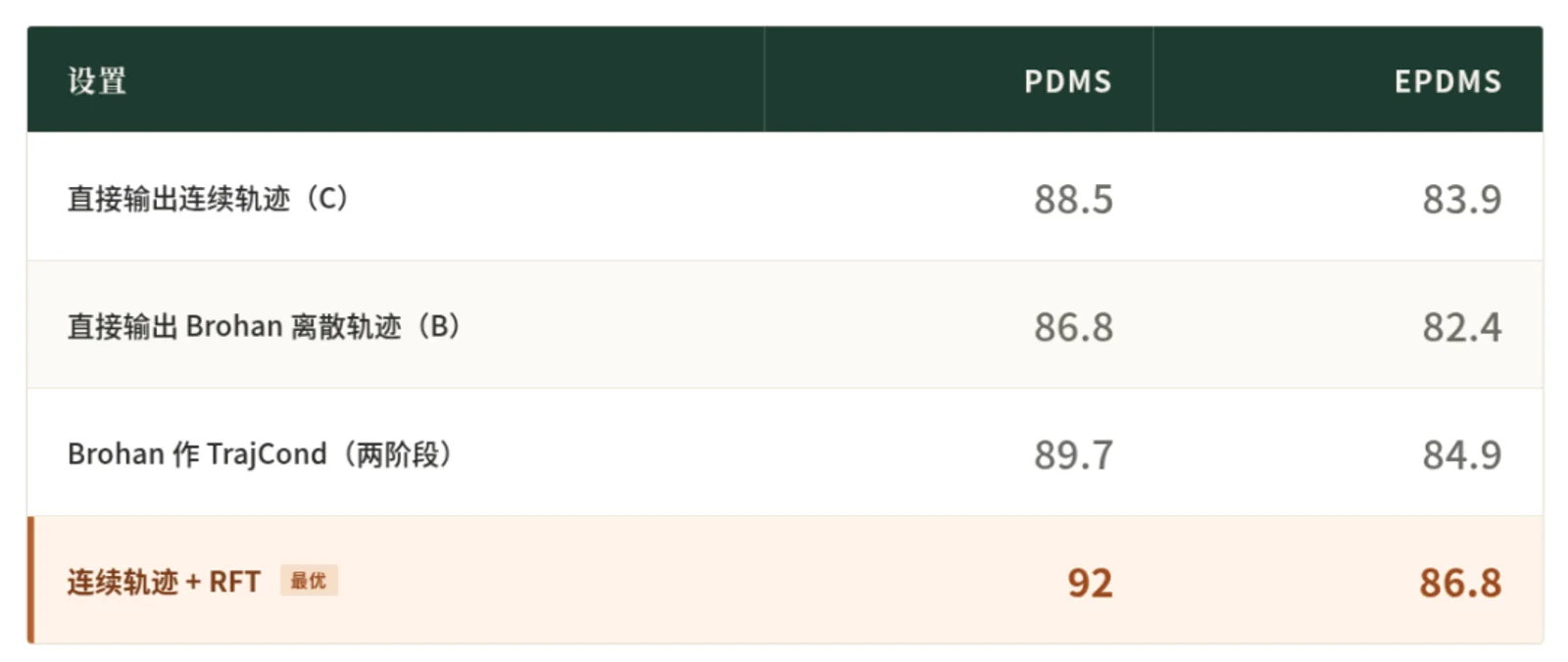
Ablation experiments reveal that directly outputting discrete trajectories performs worse than continuous waypoints due to quantization loss and token prediction difficulty. However, generating discrete tokens first and then using them as a condition to predict continuous waypoints yields better results than using continuous trajectories as the intermediate condition. The paper therefore defines the discrete action sequence as a trajectory-geometric condition (TrajCond) , letting it express how the vehicle moves at each step before guiding fine-grained trajectory generation.
1D-Brohan Action Tokenization
To construct TrajCond, the future trajectory is converted into local actions relative to the vehicle's previous position and heading, using three dimensions: longitudinal displacement, lateral displacement, and heading change. Three tokenization methods are compared:
K-Means : clusters similar 3D motions into a codebook.
K-Disks : covers action space with representative motions using a different codebook construction.
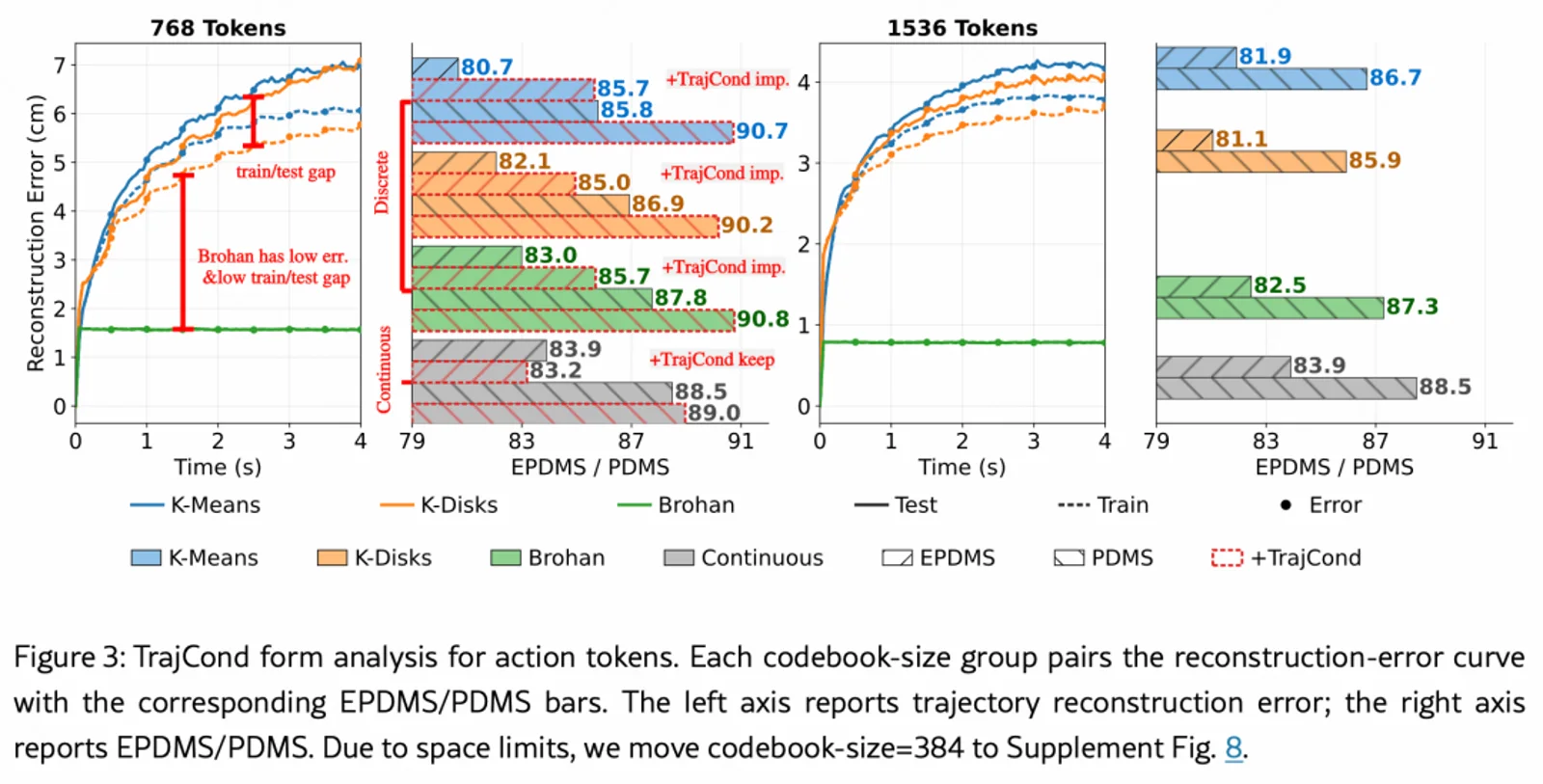
1D-Brohan : independently bins each dimension into 256 uniform bins based on the 1st–99th percentile range of training data, yielding a 768-token vocabulary (256 × 3). Each timestep uses three tokens to describe one local motion.
1D-Brohan allows free combination of the three dimensions. Reconstruction error is measured by encoding expert trajectories into tokens and decoding back. With a 768 vocabulary, 1D-Brohan achieves 1.56 cm error at 4 seconds, far lower than K-Means (7.01 cm) and K-Disks (7.09 cm), with minimal train-test distribution gap. However, increasing vocabulary to 1536 degrades direct discrete prediction PDMS (87.75 → 87.29), showing finer quantization increases prediction difficulty. As TrajCond, all three methods achieve similar PDMS (~90.7), but 1D-Brohan is chosen for its lower reconstruction error and smaller distribution shift.

Two-Stage Training Framework
Training is organized in two stages using the same autoregressive VLA model:
Stage 1 – Learn action representation : Model receives road images, driving instruction, and ego history. Under NAVSIM setup, it generates in order: driving reasoning → discrete action tokens. Expert trajectories encoded as TrajCond tokens provide supervision, linking new action vocabulary to scenes, intents, and local motions.
Stage 2 – Learn conditioned trajectory generation : Initialized from Stage 1, the output order becomes
TrajCond action tokens → driving reasoning → continuous waypoints. The model must predict the action condition and then use it with reasoning to output fine-grained trajectories. Teacher forcing uses ground-truth prefixes during training.
For NAVSIM, GRPO reinforcement fine-tuning follows the two-stage SFT. On nuScenes and NeuroNCAP, a two-stage SFT without reasoning text is used (order: action condition → continuous trajectory). At inference, the Stage 2 model autoregressively predicts action tokens, then reasoning, then waypoints in a single pass.
Experimental Results
Evaluated on three benchmarks:
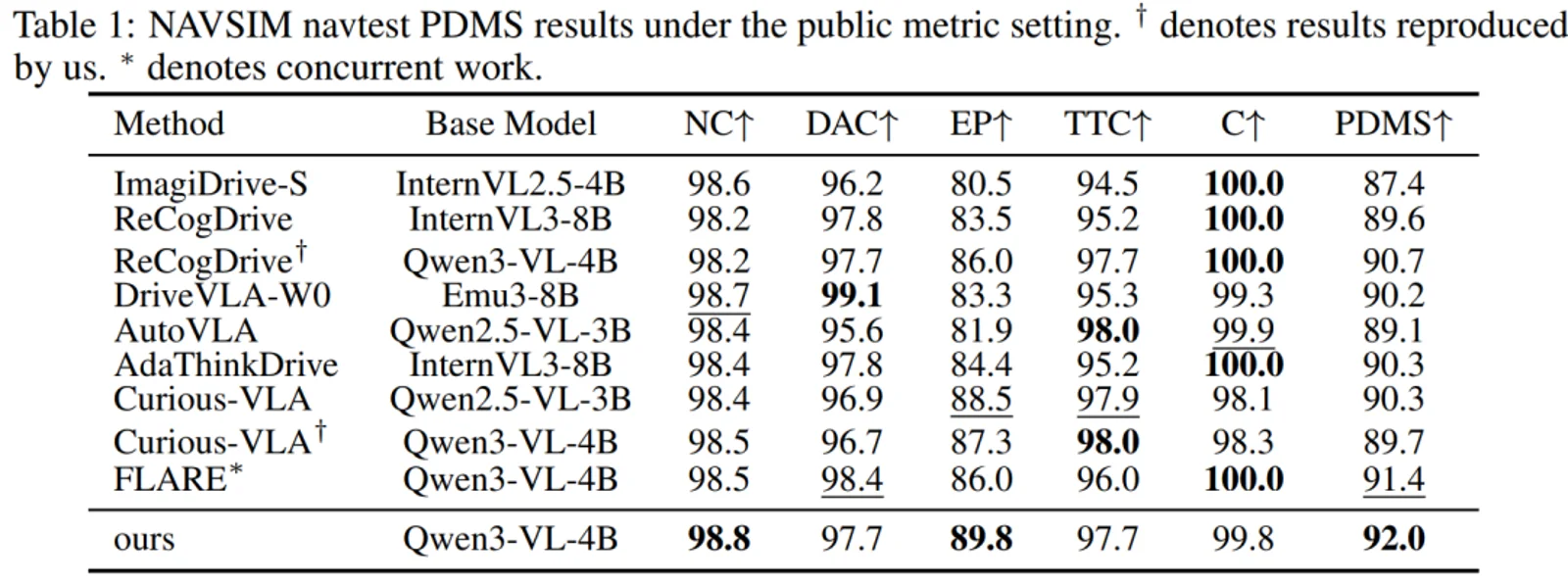
NAVSIM (with CoT + GRPO): Qwen3-VL-4B backbone achieves 92.0 PDMS , surpassing Curious-VLA (90.3), ReCogDrive (90.7), FLARE (91.4). PDMS aggregates collision, compliance, progress, comfort.
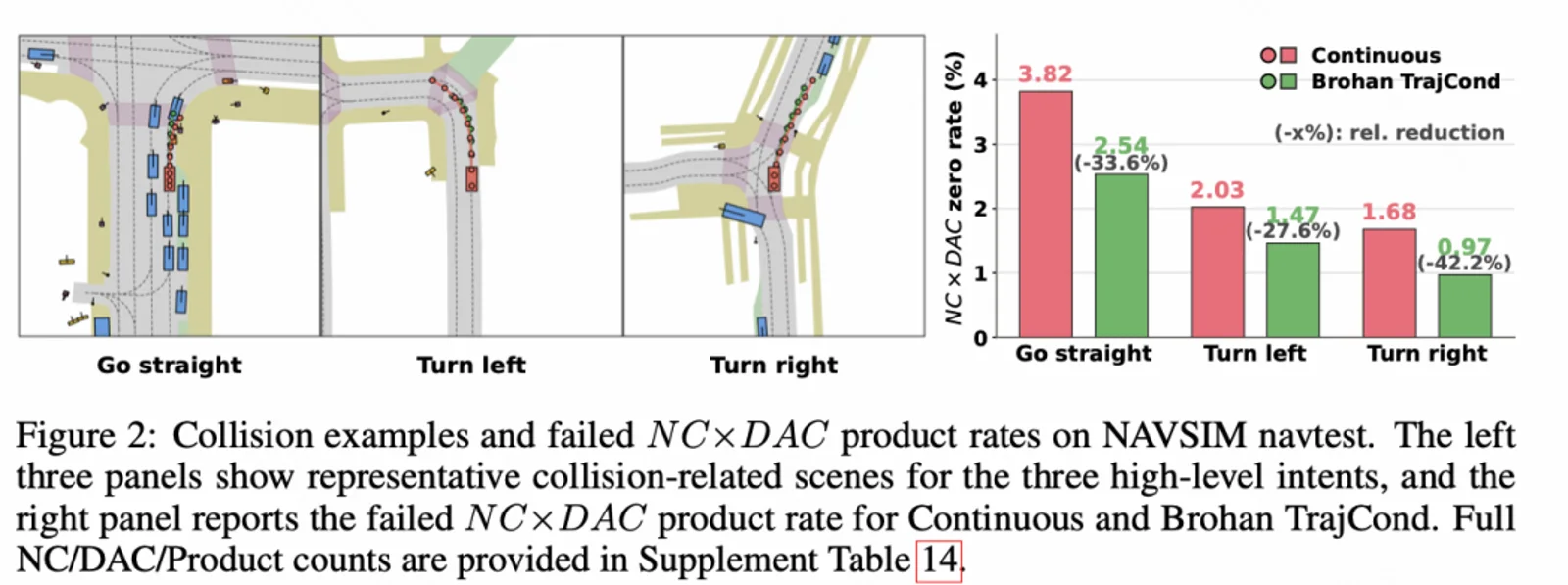
nuScenes (ST-P3, two-stage SFT without CoT): Qwen3-VL-4B yields L2 0.30 m, Col. 0.09 (lowest in table). Removing TrajCond keeps L2 0.30 m but raises Col. to 0.11, showing identical average error can mask collision differences.
NeuroNCAP (closed-loop, two-stage SFT without CoT): Qwen2.5-VL-3B full model scores 3.63 vs. 2.76 without TrajCond; collision rate drops from 0.49 to 0.36, directly evidencing TrajCond's closed-loop benefit.
Notably, prior works (CuriousVLA, DriveTeach-VLA, Impromptu-VLA, AutoVLA) plateaued on nuScenes/NeuroNCAP despite NAVSIM gains. AutoVLA-D breaks this bottleneck by changing the learning target, suggesting the new trajectory representation touches the task essence.
Representation Analysis: t-SNE Visualization
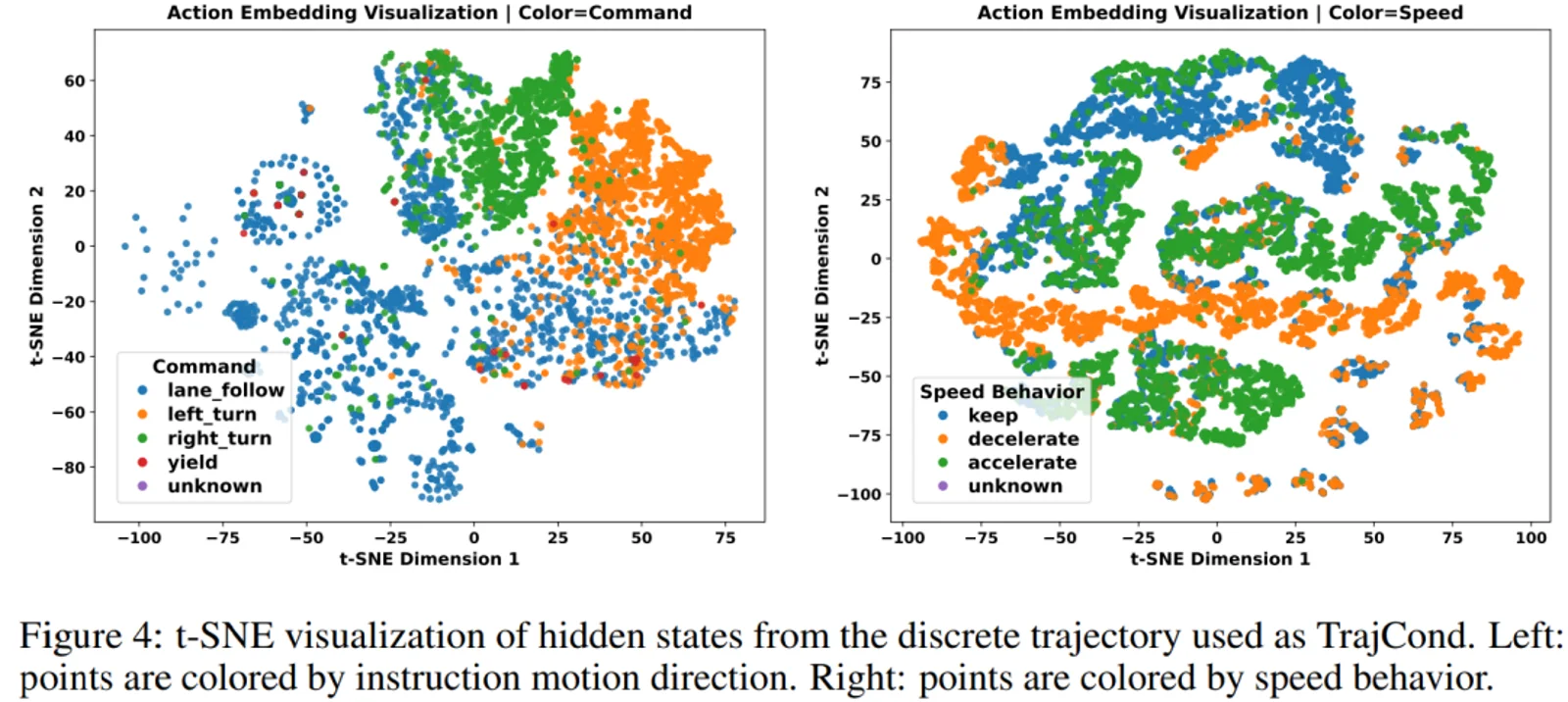
Hidden states when generating discrete actions are projected via t-SNE and colored by driving instruction (left) and speed behavior (right). Left-turn samples cluster on the right, right-turn in upper middle, lane-follow spread left/down. Speed behaviors show distinct clusters: constant speed upper, deceleration horizontal band, acceleration middle/lower clusters. This indicates TrajCond's internal representations correlate with semantic driving behaviors, supporting that local motion geometry connects with high-level intent.
Conclusion and Future Directions
AutoVLA-D demonstrates that the value of an action representation depends on its role in the generation pipeline. The same discrete tokens are weak as final output but powerful as an intermediate condition. This shifts the research question from "what should the trajectory look like?" to "how should the model learn and use representations to connect reasoning with motion?" The paper suggests future gains in driving VLAs may come not only from larger models and more data, but from designing better "action languages" that bridge reasoning and control. The two-stage paradigm—first learn to express local motion, then generate precise trajectories—offers a concrete path forward for autoregressive VLA development.
For questions about attribution, corrections or content rights, please contactand we will review it promptly.