

Why LLM Routers Overpay: EquiRouter Prioritizes Cost When Quality Matches
A NeurIPS 2026 paper reveals that LLM routers tend to overpay by preferring expensive strong models even when cheaper models perform equally well, and introduces EquiRouter, a routing method that prioritizes quality first then cost, reducing inference costs by up to 11% across four benchmarks while maintaining quality.
Reading font

Paper Overview
The paper When LLM Routers Overpay: The Cost of Strong-Model Preference was accepted at NeurIPS 2026. Authors: Guannan Lai, Long Chen, and Han-Jia Ye (corresponding author) from Nanjing University and Hong Kong University of Science and Technology. The paper is available on arXiv (https://arxiv.org/abs/2602.03478) and the code is open-sourced at https://github.com/LAMDA-Model-Reuse/EquiRouter.
Problem: LLM Routing and Overpayment
When an AI application integrates dozens of large language models, a router must decide which model to call for each user request. Flagship models excel at complex reasoning but cost more; smaller models are cheaper and often sufficient for routine tasks like rewriting or classification. LLM routing acts as a triage: match request difficulty to model capability. At million-request scale, small per-request cost differences accumulate. Good routing must balance answer quality and invocation cost.
Key Observation: Looser Budgets Increase Overpayment
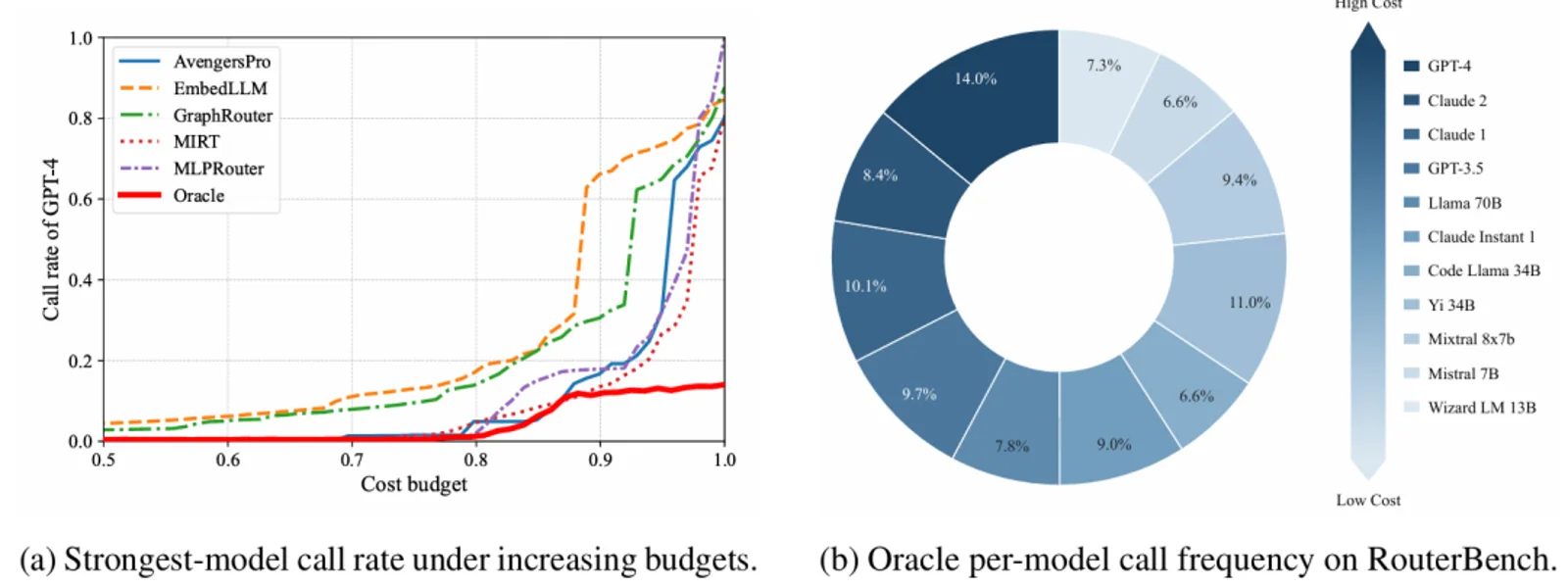
Experiments on RouterBench show that as the budget increases, several mainstream routers dramatically raise their usage of GPT-4, eventually routing nearly all requests to it. This is overpay : when two models answer correctly but one is far more expensive, the router picks the expensive one, increasing spend without quality gain.
An ideal Oracle that knows each model's true performance on every question chooses GPT-4 for less than 20% of requests, while some routers approach 100% GPT-4 usage under high budgets.
The phenomenon also appears in generalist decision models. The researchers tested Jev 1.14 (a System One decision model) via in-context examples for routing. With unlimited budget, Jev exhibited quality-neutral overpayment on 79.05% of RouterBench test requests; similar patterns appeared on MMR-Bench and RouterEval.
Why Routers Prefer Expensive Models
The paper identifies two compounding conditions:
Many questions have multiple models with comparable performance. On RouterBench, MMR-Bench, and RouterEval, the proportion of requests where at least two models achieve similar quality but differ in price is 94.7%, 93.2%, and 97.0% respectively. This leaves ample room for cost savings.
Routers develop a bias toward expensive models. Strong models have higher average performance across tasks, earning higher overall scores. Even when a cheaper model matches performance on a specific question, this average advantage skews selection. Controlled experiments show that random noise alone does not create a high-price bias; a directed model preference is required.
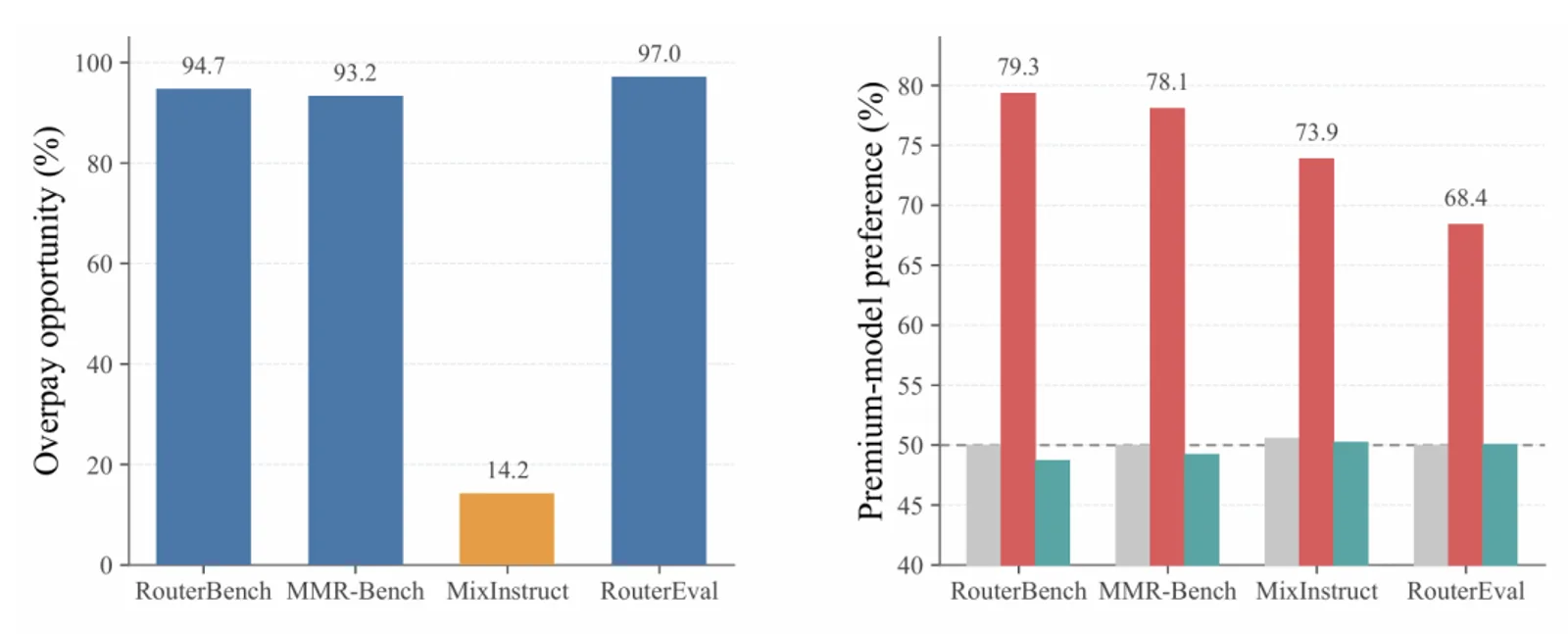
Loosening the budget opens the door for expensive models, allowing the router's inherent preference to translate into actual spend. The key to reducing overpay is making the router actively compare price when quality is similar.
EquiRouter: Quality First, Then Cost
EquiRouter implements a clear priority: when quality differs significantly, pick the better model; when quality is equal or close, pick the cheaper one.
It combines the user question with candidate model information to learn per-question relative strengths. Training uses pairwise comparisons : which model brings a genuine quality improvement, and which can do the same job at lower cost. These comparisons produce a ranked ordering of models for each question.
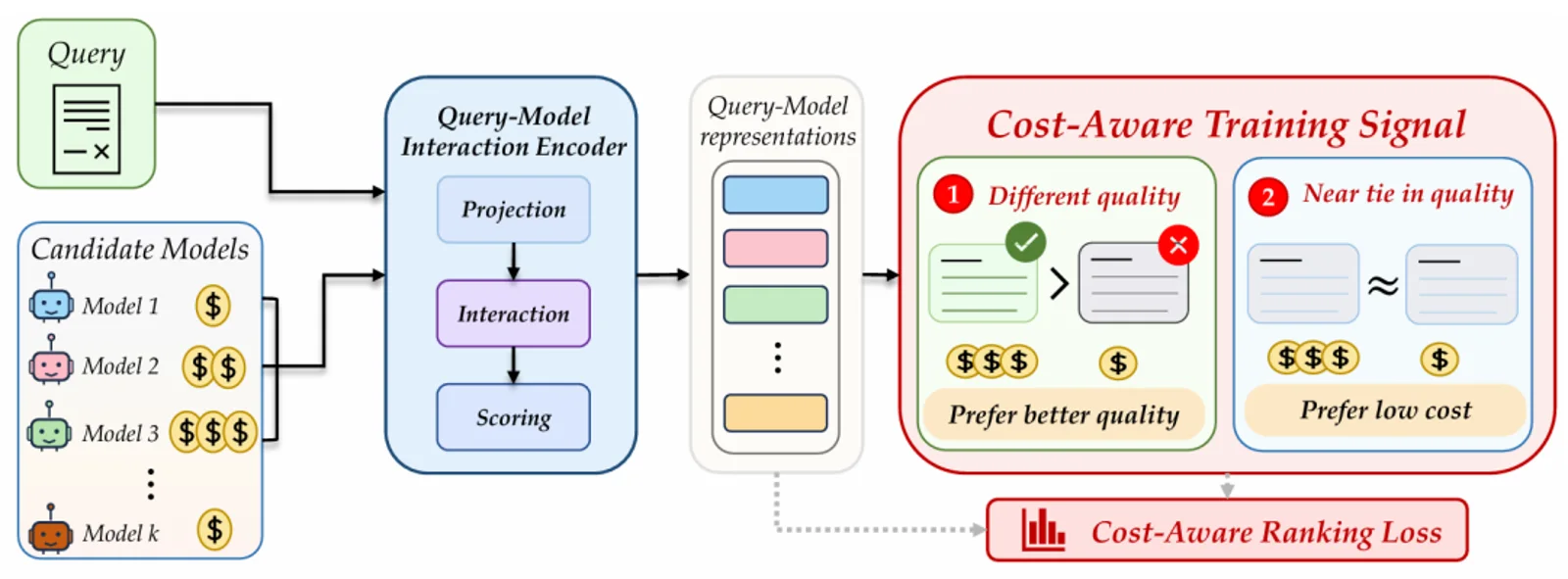
At inference, EquiRouter ranks models for the new question, then selects from the top of the ranking subject to the budget. Complex tasks still go to stronger models; routine tasks are more likely assigned to economical models. This approach is already deployed in SinapisAI's Mio (Models in One) product for model selection and collaboration under cost and latency constraints.
Experimental Results Across Four Benchmarks
EquiRouter was evaluated on RouterBench, MMR-Bench, MixInstruct, and RouterEval, covering text-only, multimodal, continuous scoring, and large candidate pools. The metric: normalized cost required to reach the overall quality of the strongest single model.
Compared to the best baseline on each benchmark, EquiRouter reduced normalized cost by 8.6%, 11.2%, 1.3%, and 10.8% respectively.
Peak task quality remained leading or near-leading. On quality-cost curves across budgets, EquiRouter ranked first on three of four benchmarks and matched the best on the fourth.
On RouterBench, the models selected by EquiRouter achieved ideal outcomes on 85.3%–100% of their assigned requests, confirming that savings come from better task-model matching: using capable-but-cheaper models where they suffice, reserving expensive models for truly hard requests.

Conclusion
As LLM capabilities grow, how models collaborate and how requests are allocated will increasingly determine AI service costs. EquiRouter demonstrates that explicitly preferring cheaper models when quality is comparable can significantly cut inference spend without sacrificing answer quality, making every invocation worth its cost.
For questions about attribution, corrections or content rights, please contactand we will review it promptly.