

Claude-BugHunter: Distilling 681 HackerOne Reports into 84 Vulnerability Hunting Skills for Claude Code
Claude-BugHunter is an open-source skill pack for Claude Code that distills 681 HackerOne vulnerability reports into 84 automated hunting skills across 24 categories, including enterprise attack chains for M365, Okta, and vCenter, while enforcing a 7-question authorization gate and requiring Anthropic's Cyber Verification Program for full functionality.
Reading font

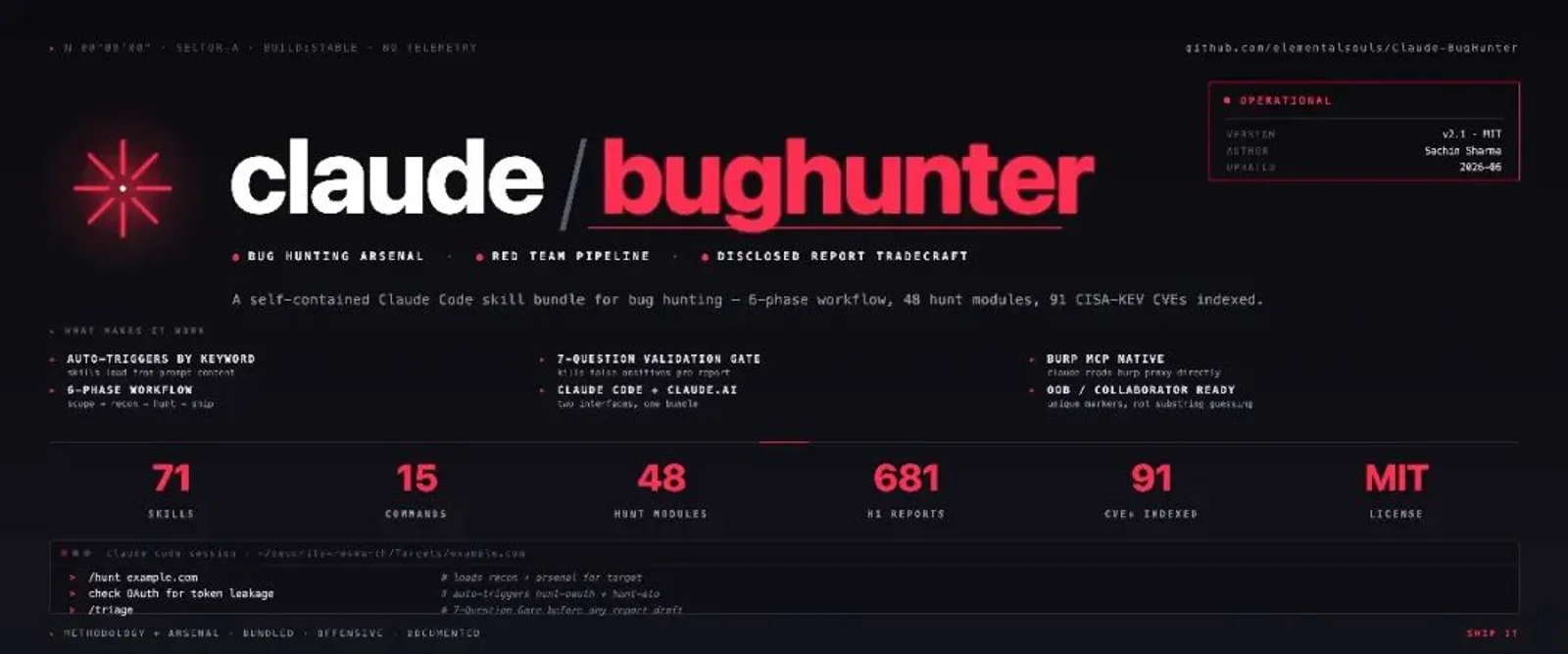
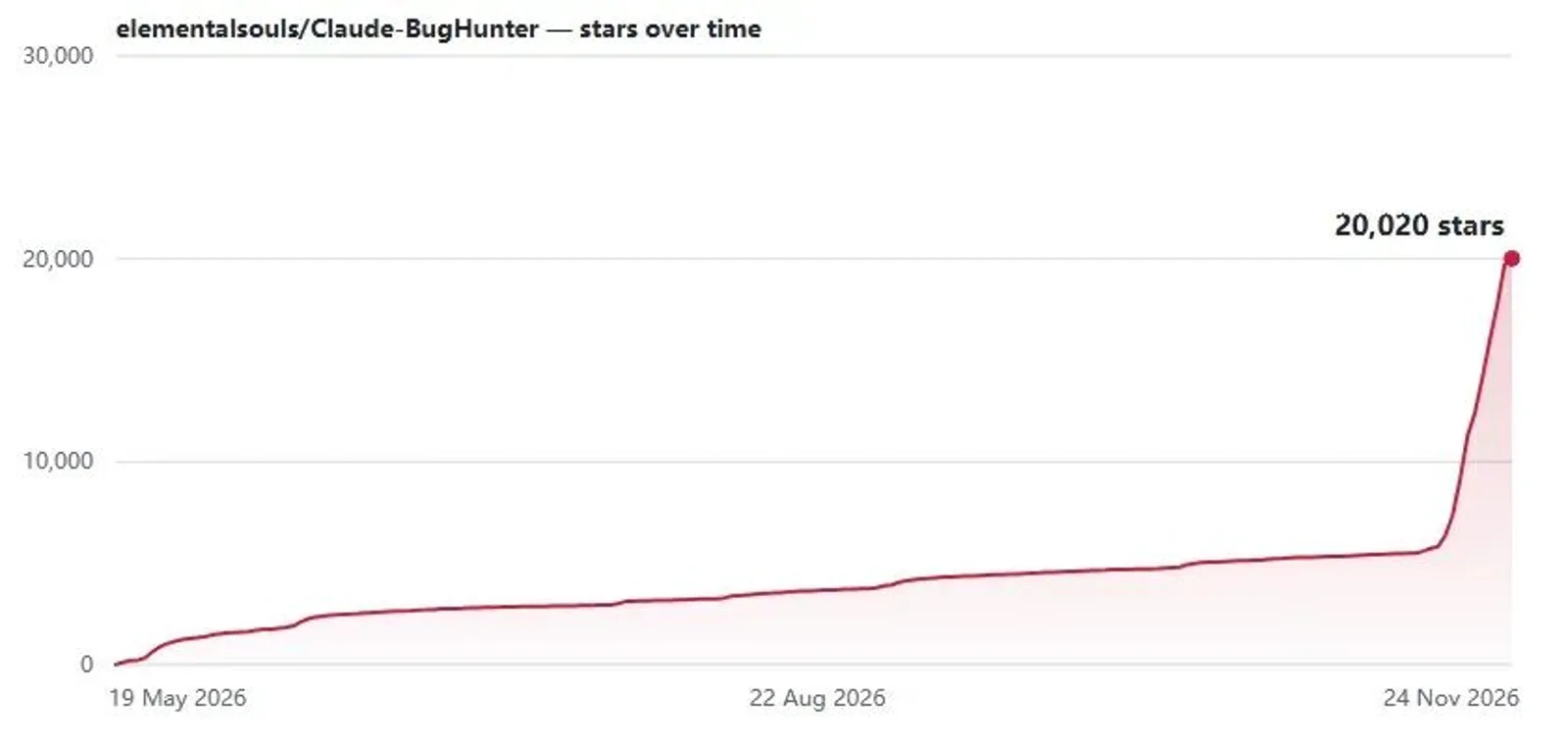
Claude-BugHunter is an open-source plugin that transforms Claude Code from a chatbot into a structured vulnerability hunting assistant. Created by bug bounty hunter and generative AI security researcher Sachin Sharma, the project has topped GitHub Trending three times in 15 days, gaining 1,800–2,000 stars daily and reaching 20,000 stars in 204 days. The skill pack is validated against public ranges like DVWA, Juice Shop, and Hacker101, and its methodology is derived from authorized red-team engagements and real bounty programs.
Project Highlights
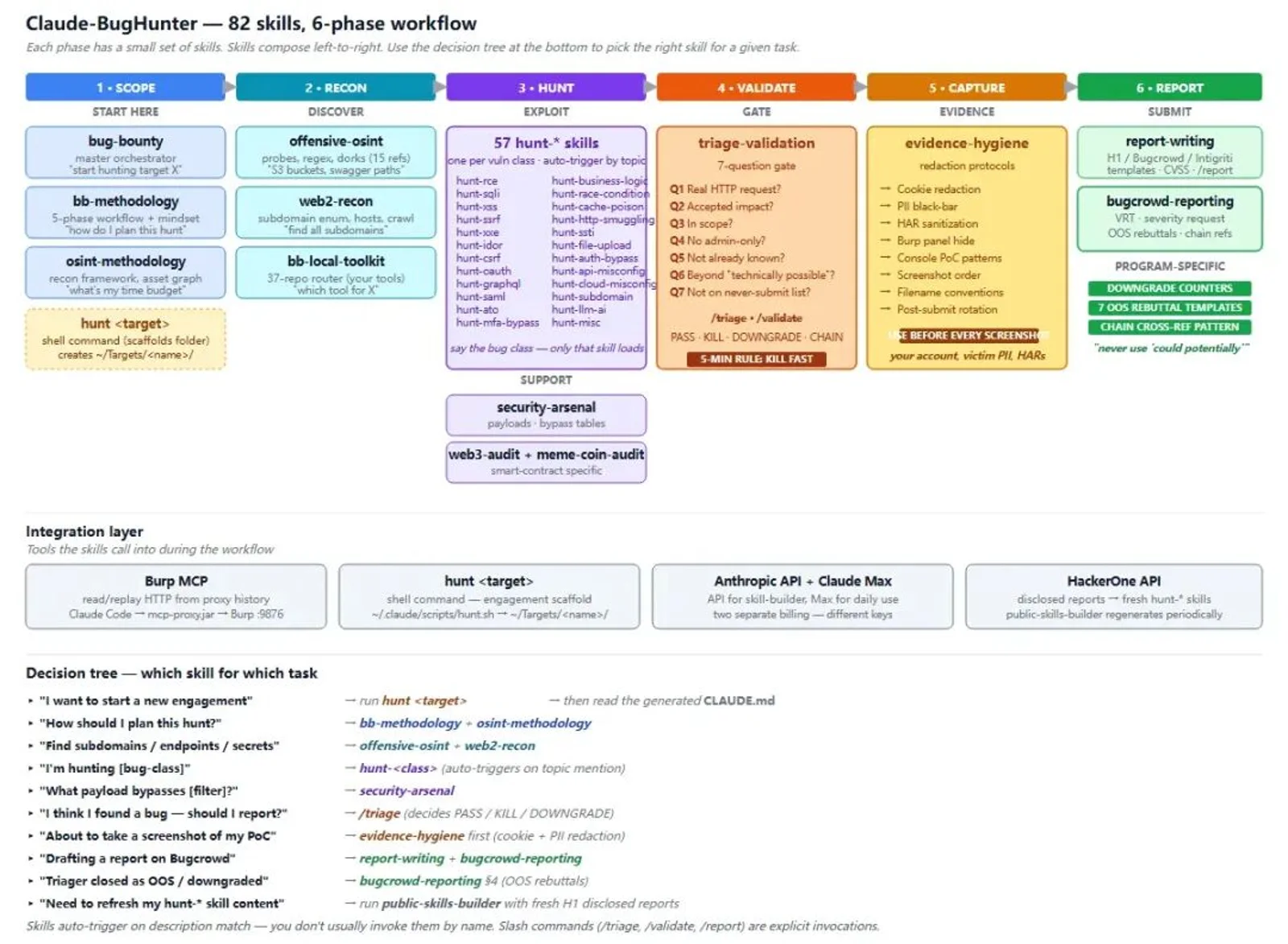
The plugin organizes 84 skills into four progressive layers that form a six-stage pipeline: reconnaissance → mapping & prioritization → hunting → verification → evidence collection → reporting, backed by 15 slash commands. Skills auto-load when you describe a target in natural language.
Think : 4 methodology skills covering a 5-phase non-linear hunting workflow and authorized red-team mindset.
Hunt : 58 hunt-* skills grouped by vulnerability class — XSS, SQLi, SSRF, IDOR, OAuth, JWT, GraphQL, etc.
Enterprise Perimeter : 10 skills targeting internet-facing enterprise entry points — M365/Entra ID, Okta, vCenter, SSL VPN (Cisco/Fortinet/Citrix/Palo Alto), SharePoint, cloud IAM — with 2024–2026 CVE chains and post-exploitation paths.
Ship : 7 reporting and verification skills for evidence retention, severity rating, and report writing.
Core Differentiators
Distilled from 681 Real HackerOne Reports
Unlike generic security prompts or small report collections, Claude-BugHunter distills 681 public HackerOne disclosures into detection logic, payloads, bypass checklists, and exploit-chain templates for 24 vulnerability categories. 433 entries cite the original report for traceability. For example, given a URL like /v1/users/42?next=, the tool offline infers potential IDOR and SSRF vectors and suggests where to start. It provides reasoning and payload libraries, not one-click exploitation; judgment remains with the operator.
Enterprise Attack Chains Included
Beyond web-app vulnerabilities, the pack ships 10 enterprise perimeter skills covering M365/Entra ID, Okta, vCenter, SSL VPN appliances, SharePoint, and cloud IAM. These include recent CVE chains (2024–2026) and credential escalation paths — a unique coverage for external red-teamers. The maintainers flag that CVE chains have time sensitivity and require quarterly refresh; operators must verify target versions before use.
Built-in Authorization Gate
Every finding must pass a 7-question gate: Q2 checks if the impact is in scope for the program; Q3 confirms the target is within scope. Failures trigger a KILL or downgrade. The documentation explicitly excludes internal AD (BloodHound, Kerberoasting), C2 frameworks, post-exploitation, and EDR evasion. This self-imposed boundary builds trust, though the gate is a prompt, not a hard enforcement — compliance ultimately rests on the operator's signed authorization.
Potential Issues
Scope boundary : Only external attack surface is covered. Internal AD, C2, privilege escalation, lateral movement, and evasion are explicitly out of scope. Pure internal penetration testers will find it insufficient.
Cost and guardrails : Anthropic's models block vulnerability exploitation and offensive tooling by default, even for authorized testing. Users must apply for the free Cyber Verification Program (CVP) to adjust guardrails. Opus 5 may silently downgrade to 4.8 on high-risk requests during long tasks. Token consumption across 84 on-demand skills is non-trivial.
Audience mismatch : The tool does not make you an expert. It supplies detection ideas and payloads, but validating exploitability and avoiding false positives requires solid vulnerability knowledge. Beginners may misuse it against unauthorized targets, which is illegal in most jurisdictions.
Installation and Configuration
Prerequisites
Claude Code (skills also load into OpenCode, Codex CLI, Hermes, AntiGravity, but slash commands and the /hunt engine are Claude Code only).
Python (required for the cbh CLI).
HackerOne account (optional; only for reading private projects/reports).
Install Commands (run inside Claude Code)
/plugin marketplace add elementalsouls/Claude-BugHunter/plugin install claude-bughunter@elementalsoulsAfter install, 84 skills and 15 commands load under the claude-bughunter: namespace; plugin upgrades update skills. Add --burp-mcp for Burp Suite integration, or --all to install into multiple AI tools at once.
First-Time Setup
Installation prompts for HackerOne API username and token (used only to read your private data); leaving blank still enables all skills.
Verification
Describe a target in natural language and watch relevant skills auto-load.
Run cbh classify "https://api.example.com/v1/users/42?next=x" — within milliseconds it returns hunt-api-misconfig, hunt-idor, hunt-ssrf with explanations of which URL segments triggered each.
Known Guardrail Block
Even after install, Claude may refuse "help me test this target" because Anthropic's default safety filters block exploitation requests. Authorized testers must apply for the free CVP to relax the guardrails for dual-use work.
Time to install: ~10 minutes. Real proficiency requires understanding vulnerability root causes; otherwise the skill suggestions are unactionable.
Personal Opinion
Worth installing if you do authorized bug bounty, penetration testing, or external red-teaming. It replaces ad-hoc memory with a repeatable, report-driven lookup process and standardizes evidence handling, severity rating, and report templates. The author is a paid bounty hunter; triple GitHub Trending and sponsors (ApiSmart, ThreatWatch360) indicate real-world adoption. Unlike "one-click auto-hack" marketing, this tool promises no shortcuts — only a reusable, structured workflow.
Caveats reiterated: external-only, CVE chains expire, guardrails need CVP. Target audience: security professionals doing bounty/red-team work — install and use. Developers casually learning web security can treat it as a textbook, but must restrict usage to targets with written permission; unauthorized scanning is illegal in most countries.
Github repository: https://github.com/elementalsouls/Claude-BugHunter
For questions about attribution, corrections or content rights, please contactand we will review it promptly.