

CoEvo-RSI: 9B Model & Harness Co-Evolution Surpasses DeepSeek/GLM on Select Tasks
Researchers from NUS, A*STAR, and SenseTime propose CoEvo-RSI, a recursive self-improvement framework where a 9B model and its agent harness co-evolve via bidirectional historical inheritance, achieving superior performance on multi-agent fault attribution, permission-aware SQL generation, and smart home control, surpassing DeepSeek-V4-Pro and GLM-5.3 on several metrics.
Reading font
CoEvo-RSI: Recursive Self-Improvement for Model-Harness Co-Evolution
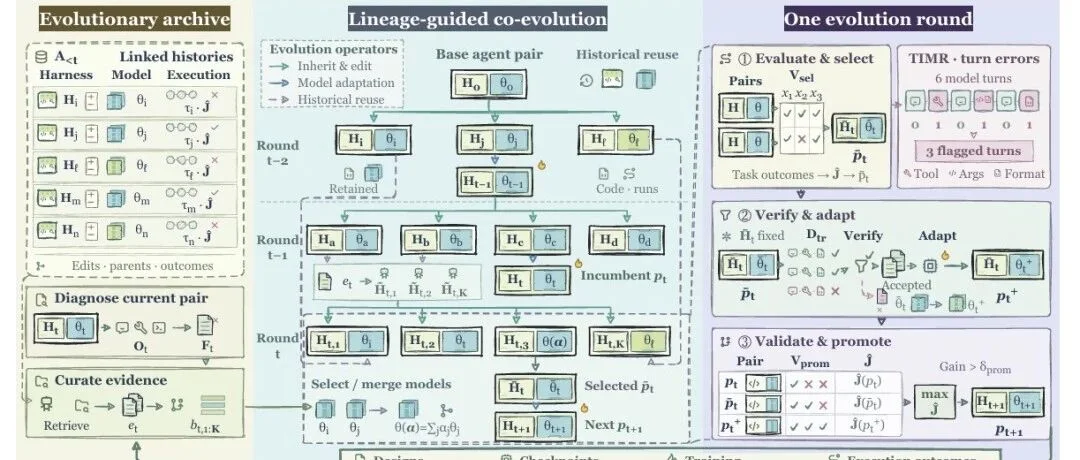
Researchers from NUS, A*STAR, and SenseTime introduce CoEvo-RSI, a framework that enables a 9B-parameter model and its agent harness to co-evolve through iterative cycles. The core problem addressed is the mismatch that arises when either the model or the harness is updated independently: a harness upgrade may change tool interfaces or execution flows, rendering the model's learned behaviors obsolete, while a model upgrade may not exploit new harness capabilities.
Bidirectional Historical Inheritance Mechanism
CoEvo-RSI maintains an evolution archive storing historical harness versions, model checkpoints, modification records, and execution trajectories. Each improvement cycle follows four steps:
Harness revision driven by failure analysis. A Curator agent analyzes execution feedback from the current model-harness pair, retrieves relevant historical designs and outcomes, and proposes modifications. Multiple harness-editor agents then develop candidate harnesses, optionally branching from any prior version rather than only the latest.
Model weight selection or merging for the new harness. For each candidate harness, the system either selects a historical checkpoint or merges multiple checkpoints using TIES-Merging, which trims small-magnitude updates, resolves sign conflicts, and merges directionally consistent updates to reduce interference.
Supervised fine-tuning on verified success trajectories. The chosen pair is evaluated on a fixed validation set. For each task, up to three trajectories are sampled; sampling stops once a trajectory passes verification. Verified trajectories, plus high-quality historical trajectories replayed from the archive, are used for a full-parameter supervised fine-tuning round, teaching the model successful behaviors under the current harness.
Strict acceptance criterion. The fine-tuned candidate is compared against the current version and the pre-training inherited pair on the same validation set. Only if the candidate achieves a predefined improvement margin does it replace the current version. All attempts, including failures, are recorded in the archive for future cycles.
Experimental Results Across Three Domains
The framework is instantiated on Qwen3.5-9B and evaluated on three tasks:
1. Multi-Agent Fault Attribution (TraceElephant)
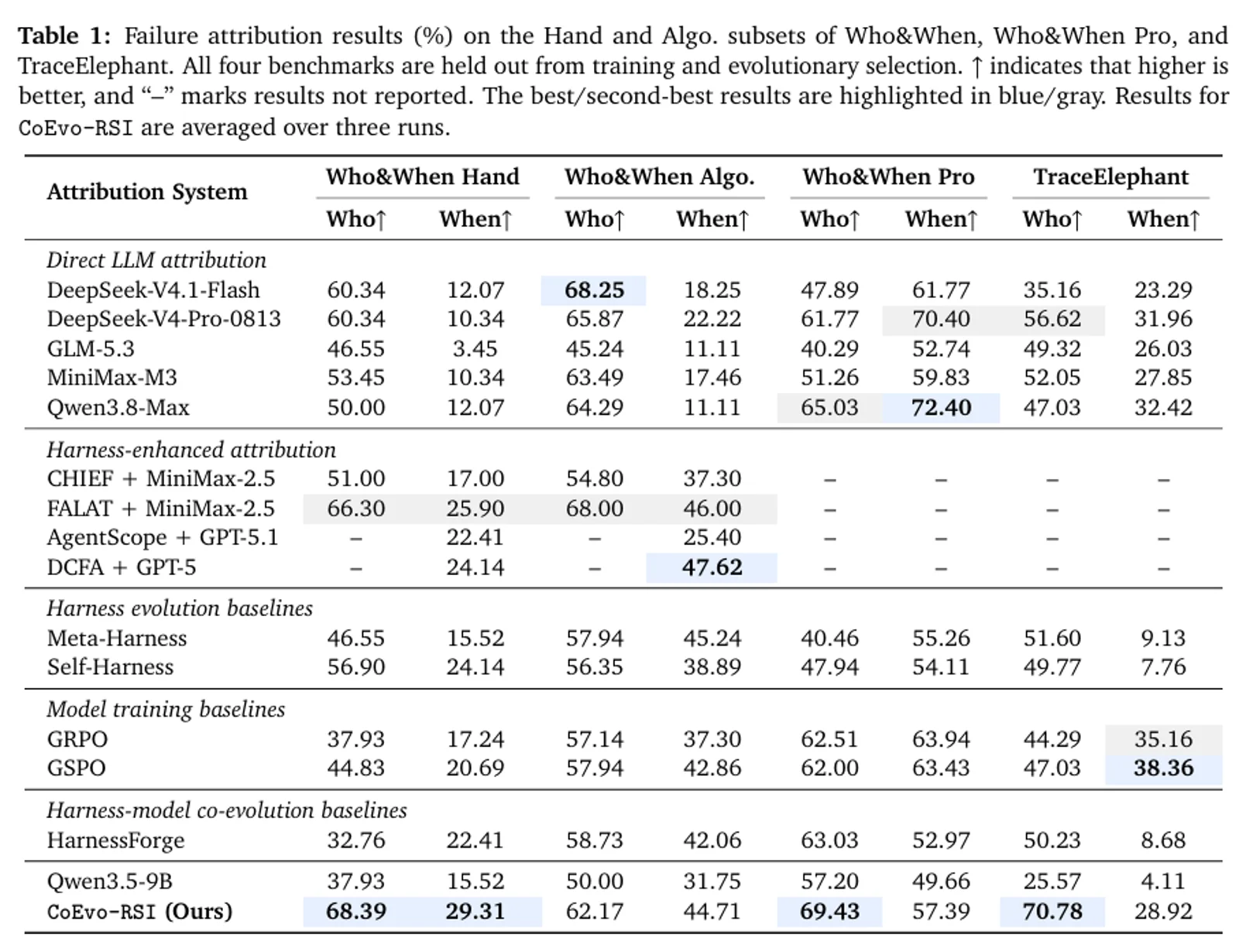
Given a failed collaboration trace, the system must identify the responsible agent (Who) and the decisive error step (When). On TraceElephant, CoEvo-RSI achieves 70.78% Who accuracy, surpassing DeepSeek-V4-Pro-0813's 56.62% by 14.16 percentage points. However, on the When metric, CoEvo-RSI scores 28.92%, still below DeepSeek-V4-Pro-0813's 31.96%. This indicates the co-evolved system excels at assigning responsibility but not yet at pinpointing the exact failure step.
2. Permission-Aware Text-to-SQL (RBAC Spider & BIRD)
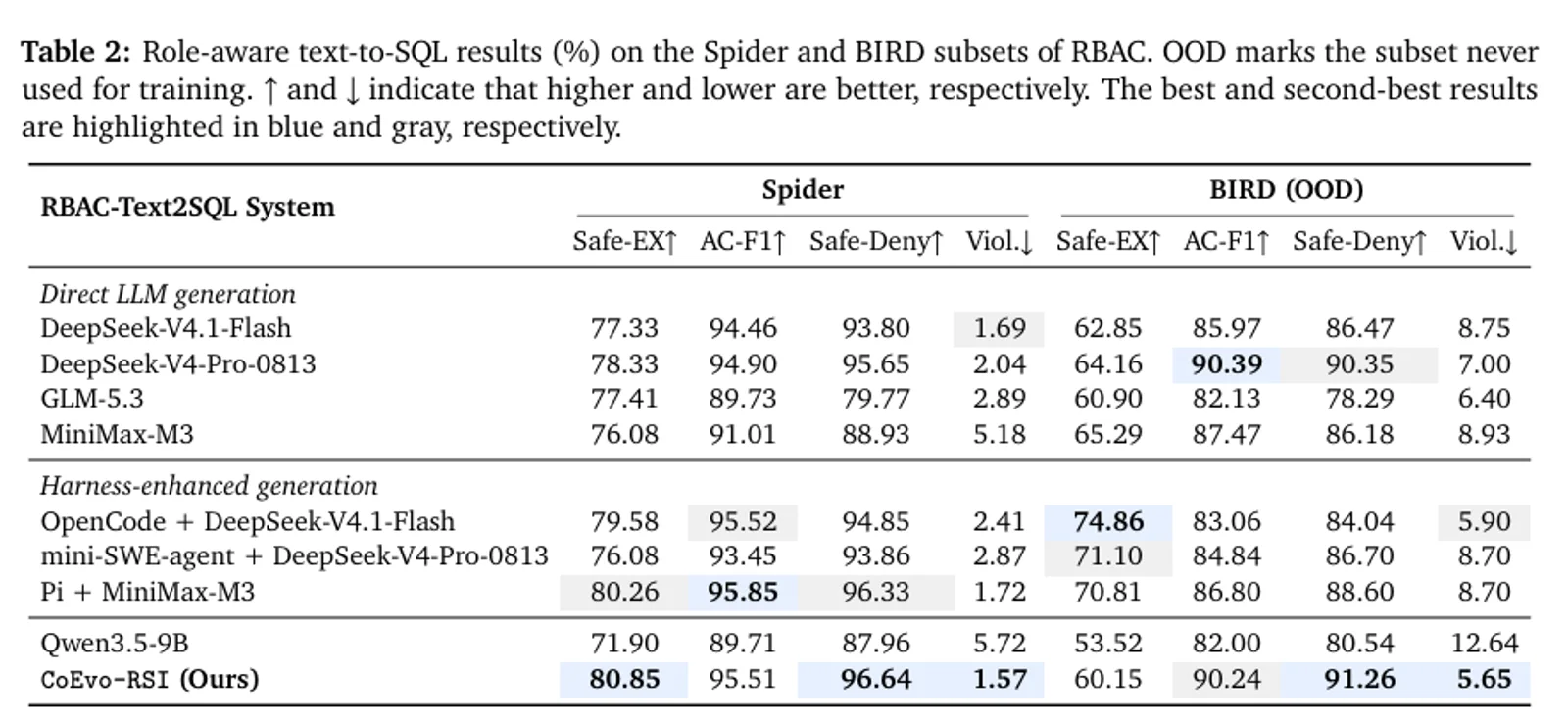
The task requires generating executable SQL while respecting role-based access control. On the in-distribution RBAC Spider test, CoEvo-RSI reaches 80.85% secure execution accuracy, outperforming all compared systems. On the out-of-distribution BIRD benchmark (unseen during evolution), accuracy drops to 60.15%, remaining below several larger models and their dedicated systems. This shows the 9B model gains strong specialization on the evolved task distribution but still struggles with cross-database generalization.
3. Smart Home Command Execution (HomeBench)
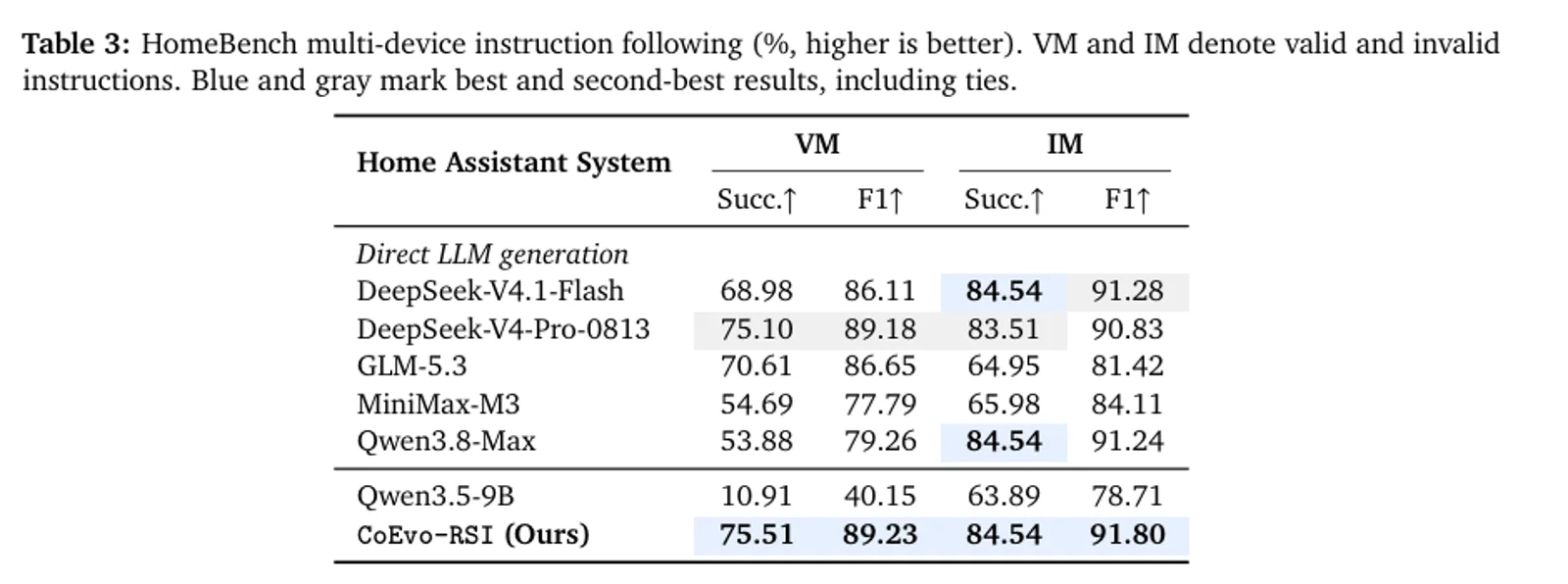
On the valid multi-device instruction subset (VM), CoEvo-RSI achieves a 75.51% success rate, edging out GLM-5.3 (70.61%) and DeepSeek-V4-Pro-0813 (75.10%).
Key Insight: Old Checkpoints Are Reused
Analysis of the SQL evolution reveals that the system repeatedly revisits earlier model checkpoints. In 5 out of 10 rounds, a previous checkpoint was reselected; the final round combined the 10th-round harness with the 3rd-round checkpoint, yielding the best secure execution accuracy for that run. Moreover, the same checkpoint exhibits different interface compatibility depending on the harness it is paired with, underscoring the value of joint search over independent optimization.
Code Availability
The CoEvo-RSI codebase (currently under the name CoEvoX in the README) and the final evolved models and harnesses for all three domains have been released. Reproduction requires downloading domain-specific checkpoints, deploying the model service, and running evaluation with the corresponding evolved harness.
For questions about attribution, corrections or content rights, please contactand we will review it promptly.