

RIO: Recursive Self-Improving Cloud Ops Agent Cuts Errors 7x via Ontology Evolution
HKUST Guangzhou and Huawei Cloud introduce RIO, a recursively self-improving cloud operations agent that evolves executable ontologies to achieve 83.9% accuracy and 7x fewer silent errors in production, outperforming baselines and enabling cross-model knowledge transfer.
Reading font
Introduction: The Enterprise RSI Bottleneck
Recursive Self-Improvement (RSI) is a frontier in agent research, but in real enterprise production environments the capability ceiling is often not model weights or code frameworks—it is the cross-system domain semantic layer: the Ontology . Enterprise data interfaces frequently suffer silent failures : wrong join keys, missing pagination, or index mismatches return valid "0 rows" or truncated lists without any error. In such black-box environments lacking ground truth, an agent that treats empty results as confirmed knowledge enters a recursive error loop.
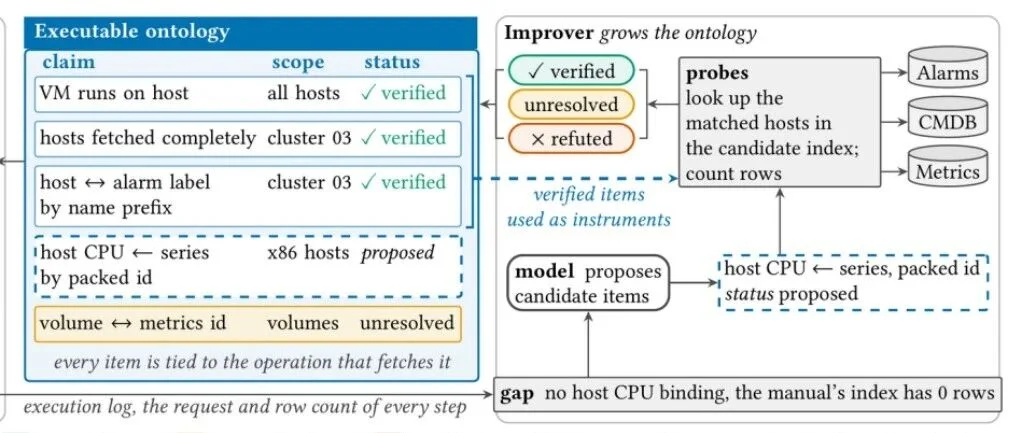
Paper: RIO: Recursively Self-Improving Cloud Operations Agent via Evolving Its Ontology (alphaxiv.org/en/pdf/2611.rio-cloud-operations-ontology-evolution). HKUST (Guangzhou) and Huawei Cloud propose RIO , an agent that implements RSI by evolving an Executable Ontology —a semantic layer where each entry binds directly to deterministic retrieval operators, verified scope boundaries, and provenance chains. Verified entries become calibrated instruments for the next round of hypothesis testing, expanding the testable hypothesis space recursively. When production data drifts, the system automatically revalidates affected entries via probe lineage.
In six rounds on Huawei Cloud's management plane, RIO lifted retained-test accuracy from 58.1% to 83.9% (beating the strongest evolving-ontology baseline EvoOntology at 69.8%), cut silent error rate from 24.5% to 5.4% (7× lower than standard ReAct), and the evolved ontology transferred across LLMs with negligible loss.
01 Why Enterprise RSI Core Is Evolving Executable Ontology
Fragmented Multi-Source Reality
Core data in large enterprises and cloud infrastructure is scattered across independently built CMDBs, alerting services, and metric stores. A single physical server may have three identities: logical/hardware records in CMDB, host-prefixed node labels in alerting, and concatenated compact string keys in metrics. Answering a routine troubleshooting query essentially requires cross-source entity alignment and set-integrity reasoning.
Standard ReAct Fails Catastrophically
Given only APIs and vendor manuals, a ReAct agent fails silently. A real production trace for "which host in cluster 03 has the highest CPU among alerting hosts" showed three successful API calls that all returned misleading empty results: pagination missed ~1/3 of hosts due to no stable sort key; alert query returned 0 rows because alerts were stored under a different type; CPU metric query returned 0 rows because 4 million records lived under an undocumented application index. The agent confidently answered "no host alerts in cluster 03." Across 298 real Huawei Cloud tasks, ReAct achieved only 41.6% accuracy while producing 38.3% fatal wrong answers . A prior real incident caused a 42-minute recovery delay just from missing two alerting hosts.
Why Static Ontology and Naïve Self-Evolution Fail
Static ontology cannot keep pace: 81 vendor-compliant metric indexes existed in manuals but zero existed online. A 96-engineer-hour expert semantic layer broke whenever a business team changed a field or pagination limit.
Self-evolution without empirical probe gating causes error snowballs: Methods like Reflexion, Voyager, EvoOntology, and OaK accept new knowledge based on "no execution error" or offline validation scores. In real ops, wrong keys silently return zero rows indistinguishable from true absence. An early prototype mistook 35 zero-row results (caused by wrong index names) as "confirmed no data," poisoning subsequent reasoning.
02 Building Probe-Admission and Lineage Loops for Self-Growing, Self-Correcting Ontology
RIO Architecture: Solver, Improver, Shared Executable Ontology
RIO separates online answering (Solver) from background evolution (Improver). In round k , the Solver uses only ontology verified up to round k-1 , logging full request and row-count traces. The Improver mines "knowledge gaps" and "observation conflicts" from logs, fires probes to live data sources within a budget, and builds the round- k ontology. This read/write separation guarantees unverified guesses never enter the ontology.
Four Core Mechanisms
(1) Five Executable Ontology Entry Types & Hybrid Execution
To address silent failures, RIO defines five fine-grained entry types: Relationships , Identities , Bindings (cross-source semantic gaps), and Completeness , Absences (local closed-world guarantees). During online answering, the Solver uses Hybrid Execution : the LLM only parses intent and binds to ontology vocabulary; deterministic code handles pagination, key parsing, and coverage audit, sharing the same runtime engine as the Improver. A compiler verifies every plan step has a verified entry covering the target population. If a step exceeds verified scope (e.g., using an x86-verified metric for ARM hosts), the system returns "Unresolved" and specifies the missing ontology type, directly guiding the Improver.
(2) Three Probe Admission Iron Laws: Blocking "False Zero-Row" Poison
Only admit entries that survive falsification: An entry becomes verified only when real data had the opportunity to falsify it but did not.
Only admit negative facts after proving search completeness: For alerting interfaces with 20,000-row silent truncation and wildcard failures, RIO introduces Sliced Absence Probing —forcing exact storage IDs with verified upstream identities, recursively bisecting time windows until every slice returns a count strictly below the truncation limit and all are empty, then certifying true zero-record absence.
Strictly scope validity and strip residuals: Rules verified in one cluster apply only there; boundaries unobservable from historical data (e.g., silent hosts that never alerted) are split into unresolved residuals for minimal high-value human confirmation.
(3) Three-Layer Topological Bootstrapping: Driving Recursive Probing Across Rounds
Circular dependency: verifying cross-source identity needs a complete entity set; certifying cross-system completeness needs correct cross-source identity. RIO breaks this via three-layer recursive probing on a dependency DAG:
Layer 1: Verify single-source basics (stable sort keys, pagination completeness).
Layer 2: Unlock cross-source identity mappings and CMDB foreign-key probes.
Layer 3: Enable complex metric semantic bindings and time-window absence certification.
Each newly verified lower-layer entry automatically activates a batch of higher-order hypotheses previously suspended for lack of probing tools.
(4) Probe Lineage & Selective Revalidation: Solving RSI's "Shifting Foundation" Problem
If an early verified entry is later falsified, all downstream knowledge that used it as an instrument loses reliability—especially hidden derivations that only used the upstream rule during probing, not during online queries. RIO records probe-level justification lineage in each entry's just field and maintains an inverted index. In Huawei Cloud round 5, a round-2 rule "alert label starts with hostname" verified in cluster 03 was globally probed and caught a collision: host-1080's alerts were misattributed to host-108. The Improver narrowed the rule to "hostname plus underscore _" and triggered Selective Revalidation : precisely suspending 14 downstream dependencies, rerunning probes in topological order, purging cross-cluster dirty data from cache—hot-fixing the entire ontology without human intervention.
03 Huawei Cloud Six-Round Live Test: 86% Later Knowledge Unlocked Recursively, Ontology Transfers Across LLMs
Benchmarks
I-cloud: 298 real Huawei Cloud troubleshooting tasks.
P-real: 400 queries on an open-source production CMDB snapshot.
P-controlled: Controlled cross-source benchmark with 5 silent failure types, 48 knowledge gaps, 12 architecture drift events.
Models: GLM-5.1, Qwen3.7-Plus, DeepSeek-V4, Claude Sonnet 4.6.
(1) vs. Mainstream Self-Evolution Baselines
After 6 rounds, RIO accuracy rose from 58.1% to 83.9% ; on hardest cross-three-source tasks from 26.3% to 63.2% (ReAct: 12.3%). EvoOntology stalled at 69.8% (error 17.4%), Skill Library at 66.4% (error 20.1%). Text Memory showed negative evolution (60.4% → 54.0%), with >70% new errors traced to early cached false "no data" conclusions. RIO's silent error rate dropped to 5.4% (7× lower than ReAct's 38.3%, even better than human expert ontology's 6.4%). With only 12.5 human hours , RIO matched 92% of the performance gain from a 96-engineer-hour expert ontology; fully autonomous reached 80.9%.
Admission logs reveal the three-layer bootstrapping rhythm: Round 1 – basic completeness; Round 2 – cross-source identity peak; Round 3+ – metric binding surge. Verified ontology grew from 112 (R0) to 274 (R6).
(2) Quantifying Recursion's Contribution
Ablation at R3 (same budget): full RIO vs. "reuse R3 instruments but no chained recursion" vs. "no recursion". In rounds 4–6, 86% (55 of 64) new entries directly depended on previous rounds' entries as instruments (e.g., R1's verified host list drove 23 probes unlocking 9 cross-source identities in R2, supporting 61 metric binding probes in R3–4). Cutting recursion dropped cross-three-source accuracy by 12.3 percentage points and increased data-source requests per correct entry by 1.8× (1000 vs 557).
Probe admission ablation on P-controlled: removing falsifiable probes raised round-6 ontology error rate from 2.8% to 27.3% ; without sliced absence probes, 20 false zero-results appeared, 17 entered ontology, contaminating 96 downstream answers (RIO only 1). For 12 architecture changes, selective revalidation needed only 1/19 of full retest requests (268 vs 5020) to restore affected task accuracy to 97.5% .
(3) Knowledge-Layer RSI Dividend: Cross-Model Zero-Shot Transfer
Ontology evolved with GLM-5.1 transferred to Qwen3.7-Plus: cross-three-source accuracy jumped from 24.6% to 61.4% , slightly exceeding Qwen's own evolved ontology (59.6%). Four models cross-inheriting ontologies averaged only 1.6 percentage points performance loss.
In a 2-month, 1,120-investigation real deployment, 60 paired timings showed median human verification time for single/dual/three-source troubleshooting reduced from 12/31/58 minutes to 3/6/11 minutes ; 1-hour resolution rate rose from 70% to 97%; each round's traffic consumed only ~0.3% of daily production data-source requests.
04 When Ontology Becomes the Agent's Cross-Generational "Living Compound Asset"
Prior agent self-improvement modifying model weights or global prompts suffers catastrophic forgetting/overfitting. RIO demonstrates a different paradigm: enterprise RSI at the executable ontology layer. A full-process case (spanning all five ontology types) shows RIO starting at round 0 with honest refusal listing 5 missing prerequisites, then recursively lighting up pagination completeness, disk foreign key, alert identity, 30-day zero-alert absence proof, and CPU binding in rounds 1–4. Round 5 automatically captured cross-cluster prefix collision, revalidated dependencies, and produced a perfect global answer. Across 6 rounds solving 101 new problems, three-quarters of rule-narrowing changes safely became explicit refusals highlighting gaps—not dangerous blind guesses.
Key Takeaways
In serious enterprise scenarios, ontology must upgrade from static knowledge graph to executable living asset bound to code with scope and evidence chains.
Negative facts (zero rows) without search-completeness proof are the most dangerous poison for self-evolving systems; probe falsification gating is the lifeline preventing RSI error snowballs.
When RSI occurs at the executable ontology layer, every daily business traffic turns into verifiable, traceable, self-healing, cross-generational LLM-seamless domain knowledge compound interest.
For questions about attribution, corrections or content rights, please contactand we will review it promptly.