

CoNSE: Near-Storage Computing Accelerates High-Dimensional Vector Retrieval 2-3x
Alibaba Cloud's CoNSE engine offloads vector distance calculations to SSD controllers, cutting host data movement and CPU overhead; it supports multiple distance metrics and precisions, integrates with HNSW and DiskANN, and delivers 2-3x query throughput with 50%+ CPU reduction and 30-90% memory bandwidth savings in bare-metal and cloud-native deployments.
Reading font
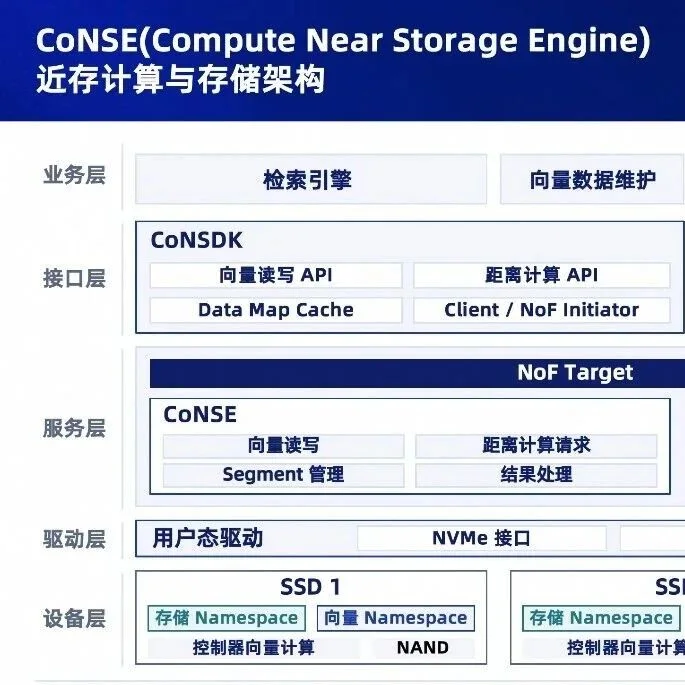
At the 2026 China Data & Storage Summit, Alibaba Cloud senior technical expert Zhengyong Wang presented CoNSE (Compute Near Storage Engine), a near-storage computing architecture designed to accelerate high-dimensional vector retrieval for AI workloads such as search, recommendation, advertising, content moderation, and RAG.
Background and Bottlenecks
Production platforms now handle hundreds of billions to trillions of vectors, with billions added daily. As embedding models shift to higher dimensions, the cost of distance computation and host data movement escalates. Existing approaches — in-memory residency, memory-SSD tiering, or object storage with local caching — all concentrate distance calculation on host CPUs, forcing raw vectors to shuttle back and forth. This creates three intertwined constraints: capacity pressure, host bandwidth saturation, and interaction latency, forming a "capacity wall" and "bandwidth wall" that limit scale and cost-efficiency.
CoNSE Architecture
CoNSE moves the bulk of vector distance computation into the SSD controller. The host retains only graph search and candidate management; raw vectors never leave the drive. Key hardware/software elements:
Controller-integrated compute unit : Supports Euclidean, cosine, and inner-product distances across FP32, FP16, BF16, FP8, and INT8 precisions.
Extended NVMe commands : Custom opcodes submit compute jobs; results return via completion queues. The design remains NVMe-compliant and allows mixed compute and read/write operations.
Software stack : CoNSDK provides vector read/write and distance-calculation APIs; the CoNSE component handles data management, result processing, and device management.
Data organization : Vectors are stored in segments, with LBA metadata and controller-level hardware checksums ensuring integrity.
Fully asynchronous execution : A single thread can issue new queries while waiting for device responses, and multi-node prediction merges neighbor requests.
With recall unchanged, average host-device interactions drop ~40% and average latency falls ~20%. The architecture is compatible with mainstream graph indexes such as HNSW and DiskANN.
Productization: Bare-Metal and Cloud-Native
Bare-metal : CoNSDK uses a user-space NVMe driver to connect directly to multiple SSDs. Requests are batched per target drive based on candidate IDs, and results are aggregated.
Cloud-native : An engine inside a device-service pod centrally dispatches compute and I/O requests, decoupling applications from hardware.
Measured against traditional host-side computation, CoNSE achieves 2-3x higher query throughput, reduces CPU consumption by over 50%, and lowers host memory bandwidth usage by 30-90%.
Broader Panjiu AI Storage Context
CoNSE is part of Alibaba Cloud's Panjiu server AI storage portfolio, which follows a "software-hardware co-design, compute sinking" philosophy. The stack spans:
AliMemory, AliSCM persistent memory, CXL memory pools
AliFlash SSDs (TLC/QLC) and EBOF high-performance cache servers
CIPU (cloud infrastructure processor) for multi-tenant isolation and high-performance access
The UMX (Unified Memory Expansion) architecture uses Alink Scale-Up Fabric (UALink + CXL) as interconnect, preserving load/store semantics while pooling DRAM, SCM, and SSD. CoNSE extends this by pushing compute into the SSD controller, alongside research on new media like HBF, giving the Panjiu stack evolvable innovation at the media, controller, interconnect, and software layers.
Conclusion
Wang emphasized that near-storage computing establishes a new paradigm for vector retrieval: offloading distance math to the closest compute resource lets the host focus on graph search and scheduling, effectively addressing the dual growth of vector scale and dimensionality. The value lies not only in single-point speedups but in jointly optimizing throughput, latency, CPU overhead, and memory bandwidth. Alibaba Cloud aims to collaborate with ecosystem partners to mature the controller, media, driver, retrieval engine, and cloud service layers for large-scale production adoption.
For questions about attribution, corrections or content rights, please contactand we will review it promptly.