

CSPD: Plug-and-Play RL Expert Composition via Soft-Prompt Distillation
Composable Soft-Prompt Distillation (CSPD) distills each RL expert into a 256-vector soft prompt, keeps the base model frozen, and concatenates prompts at inference to combine capabilities without retraining, recovering ≥90% of teacher gains on 22/23 tasks, matching multi-teacher distillation on four-domain benchmarks, outperforming baselines on six out-of-domain tests, and cutting P95 first-token latency 2.27× versus Rank-4 LoRA.
Reading font
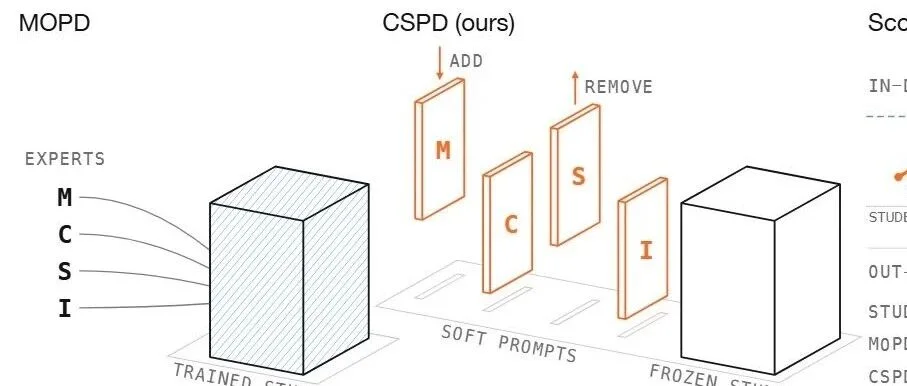
Reinforcement learning (RL) post-training typically produces domain-specific expert models. Existing approaches such as weight merging and multi-teacher online distillation (MOPD) require re-integrating the model whenever a new expert is added, risking interference between capabilities.
To address this, researchers from UC Santa Barbara, Carnegie Mellon University, NVIDIA, Apple, and others introduced Composable Soft-Prompt Distillation (CSPD). The method decouples expert capability learning from composition: each RL expert is independently distilled into a soft prompt while the base model remains frozen; at inference, the desired prompts are simply concatenated as a unified input prefix. Adding or removing an expert only requires training or deleting its corresponding prompt — no retraining of existing modules.
Method
(1) Distilling RL experts into soft prompts
A pre-RL base model serves as the frozen student. For each RL-trained expert, a dedicated soft prompt of 256 vectors is inserted into the system message before the user query. The expert answers domain-specific questions; a verifier filters correct responses to build a distillation dataset. Sequence-level knowledge distillation then minimizes the length-normalized negative log-likelihood of the student generating those expert responses, optimizing only the soft-prompt parameters.
(2) Combining experts via prompt concatenation
When multiple experts are needed, their soft prompts are concatenated directly — no weight merging or joint training. New experts are added by training their prompt and appending it; removal is a simple deletion.
(3) Prefix-robust training
Because each prompt is trained in isolation but may appear after other prompts at inference, the authors introduce prefix-robust training. In half the training samples, a random context prefix of 128–256 tokens (sampled from other questions in the same domain) is prepended to the soft prompt. The prefix does not contribute to the loss and is not used at inference, teaching the prompt to function reliably under varying preceding context.
Experiments
Single-expert distillation
Twenty-three models ranging from 7B to 35B (dense and MoE) were tested. In 22 of 23 settings, CSPD recovered at least 90% of the teacher's performance gain; several student models even surpassed their teachers. For example, on SWE-bench Verified, Qwen3-32B's student score rose from 24.90 to 45.65, exceeding the teacher's 44.05. On Terminal-Bench 2.1, Qwen3.6-27B's student reached 48.69 versus the teacher's 46.07.
Four-domain expert combination
Using Qwen3-4B-Base (M2RL-SFT) as the frozen student and four RL experts (math, code, science, instruction following), two concatenation orders were evaluated: MCSI and its reverse ISCM. MCSI achieved an average score of 67.83, surpassing the ideal single-expert routing average (66.61) and slightly edging out MOPD (67.79). This demonstrates that independently trained soft prompts can be effectively combined at inference without joint training.
Out-of-domain generalization
Six benchmarks — XSTest, TruthfulQA, BFCL, TriviaQA, BBEH, and FinQA — were used to test generalization. CSPD averaged 56.6, outperforming MOPD (53.5), LoRA distill+TA (53.8), and TIES (54.1).
Inference deployment efficiency
On a single NVIDIA B200 running SGLang with GPT-OSS-20B, the authors compared the base model, the base plus a 256-vector soft prompt, and the base with a Rank-4 LoRA adapter. Input length was 20,480 tokens, output 512 tokens, concurrency scaled from 1 to 32. Across all seven concurrency levels, soft-prompt throughput stayed within 1.5% of the unadapted model. At 32 concurrent requests, soft-prompt output throughput reached 715.4 tokens/s (base: 721.3 tokens/s), 2.40× the Rank-4 LoRA throughput. P95 first-token latency dropped from 39.21 s to 17.26 s, a 2.27× reduction.
Paper: "Composable Soft-Prompt Distillation of RL Experts: Toward Continual Post-Training" (arXiv:2611.27376v1). Repository: UCSB-AI/CSPD. First author: Zhang Zhen (UCSB, advised by Xin Eric Wang); contributors include Apple Chief Research Scientist Gan Zhe, Pony Ma (Mind Lab), and Chen-Yang Zhao (LMSYS Org).
For questions about attribution, corrections or content rights, please contactand we will review it promptly.