

DeepEP-Ascend v1.1 Hits 375 GB/s on Ascend 950DT, 95% of Physical Limit
DeepSeek's DeepEP-Ascend v1.1 update for Huawei Ascend 950DT NPU achieves up to 375 GB/s data distribution bandwidth and 347 GB/s result aggregation, reaching 90-95% of physical bandwidth limit at expert parallel scales up to 32, while removing HCCL dependency and extending collective communication primitives for MoE distributed training.
Reading font
DeepEP-Ascend v1.1 Release Overview
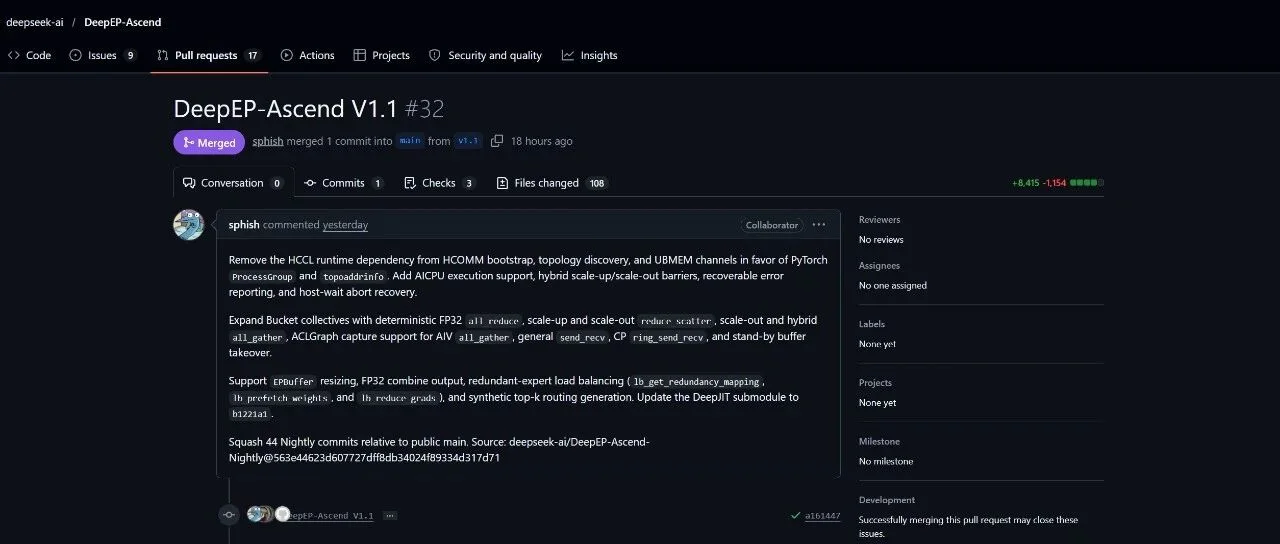
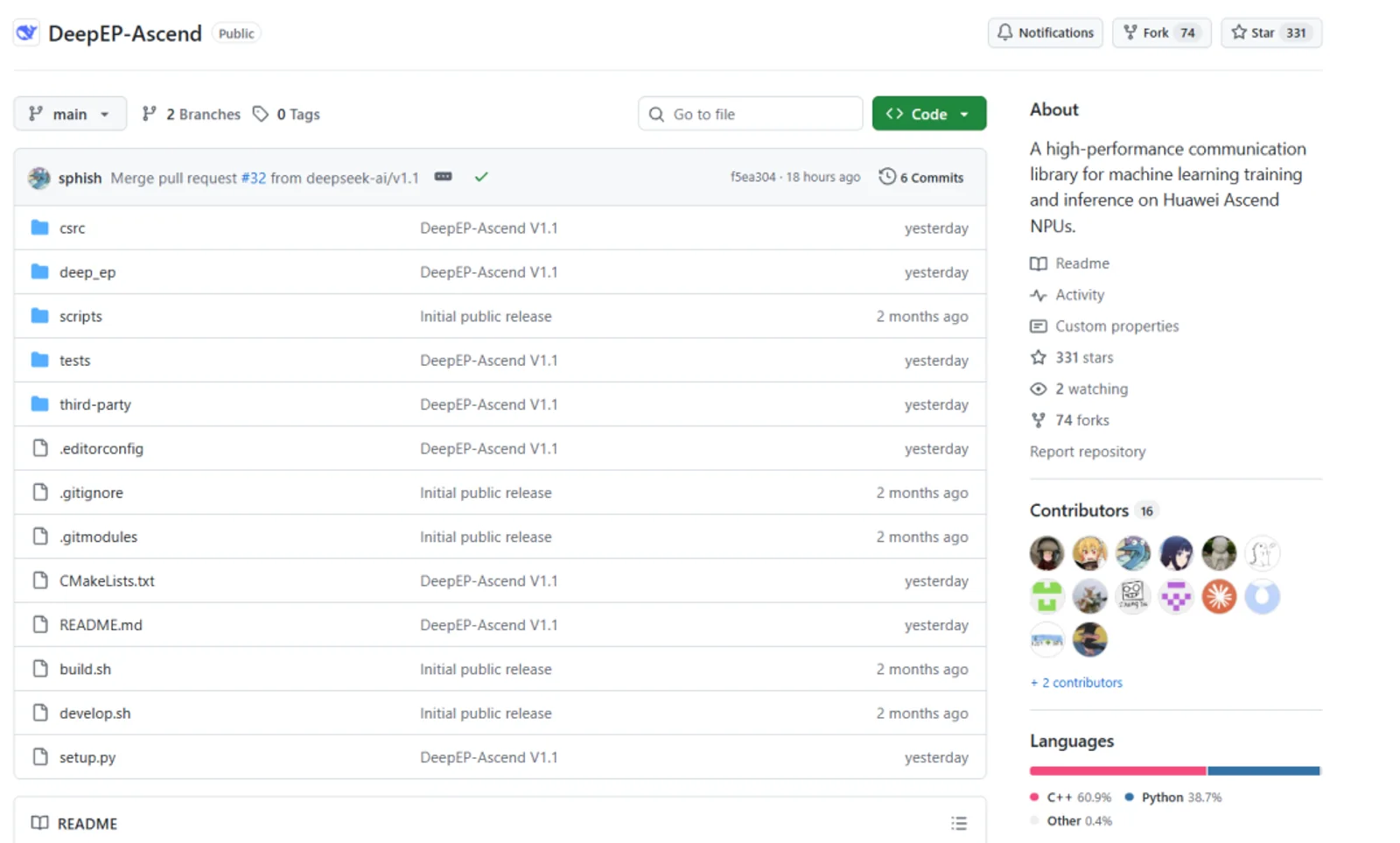
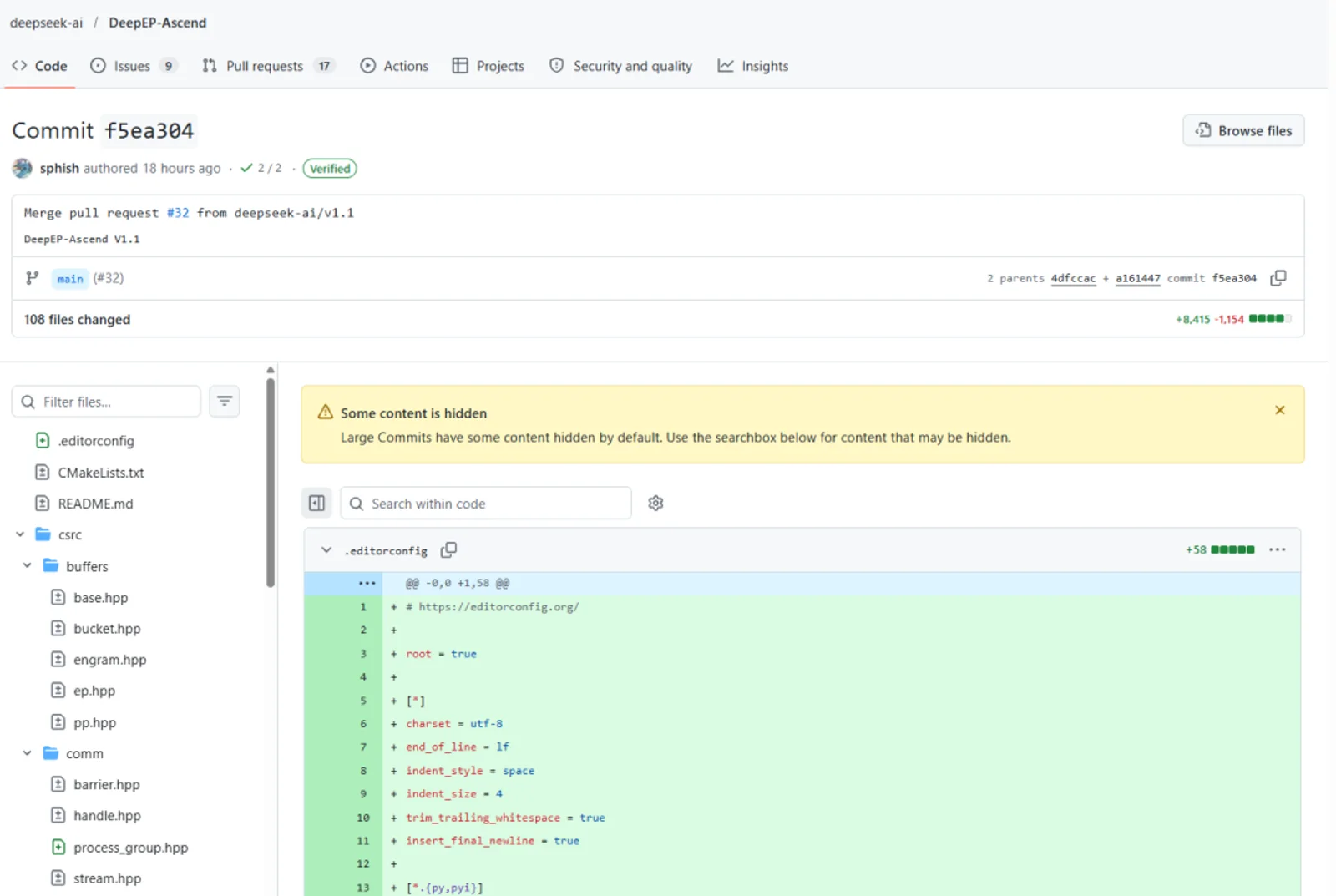
DeepSeek has released version 1.1 of DeepEP-Ascend , an open-source high-performance communication library tailored for Mixture-of-Experts (MoE) models on Huawei Ascend NPUs. The update modifies 108 files and adds over 8,400 lines of code, targeting the communication bottleneck that arises when expert parallelism distributes different experts across multiple NPUs.
Performance Benchmarks on Ascend 950DT
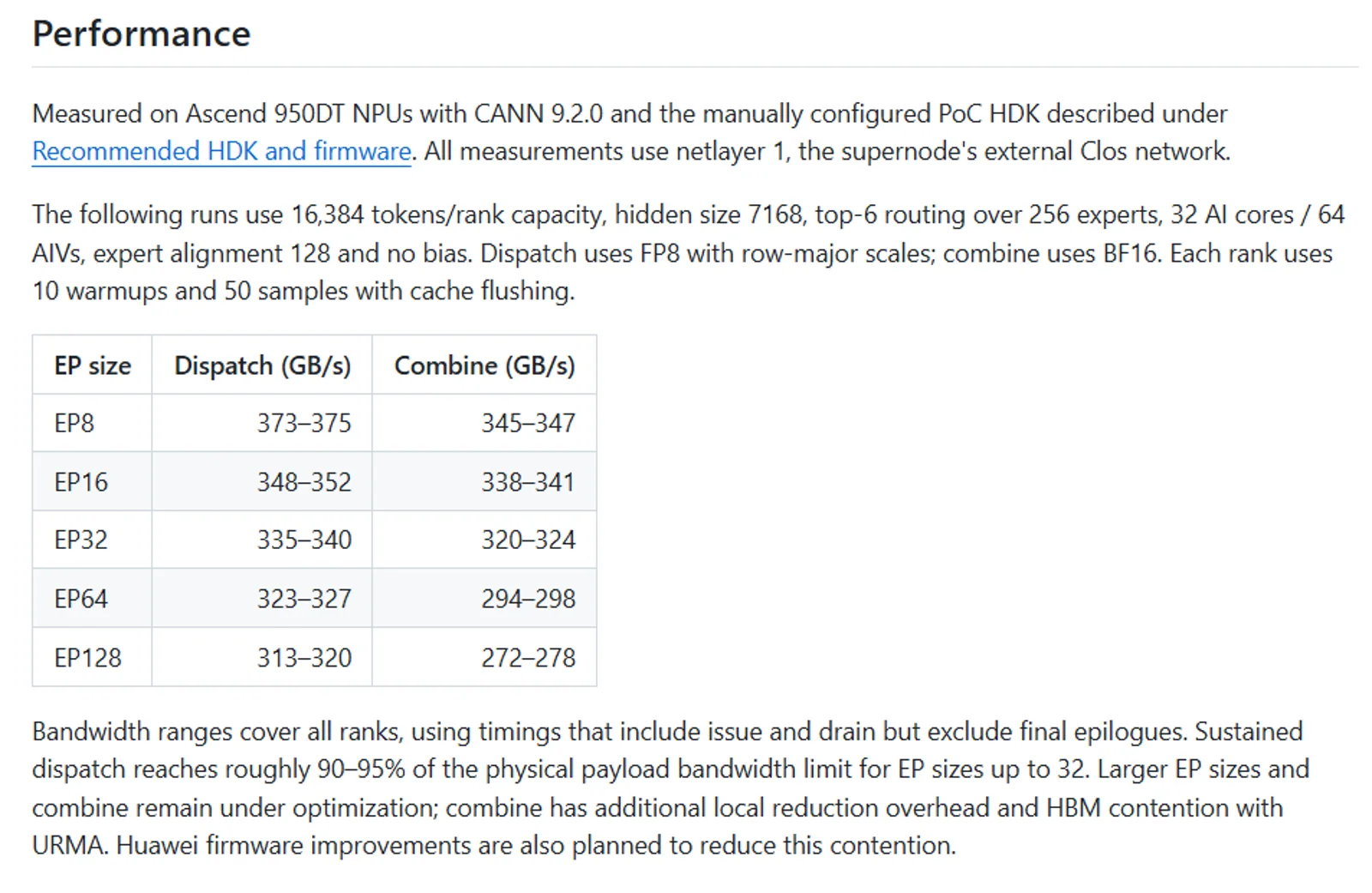
Official tests on the Ascend 950DT NPU with an 8-way expert parallel configuration show:
Data distribution (dispatch) communication bandwidth peaks at 375 GB/s .
Result aggregation (combine) communication bandwidth peaks at 347 GB/s .
When the expert parallel (EP) scale does not exceed 32, the sustained data distribution bandwidth reaches approximately 90%–95% of the physical payload bandwidth limit , indicating near-optimal utilization of the interconnect.
Core Architectural Changes
The v1.1 release removes the dependency on the HCCL runtime for several critical initialization steps. Instead, it leverages PyTorch ProcessGroup and topoaddrinfo to handle:
HCOMM initialization
Network topology discovery
UBMEM communication channel establishment
This shift reduces runtime overhead and improves portability within the PyTorch ecosystem.
New Communication Features
AICPU execution support for greater flexibility in operator placement.
Hybrid intra-node and cross-node Barrier synchronization across communication domains.
Recoverable error reporting and host wait abort recovery to improve fault tolerance.
Extended Bucket Collective Communication
Beyond MoE expert dispatch and combine, distributed training requires gradient synchronization, tensor aggregation, and context exchange. To reduce per-tensor launch and scheduling overhead, v1.1 expands the Bucket collective API:
All-Reduce now supports deterministic FP32 reduction.
Reduce-Scatter extends to both intra-node and cross-node communication.
All-Gather adds cross-node and hybrid communication domain support.
Ring Send-Recv is introduced for context parallelism.
AIV All-Gather supports ACLGraph capture for graph-mode execution.
Additional enhancements include dynamic EPBuffer size adjustment and FP32 output for Combine operations .
Verified Software Environment
NPU: Ascend 950DT
CANN: 9.2.0
Python: 3.12
PyTorch: 2.13.0+cpu
torch_npu: 2.13.0rc1
Developers must configure the CANN environment and install matching PyTorch and torch_npu versions before proceeding.
Installation Steps
git clone <repository-url>
cd DeepEP-Ascend
git submodule update --init --recursive third-party/deep_jit
python -m pip install --no-build-isolation .Basic Usage
After installation, the library is accessible via the deep_ep Python module. A typical workflow:
Select the local NPU device.
Initialize the distributed process group with torch.distributed.init_process_group(backend='hccl').
Create an EPBuffer for communication buffering.
Invoke dispatch and combine operations for MoE expert data distribution and result aggregation.
For questions about attribution, corrections or content rights, please contactand we will review it promptly.