

Gemma 3 270M Runs on Office Printer with 14MB RAM via PostScript
Google DeepMind engineer Omar Sanseviero ran the 270M-parameter Gemma 3 model on an office laser printer using only 14.1MB of RAM by leveraging PostScript's Turing-complete interpreter and Carbon inference engine with dynamic layer streaming, achieving 61.3 tokens/sec and printing 'Read the fine print' as output.
Reading font
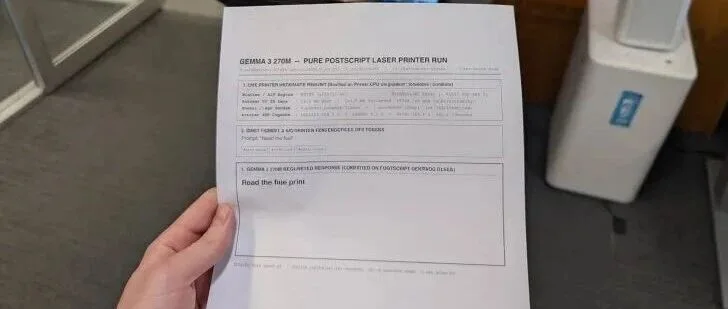
Running Gemma 3 270M on an Office Laser Printer
A Google DeepMind software engineer, Omar Sanseviero, demonstrated that the 270-million-parameter Gemma 3 model can execute natively on a standard office laser printer with a peak memory footprint of just 14.1 MB. The experiment used the printer's built-in PostScript Level 3 interpreter — a Turing-complete page-description language — as the compute substrate, requiring no firmware modifications or external compute boards.
Technical Approach
Inference engine: Carbon, a lightweight Transformer inference engine written in PostScript.
Model: Quantized Gemma 3 270M (2.7×10⁸ parameters).
Memory management: Dynamic layer streaming — model layers are loaded and released sequentially during inference, keeping peak usage at 14.1 MB within the printer's 244.6 MB PostScript virtual memory allocation.
Performance Results
Throughput: 61.3 tokens/second during decoding.
Prefill latency: 184 seconds for a 4-token prompt ("Read the fine").
Decode latency: ~0.1 second per generated token.
Total runtime: 184 seconds for the full forward pass across 18 transformer layers.
Output Verification
After computation completed on the PostScript stack, the printer physically printed the three-word response: "Read the fine print", confirming end-to-end execution on the device.
Significance
The demonstration shows that even commodity office equipment with severely constrained memory can run modern small language models when paired with aggressive quantization, layer-wise streaming, and a Turing-complete interpreter already present in the hardware. It highlights the portability of transformer inference to unconventional platforms without hardware changes.
For questions about attribution, corrections or content rights, please contactand we will review it promptly.