

Google CRSI: Agents Transfer Experience Across Models and Data for Self-Improvement
Google researchers introduce Continual Recursive Self-Improvement (CRSI) and Self-Improvement Memory (SIM), enabling agents to transfer optimization experience across model and dataset changes; experiments show SIM improves harness optimization over naive transfer, though benefits vary and scalability remains unproven.
Reading font

Background: The Need for Continual Self-Improvement
Agent self-improvement is typically studied under fixed models, fixed data, and fixed benchmarks. In practice, systems evolve: task models may be upgraded, or the same model may face new datasets and tasks. The question is whether previously accumulated optimization experience can help the system continue improving after such changes, without restarting search from scratch.
Google Cloud AI, Google DeepMind, Google Cloud AI Research, and Pennsylvania State University collaborators recently published a preprint titled "Self-Improvement Memory Enables Continual Recursive Self-Improvement" (arXiv:2611.18856) that explores Continual Recursive Self-Improvement (CRSI) and introduces Self-Improvement Memory (SIM) .
Harness as the Target of Recursive Self-Improvement
An agent's capability depends not only on model weights but also on the external program that organizes prompts, selects tools, processes returns, and decides when to stop. This program is called the harness . Recursive self-improvement can operate on the harness while the task model's weights remain frozen: run the current version, collect feedback, propose modifications, and evaluate to select the next version.
Challenge: Harness Transfer Is Not Guaranteed
A harness optimized for one model may not suit another. The paper gives a concrete example: a harness optimized for Opus, when executed by Gemini on workspace tasks, scored 68.41 , which is lower than the Gemini seed harness score of 73.89 . Simply reusing the code does not guarantee benefit.
CRSI Settings: Cross-Dataset and Cross-Model
CRSI studies two primary transfer settings, assuming executable interface compatibility:
Cross-dataset : keep the task model fixed, switch the task benchmark.
Cross-model : keep the task benchmark and data splits fixed, switch the task model.
In both settings, optimization continues from an existing harness. SIM records why the source optimization produced that code, helping subsequent runs decide which modifications to keep, which to redesign, and appending new attempts to the history.
Self-Improvement Memory (SIM) Design
SIM serves the optimizer that proposes and selects modifications, not the task model directly. It is not a user profile or chat history.
Organization : records are grouped by recurring harness issues.
Stored fields for each selected modification : modification content, rationale, predicted outcome, observed outcome, and context (model, benchmark, round).
Append-only history : subsequent attempts append to the same issue; even rollbacks are kept.
Unselected candidates : current implementation does not save all rejected candidates.
Both the modification proposer and the selector read these records. For instance, a completion check originally added to prevent premature termination may need a different implementation on a new task, but the principle "do not stop solely because the model declares completion" may still hold. The record lets the optimizer re-evaluate that principle rather than blindly copying code.
Experimental Setup
The paper defines four control conditions, all starting from the same source harness, with identical target task, task model, optimization rounds, and candidate budget (note: equal rounds and budget do not imply equal token usage or wall-clock time):
Cold start from seed harness.
Transfer only the optimized harness.
Transfer harness plus root-cause labels.
Transfer full SIM.
Evaluation sets are separate from the feedback used during optimization. Experiments cover four domains: coding, text classification, workspace, and engineering design . The study includes six cross-dataset settings and four Opus-to-Gemini cross-model comparisons.
Results: Cross-Model Workspace Example
In the workspace cross-model experiment, both continuation runs started from the same 68.41 score. With full SIM, the final score reached 84.75 ; with harness-only transfer, it reached 73.42 — a difference of 11.33 points in this specific setting (not an average across domains). Across all tested cross-dataset and cross-model comparisons, full SIM's final score was higher than both harness-only and root-cause-label-only conditions.
Results: Coding Domain — Ten Independent Source Runs
To reduce dependence on a single source optimization, the authors ran ten independent source optimizations in the coding domain. Each source run optimized Terminus-2 on Terminal-Bench 2.1, then continued on Terminal-Bench 4 for ten rounds with and without SIM (paired).
Nine out of ten pairs achieved a higher final score with SIM.
Average advantage: 2.36 points (95% CI [1.05, 3.68]), paired t-test p = 0.003.
One pair was 0.61 points lower with SIM.
The 2.36 figure is an absolute score difference, not a relative percentage.
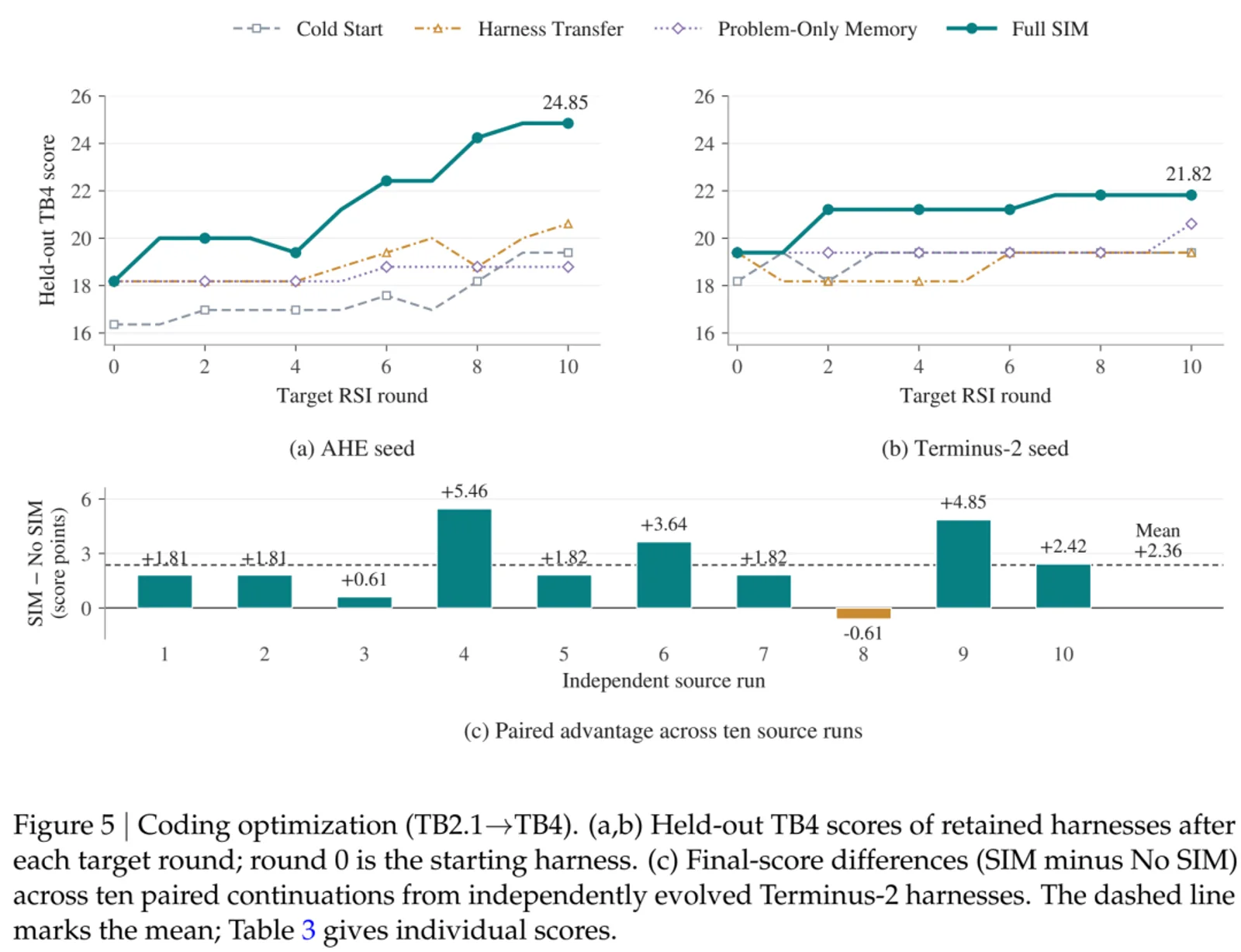
The authors caution that these results support the average benefit of the full SIM continuation pipeline in this coding experiment, but cannot isolate the causal contribution of each memory field. Other domains mostly have only one full optimization run per condition, so the ten-run replication is not claimed for all four domains.
Limitations and Caveats
Interface compatibility is a prerequisite.
Benefits are not guaranteed for every transfer; besides the coding negative pair, one model-generational continuation underperformed from-scratch optimization.
The current implementation lets the optimizer read the entire SIM; long-term accumulation raises questions about context cost, retrieval strategy, and scalability.
The work does not prove unlimited self-improvement; it shows that preserving "why we changed it and what happened" improves continual harness optimization in the tested settings.
References and Links
Paper: https://arxiv.org/abs/2611.18856
Project page: https://lucasxinyu.github.io/sim/
Discussion: https://huggingface.co/papers/2611.18856
For questions about attribution, corrections or content rights, please contactand we will review it promptly.