

How OntoL Scales Ontology Products: A Three-Layer Flywheel for Replicable Implementation, Asset Accumulation, and Mass-Produced Engineers
OntoL transforms ontology delivery from bespoke expert projects into a scalable product by standardizing a three-layer architecture (core ontology, industry suites, customer extensions), building a closed-loop asset repository that feeds back verified models and mappings, and training Field Delivery Engineers (FDEs) through a tiered, practice-heavy program — creating a flywheel where product, assets, and talent reinforce each other to lower marginal cost per deployment.
Reading font
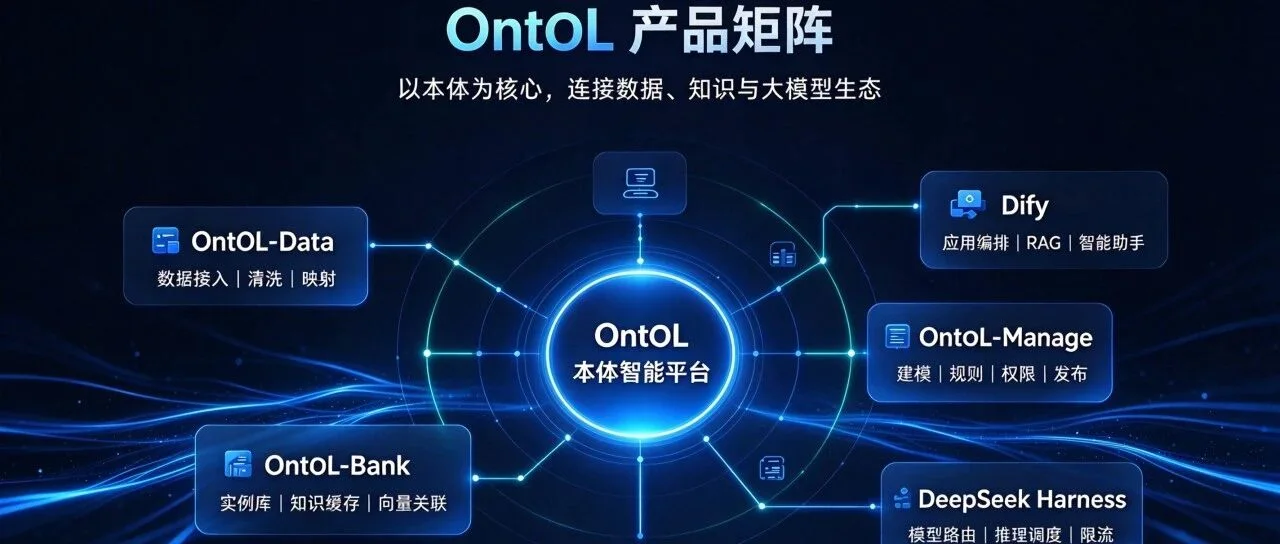
Product Foundation: Standardized Three-Layer Architecture
OntoL avoids the "project trap" — where each client requires custom modeling, expert teams, and from-scratch delivery — by fixing a product architecture that separates stable, reusable capabilities from variable customer extensions. The architecture has three layers:
Core Ontology Layer : Defines cross-industry foundational concepts, relations, axioms, and inference rules. It is versioned, consistency-checked (via SHACL), and insulated from per-client changes.
Industry Suite Layer : Pre-built ontology packages for verticals such as chemical, equipment manufacturing, logistics, mining, apparel, and new energy. Each suite includes high-frequency models (BOM, ECN, supply chain, master data, quality traceability) plus pre-configured DSL (OntologyL_Cypher), Allen temporal reasoning, DE-9IM spatial reasoning components, and federated query capability. FDEs adapt these suites rather than designing from zero.
Customer Extension Layer : Isolated space for client-specific objects, attributes, and rules. Private data and definitions never pollute the shared industry asset pool.
Implementation follows a standardized pipeline: scenario diagnosis → semantic alignment → Minimum Viable Ontology (MVO) modeling → data source mapping → rule and inference configuration → consistency verification → trial run → continuous iteration. Every stage embeds templates, checklists, automated test cases, and SHACL constraint validation. The approach shifts delivery from "build enterprise-wide ontology at once" to "lock high-value closed-loop scenario, run MVO, then expand."
Cost curve evidence: first client in a vertical incurs high effort to harden the suite; by the 5th–8th client, most models, mapping scripts, and inference chains are reusable, incremental effort drops sharply, cycle time shrinks, and gross margin rises. The product includes version control, change approval, rollback, and audit trails so the ontology becomes a governable, maintainable production asset like software.
Asset Flywheel: Four Categories of Structured Reuse
Project close-out is not the end; it feeds the asset repository. Four asset types are captured with strict boundaries and access control:
Industry Ontology Assets : Verified concepts, relations, axioms, constraints, and inference chains — de-identified, reviewed, stripped of client proprietary info — flow back into the relevant industry suite, upgrading its version. Example: ECN change inference and material substitution rules validated in equipment manufacturing; SKU color-size-code and process chain models validated in apparel.
Data Mapping & Cleansing Assets : Scripts and rules for mapping ERP, MES, PLM, and supply-chain systems into the ontology — field alignment, data quality checks, entity disambiguation strategies — stored as reusable mapping packages that eliminate repeated integration pitfalls.
Scenario Case Assets : Each deployment produces a standardized case pack: business pain points, acceptance criteria, ontology scope, inference chains, sample queries, measured outcomes, risk register, and lessons learned. Packs are tagged by industry, business domain, system type, and difficulty for retrieval. They serve as FDE playbooks, explicitly marking applicability boundaries and known controversy points.
Evaluation & Harness Assets : Consistency test suites, inference result verification cases, diagnostic scripts per scenario. On suite upgrades or ontology iterations, automated regression ensures logic stability.
Red line : Raw customer business data never leaves the client environment. Only semantic models, rules, mapping designs, methodologies, and case experiences return. This separation sustains trust and keeps the flywheel turning.
Talent Mass Production: Tiered FDE Training System
Scaling bottlenecks shift to talent supply. OntoL defines FDE (Field Delivery Engineer) as a standardized, reproducible role rather than relying on scarce senior ontology experts. Competency is split into four modules: OntoL platform operations, ontology modeling & inference standards, industry business literacy, and delivery & asset-immersion process.
Three tiers:
Junior FDE : Platform basics, read industry suites, execute basic data mappings, deliver simple scenarios using case templates under supervision. Handles implementation, data onboarding, issue logging, asset collation.
Mid-level FDE : Independently completes semantic alignment, ontology tuning, and inference rule configuration for a vertical domain. Delivers standard projects end-to-end, identifies scope boundaries, avoids modeling anti-patterns, and produces compliant case packs for repository ingestion.
Senior FDE : Leads suite iteration reviews, designs complex inference chains, architects cross-vertical solutions, tackles escalations, and acts as internal instructor feeding training content back into the system.
Training mix: 30% theory (architecture, axioms, DSL, inference principles), 30% workshop labs (suite modification, conflict validation, federated query debugging in a sandbox), 40% on-the-job shadowing (join live projects, hit defined delivery milestones, graduate by producing a repository-ready case pack). The asset library itself becomes the learning platform: new FDEs retrieve cases, reuse mapping packages, reference inference designs — lowering ramp-up time as the repository thickens.
Three-in-One Flywheel: Long-Term Growth Logic
The flywheel runs: standardized product equips FDEs with configurable, reusable tools → mass-produced FDEs deploy at client sites and feed structured assets back per protocol → thickening asset pool upgrades industry suites → next FDE cohort delivers faster, more stably, at lower cost. Contrast with traditional project model: "people take experience away" vs. "experience stays in assets, people replicate capability." Ontology capability becomes an industrialized, deliverable, reproducible product.
Guardrails remain: scenario-first, minimum-closed-loop principle; no blind pursuit of monolithic enterprise ontology. Every suite upgrade, case ingestion, and FDE graduation passes review, validation, and quality gates ensuring semantic consistency, inference trustworthiness, and measurable business value. In master data, BOM, supply chain, quality traceability, and compliance risk control — where ontology serves as the unified semantic substrate connecting silos and enabling explainable reasoning — OntoL's path turns ontology from lab pilot and consulting artifact into batch-deliverable, continuously evolving, talent-self-sufficient infrastructure: implementation replicable, cases accumulable, FDEs mass-producible .
For questions about attribution, corrections or content rights, please contactand we will review it promptly.