OntoL provides an ontology-native dual-mode decision routing framework for enterprise AI automation: default LLM-based flexible judgment selects from a pre-defined atomic action pool, while an optional symbolic reasoning layer can be added for deterministic pre-checks like compliance, throttling, and hard thresholds, enabling progressive risk control without sacrificing agility.
OntoL provides pre-built industry ontology packages from 44 real projects, enabling a lightweight mode for fast semantic search with minimal experts and an enterprise trusted mode for high-risk decisions with formal axioms, audit trails, and 70%+ expert workload reduction.
OntoL provides a lightweight, high-compatibility ontology platform that unifies RDFS, OWL2 DL, SWRL, SHACL, and Cypher standards, supports Memgraph and Neo4j, includes built-in temporal and spatial reasoning, and enables executable business actions across 44 industrial use cases from manufacturing to finance.
OntoL transforms ontology delivery from bespoke expert projects into a scalable product by standardizing a three-layer architecture (core ontology, industry suites, customer extensions), building a closed-loop asset repository that feeds back verified models and mappings, and training Field Delivery Engineers (FDEs) through a tiered, practice-heavy program — creating a flywheel where product, assets, and talent reinforce each other to lower marginal cost per deployment.
OntoL separates ontology complexity from user experience, enabling business users to query data via natural language and generate BI dashboards without ontology knowledge, using a semantic firewall to ensure consistent metrics and auditability while reducing modeling effort through AI-assisted schema scanning and visual configuration.
This article details a comprehensive AI-native smart factory solution built on the OntOL ontology platform, covering its five-layer architecture, core product matrix, five key business scenarios, four core capabilities, and a three-phase implementation roadmap for transforming traditional manufacturing into reasoning-driven intelligent factories.
OntoL proposes a three-layer architecture for AI-native organizations, placing an ontology semantic layer between existing data systems and AI agents to enable deterministic reasoning, cross-system collaboration, and governed task execution through structured business contracts and symbolic verification.
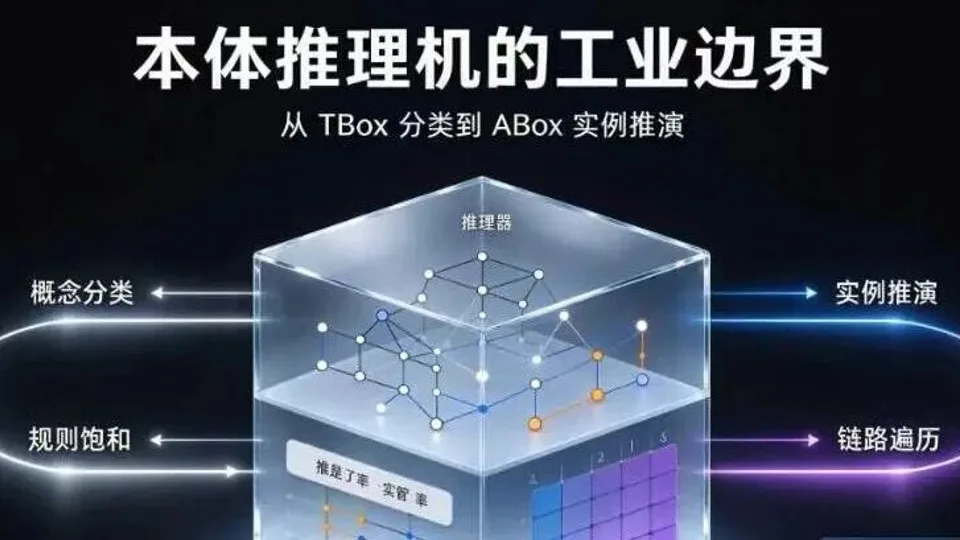
OntoL's ontology platform decouples TBox and ABox layers, providing built-in ABox consistency checking and two implementation paths: a standard TBox-first approach for rigorous governance, and a lightweight ABox-first approach for rapid pilots, both supporting bidirectional evolution and integration with industrial systems.
OntoL's lightweight ontology platform enables rapid knowledge graph deployment by prioritizing ABox instance graphs over upfront TBox modeling, integrating multi-source data, entity resolution, and a custom query language to support traceability and agent-augmented RAG, with a progressive path to add semantic axioms later.
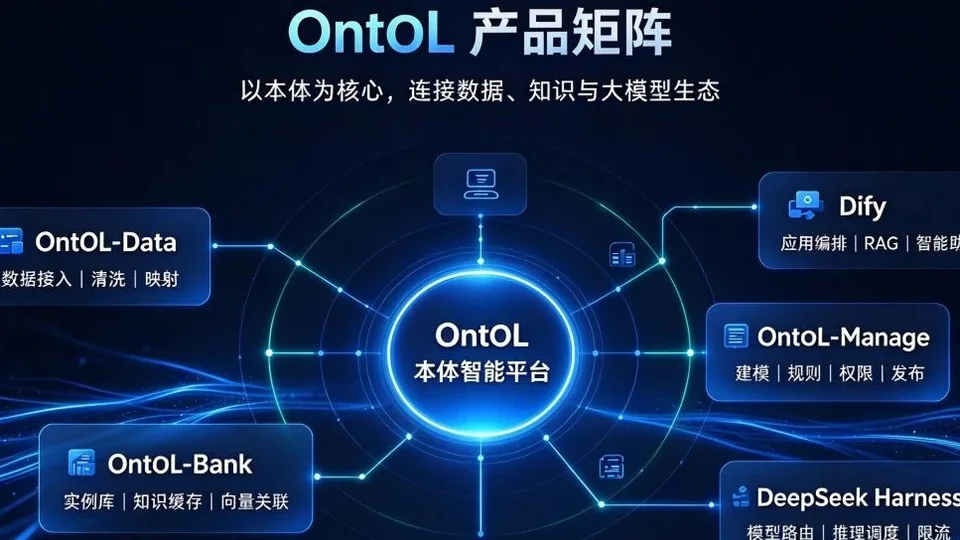
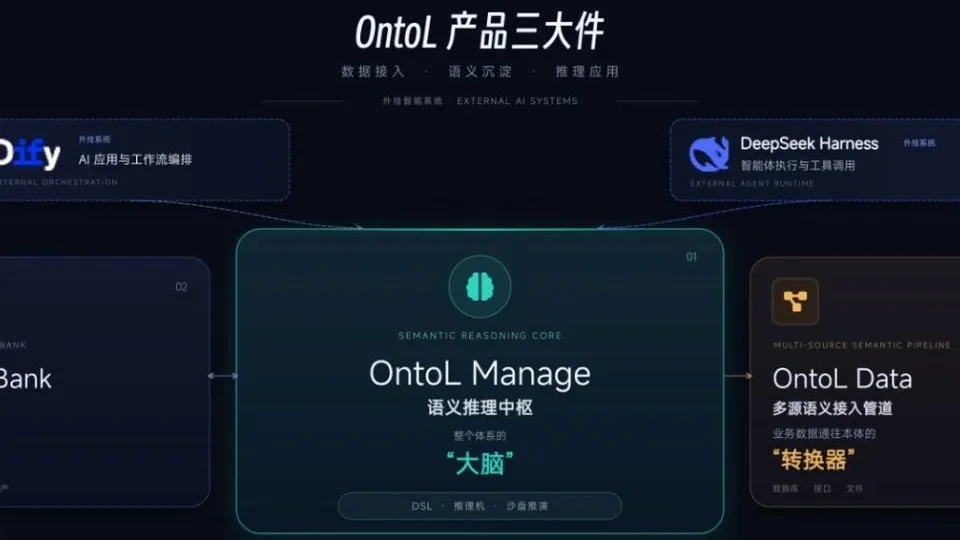
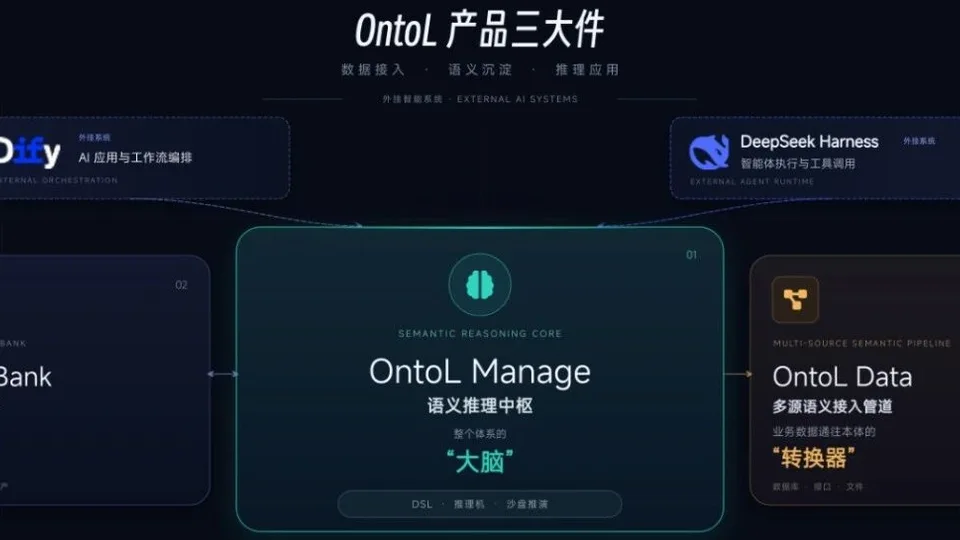
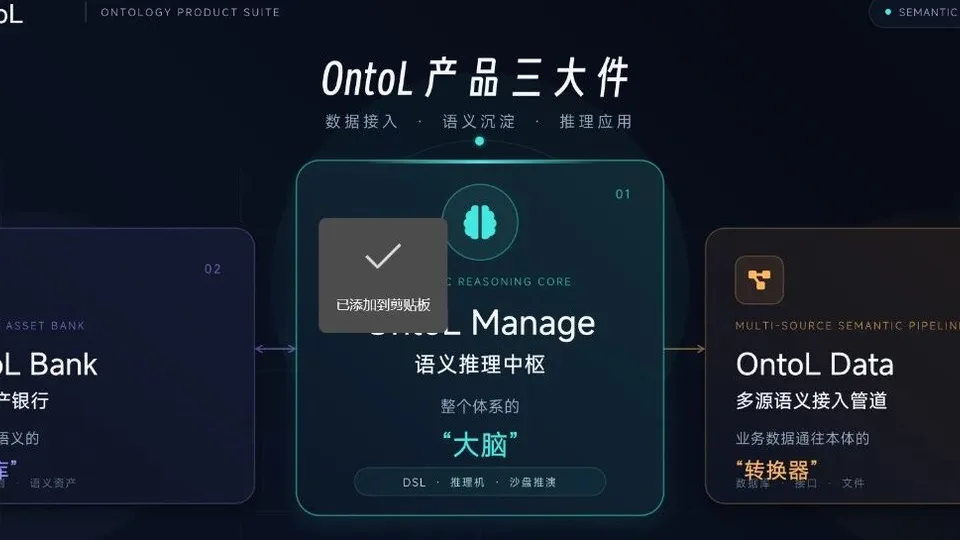
OntoL is an ontology-based intelligent reasoning platform that integrates with general simulation systems to enable autonomous blue force decision-making through three modules: OntoL-Data for multi-source intelligence fusion, OntoL-Manage for simulation orchestration, and OntoL-Bank for case knowledge reuse, demonstrated via a 15-step anti-submarine warfare simulation loop.
OntoL's ERP ontology platform defines a machine-readable semantic model covering core ERP domains like finance, supply chain, and production, enabling unified business language, cross-module data alignment, automated compliance checks, and trusted context for large language models and intelligent agents.
OntoL's OntologyL_Cypher (OLC) is China's first ontology language tailored for a specific ontology product, orchestrating SQL, Cypher, and SPARQL across relational and graph databases to provide a unified scheduling layer that manages reasoning contexts, optimizes cross-source queries, and defines inference boundaries for industrial ontology applications.
The article details an ontology-based architecture (OntoL) that unifies fragmented metrics from ERP, MES, WMS, finance, and IoT into a federated operational knowledge graph, covering TBox modeling, multi-source ABox ingestion, indicator assetization, a declarative DSL reasoning engine, and governance pitfalls.
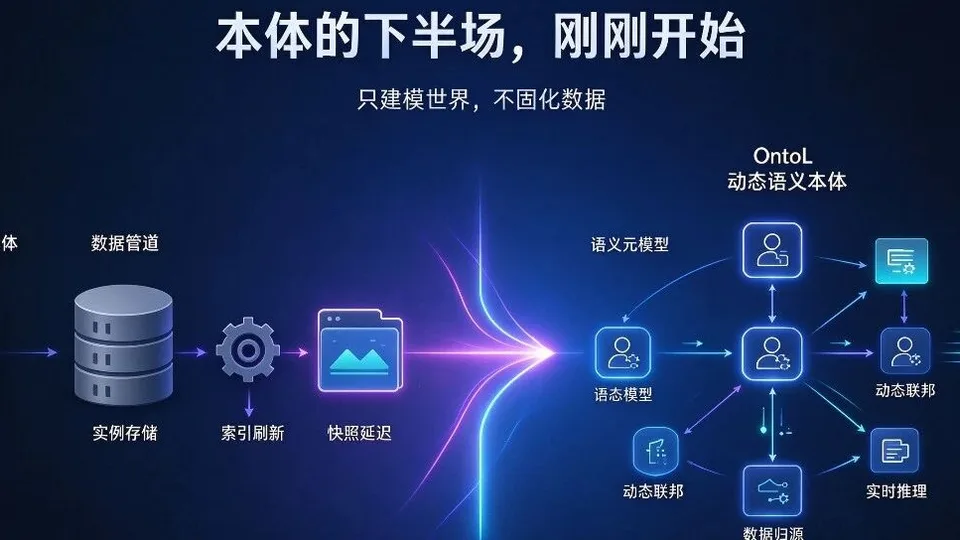
The article argues that while enterprise ontologies are essential for AI agents, current approaches either lack production scalability (academic OWL) or suffer from data duplication and latency (pre-loaded instance ontologies like Palantir's), proposing OntoL's dynamic semantic ontology that models only business rules and fetches data in real-time from source systems.
This article details how the OntoL ontology platform enables ERP system generation by capturing business entities, relationships, rules, actions, and metric calibers in a formal ontology, allowing LLM-assisted category discovery and automatic translation of business definitions into executable ERP modules without code changes.
A detailed case study of a 10-step ontology platform deployment for a clothing company's fast-response supply chain, covering strategic positioning, goal decomposition, organizational alignment, SOP definition, competency questions, rule reasoning, causal analysis, workflow automation, strategic feedback, and ontology upgrades using the OntoL semantic platform.
This guide details deploying OntoL, a query layer that compiles ontology and DSL rules into standard openCypher, enabling seamless switching between Memgraph and Neo4j graph database backends with configuration, verification, and operational procedures.
This article compares implicit reasoning (OWL2/SWRL) with explicit reasoning (OntoL/Palantir), explaining why industrial knowledge graph systems prefer explicit reasoning for auditability, traceability, temporal/spatial reasoning, and performance in dynamic, open-world scenarios like manufacturing and intelligence analysis.
This guide details a 12-step process for creating executable ontologies using OntoL's Auto Workshop, covering prerequisites, iteration modes, prompt writing, canvas inspection, field and relationship management, data binding, loading, reasoning, self-testing, approval workflow, troubleshooting, and includes prompt templates, a complete example, and a checklist.
The article compares NVIDIA's Auto-Ontology, which uses LLMs to generate semantic layers from database schemas, with OntoL, which deterministically parses interface comments into DSL for rule-based reasoning, highlighting trade-offs between probabilistic flexibility and deterministic correctness for AI agent contexts.
OntoL demonstrates that the world's largest knowledge graphs — billions of nodes and edges — fit comfortably in a single-machine in-memory graph database (Memgraph), eliminating distributed sharding overhead and enabling nanosecond multi-hop traversals by co-locating the reasoning layer with storage.
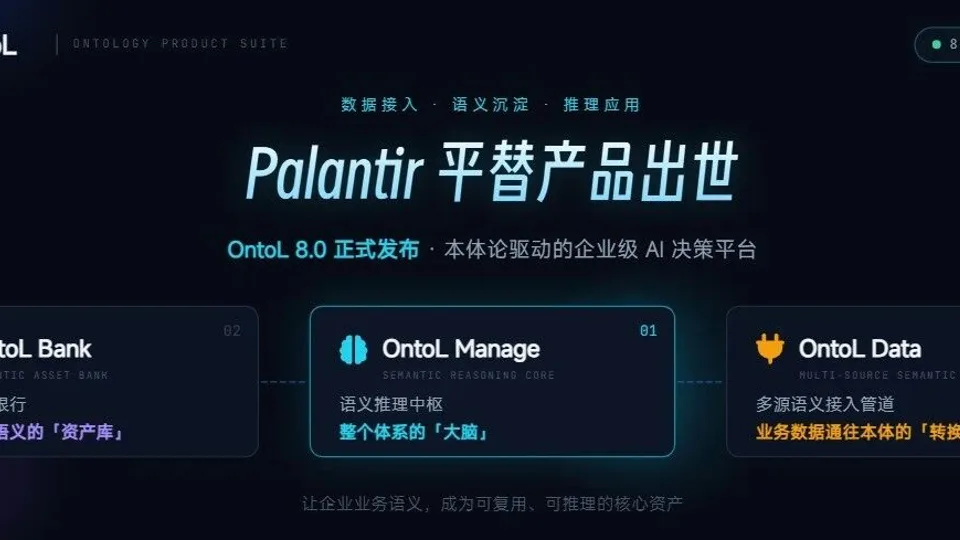
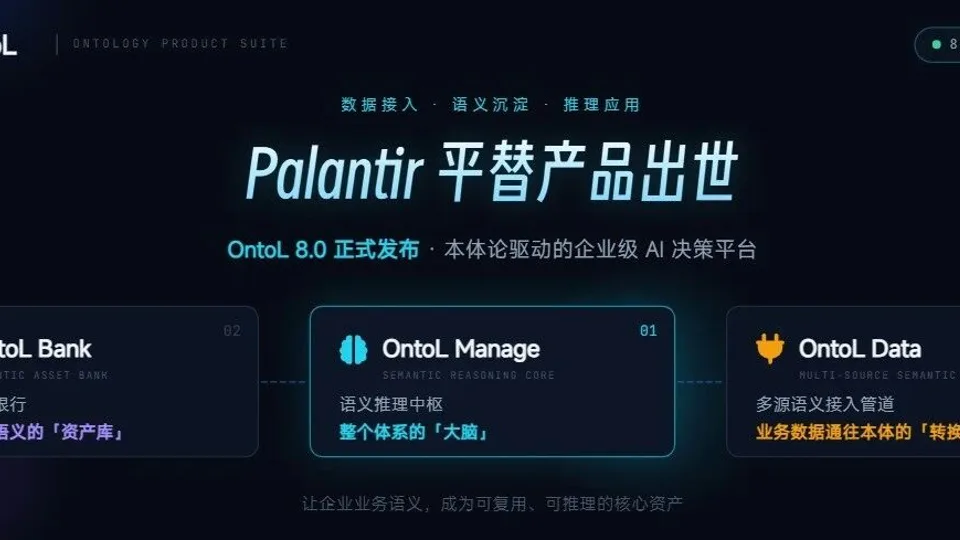
OntoL 8.0 replicates Palantir's ontology-driven enterprise AI platform with data health dashboards, natural-language ontology generation, document-to-graph conversion, sandbox simulation, and granular permissions, delivering comparable decision-making capabilities to Chinese enterprises at one-tenth the cost.
This article compares Palantir's ontology-as-operational-layer approach with OntoL's standards-based semantic platform, analyzing six key divergences in philosophy, standards, AI integration, and deployment to help enterprises choose between closed-loop execution and open, governable semantic foundations.
This article analyzes why China has numerous ontology construction projects but few production-grade ontology products, defining seven criteria for production readiness and examining how OntoL addresses industrial needs through integrated modeling, reasoning, deployment, and governance capabilities that transform ontologies from static deliverables into sustainable semantic infrastructure.
This article details how OntoL's custom DSL and inference engine collaborate with standard fields and sandbox replicas to transform static ontologies into executable knowledge graphs, covering architecture layers, rule structure, execution flow, propagation, LLM integration, and engineering challenges.
OntoL's self-developed DSL simplifies ontology modeling and reasoning with simple syntax, multi-scenario reuse, strong system integration, unified semantic expression for graph computing, front-loaded constraints for reliability, inherent explainability for auditing, and full technical autonomy for sustainable evolution.
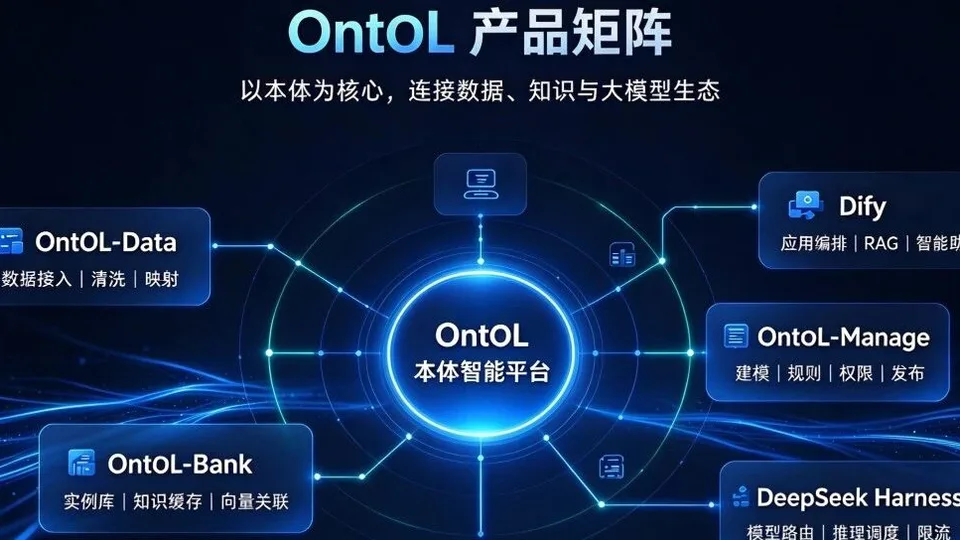
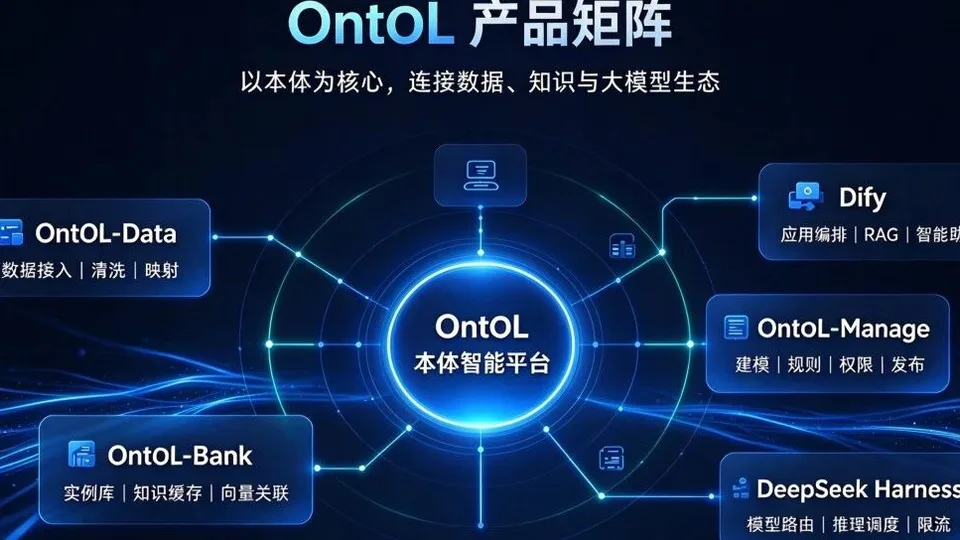
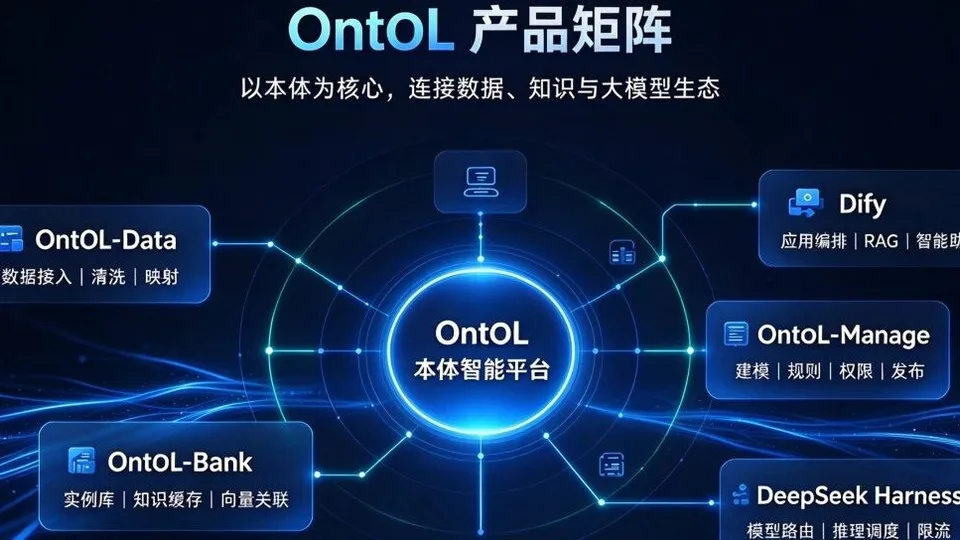
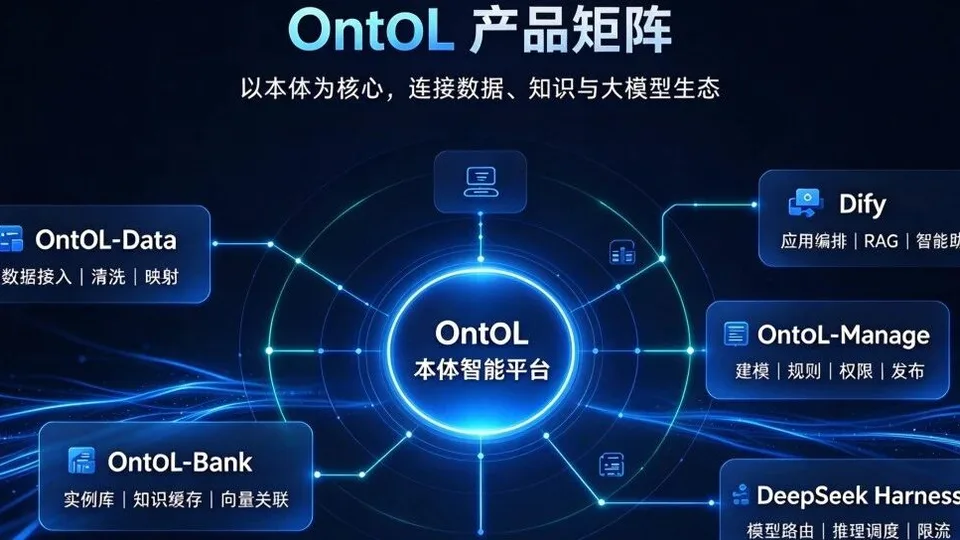
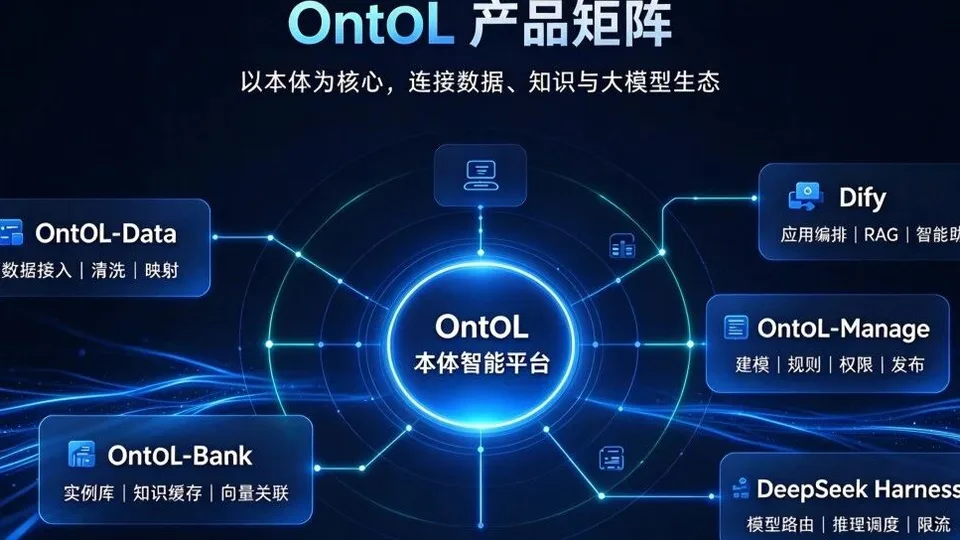
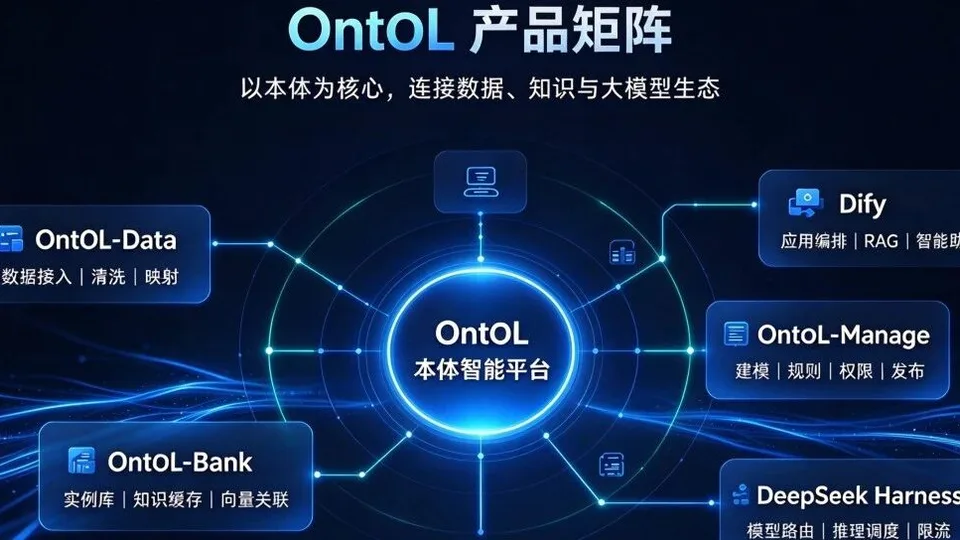
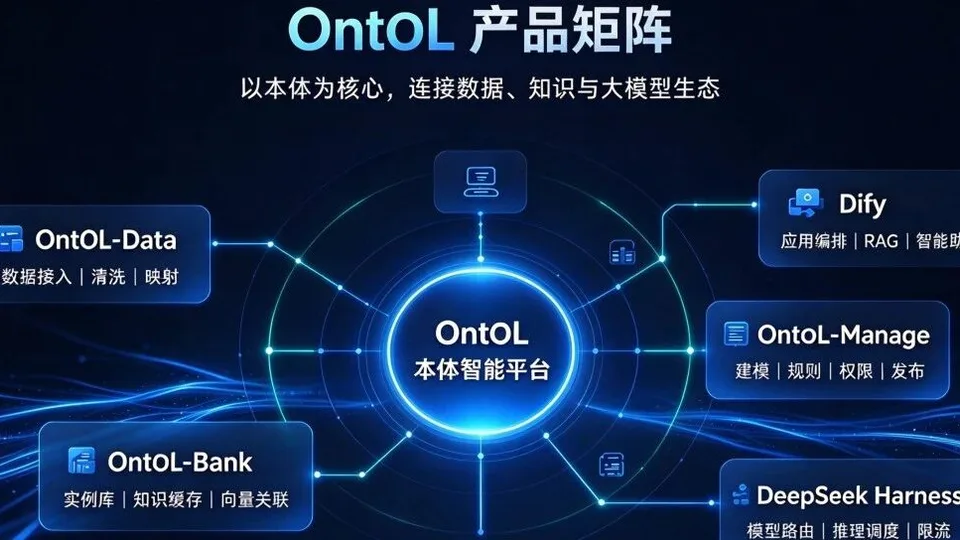
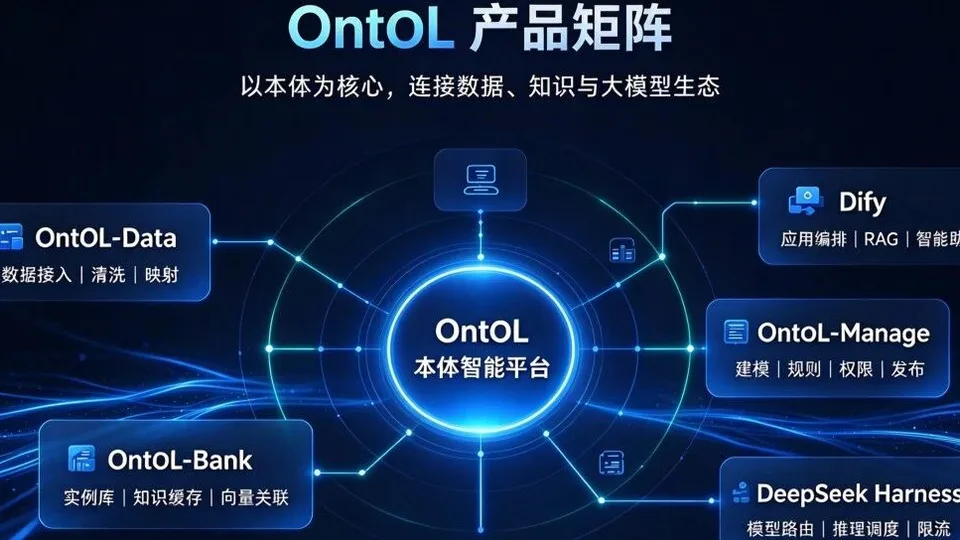
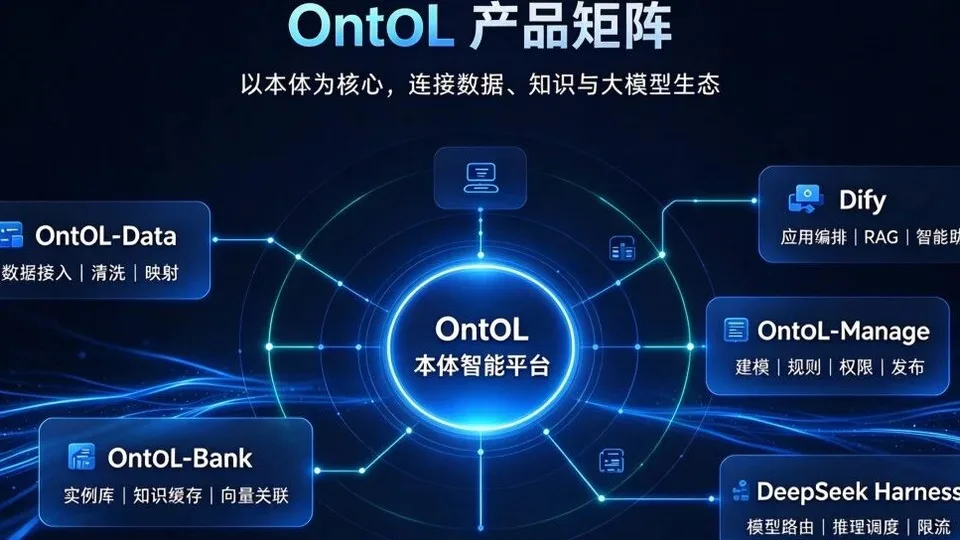
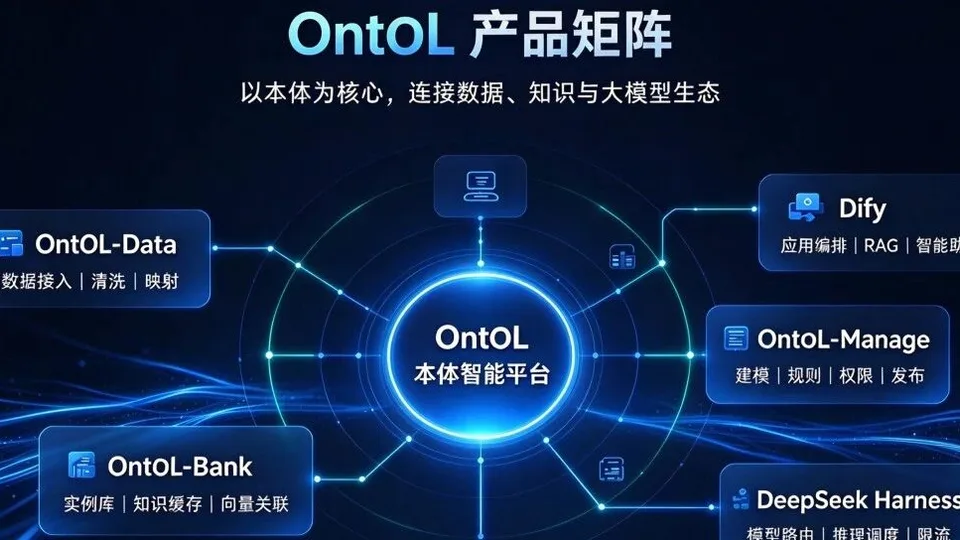
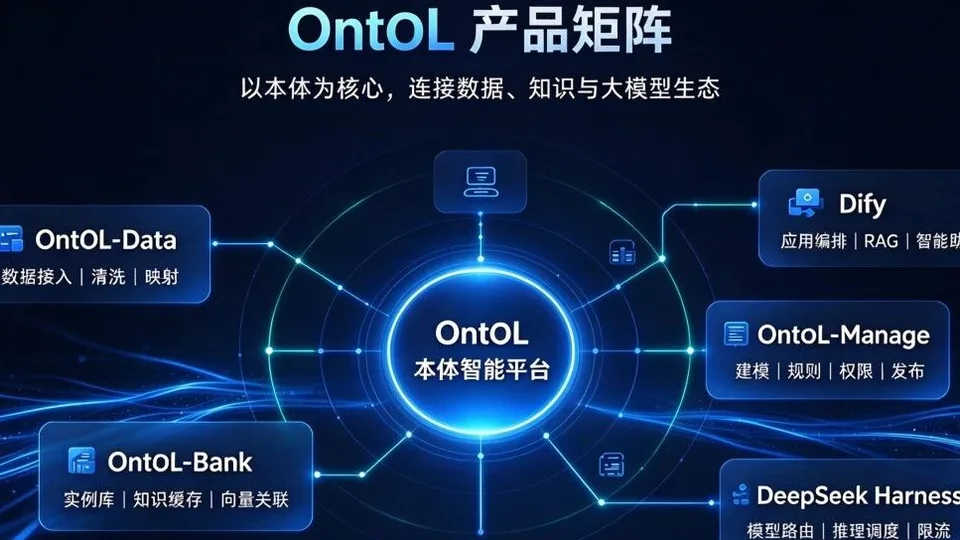
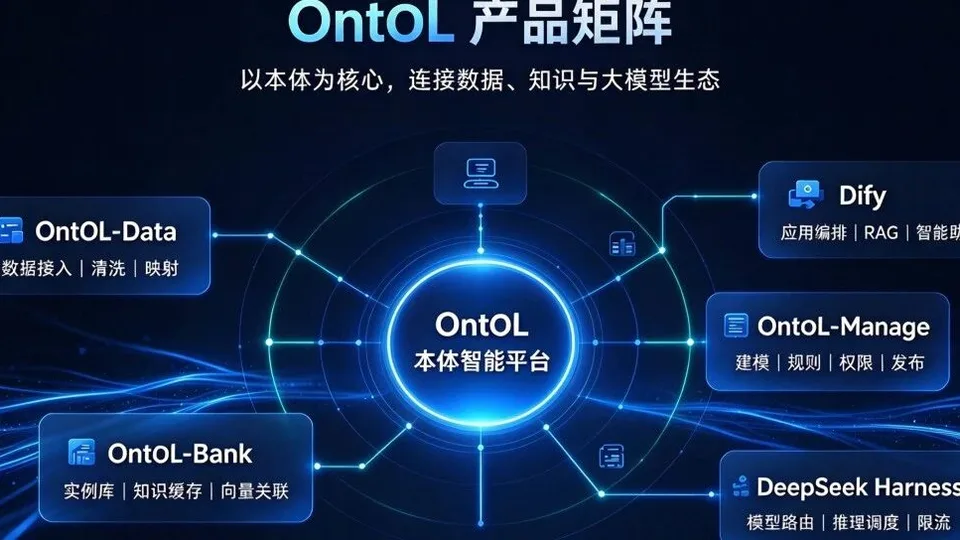
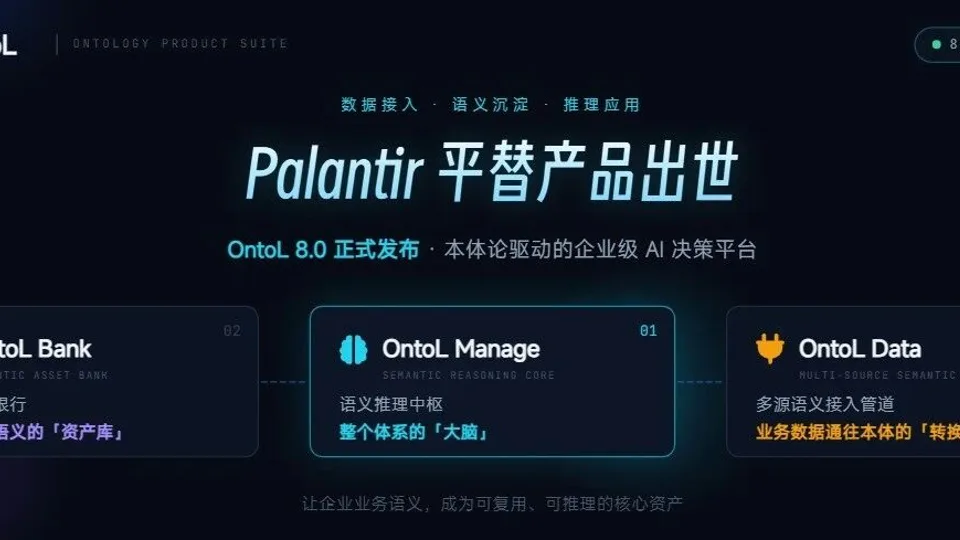
OntoL 7.0 provides a semantic ontology product matrix — OntoL Manage for reasoning with TBox/ABox separation and SHACL constraints, OntoL Bank for ontology asset versioning and reuse, and OntoL Data for multi-source semantic ingestion — enabling private, offline industrial AI deployment without migrating legacy ERP, MES, or Doris systems.
A case study of OntoL ontology deployment at a chemical manufacturer, detailing two workflows—project-contract-payment querying and contract attachment verification—highlighting data governance gaps, DeepSeek Harness prototyping, and the birth of OntoL-Data governance tooling.
This article presents a free, validated 5-step methodology for implementing AI ontology in enterprises, emphasizing scenario selection over technical starting points, illustrated with an HR case study where a manufacturing company achieved turnover prediction in three months.
This article analyzes six core software implementation challenges at Hangchi, a heavy equipment manufacturer, including heterogeneous system data silos, BOM version chaos from frequent ECNs, WIP-cost accounting misalignment, master data governance issues, planning-execution disconnect, and broken traceability chains, and maps each to OntoL's ontology-based knowledge graph solutions.
This article explains why ERP systems with identical workflows produce vastly different outcomes, revealing that business semantics and rules—not processes—determine success, and demonstrates how OntoL's ontology modeling with TBox/ABox layers and inference engines standardizes constraints, versioning, and traceability across manufacturing scenarios.
The author details how LLMs failed in underwater battlefield simulations despite trying prompts, agents, RAG, and knowledge graphs, and explains why ontologies — formal, reasoning-capable world models — are essential for trustworthy AI decisions, illustrating with a concrete case and a six-step ontology engineering process.
The article explains why most factories cannot implement the 40 official smart manufacturing scenarios, identifying semantic fragmentation across MES, ERP, PLC, and other systems as the core blocker, and shows how OntoL's ontology-based unified semantic layer enables incremental, pain-point-first deployment without ripping out existing IT.
This article analyzes OntoL, an ontology modeling tool for enterprise knowledge governance, detailing its three-layer architecture, core capabilities like visual modeling and versioning, applicable scenarios, current technical limitations, and future roadmap including SHACL constraints and federated query.
The article explains that Python/Java focus on execution, BI on measurement, while ontology provides a living semantic foundation that unifies meaning and reasoning across systems, enabling AI to understand context, infer hidden knowledge, and turn scattered business expertise into actionable assets.
The article analyzes OntoL’s ability to provide enterprise‑wide resource awareness, disturbance simulation, scheduling suggestions, and closed‑loop execution, while clarifying that it lacks an internal industrial optimization solver and therefore cannot independently generate minute‑level optimal shop‑floor schedules without integrating an external APS engine.
The article argues that the ontology field stalls because there is no unified semantic standard, leading to isolated products and costly negotiations, and explains how OntoL's open DSL approach can bridge systems, reduce duplication, and enable standards to drive real-world adoption.