

Java to Rust Migration: 5x Throughput, 75% Server Reduction, Real-World Trade-offs
A team migrated a high-load Java microservice to Rust after GC pauses caused high CPU and costs; benchmarks showed Rust achieved 2-5x higher throughput on 1-2 servers vs 8 Java servers, cutting annual cloud costs by ~200k RMB, but required a steep learning curve, slower initial development, and strict code reviews.
Reading font
The project began as a Java microservice. As user count, business complexity, and data throughput grew, frequent garbage collection drove CPU usage up and response times down. Code optimizations helped briefly, but load-test targets kept rising. Adding servers (up to 8 nodes of 2-4 vCPU, 8 GB RAM on Alibaba Cloud) pushed monthly costs to ~400k RMB, prompting a language reevaluation.
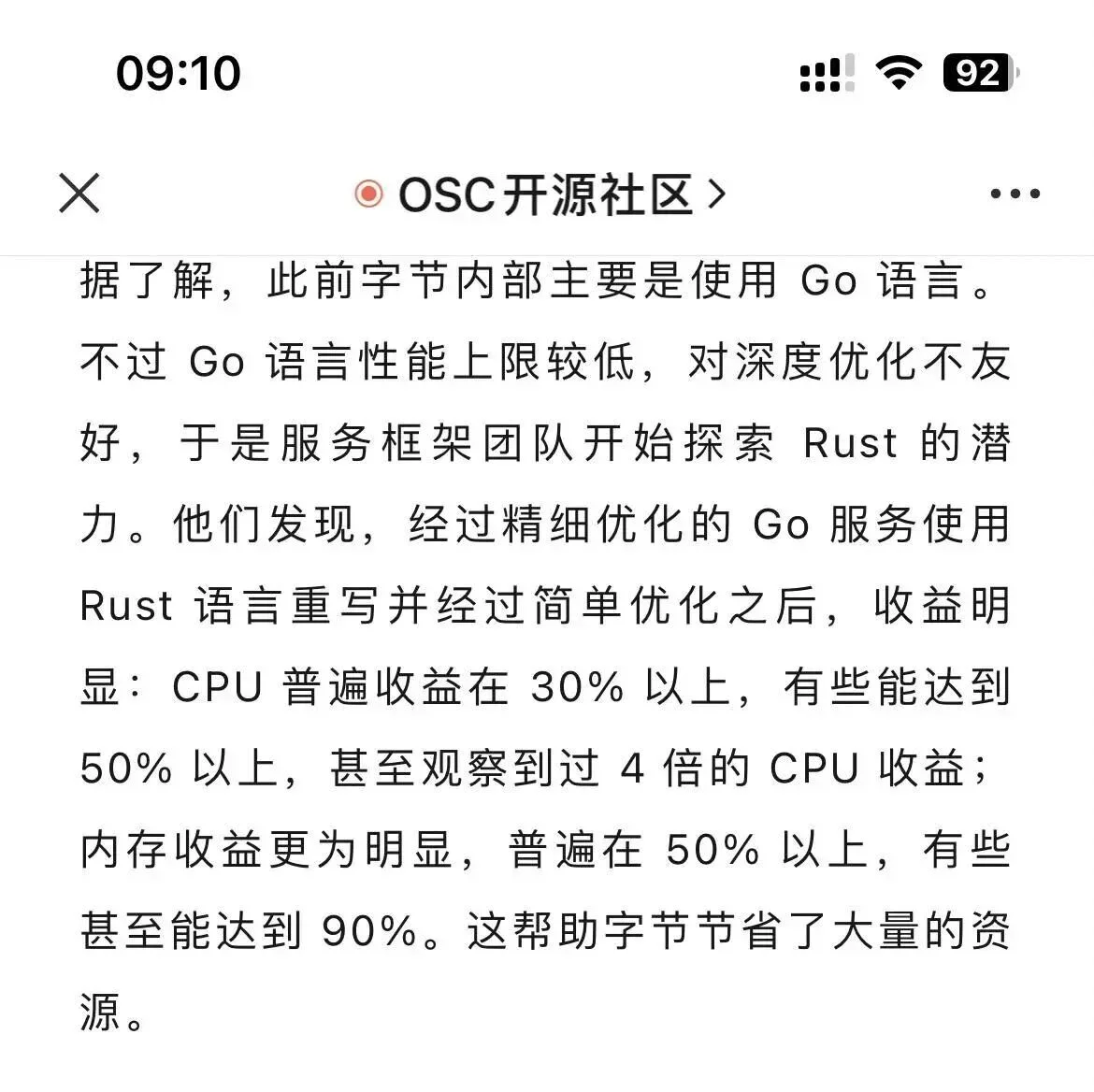
The team lead evaluated Go and Rust (C++ was dismissed quickly). Performance tests showed Rust winning decisively; Go was solid but Rust outperformed it by a wide margin. The lead lost trust in any GC-based language, fearing Go might not solve the core GC problem. A visit to ByteDance to discuss their Rust usage and a desire to build a personal "moat" reinforced the decision.
After migration, load tests compared the old Java deployment (8 machines, 2-4 vCPU, 8 GB each) with the new Rust deployment (1-2 machines, 1-2 vCPU, 2 GB each). Rust delivered 2-5x higher throughput; the advantage grew when network I/O was minimal. Java became a baseline. One year later, the rewrite was complete without delaying feature iterations. Annual server costs dropped by at least 200k RMB (team monthly cost ~80k RMB), and response latency improved.
The transition exacted a heavy human cost: relentless overtime, steep learning curve (Windows debugging, slow compilation, ownership/borrowing, clone overuse criticized by the lead), and slow initial velocity. Over time the team internalized Rust; macros remained the hardest part, but a few capable developers handled them. The author now writes Rust at roughly the same speed as Java.
Budget impact was neutral: development pace returned to normal, and migration was done during a low-iteration window. The rewrite was not a greenfield redesign — most code was a direct translation of the existing Java "spaghetti" codebase. Code reviews were strict (public warnings, then termination for repeated quality issues), but the performance gains came from Rust's runtime characteristics, not from algorithmic improvements.
Architecture: fine-grained microservices with local cache, Redis, MySQL, Nacos, MQ, and Kubernetes. User-facing services received 4 vCPU and 16-32 nodes; other services used 1-2 vCPU and 4-8 nodes. Request payloads up to 400 KB. Auto-scaling and health checks are in place. Daily active users ~200k, with 10 annual events peaking at 1M concurrent users. Only part of the system was migrated; other teams continue with Java/Go.
Guideline: for low-to-moderate traffic, Java or Go remain the best choices. For high-throughput, latency-sensitive workloads, Rust is the top recommendation. The decision depends on context — like choosing a bank card based on specific needs — not on a universal hierarchy.
For questions about attribution, corrections or content rights, please contactand we will review it promptly.