

Legal Data Source ≠ Free Use: Governing Licenses, Purpose Limits, PII & Derived Data
The article explains that legally obtained data does not automatically permit all downstream AI uses such as training, evaluation, RAG, and external model calls. It proposes an engineering governance framework: purpose‑rights matrix, six compliance gates (source, purpose, content, environment, derivation, exit), lineage tracking for derived data, and exit mechanisms. It emphasizes that de‑identification ≠ anonymization, purchased or public data does not grant training rights, and compliance must be embedded in versioned data products with executable controls.
Reading font
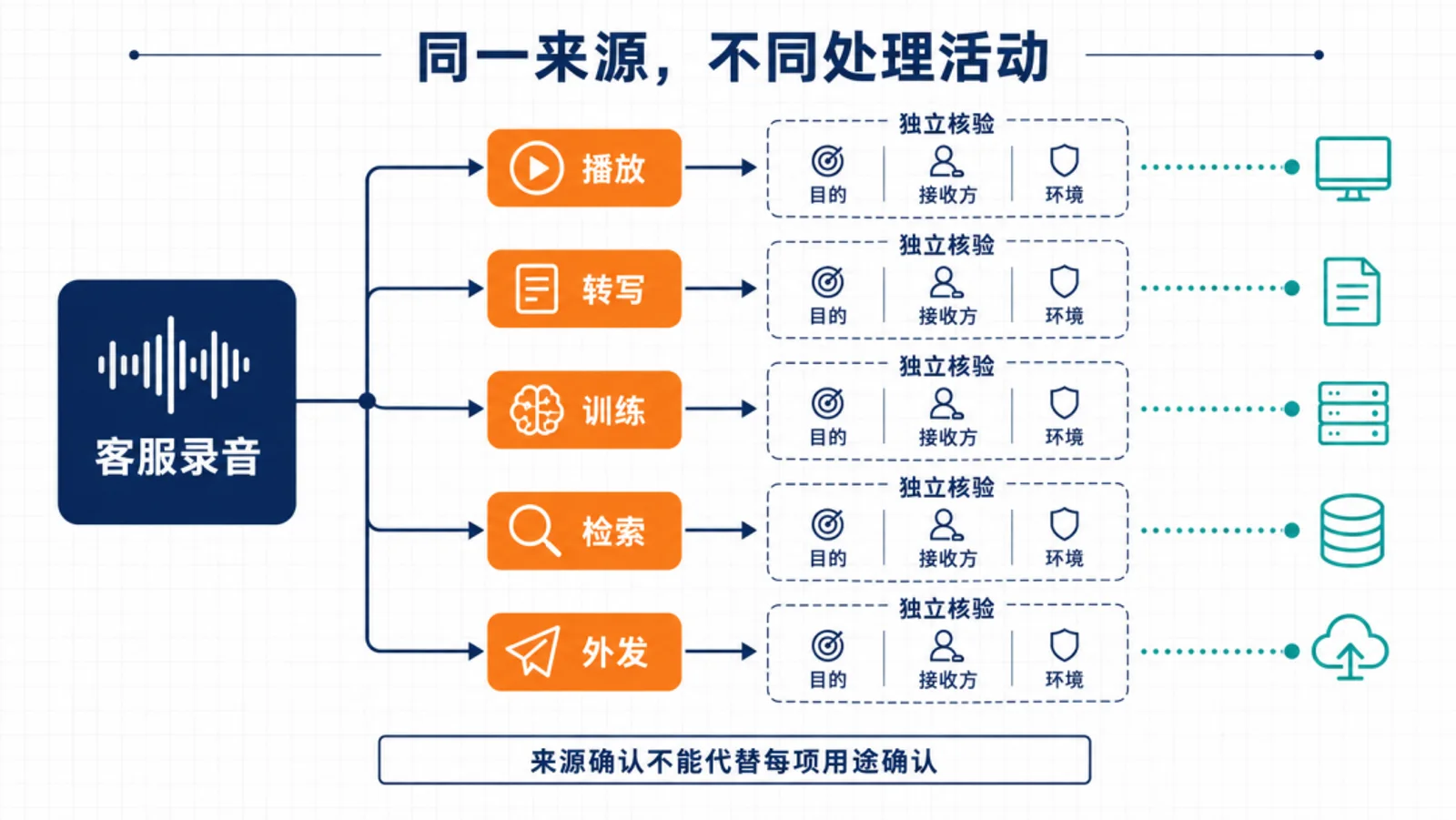
The article discusses why legally obtained data does not automatically permit all downstream AI processing activities such as training, evaluation, retrieval‑augmented generation (RAG), and external model calls. It uses a customer service call center scenario where recordings are kept for service, quality assurance, and dispute evidence. Multiple teams want to reuse the recordings: transcription, fine‑tuning, hard‑case extraction, RAG indexing, and external model summarization. Even with proper initial notice and legal basis for collection, each new processing activity must be separately justified.
Shift compliance object from "file" to "processing activity"
Data source legality is only the starting point. Whether AI data use can proceed depends on whether the authorizing subject, processing basis, purpose, operation, region, period, consumer, and exit obligation can all align simultaneously.
The question "Is this data compliant?" is too vague. The same recording played back, transcribed, retrieved, sent to a vendor, or used for training has different purposes, methods, recipients, and risks. Under the Personal Information Protection Law (PIPL), collection, storage, use, processing, transfer, provision, disclosure, and deletion are all personal information processing, requiring purpose specification, necessity, and minimal scope. Engineering must judge each processing activity separately, not just label the source as compliant.
Admission condition formula:
Purpose Admission = Source Provable × Processing Basis Valid × Rights Scope Permits × Control Executable × Exit CompletableAny missing evidence blocks admission; unknown is not low risk but unapproved.
Purpose‑Rights Matrix example
The article provides a hypothetical matrix for six planned uses: complaint review, quality inspection, model training, independent evaluation, RAG retrieval, external model summarization. For each, it lists source, personal info processing basis, license/IP/confidentiality, current judgment, region/access location, environment/consumer, expiry trigger, exit action. The matrix exposes gaps: complaint review playback permission ≠ vendor model improvement permission; training approval in isolated environment ≠ evaluator download permission.
Personal information cannot be judged solely by "de‑identification done"
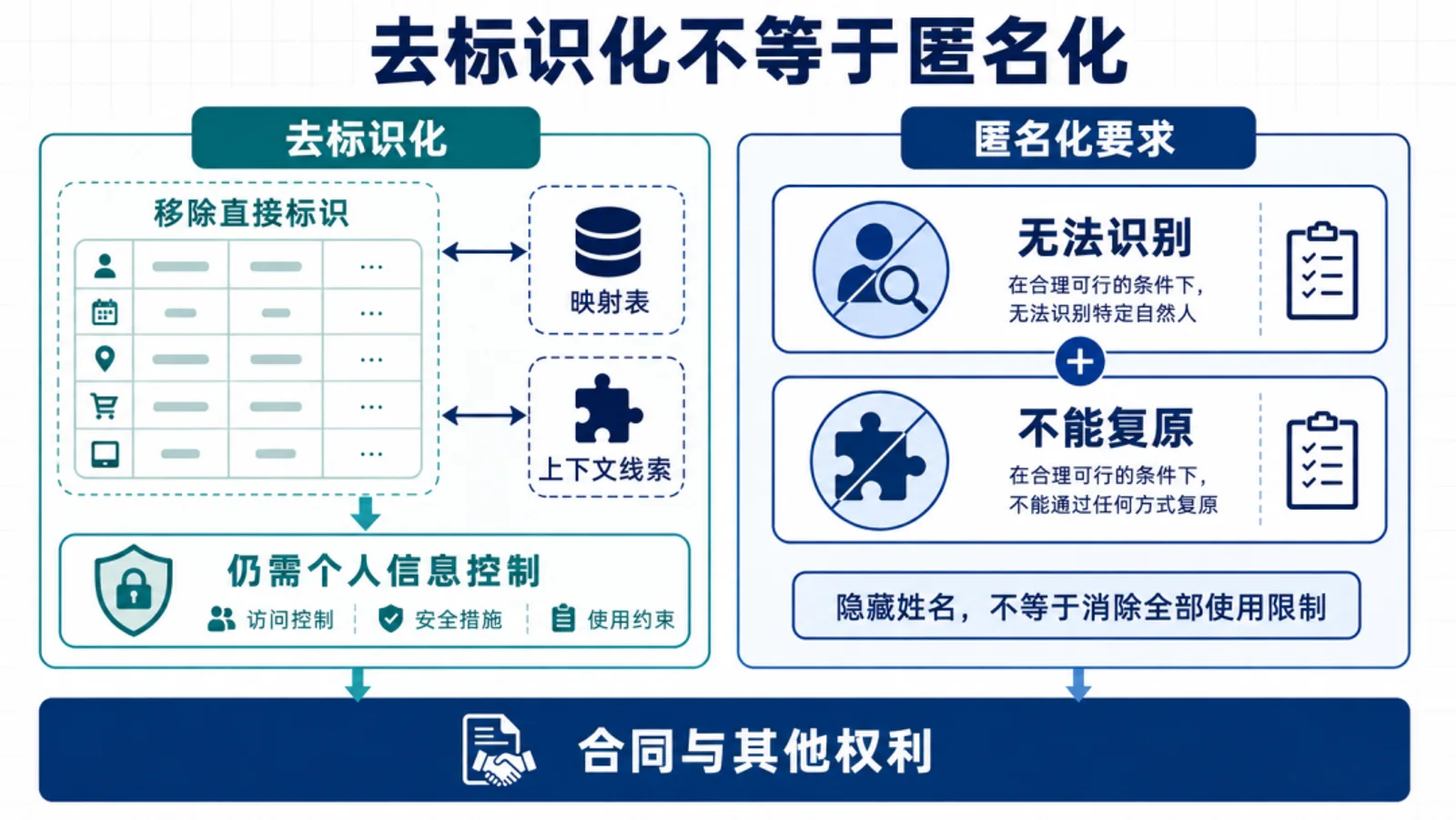
Call recordings may contain contact info, orders, accounts, health, third‑party info; voiceprints involve biometric sensitive data. Engineering often confuses de‑identification (cannot identify without additional info) and anonymization (cannot identify and cannot restore). Deleting names, replacing phone numbers only handles direct identifiers; order details, rare complaints, location‑time combinations can re‑identify. Therefore, after de‑identification, personal information processing controls must remain:
Mapping tables stored separately, separate approval, check indirect identifiers in free text/audio background/context.
Training/evaluation/retrieval each retain minimal necessary fields, not one wide table.
Record processing methods, tool versions, sampling results, re‑identification risk, reassess after combination with external data.
Anonymization requires verifiable accountability for "cannot identify, cannot restore". Even if anonymized, contracts, IP, trade secrets, industry obligations persist.
Purchased data, publicly visible data ≠ training permission
Must check contract licenses, IP, trade secrets, redistribution limits. "Accessible" ≠ "copy, process, train, provide". Database distinctions: underlying facts, individual items, overall arrangement. Single facts not copyrightable; individual items may be works; selection/arrangement with originality may make database a compilation work. Contracts, API terms, trade secrets independently restrict acquisition, copying, use. Procurement contracts must be examined for:
License coverage (original files, annotations, updates), training/evaluation/vectorization/derived samples permission.
Industry/product/region/deployment/user restrictions.
Permission to share with annotators, cloud model providers, affiliates, redistribution.
What copies and derivatives must stop on license expiry, contract termination, rights disputes.
Derived data does not automatically wash away upstream restrictions
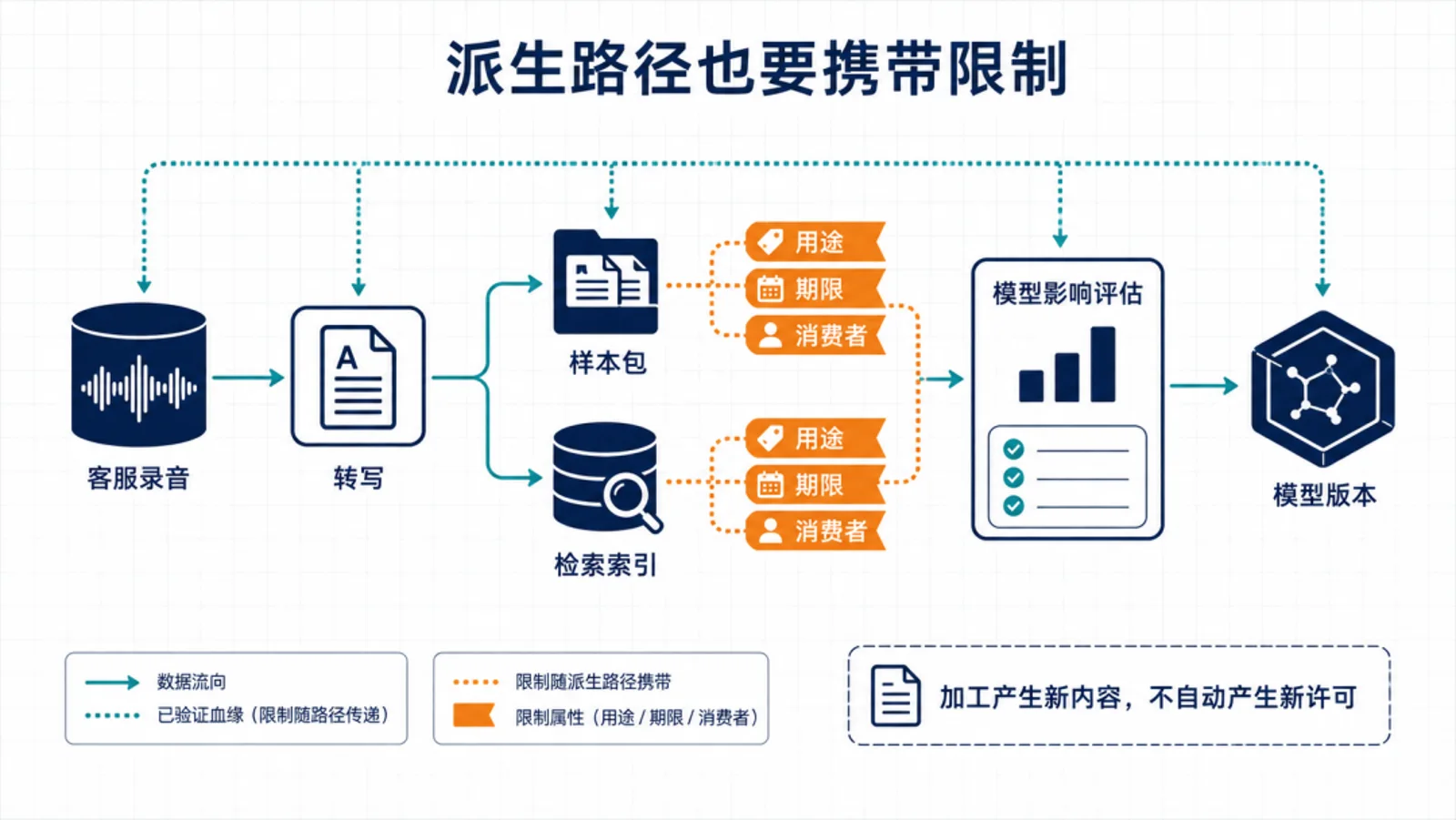
Recordings enter pipeline producing transcripts, labels, summaries, slices, vectors, indexes, hard cases, logs, model checkpoints. "We processed it" ≠ free use. Derivatives must retain upstream relationship:
Original Source → Processing Activity → Derivative → Release Version → ConsumerRestrictions propagation as part of data product contract:
Labels, summaries, synthetic/rewritten samples inherit purpose, period, consumer scope unless evidence supports new conclusion.
Vectors and indexes may still support content retrieval or inference; caches, logs, temporary files are actual copies.
Model weights neither equal raw data nor are automatically unrelated; assess based on training method, extractability risk, contractual commitments, specific obligations.
Cannot claim deleting one datum forces full model retrain, nor that upstream obligations end after training. Pre‑register affected artifacts; on deletion, withdrawal, license expiry, source dispute, decide delete copies, rebuild indexes, restrict use, or further assess model disposition.
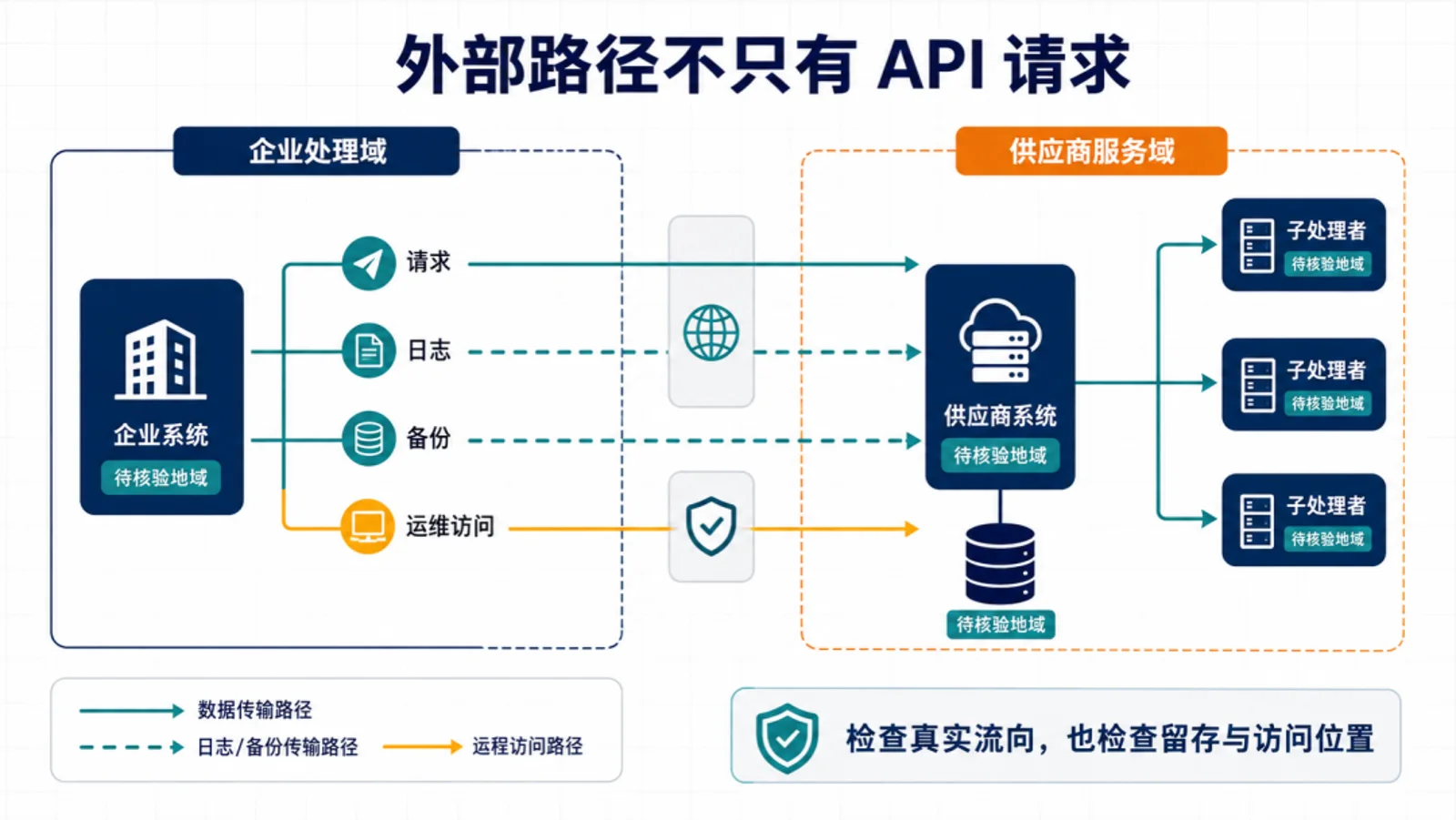
Data not leaving library ≠ no external provision
When integrating external models, must check API requests, vendor ops, remote access, logs, backups, content moderation chains, not just database deployment location. Determine if cross‑border transfer occurs by mapping real data flows and recipients, not just product name in procurement contract. Confirm three things:
What request body, attachments, prompts actually send.
Where inference, logs, backups, human support, remote access occur and who participates.
Whether vendor and sub‑processors retain inputs, use for model training/service improvement, and how they delete copies.
Cites "Regulations on Promoting and Regulating Cross‑Border Data Flow" for security assessment, standard contracts, certification applicability and exemptions. Exemption from one outbound procedure ≠ exemption from notice, separate consent, PIA, security protection. Project must judge per subject, data, volume, scenario, current rules.
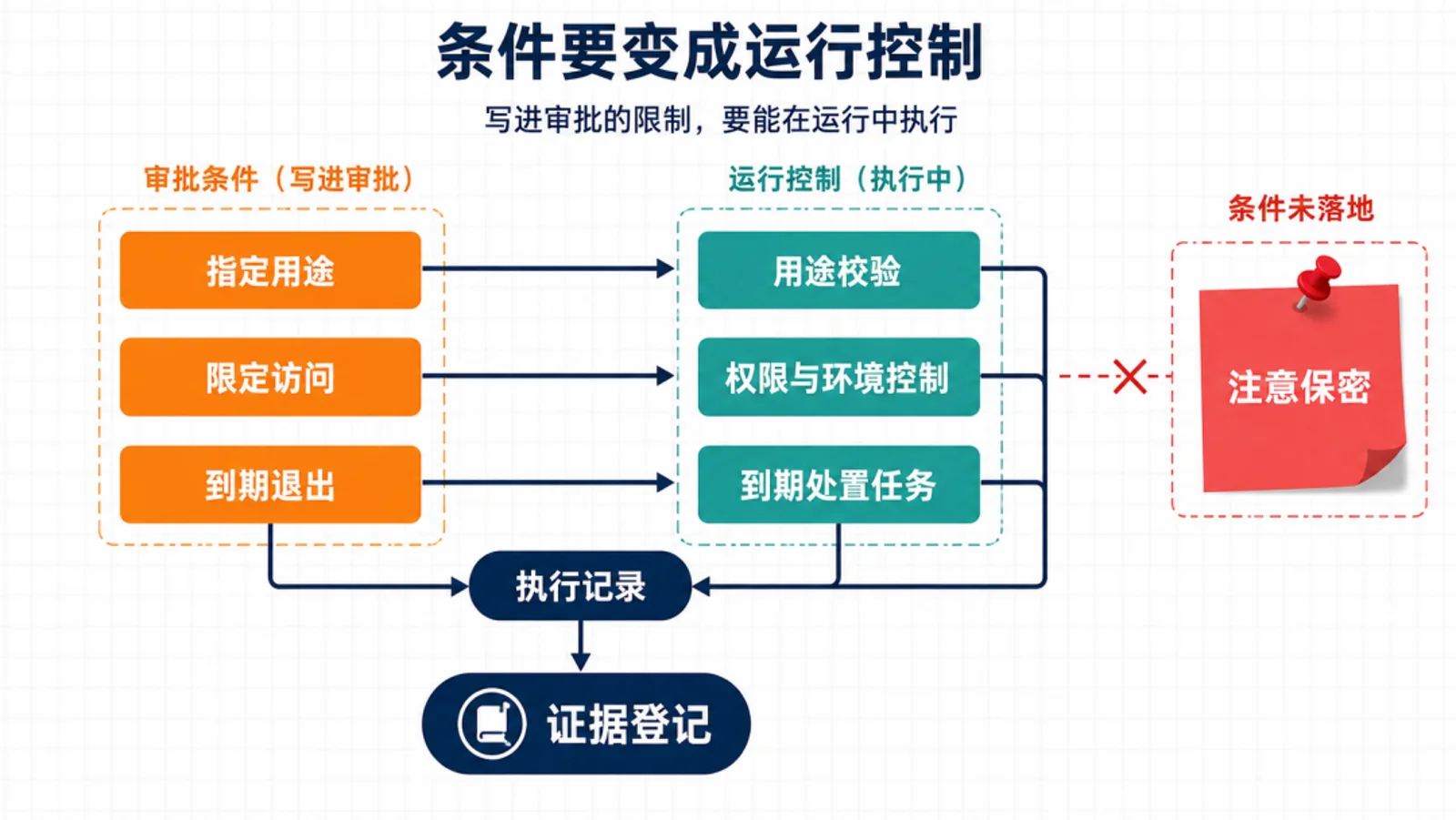
Write compliance conclusions into six admission gates
Compliance review producing only an email leaves pipeline unaware. Better: turn conclusions into data product admission conditions bound to version, consumer, environment. Six gates:
Source Gate – origin, authorization chain.
Purpose Gate – current training/eval/RAG/call within allowed scope.
Content Gate – what personal/sensitive/secret/protected content.
Environment Gate – who, where, system, permissions.
Derivation Gate – what restrictions new artifacts inherit, traceability upstream.
Exit Gate – how expiry, withdrawal, dispute, deletion requests fulfilled.
Each gate needs three states: allow, conditional allow, block. Conditions must translate to access control, environment limits, expiry tasks, consumer constraints; vague "keep confidential", "principally no external sharing" are not valid conditions.
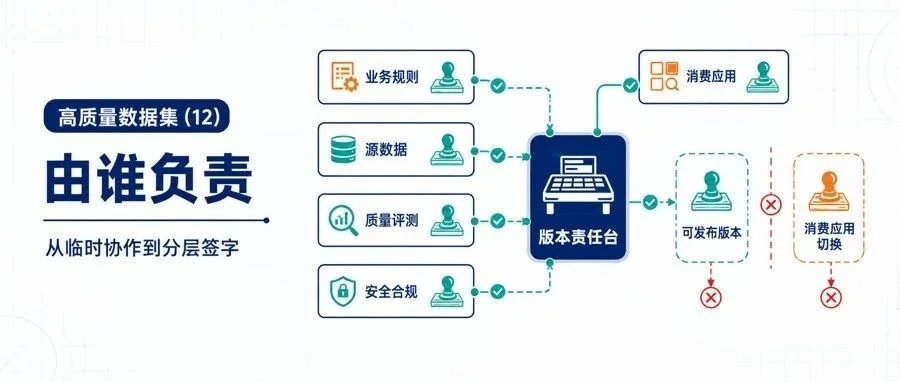
Responsibility assignment: each gate has execution/collection role (R) and professional conclusion ultimate accountable (A). Source Gate: source data business, data engineering; A: source business owner. Purpose Gate: data product owner; A: purpose‑authorized business owner. Content Gate: data governance, security; A: data governance owner. Environment Gate: platform, security; A: security owner. Derivation Gate: data engineering; A: data product owner. Exit Gate: data operations, engineering, suppliers; A: data product owner. Required confirmations before sign‑off include compliance, legal, security, affected business.
Registry must record source evidence ID, allowed/prohibited purposes, data categories, region/environment, expiry time, consumers, derivation rules, exit methods, responsible persons. Training platform or RAG system should receive versions with these conditions, not unconstrained download links.
Delete response must follow lineage, not just delete source file
When individual requests deletion, consent withdrawn, license expires, purpose completed, data team must trace lineage to locate object storage, transcription tables, training packs, evaluation sets, indexes, caches, logs, vendor copies, then execute applicable disposal. Without consumer registry and derivation lineage, team cannot prove processing nor judge where to restrict use. PIPL Art. 47 lists proactive deletion or response scenarios; legal retention periods not expired or technically difficult deletion → stop processing except storage and necessary security. Enterprise backup cycles ≠ legal retention; technical difficulty ≠ reason to continue use. Admission must define at least three actions: delete locatable copies or rebuild data product; restrict processing when legal retention or temporary inability to delete; impact assessment for models and hard‑to‑locate derivatives. Complex index, cache, backup, model retirement left for episode 15; here only require upfront clarity on who disposes, to what extent, with what proof.
Industry practices can support control combinations, not replace legal judgment
CCSA TC601 "High‑Quality Dataset Practice Guide (1.0)" medical case uses authorized acquisition, de‑identification, data sandbox, raw data not leaving domain, "usable not visible". It only corroborates that high‑risk data needs combined authorization, processing, access control, controlled environment; cannot prove same technical labels guarantee compliance, nor transplant case metrics as thresholds for other projects.
Small teams need not build complex platforms but cannot skip judgments
Small volume, single purpose, internal controlled environment can use purpose‑rights matrix, consumer list, approval records for admission without full platform. But source traceability, purpose confirmation, access control, derivation location, exit responsibility cannot be omitted. Can reverse‑check a released version: can samples trace to source and basis? Can consumers explain purpose and environment? Can derivatives trace to upstream version? Can deletion requests locate objects and responsible persons? Any broken chain means "compliance passed" remains a document conclusion.
Summary
High‑quality dataset compliance governance is not a one‑time stamp on source, but establishing verifiable, executable, exitable permission boundaries for each processing activity. Legal possession, de‑identification, source file deletion cannot substitute purpose admission, other rights judgments, derivative impact disposal. Truly releasable data products should bring source, rights, purpose, region, period, consumer, exit method together into version baseline.
Next episode preview: data drift types – why schema change, distribution shift, business concept change, semantic rule change cannot all be called "data drift".
References
Personal Information Protection Law (PIPL) – Arts. 6, 13‑21, 28‑30, 38‑40, 47, 51‑56, 73.
Personal Information Protection Compliance Audit Measures (effective 2025‑05‑01).
Network Data Security Management Regulations (effective 2025‑01‑01).
Interim Measures for Generative AI Service Management.
Regulations on Promoting and Regulating Cross‑Border Data Flow.
Copyright Law.
Anti‑Unfair Competition Law (2025 revision).
CCSA TC601 "High‑Quality Dataset Practice Guide (1.0)" – medical scenario reference only.
For questions about attribution, corrections or content rights, please contactand we will review it promptly.