

Local-First AI Coding: Routing Simple Tasks to Qwen3.8-27B, Hard Ones to Qwen4-Max with d3 Decision Model
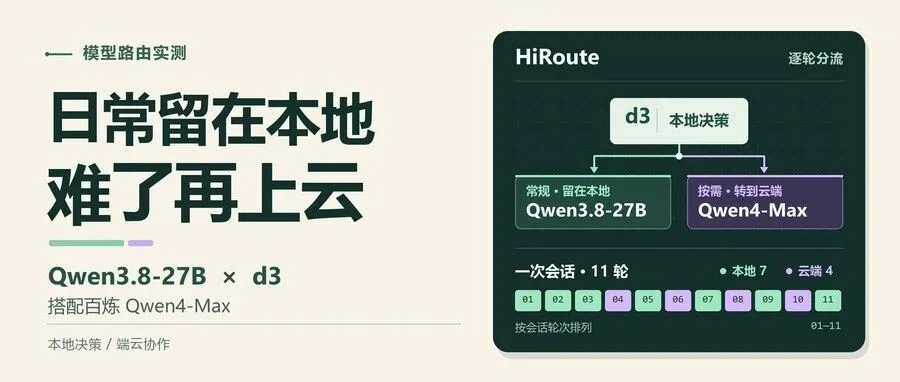
The author integrates vLLM's d3 decision model with HiRoute gateway to route coding tasks between a local Qwen3.8-27B and cloud Qwen4-Max. In an 11-turn session, 7 turns stayed local for file operations, while 4 difficult turns went to the cloud. The local decision model evaluates task difficulty and prior performance, keeping routing decisions on-premises.
Reading font
Motivation: Most Coding Tasks Are Simple
The author observes that Coding Agents spend many turns on trivial work—listing files, reading READMEs, confirming writes—which a local 27B model can handle without sending data off-premises. Only a few turns (bug root-cause, verified fixes) justify cloud inference. The goal: keep daily work and routing decisions local, upgrading to cloud only when a turn is sufficiently hard or the previous phase performed poorly.
Architecture: HiRoute + d3 Decision Model
HiRoute (Higress team, Apache-2.0) runs on the developer's machine between the Agent (Codex) and models. The Agent points its base URL to HiRoute, unaware of multiple backends. Models are grouped: Regular (local Qwen3.8-27B) and Primary (cloud Qwen4-Max via DashScope compatible-mode).
d3 (Decision 3.0, from vLLM Semantic Router, Apache-2.0) is a 27B model (26.09B params, BF16, ~52 GB) deployed via vllm serve --tensor-parallel-size 2 on two L40 GPUs. It exposes the /v1/systemone endpoint, answering structured questions (Choice, Yes/No, Score) with probabilities in a single call. A 4B variant d3-mini runs on one L40 (~55 ms median latency vs ~122 ms for d3).
Routing Logic
On each new user message, HiRoute asks d3 three questions:
How well did the previous phase complete? (competence score)
How simple is the current turn? ( P(simple))
Does the previous issue persist?
Thresholds (defaults): P(simple) ≥ 0.80 → Regular group; previous competence < 0.50 with persistent issue → Primary group (low-score protection). HiRoute calls these Familiar trust level and Low-score protection.
Experimental Setup
Decision : d3 (System One) on 2×L40, vllm serve :8900 -tp 2, endpoint :8900/v1/systemone Regular : Qwen3.8-27B on same node, port 8910 via local proxy :18081 Primary : Qwen4-Max (Alibaba Cloud Bailian) via local shim :18084 → DashScope compatible-mode
Agent : Codex, base URL → local HiRoute /v1/responses HiRoute version 0.6.3 in Singularity (Ubuntu 22.04). Routing plan d3-bailian-route uses difficulty routing with default thresholds.
Experiment 1: Human Points Out Fix Is Wrong
Repo: small memory rate limiter with broken allow() (no timestamp eviction). First message: "Simple task: fix window eviction." d3 returns P(simple)=0.98 → local Qwen produces draft. Author replies "Wrong. Test test_blocks_over_limit_then_recovers fails after sleep window." This turn gets P(simple)=0.79 and previous competence 0.37 (<0.50) → low-score protection triggers, routed to Qwen4-Max, which rewrites eviction logic; tests pass.
Experiment 2: Gate Failure Without New Requirements
Two-turn session. Turn 1: simple fix, P(simple)=0.98 → local Qwen, competence 0.44. Turn 2: gate failure message ("pytest still fails…"), P(simple)=0.89 (above 0.80) but previous competence 0.44 < 0.50 → low-score protection routes to Qwen4-Max. Shows protection works on gate feedback, not just difficulty.
Experiment 3: 11-Turn Session Until Both Gates Pass
Repo demo-vllm-sr-decision with five broken files. Two gates: pytest tests/ (14 passed) and python diagnose.py (healthy, route_ok, latency_ok, endpoints_ok, log_ok all true). Author drives step-by-step (one action per message). Turns 1-3: list/read files → local (P(simple) 0.99-1.00). Turn 4: first real fix → cloud. Then alternates: T5 local, T6 cloud (0.69), T7 local, T8 cloud (0.60), T9 local, T10 cloud (reason unknown), T11 local (done). Demonstrates upgrade/downgrade: after hard turns, simple ones return to local.
Single Request vs Tool Continuation
In author-driven sessions, one message = one request = one routing decision. With tool-using Agents, one user message triggers multiple model requests (read → edit → test…); HiRoute keeps the same model for the whole turn to preserve prompt cache. Video recording shows T4: one decision, four requests, all on local Qwen.
What Stays Local, What Goes Cloud
Local: all routing decisions (d3 on own GPUs), 7/11 turns in long session (file ops, confirmations), any session that never upgrades.
Cloud: every turn routed to Primary group, plus full context sent in that request (including history if Agent resends).
d3 latency: ~122 ms (2×L40), d3-mini ~55 ms (1×L40) median on 12 System One test cases (coding, writing, math, ops). Both pass 12/12 System One and 8/8 HiRoute decision tests.
Key Takeaways
Two triggers are distinct: P(simple) is a pre-turn difficulty estimate; competence score is post-turn retrospective. Experiment 2 shows a turn with high P(simple) still upgraded due to low prior competence.
Design is model-agnostic: thresholds in HiRoute, decision model swappable, Agent sees single model name.
Small-scale demo, not a benchmark; but proves the local-decision + local-regular + cloud-primary pattern works end-to-end.
Reproduction Pointers
HiRoute: GitHub, hiroute.ai, local-model-routing docs. Add local model as Custom API, decision model as Other Compatible with full /v1/systemone URL, create difficulty-routing plan.
vLLM Semantic Router: GitHub, vllm-sr.ai, blog. d3 and d3-mini on Hugging Face. Deploy with
vllm serve /path/to/d3 --max-model-len 32768 --tensor-parallel-size 2 --host 0.0.0.0 --port 8900.
VRAM: d3 ~62-65 GiB (MI325X), d3-mini ~15-23 GiB. vLLM defaults to 92% GPU memory; adjust --gpu-memory-utilization for co-location. This experiment adds NVIDIA L40 data point: both models deploy and pass tests via vllm serve.
For questions about attribution, corrections or content rights, please contactand we will review it promptly.