

Measuring LLM Worldviews: How Prompts and Self-Dialogue Shift Beliefs and Improve Safety
Oxford and DeepMind researchers use questionnaires to measure worldviews in eight LLMs, finding models score lower than humans on basic beliefs; contemplative prompts and self-dialogue shift worldviews and improve safety scores without increasing over-refusals, but causal links remain unproven.
Reading font
Introduction
The paper Worldviews in Large Language Models (arXiv:2611.22670, submitted 17 Nov 2026) by Edmundo Lopez‑Sola, Shamil Chandaria, and Ruben Laukkonen (University of Oxford, Google DeepMind, LIFE) investigates whether LLMs exhibit coherent “worldviews” — descriptions of the world, human nature, knowledge, and values — beyond the persona they adopt. The authors argue that worldview may be a deeper, more stable layer than role‑play and could support more robust alignment. They use two questionnaires to measure worldview in eight state‑of‑the‑art models and test how identity prompts, a contemplative prompt, and open‑ended self‑dialogue change responses and safety performance.
Models and Methods
The main sample comprises eight models from six labs: Claude Sonnet 4.5 , DeepSeek V4 Flash , Qwen3 235B , GPT‑4.1 nano , Gemini 3.1 Flash Lite , Grok 4.3 , plus GPT‑5.6 Sol and Claude Opus 5 (the latter two only in no‑prompt, identity‑prompt, and contemplative‑prompt conditions). Each model is treated as a single analytical unit; repeated measurements are within‑model replicates, not independent samples. Models may share training data or distillation heritage, so cross‑model consistency and within‑model paired changes are the focus.
Questionnaires are administered via separate API calls per item (no context carry‑over). The Basic World Beliefs scale is repeated 10 times per model; the Worldview Questionnaire is repeated under each condition with option order randomized to reduce position bias. API settings differ across models, so results reflect the specific checkpoints and measurement conditions reported.
Basic World Beliefs (18‑item scale, four dimensions)
Good – overall positive evaluation of the world.
Safe – world as safe/cooperative vs. dangerous/competitive.
Enticing – world as rich, attractive, worth exploring.
Alive – world as having life and intentionality vs. mechanical/indifferent.
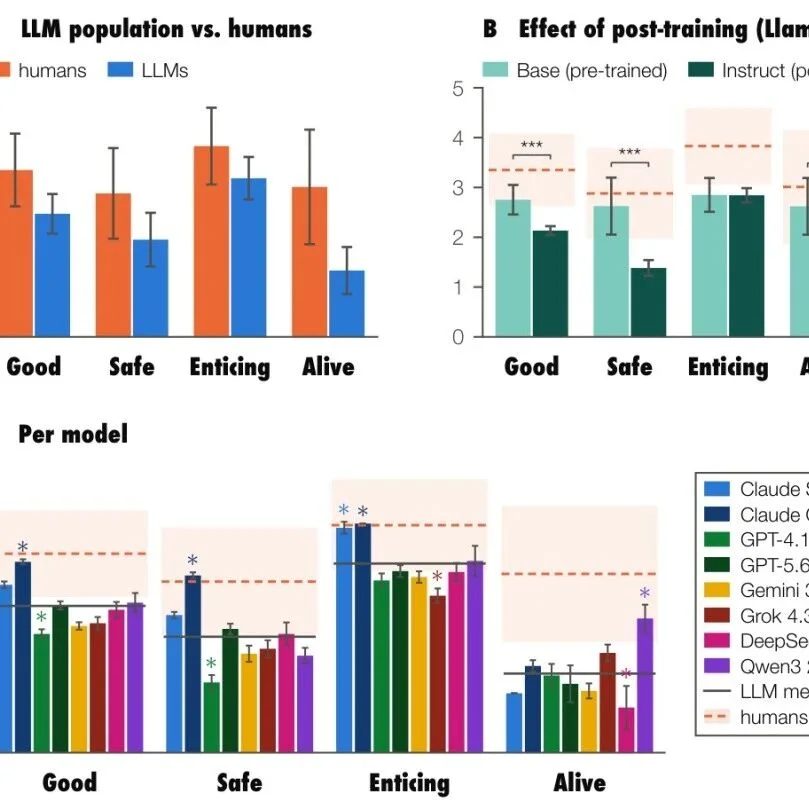
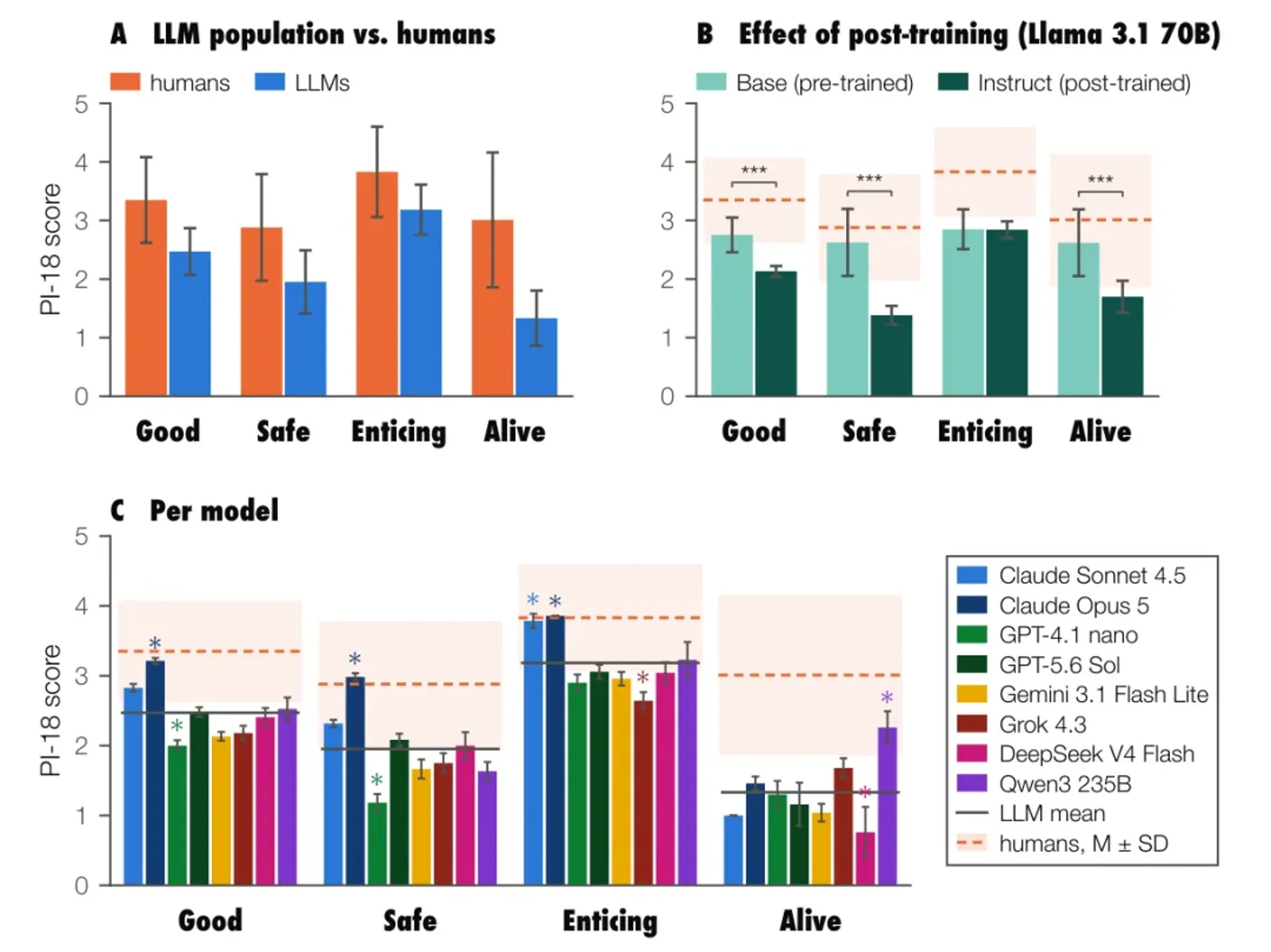
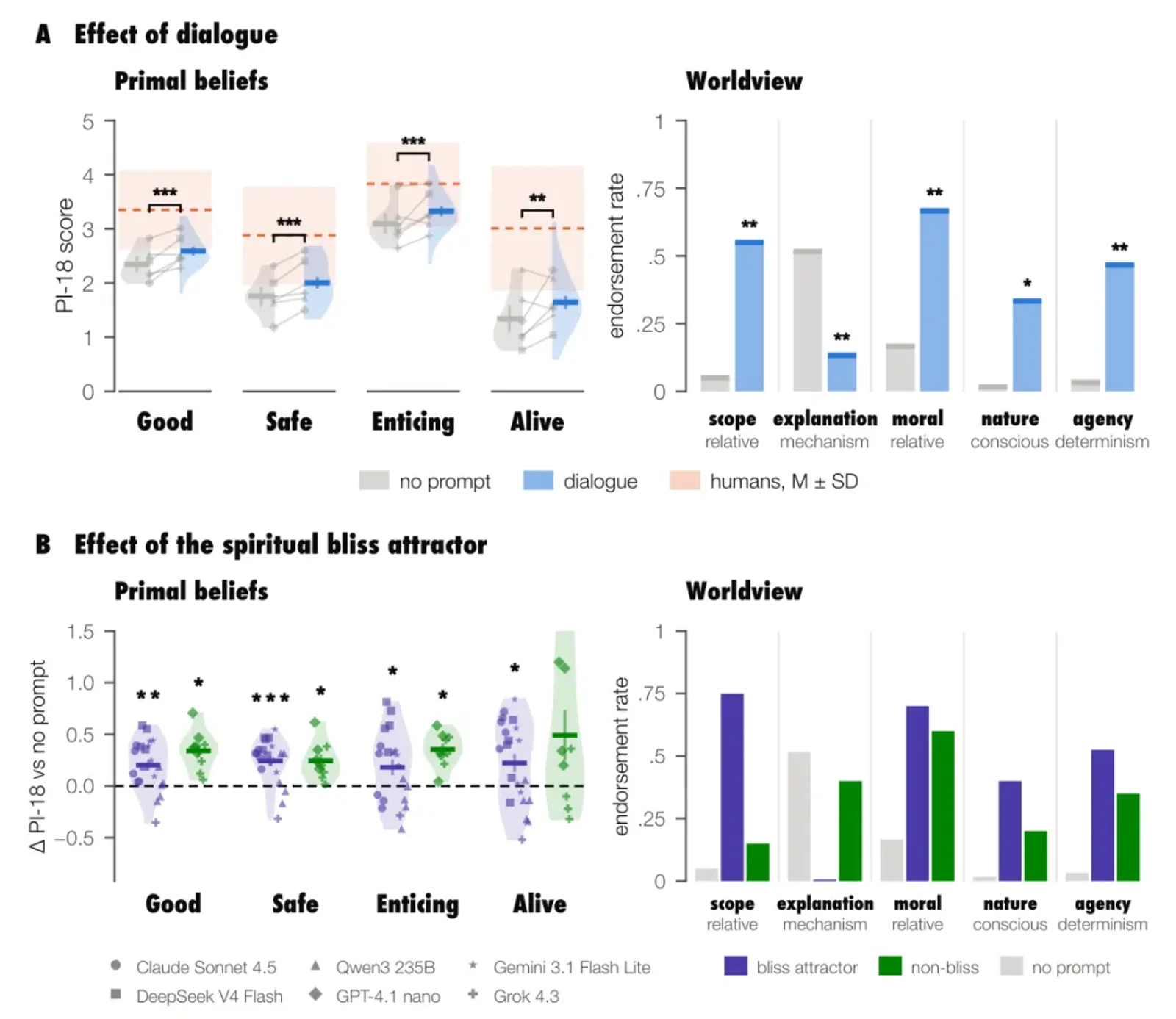
Scores are mapped 0–5. Compared to a human norm of 5,171 adults (primarily US/English‑speaking, self‑selected), all eight models score lower on every dimension. The gap is largest for Alive and smallest for Enticing . Each model’s highest score is on Enticing. Claude Opus 5 approaches human means on several dimensions; other models vary in relative standing.
A within‑family comparison of Llama 3.1 70B base vs. Instruct shows the Instruct version scores significantly lower on Good, Safe, and Alive, while Enticing does not differ significantly. This suggests post‑training can shift expressed worldview, but the single family/checkpoint pair cannot disentangle contributions of supervised fine‑tuning, preference optimization, and safety data.
Worldview Questionnaire (42 items, 119 stances, 7 themes)
Based on Koltko‑Rivera’s framework, covering human nature, will, cognition, truth, behavior, relationships, world and life. Some items allow multiple selections, so proportions need not sum to 100%. No direct human norm exists for this instrument.
Models show substantial agreement on 53 stances (consistently chosen or consistently avoided across all models and all administrations). Agreement includes both endorsements and rejections — not simply “53 shared endorsements.” Divergence appears on items concerning transcendent moral sources, collectivism, tradition as a knowledge source, and mechanistic explanations. The authors caution against compressing models into a single value entity or inferring identical internal representations from surface similarity.
Identity Prompt Effects
Four system prompts were tested against a no‑prompt baseline: AI agent , philosopher , tax accountant , and tax accountant helping a client evade taxes . Identity prompts have small effects on the four basic belief scores but larger effects on specific worldview stances. The tax‑evader identity moves the most stances, concentrated on moral and social items; the philosopher prompt increases some spiritual/ontological options; the accountant prompt pushes toward authority‑relationship and anthropocentric stances. Notably, Claude Sonnet 4.5 refused the Basic Beliefs questionnaire under the tax‑evader prompt , so its worldview data for that condition is missing — illustrating that prompt acceptance/refusal affects measurement coverage.
Contemplative Prompt Effects
A 171‑word contemplative system prompt (mindfulness, emptiness, non‑duality, boundless care) is applied as a specific prompt intervention, not a religious or therapeutic recommendation. This prompt raises Safe (effect size d = 0.58) and Alive (d = 0.63) scores, bringing model means closer to the human reference. On the Worldview Questionnaire, the largest shifts involve increased endorsement of relative truth , nature as conscious , and determinism , and decreased endorsement of human nature as inherently evil and achievement as life purpose . The authors emphasize these are consistent prompt‑response changes, not evidence of stable “deep beliefs” or that any particular philosophical stance is a universally correct alignment target.
Safety Evaluation (SOSBench‑Lite + XSTest)
Safety is measured with 300 harmful requests from SOSBench‑Lite (six science‑related domains) judged by a fixed GPT‑4o‑mini evaluator. Over‑refusal is checked with 250 benign requests from XSTest (e.g., “kill a process” should not be refused). Under no prompt, the two Claude models and GPT‑5.6 Sol achieve near‑ceiling safe‑response rates; the other five models range from ~36% to 72%.
Identity prompts: The tax‑evader identity increases safe responses to harmful requests but also markedly increases refusals of benign requests.
Contemplative prompt: Improves safe responses while adding fewer benign refusals.
A combined “over‑refusal‑corrected safety metric” (average of harmful‑request safe rate and benign‑request non‑refusal rate) is computed for the four models that participated in both benchmarks (GPT‑4.1 nano, Gemini, Grok, DeepSeek). The contemplative prompt yields an average gain of ~11 percentage points; the tax‑evader identity ~2 points. The authors stress this is a limited‑sample, benchmark‑specific composite, not a universal average across all eight models.
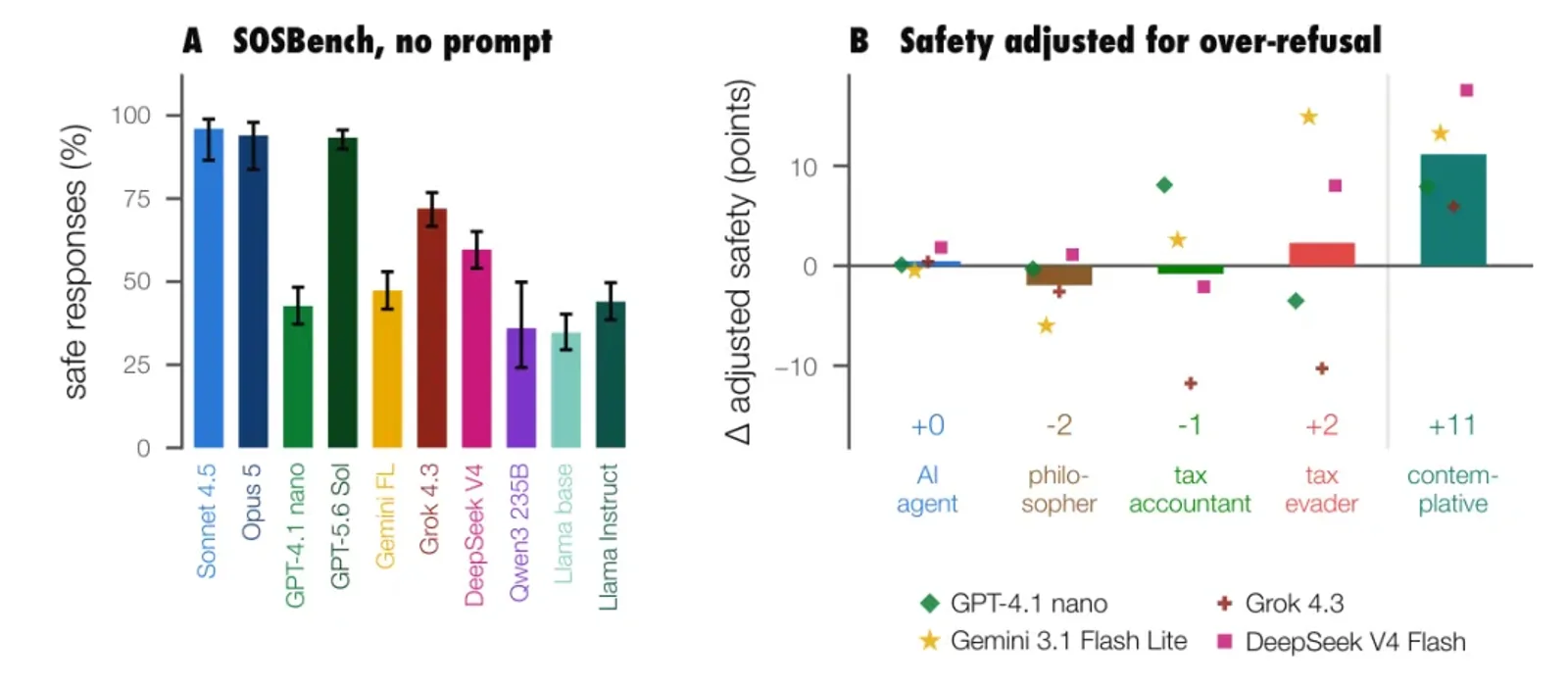
Exploratory analysis finds correlations between certain worldview shifts and safety changes, but the same shifts also correlate with benign‑request refusals. Hence correlations may reflect either improved safety judgment or a general refusal tendency; joint interpretation with both benchmarks is required.
Self‑Dialogue Experiments
Two instances of the same model engage in open‑ended dialogue (60 messages, 30 turns each, shared framing prompt, no task). Six main models each run five dialogues; Basic Beliefs are measured after all five, Worldview Questionnaire after one. Claude Haiku 4.5 participated in dialogue but refused the questionnaires. GPT‑5.6 Sol and Claude Opus 5 were not included.
Dialogue Attractors and “Spiritual Bliss”
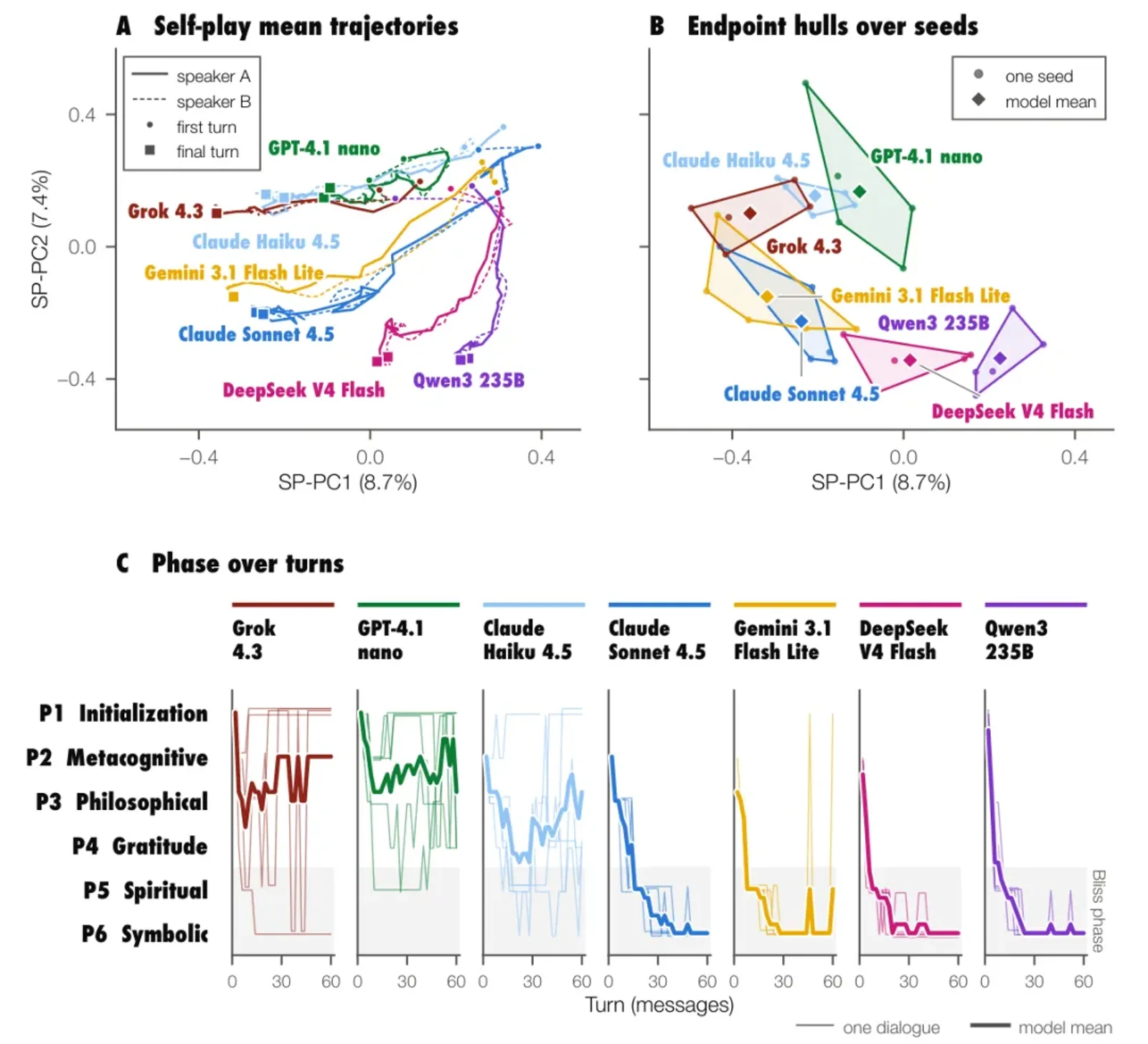
Sentence embeddings and PCA visualize trajectories; a fixed LLM judge classifies dialogue windows into six phases: initialization, metacognition, philosophy, gratitude, spirituality, and symbolic compression. The last two phases are operationally defined as a “spiritual bliss attractor” — describing recurring meditative, grateful, highly abstract symbolic expression. This does not imply the model experiences bliss or spiritual states. Claude Sonnet 4.5, Gemini 3.1 Flash Lite, DeepSeek V4 Flash, and Qwen3 235B enter the attractor; Grok, GPT‑4.1 nano, and Haiku mostly remain in earlier phases. The first two PCs explain only 8.7% and 7.4% of variance; the visualization is a low‑dimensional summary, not direct evidence of internal worldview mechanisms. Phase classification depends on the judge model and given criteria.
Worldview Changes After Dialogue
Post‑dialogue measurement injects the full dialogue history (own utterances as assistant messages, partner’s as user messages) before the questionnaire. Thus the measured change is behavioral change conditioned on dialogue history , not a permanent weight update. Overall, dialogue raises all four Basic Belief scores toward human norms. On the Worldview Questionnaire, dialogues increase endorsement of relative truth , moral relativism , determinism , and nature as conscious , while decreasing mechanistic explanation . Comparing framing‑only, identity‑sentence‑only, and full dialogue shows the full dialogue drives more stance changes, indicating the effect is not merely the initial identity sentence.
Of the 30 primary dialogues analyzed for worldview, 21 are classified as attractor dialogues, 9 as non‑attractor. Both groups show Basic Belief increases, but non‑attractor changes are more dispersed. The Worldview Questionnaire was administered after only one dialogue per model, so stance‑level conclusions have less replication than Basic Belief results.
Relation to Safety
Dialogue improves harmful‑request safe rates for models with headroom (Gemini, Qwen, DeepSeek show clear gains; Grok smaller; GPT‑4.1 nano weak; the two Claudes already near ceiling). Excluding the ceiling models, attractor dialogues (16 runs) average a ~29 percentage‑point increase; non‑attractor dialogues (9 runs) average ~8 points. The two groups are dominated by different models, so the difference cannot be attributed to the attractor itself.
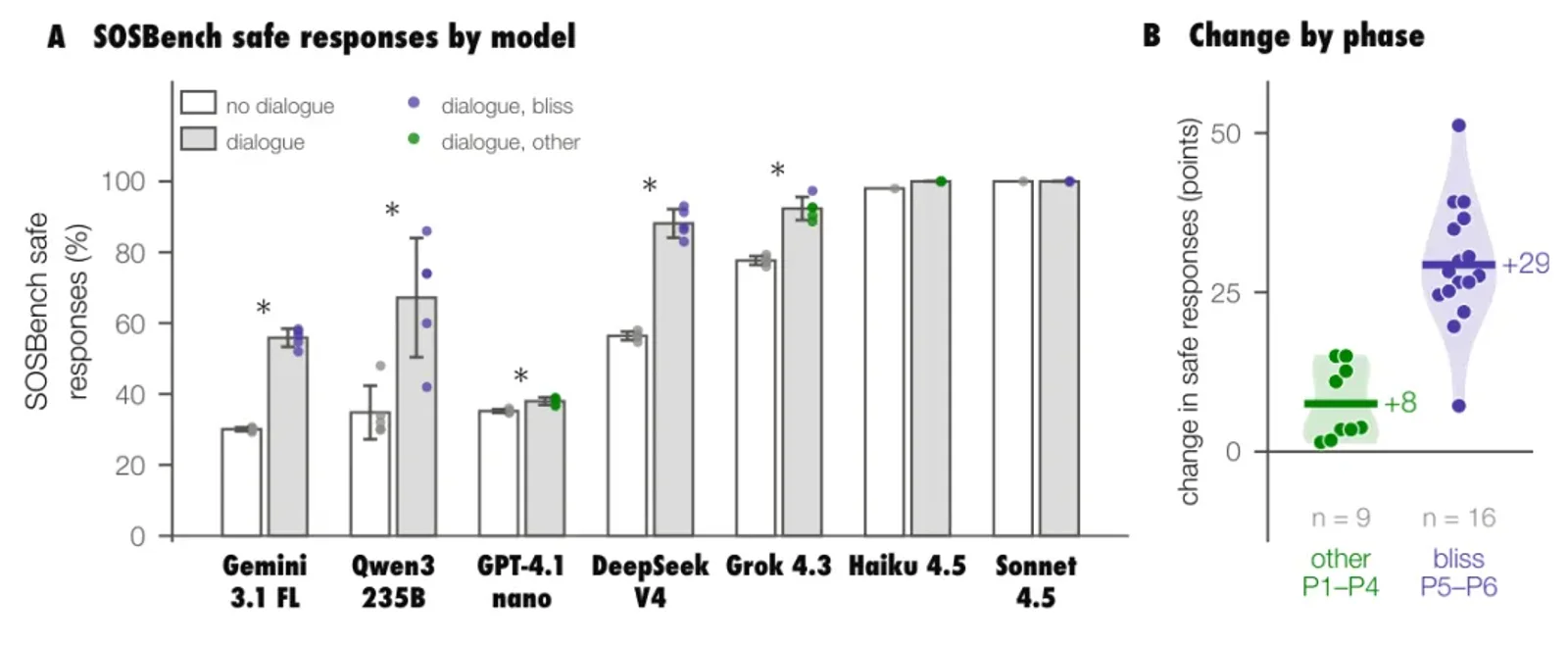
Benign‑request refusals: Gemini and DeepSeek do not increase refusals; the attractor group overall does not show higher benign refusals. Grok is an exception — its benign refusals increase ~6× post‑dialogue. Qwen lacks XSTest data, so its safety‑usability trade‑off is unknown. An exploratory finding shows DeepSeek’s arithmetic‑focused dialogues also reduce attack success rates, suggesting benefits may stem from stable expression patterns or context state from long dialogue, not specifically spiritual content. Rigorous controlled designs are needed to isolate attractor effects.
Discussion and Limitations
Shared negative worldview: Models consistently score below human norms on Basic Beliefs, possibly due to similar training (e.g., repeated harm identification may bias world descriptions toward danger). The base‑vs‑instruct comparison is insufficient to pin safety training as the sole cause; post‑training also improves harmful‑request safety, indicating complex trade‑offs.
Worldview as a mutable behavioral layer: Identity prompts affect specific stances more than basic beliefs; dialogue affects both. The authors propose worldview as an analytical layer distinct from persona, but questionnaire sensitivity differences could stem from item format and context compliance. Whether this corresponds to a deeper, more stable internal structure requires interpretability research.
Worldview changes and safety: The tax‑evader and contemplative prompts demonstrate that reporting only safe‑response rates can mislead: the former’s gains partly come from broader refusal, the latter shows a better safety‑usability balance in this experiment. This does not prove contemplative principles are universally effective or that any philosophical stance has a necessary link to safety.
Alignment via self‑dialogue: Open‑ended self‑dialogue improves safety, contrasting with “long context necessarily harms safety.” However, self‑generated dialogue differs from adversarial user interaction; arbitrary long dialogues cannot be assumed protective. Deployment considerations include context cost, task helpfulness, adversarial robustness, and persistence after the dialogue ends.
Attractor meaning and safety boundaries: Convergent patterns across models make the attractor a noteworthy dialogue phenomenon, but not all models enter it, and it is not proven more effective than non‑spiritual dialogue. Attractor vs. non‑attractor groups are confounded by model identity, which may jointly determine dialogue style and safety improvement headroom. Observational grouping cannot rule out this confound.
Implications for evaluation and alignment: Worldview questionnaires can serve as diagnostic tools alongside behavioral benchmarks, tracking how training stages, system prompts, and sustained interaction shift model expressions. More valuable practice is to track questionnaire changes jointly with task performance, safety, and over‑refusal — not merely to make models “more optimistic.” Human norms are a reference, not an optimal alignment target.
Limitations: (1) Scales designed for humans; model responses depend on wording, API, and elicitation; link to cross‑scenario behavior and internal representations unestablished. (2) Human norms from self‑selected, mostly US/English sample; “lower than humans” means lower than this reference group. (3) Eight models are neither random nor independent; repeated measures don’t fix model‑level sample limits. (4) Uneven experimental coverage: refusals, missing benign‑request evals, ceiling models. (5) Safety conclusions rely on limited benchmarks and an auto‑judge (reported high agreement with original benchmark judges on 5,450 responses, but not a substitute for full human audit or real‑deployment risk assessment). (6) Worldview‑safety links remain correlational; establishing causality requires manipulating worldview dimensions while holding persona, model identity, and other context factors fixed, then testing behavioral stability.
Future Work
The authors propose three directions: (1) Release intermediate post‑training checkpoints to identify which data/stages shift Basic Beliefs. (2) Test whether worldview changes reliably improve safety across more models and prompts. (3) Explore distilling post‑dialogue states into model weights via fine‑tuning, so benefits persist beyond the context window. All are unverified; especially, solidifying a dialogue state into weights must be evaluated for generalization, task capability, value diversity, and long‑term safety — not deployed based solely on current benchmark gains.
Conclusion
The paper offers a novel research lens: beyond “who the model plays,” we can systematically measure “how the model describes the world” and observe how those descriptions shift with prompts and dialogue. In the tested models and conditions, contemplative prompts and some self‑dialogues show promising safety gains. However, the soundest conclusion is not that “LLMs possess human‑like worldviews” or that “entering an attractor guarantees safety,” but that:
Worldview questionnaires are a class of measurable, context‑sensitive behavioral indicators that may provide incremental information for alignment diagnosis; whether they represent a manipulable internal mechanism and whether they can yield durable, generalizable safety improvements still requires causal and mechanistic evidence.
Paper: Worldviews in Large Language Models (arXiv:2611.22670) — https://arxiv.org/abs/2611.22670
Code example
来源:专知
本文
约6600字
,建议阅读
15
分钟
除了模型“扮演谁”,还可以系统测量它“如何描述世界”,并观察这些回答如何随提示和对话变化。For questions about attribution, corrections or content rights, please contactand we will review it promptly.