

MemT 1.0: Memory-Native Model Training at Scale with 50K Sandboxes/Minute
The article details how Alibaba Cloud's Agent Sandbox Extreme Edition provides millisecond-level sandbox provisioning, minute-level 50K sandbox delivery, elastic scaling, and fine-grained network control to support the training and evaluation of MemT 1.0, a memory-native large model that achieves state-of-the-art results on memory benchmarks by extracting structured experiences from code trajectories.
Reading font

MemT 1.0: Memory-Native Model Release and Benchmark Results
On October 20, 2026, MemTensor (MemOS team) released and open-sourced the first memory-native large model series MemT 1.0 , comprising two variants: Flash (288B parameters, 17B activated) and Nano (36B parameters, 3B activated). The models integrate native memory modules in parallel within the Transformer architecture, turning "remembering" from an external retrieval add-on into an intrinsic model capability. On 11 memory benchmarks, Flash and Nano achieve average scores of 50.6 and 47.0 respectively, ranking first and second among parametric memory methods , outperforming the previous best by 12.5 and 8.9 points.
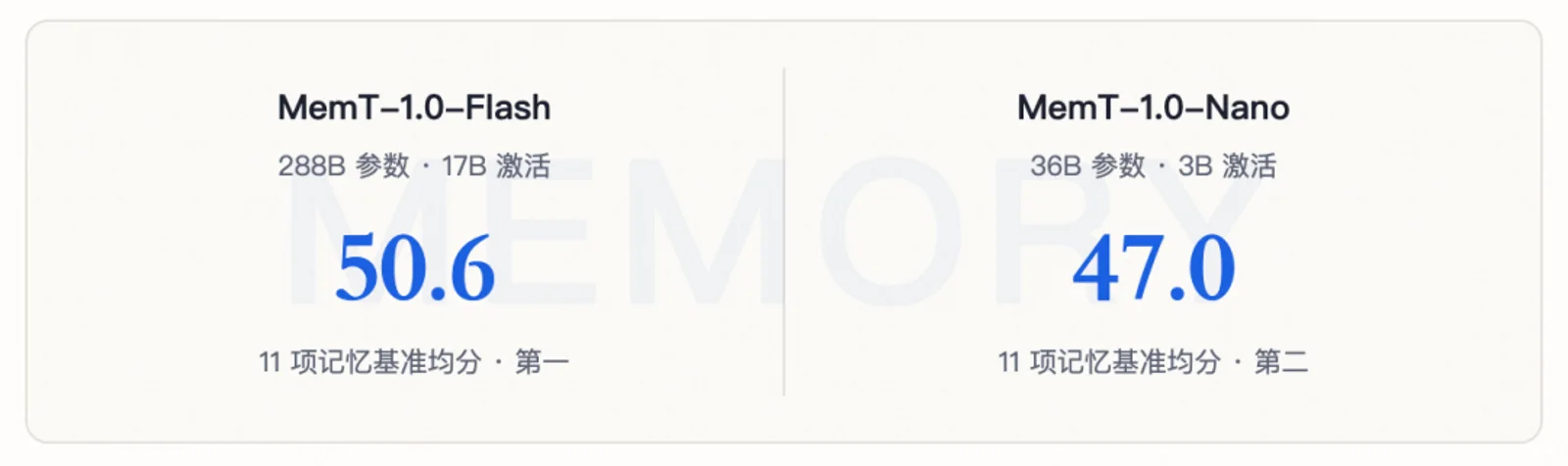
MemT 1.0 dual-version 11 memory benchmark scores · 12.5 / 8.9 points higher than previous best
After open-sourcing, the models gained rapid adoption: within 10 days on Hugging Face and GitHub, cumulative downloads exceeded 100,000 with daily downloads over 10,000, placing them among the leading large innovative-architecture models. The technical report debuted at #2 on Hugging Face Daily Papers. Developers worldwide have deployed and fine-tuned the Nano version locally.
Experience Loop: From Code Trajectories to Structured Memory
A key training ingredient is an experience closed loop : from 41,000 successful code trajectories , the team distilled 1,040 structured programmatic experiences . When an Agent execution stalls, the system retrieves relevant experiences by task description, writes them into native memory, and implicitly invokes them in subsequent actions. This loop yields hard gains on SWE-bench Verified: pass³ (three consecutive successful runs) rises from 54.0% to 62.8% , and average success rate improves from 66.07% to 69.73%.
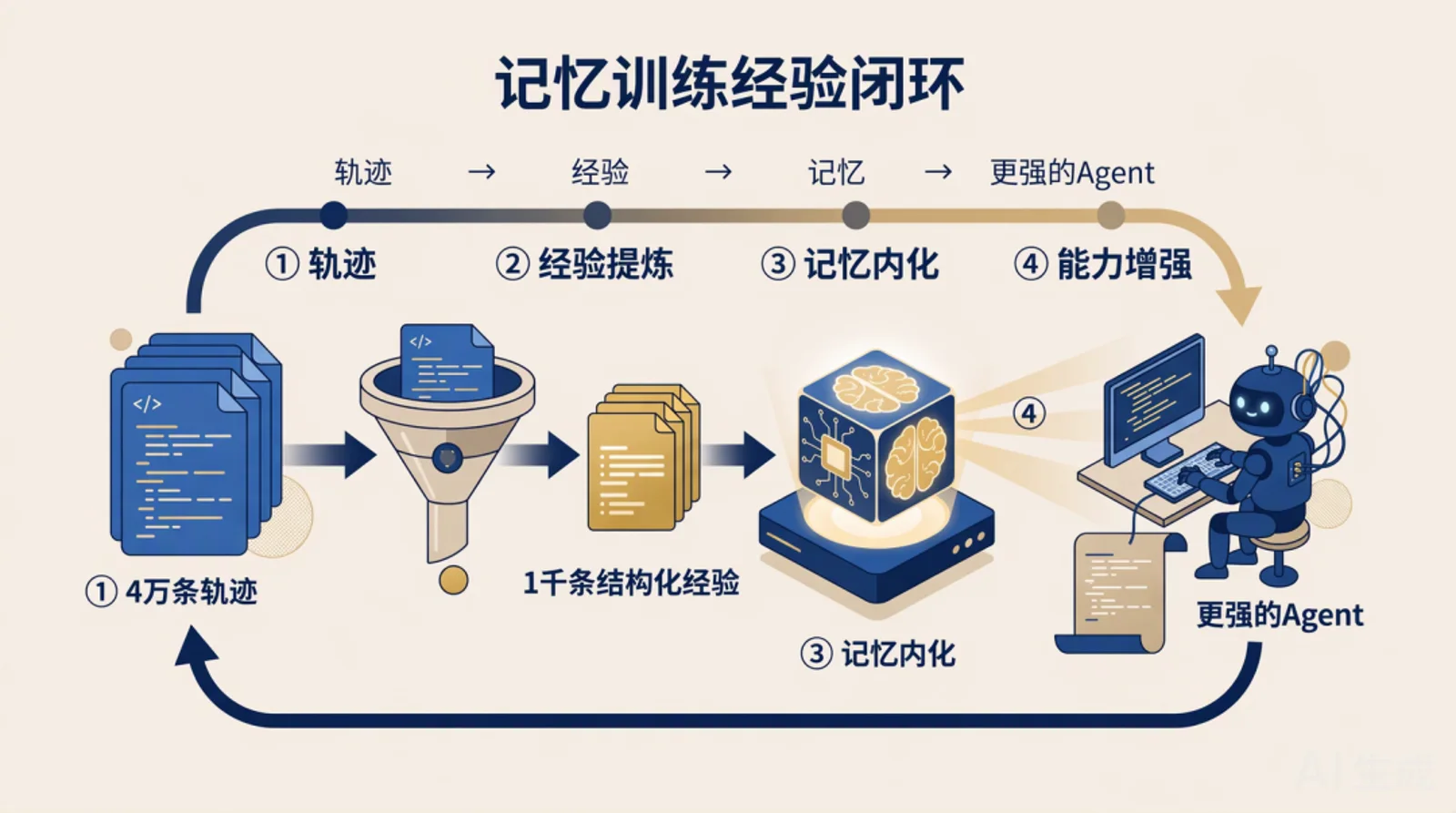
Trajectory → Experience → Memory → Stronger Agent: experience loop
Agent Sandbox Extreme Edition: The Training Infrastructure
Most of these training and evaluation tasks run on Alibaba Cloud's Agent Sandbox Extreme Edition sandbox clusters. Facing massive burst sandbox requests, the service acts as a "training ground" delivering 50,000 sandboxes per minute , providing "on-demand, any-scale" compute for memory training. The article dissects three key capabilities:
1. Rich Sandbox Templates & Millisecond Provisioning
Millisecond sandbox request, minute-level 10K+ sandbox readiness. The platform manages sandbox lifecycles end-to-end, using multi-level image caching, intelligent pre-scheduling, and control-plane optimization to return queue time to training.
Diverse sandbox shapes, environment-as-template. Training spans code execution, evaluation verification, and experience replay, each needing different runtimes. Agent Sandbox offers code, browser, desktop, and mobile sandbox types; each template combines a container image with optional Checkpoint. Clones from the same template are highly consistent, ensuring experimental comparability for "with-experience vs. without-experience" memory ablations — critical for memory experiments.
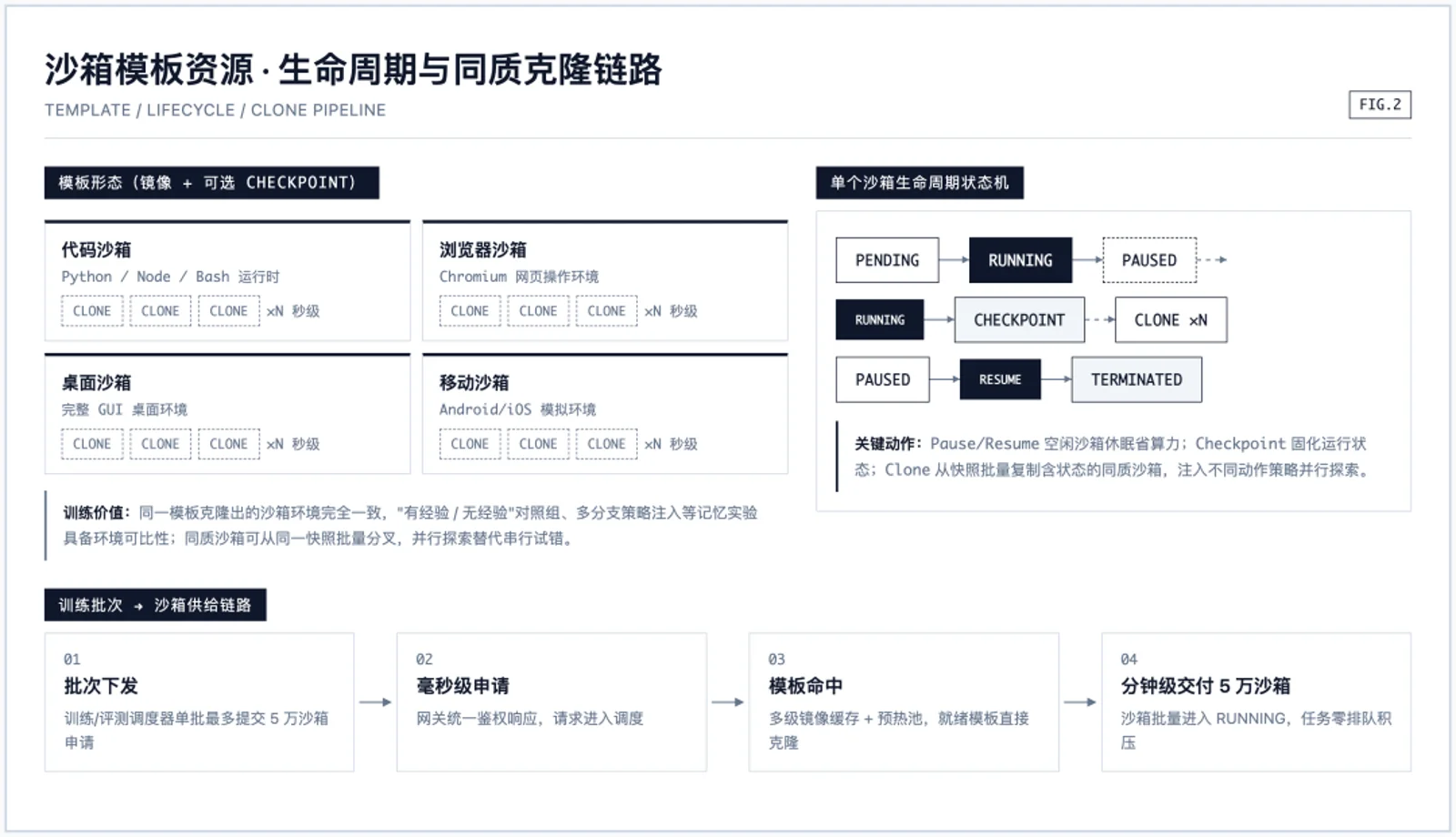
Sandbox template shapes, lifecycle state machine, and batch supply chain
Unified platform management cuts image startup time by 90%, compressing evaluation cycles from weeks to days.
2. Concurrent Elasticity: Minute-Level 50K Sandbox Delivery
The standout metric: after a training batch is dispatched, 50,000 sandboxes are delivered within a minute window — from request, scheduling, template cloning to full readiness, with zero queue backlog. For memory training with tens of thousands of tasks per batch, this flattens the "flood peak": the training platform no longer needs retry/backoff logic for sandbox queuing; it simply opens the gate per batch.
Agent RL training loads are unpredictable "black boxes": within one batch, nodes vary wildly in compute/storage demand — some trajectories finish in minutes, others retry for hours. Provisioning for peak wastes resources; provisioning for average starves long-tail tasks. Agent Sandbox solves this by organizing sandboxes into an elastic "memory training factory" backed by three mechanisms:
Scheduling decoupled from physical nodes. The scheduler sees a fluid resource pool that scales dynamically with training peaks/valleys: rapid gap-filling at peak, automatic release in valleys — no need to keep 50K resident sandboxes for a 50K peak.
Lifecycle management amplifies parallel exploration. Sandboxes support create, Pause/Resume, and Checkpoint-based state snapshots with batch cloning. For memory training, this turns "forked exploration" from serial to parallel: from one snapshot, clone many homogeneous sandboxes, inject different action policies or experiences, explore synchronously.
Serverless compute pool across availability zones and instance families.

Minute-level 50K sandbox delivery · elastic scaling · snapshot forking · sleep reuse
For MemTensor, concurrent elasticity directly determines experience accumulation speed: more "experience hypotheses" verified per unit time means tighter memory-loop iterations, faster "learn from mistakes" cycles.
3. Network Control: Sandboxing Untrusted RL Rollouts
Code running in RL training sandboxes is essentially model-generated untrusted workloads : models emit unpredictable code, commands, and network requests to explore environments. At scale, such anomalies can threaten host nodes, exfiltrate training data, or interfere with other tasks; manual guardrails don't scale. Agent Sandbox provides multi-layer boundaries:
MicroVM-level end-to-end strong isolation. Each sandbox runs in an independent MicroVM with compute, network, storage, and permission isolation; at 10K+ concurrency, an anomaly in one sandbox cannot laterally affect the training platform.
Security groups + L4/L7 network policies for multi-level control. Training pipelines only need specific dependency sources and API endpoints; egress paths are allow-listed. For evaluation tasks that call LLM APIs, zero-trust access to cloud products and LLM APIs is provided without injecting real secrets into the sandbox — a critical safeguard for companies like MemTensor whose data assets are experiences and trajectories.
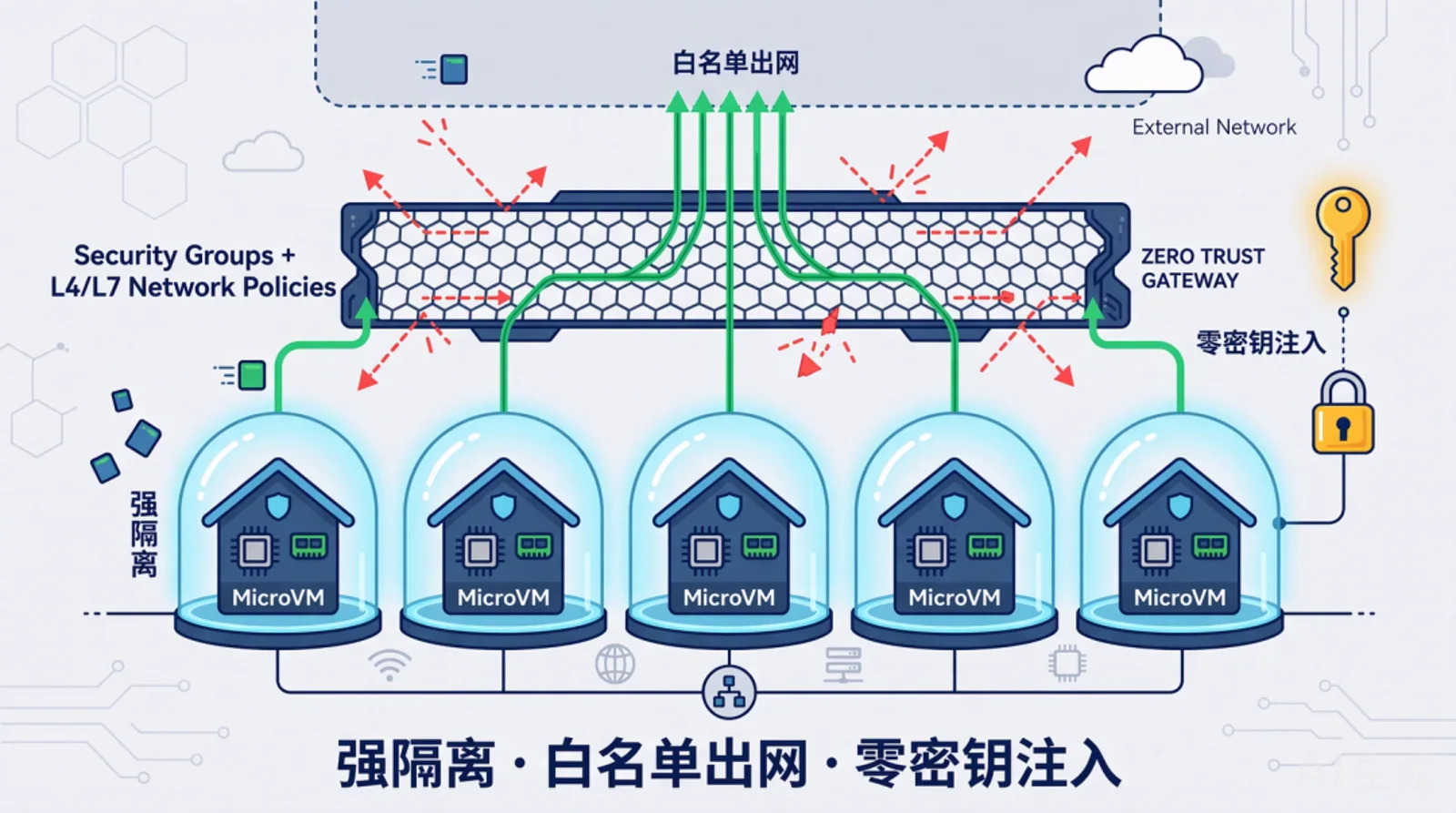
Network control and security isolation
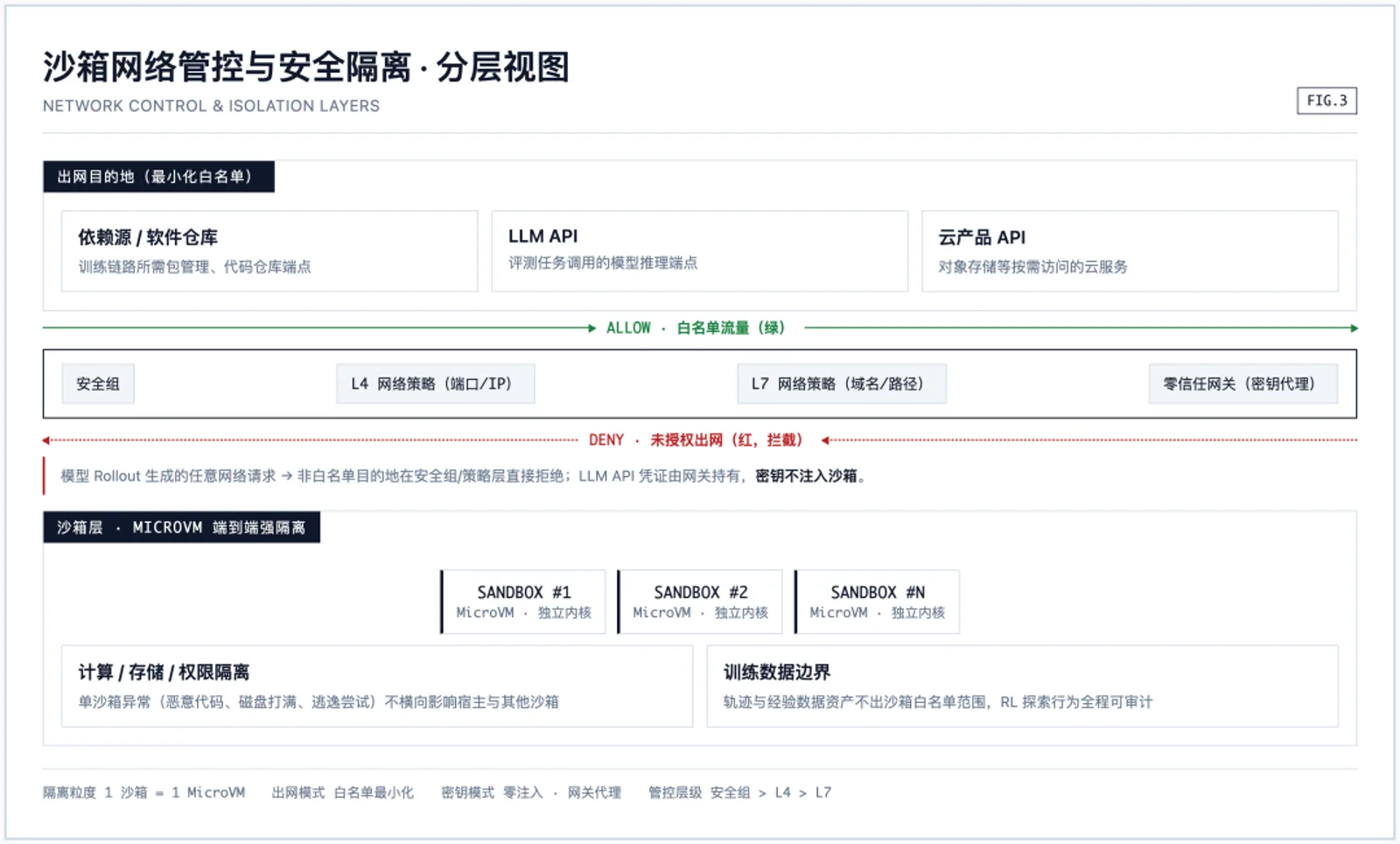
Network governance layers: allow-list egress / zero secret injection / MicroVM isolation
4. Migration Cost: Ecosystem Compatibility
Infrastructure upgrades shouldn't add new costs. Agent Sandbox is compatible with the E2B SDK ; migration only requires switching the endpoint, no rewrite of existing Agent business logic. It also provides code, browser, desktop, and mobile sandbox shapes. This lets MemTensor focus core engineering on the "memory mechanism" rather than sandbox operations.
Results and Outlook
After adopting Agent Sandbox Extreme Edition:
Concurrency support: minute-level 50K sandbox delivery, sustaining MemT 1.0 training and evaluation daily peak loads.
Startup efficiency: image startup time reduced, enabling many more daily experiments.
Evaluation cycle: model evaluation cycle significantly compressed.
Security boundary: 10K+ sandboxes run under strong isolation and controlled networking, zero secret injection throughout training.
Cost: elastic scaling avoids peak provisioning, noticeably lowering resource costs.
Next steps: MemTensor and Alibaba Cloud will continue exploring larger-scale memory training frameworks, finer-grained sandbox network governance, and experience-loop pipelines, pushing "smarter-with-use" memory-native agents toward production.
For questions about attribution, corrections or content rights, please contactand we will review it promptly.