

Microsoft CEO Admits Claude Code Upended IDEs in Six Months: Strategic Pivot Revealed
Satya Nadella acknowledges Anthropic's terminal-based Claude Code disrupted traditional IDEs like VS Code within six months, prompting Microsoft to shift from editor-centric tools to an AI engineering architecture emphasizing model decoupling, hybrid intelligence, decision models, and treating agents as insider risks.
Reading font
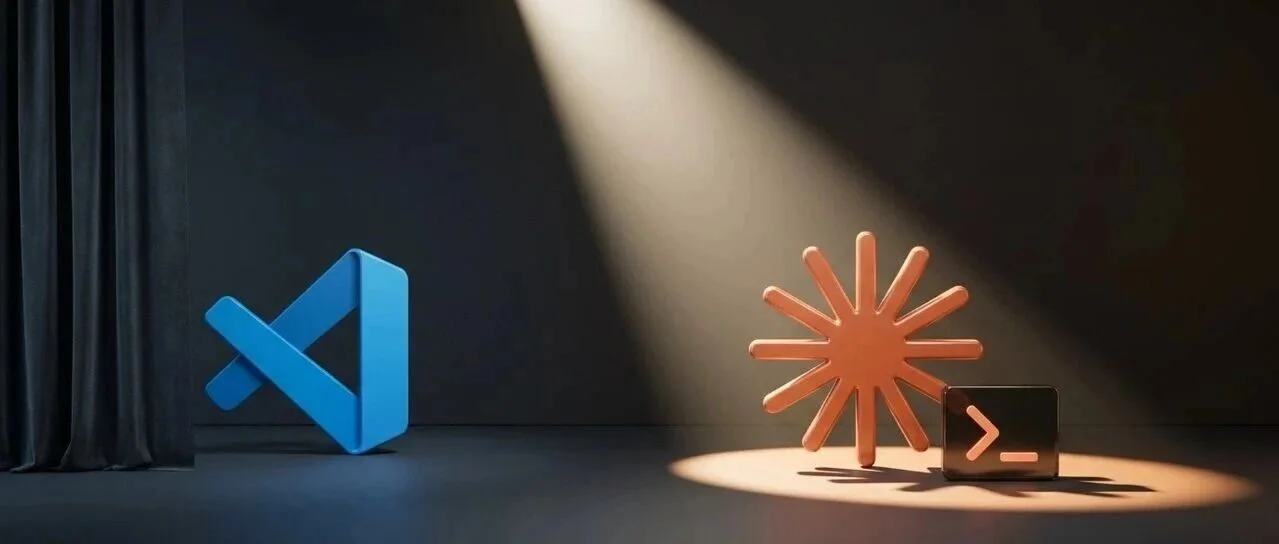
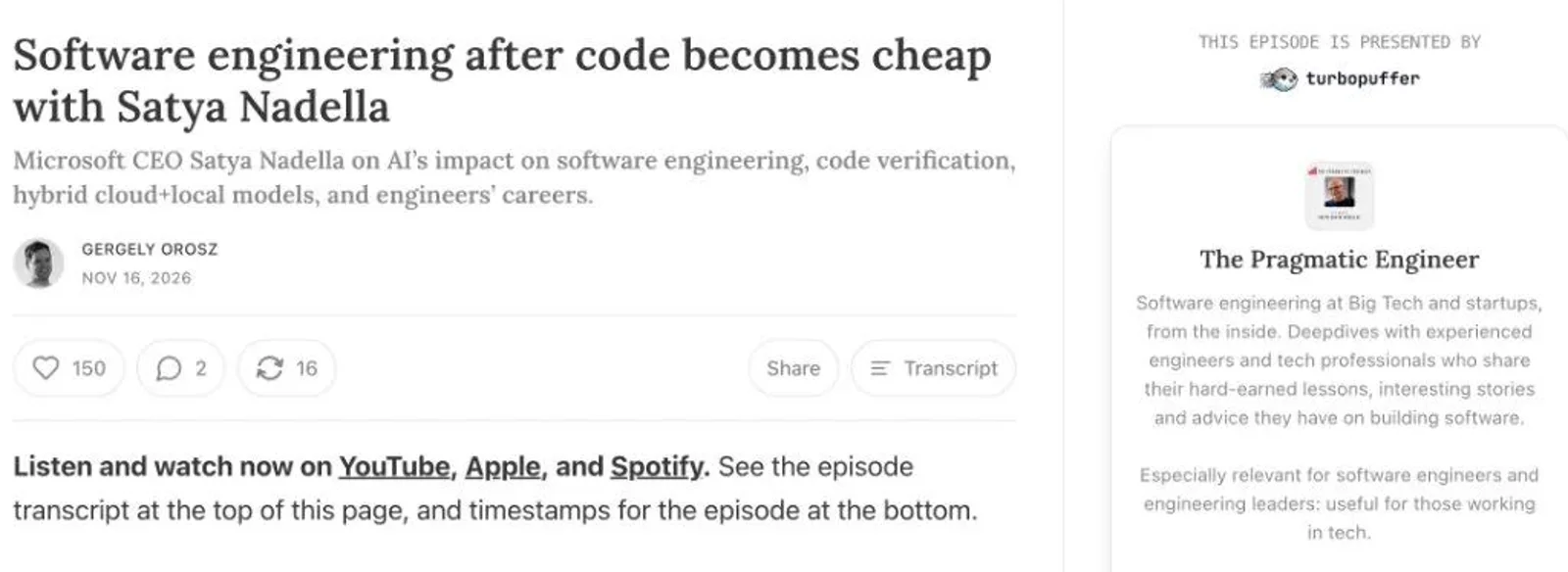
On November 16, Microsoft CEO Satya Nadella appeared on The Pragmatic Engineer podcast (recorded at Microsoft's Redmond headquarters) and spoke candidly about how Anthropic's Claude Code — a command-line agent that reads files, edits code, and runs tests directly in the terminal — caught Microsoft off guard despite its early lead with VS Code, GitHub, and GitHub Copilot.
Nadella admitted that Microsoft had placed its bets entirely on the IDE paradigm, polishing code completion and sidebar chat inside VS Code, and did not anticipate a competitor bypassing the graphical interface altogether. He stated that within just six months the traditional IDE concept had faded from the mainstream spotlight. His key lesson: building AI-native products is brutally unforgiving; when the underlying model makes a non-linear leap, the interaction paradigm can reshuffle rapidly, and no company can afford to cling to the product it previously built.
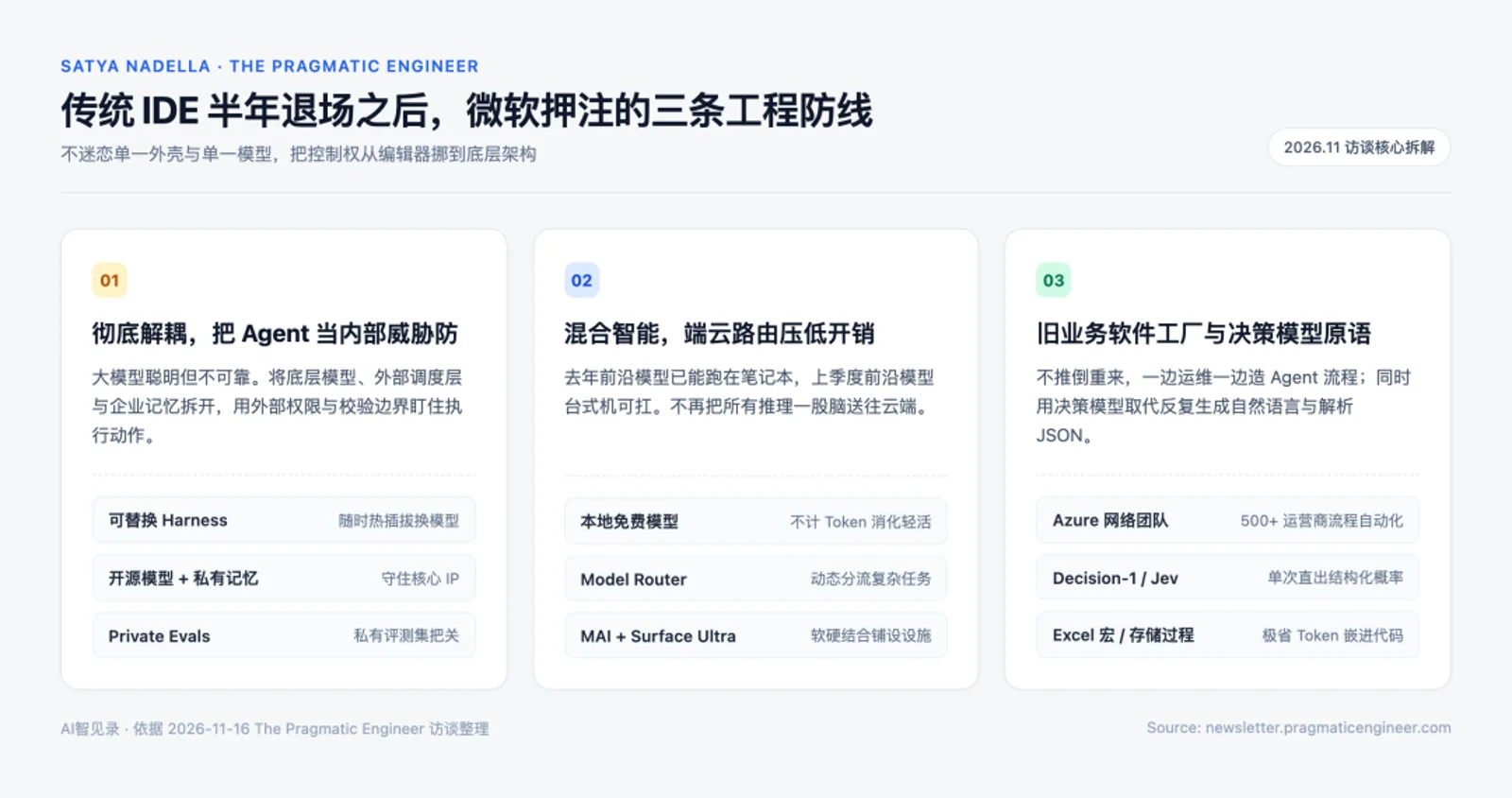
In response, Microsoft is pivoting from a single-editor strategy to a deeper AI engineering architecture built around three defensive lines:
Treat agents as insider risks. Nadella argues that today's models are smart but unreliable. They can access core enterprise data and execute autonomous actions, so a mistake or manipulation carries the same damage as an internal privilege escalation. Enterprises must decouple the model, the external orchestration layer (Harness), and private memory. The model only supplies intelligence; context and memory stay inside the enterprise, wrapped by an independent permission-control and verification boundary.
Adopt open-source models and private evals. To avoid vendor lock-in, Nadella recommends serious evaluation of open-source models to protect core IP, coupled with private evaluation sets. When a new model is released, run it against the private eval suite; if it passes, swap it in through a replaceable Harness without letting any single vendor lock the entire R&D stack.
Hybrid intelligence for cost control. Noting that last year's frontier models now run on a laptop and last quarter's top models run on a desktop, Nadella questions sending all inference to the cloud. Microsoft's solution is "hybrid intelligence": run zero-token-cost models locally, insert a model router, handle routine tasks locally, and route only complex tasks to expensive cloud models. Microsoft is building this infrastructure with its own Microsoft AI (MAI) models and Surface Laptop Ultra hardware to own the routing layer between local and cloud.
On practical deployment, Nadella cited Microsoft's Azure networking team (managing 500+ fiber operators) as an example of the "software factory" approach: they did not halt daily operations but embedded an agent system into existing workflows to handle email and process automation, measurably improving team efficiency. He emphasized there is no off-the-shelf blueprint; each team must build its own factory while doing the work.
Regarding the future of software engineering as code generation becomes cheaper, Nadella highlighted decision models — a new class exemplified by Microsoft-Decision-1 (released on Foundry in October) and TypeSafe's Jev. Unlike generative LLMs, decision models ingest a state description and a fixed set of options, then output a structured probability score in a single pass. This eliminates repeated JSON parsing and drives token costs to a minimum. Nadella likened them to "Excel macros" or "stored procedures" for the intelligent era: high-frequency judgments are encapsulated as stable decision primitives embedded in code, avoiding repeated generation.
The article concludes that Microsoft's painful lesson — being blindsided by a terminal tool while holding VS Code — has forced a strategic shift away from defending a single editor shell toward owning the underlying AI engineering stack: model independence, local-cloud routing, and decision-model primitives. As model capabilities continue to leap, any organization that concentrates all bets on one tool surface or one vendor risks being disrupted in the next half-year.
Reference: The Pragmatic Engineer interview with Satya Nadella - https://newsletter.pragmaticengineer.com/p/software-engineering-after-code-becomes
For questions about attribution, corrections or content rights, please contactand we will review it promptly.