

OntoL Ontology Operations: Central Standards, Domain Autonomy & FDE Frontline Collaboration
This article details the OntoL ontology operations framework, covering governance principles, matrix organization roles, lifecycle processes with branching and deprecation, monitoring metrics, SLA tiers, quality gates, tooling stack, phased rollout plan, and risk mitigations for semantic consistency and cross-domain governance.
Reading font
Benchmarking Palantir's governance paradigm: Central ontology standard foundation + domain autonomous modeling + FDE frontline collaboration, balancing unified semantics, cross-domain consistency, change risk, permission compliance, and observable operations; implemented via OntoL ontology foundation native capabilities. Core philosophy: Ontology is not a one-time modeling delivery but a continuously evolving business semantic contract layer; central controls standards, domains control objects, operations control health, FDE controls business closure.
1. Overall Positioning and Governance Principles
1.1 Positioning
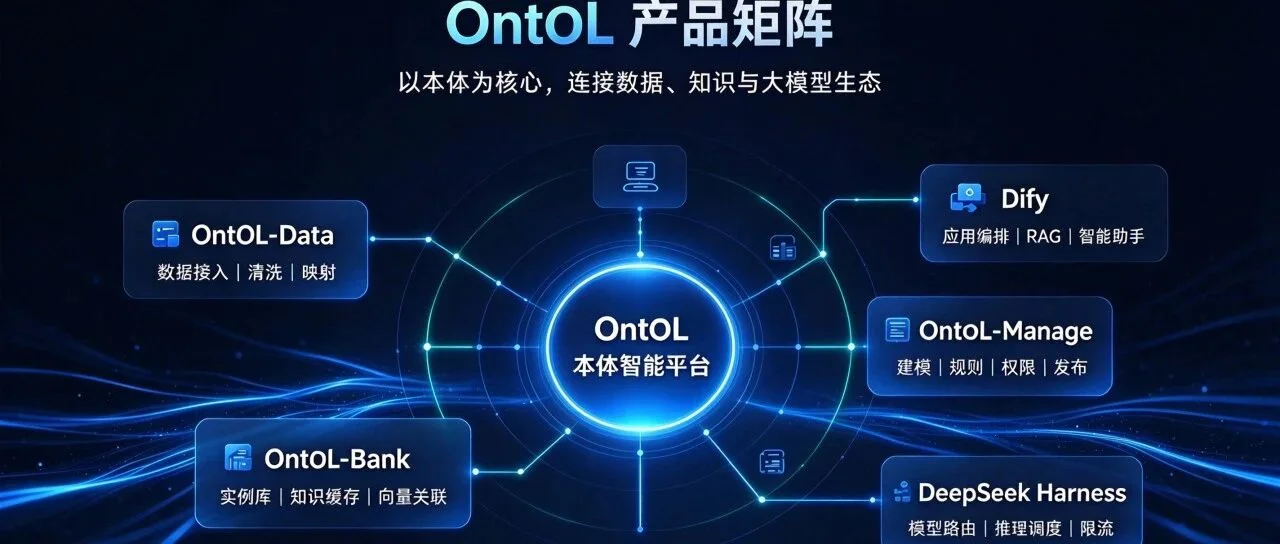
OntoL ontology serves as the unified business semantic foundation: object types, properties, relationship Links, Actions, rule constraints, spatiotemporal reasoning, permission views. The ontology operations organization is responsible for ontology standards, changes, quality, versions, permissions, lineage, monitoring, incidents, documentation, lifecycle, cross-domain conflict arbitration , supporting upper-layer applications, analytics, automation, and federated queries. OntoL comprises three collaborative components: OntoL Manage (ontology modeling governance), OntoL Bank (instance storage and data value precipitation, no inference engine), OntoL Data (data ingestion and mapping). TBox carries axiomatic models, ABox carries business fact instances, supporting OntologyL_Cypher queries, Allen temporal reasoning, DE-9IM spatial reasoning.
1.2 Five Governance Principles
Single Trusted Foundation : Global common ontology (TBox) is unique; domain extension ontologies must not conflict with public definitions. Common objects, common relationships, common enumerations are converged by the central ontology team.
Domain Autonomy + Guardrail Control : Business domains own domain-private objects but must comply with central ontology specifications, naming, metadata, and association contracts.
Branching Changes, Auditable, Rollbackable : Ontology changes follow branching, proposal review, pre-release validation, canary release; direct modification of production main ontology branch is prohibited.
Business First, Semantic Fidelity : Ontology modeling involves business experts, not purely technical models; ontology changes must assess business impact, downstream applications, Action write-back chains.
Observable, Measurable, Degradable : Ontology health indicators, data freshness, instance integrity, link errors, permission leaks, query & reasoning performance are incorporated into operations SLA.
1.3 Four Implementation Phases (Benchmarking Palantir Adoption, Adapted for OntoL)
Phase 1 (Pilot): Centralized ontology squad, supports only 1-2 benchmark scenarios, establishes standard templates and OntoL modeling specifications.
Phase 2 (Scale Preparation): Establishes change review committee, SOPs, quality checks, basic monitoring, Memgraph cluster foundational operations.
Phase 3 (Platform Autonomy): Dedicated ontology operations team + domain ontology liaisons, platform capabilities self-operated; OntoL core tech team as second-line backup.
Phase 4 (Hypergrowth): Federated ontology governance, cross-domain ontology arbitration, ontology catalog, impact analysis, automated inspection, self-service change requests.
2. Organizational Structure and Roles (OntoL Matrix Organization)
Adopts matrix organization: Central Ontology Governance Group + Domain Ontology Owners + Data Engineering/Pipeline Group + FDE Forward Deployed Engineers + Platform Security & Compliance Group .
2.1 Central Ontology Governance Group (Ontology Steering & Core Team) — Global Foundation Ownership
Ontology Manager (Ontology Architect) [Core Role] : Responsible for OntoL top-level roadmap, global TBox standards, common object/common relationship definitions, cross-domain conflict arbitration, ontology specifications, naming conventions, metamodel specifications, version strategy, review committee chair; evaluates all cross-domain and breaking changes; maintains ontology catalog and lineage view; interfaces with project leads; produces OntoL ontology architecture whitepaper and modeling specifications.
Ontology SRE : Responsible for OntoL monitoring, alerting, incident response, branch/release pipelines, export backup, migration, deprecation/sunset processes, performance operations (Memgraph indexes, Link queries, OntologyL_Cypher, reasoning tasks, Action execution health), inspection scripts, automated validation rules, disaster recovery rollback; interfaces with OntoL foundation and Memgraph cluster operations.
Ontology Documentation & Metadata Administrator : Responsible for ontology object dictionary, property descriptions, business definitions, examples, deprecation notes, change log maintenance; ontology self-service knowledge base, FAQ, modeling templates; maintains OntoL ontology catalog portal.
Central team in one sentence: Define rules, govern common, control risk, arbitrate conflicts, platform-side operations .
2.2 Domain Ontology Owner (Business Domain Lead, one per domain)
Business domains (supply chain, production, equipment, orders, customer, finance, etc.) designate business lead + modeling liaison.
Responsibilities: Domain business semantic definitions, private objects, private Links, domain business rules; submit ontology change requests in OntoL Manage; review domain changes; validate domain ABox instance correctness; own domain business acceptance; identify domain requirements, do not add new global common objects; autonomous modeling within central guardrails.
Constraints: Adding/modifying common objects, cross-domain Links, breaking schema changes must be submitted to central ontology review committee.
2.3 Data Pipeline Engineer
Responsibilities: Source data → dataset → OntoL ontology object mapping, transformation, quality assertions, pipeline scheduling, data freshness; ensure stable data sources behind ontology; ontology instance backfill, incremental sync to OntoL Bank; fix ontology instance anomalies caused by data source issues; align object mapping contracts with Ontology Manager.
2.4 FDE Forward Deployed Engineer
Responsibilities: Embedded in business frontline, capture business requirements, translate business processes into OntoL objects + Links + Actions; build application-side prototypes, validate ontology usability; collect business-side ontology issues, ambiguities, gaps; act as translator between business and ontology teams; drive ontology adoption in business scenarios, verify semantics match frontline operations; submit optimization change proposals.
2.5 Security & Permissions Governance Group
Responsibilities: OntoL ontology object/property/instance-level permission policies, row-level permissions, column-level permissions, data classification, sensitive attribute tagging; permission auditing, permission leak inspection; compliance checks (privacy, confidentiality, GxP, etc.); control Action write-back permissions; approve high-sensitivity ontology object releases.
2.6 Release Manager
Responsibilities: Ontology release scheduling, release windows, canary strategy, release approval, post-release validation, release logs, rollback triggers; coordinate OntoL ontology changes + pipelines + application synchronous releases to avoid downstream application breakage.
2.7 Ontology Review Committee (Change Review Board)
Members: Ontology Manager, Domain Owner representatives, Security & Compliance, Release Manager, FDE representatives; periodically reviews high-risk changes, cross-domain changes, breaking changes, common object additions; rejects changes violating specifications, semantic conflicts, or lacking business justification.
2.8 Support Tiers (L1 / L2 / L3)
L1: Domain Ontology Owners, FDE — business-side issues, simple instance errors, usage questions.
L2: Central Ontology SRE — ontology structure, branching, releases, monitoring, link failures, reasoning anomalies.
L3: OntoL Foundation R&D Team (Memgraph cluster, OntoL Manage/Bank/Data kernels, OntologyL_Cypher engine issues).
3. Ontology Full Lifecycle Operations Processes (Core SOPs)
3.1 Ontology Requirements and Change Request Process
Requirement Submission: Business / FDE / Domain Owner submit OntoL change ticket (including: object/Link/Action change content, business justification, impact scope, downstream application list, whether breaking change, rollback plan).
Pre-assessment: Ontology Architect quickly classifies: private domain change / cross-domain change / common object change / breaking change .
Low-risk, domain-internal non-breaking changes: Domain Owner self-review, CC central team.
Cross-domain, common object, breaking schema changes: Enter review committee review.
Review: Check semantic consistency, naming conventions, conflicts, permissions, downstream dependencies, data quality constraints, deprecation strategy.
Development Branch: OntoL ontology branch isolated development; direct modification of main branch prohibited; validation and conflict checks within branch.
Validation Stage (Dev → Staging Pre-release)
Semantic Validation: Model constraints, Link cardinality, enumeration values, rule validation, reasoning chain consistency checks.
Instance Validation: Pipeline backfill, data quality assertions, instance completeness, null checks, value range checks.
Downstream Impact Testing: Dependent applications, Actions, functions, dashboard connectivity, OntologyL_Cypher query validation.
Release Proposal: Branch submits proposal with test report and approval records.
Canary Release → Full Release: Small traffic validation, Release Manager executes; record change logs.
Post-release Inspection: Operations SRE performs health checks; alert observation; Business Owner acceptance.
Closure Archival: Change records written to ontology change log; update dictionary documentation.
3.2 Version, Branch, Deprecation (Sunset) Management
Branch Specification: main (production stable ontology), dev (integration branch), feature/xxx (requirement branches), hotfix/xxx (emergency fixes).
Version Strategy: Ontology uses CalVer versioning, distinguishing compatible changes (new properties, new Links) / breaking changes (delete properties, modify types, delete Links); breaking changes must plan migration window, migration scripts, downstream application refactoring timeline.
Deprecation Sunset Process: Mark Deprecated, set deprecation deadline; notify all dependents; continuous alerts before deadline; cleanup after deadline; retain historical version export packages for audit traceability.
Backup Strategy: Periodic export of OntoL ontology packages, off-site storage; automatic snapshot before each release, support one-click import rollback.
3.3 Ontology Monitoring and Operations Metrics (SRE Operations Dashboard)
Ontology Model Health
Model errors, constraint conflicts, Link cardinality anomalies, orphan objects, unreferenced objects, naming violations.
Unreviewed changes, legacy objects without deprecation tags, TBox axiom conflicts.
Ontology Instance & Pipeline Health
Object instance freshness, pipeline latency, pipeline failure rate, data quality assertion failure count.
Instance completeness, primary key conflicts, Link breaks, references to non-existent instances, ABox instance drift.
Runtime Health (OntoL Specific)
Action execution success rate, write-back failures, function call errors.
OntologyL_Cypher query latency, Memgraph index hit rate, federated query link success rate.
Reasoning Task Health: Allen temporal reasoning, DE-9IM spatial reasoning task errors, reasoning timeouts.
Permission Alerts: Over-privileged access, unclassified sensitive attributes, permission drift.
Governance Metrics
Change review duration, change pass rate, breaking change count, ontology dependency count, deprecation on-time cleanup rate, issue closure SLA.
All metrics integrated into OntoL operations dashboard, tiered alerting (P0/P1/P2/P3).
3.4 Incident Response SLA
P0 (Ontology unavailable, full query failure, reasoning cluster down, Action massive write failures): 5-minute response, operations + ontology architect + release manager + OntoL foundation R&D, activate rollback plan; target RTO < 30min.
P1 (Partial object/link anomalies, core business scenario interruption, core reasoning link failure): 15-minute response, 1-hour localization, 4-hour fix.
P2 (Non-core objects, documentation missing, few instance anomalies, non-core reasoning task anomalies): Business day 4-hour response, 24-hour closure.
P3 (Consultations, specification questions, optimization suggestions): 2 business days response.
3.5 Ontology Catalog, Lineage, and Impact Analysis
Unified Ontology Catalog Portal: All objects, properties, Links, Actions, business definitions, Owners, dependencies, downstream applications, status (Official / Draft / Deprecated).
Automated Lineage: Object ↔ Source Dataset ↔ Pipeline ↔ Application / Action; pre-change automatic impact list output, assess which businesses will be disrupted.
Cross-domain Conflict Detection: Automatic scan for cross-domain Link type mismatches, enumeration value conflicts, same-name object semantic inconsistencies, TBox axiom conflicts.
4. Specifications and Quality Gates (Mandatory Guardrails)
Naming Convention: Objects, properties, Links in English, camelCase, unified business semantics; global enumerations centrally managed.
Metamodel Specification: Every object must have business definition, data classification, sensitivity tag, Owner, SLA, lifecycle.
Cardinality Constraints: Link one-to-one / one-to-many / many-to-many explicitly defined, avoid unconstrained associations.
Write-back Action Control: Actions must bind permissions, approval flows, audit logs; direct write-back to source systems without audit prohibited.
No Implicit Cross-domain Dependencies: Cross-domain Links prioritize common foundation; domain-private objects not allowed to directly hard-couple other domain-private objects.
5. Operations Tool Stack (OntoL Native System)
OntoL Manage: Ontology modeling, branching, proposals, conflict review, export/import, TBox management.
OntoL Data: Data ingestion, mapping configuration, pipeline scheduling, data quality assertions.
OntoL Bank: Memgraph graph storage, ABox instance management, OntologyL_Cypher queries, temporal/spatial reasoning engines.
OntoL Operations Platform: Monitoring, alerting, health checks, lineage analysis, impact analysis.
Permission Module: Ontology instance/property permissions, security policies, audit logs.
Functions / Actions: Ontology-side business logic, write-back capabilities.
Supporting: Ticket system, change ledger, ontology knowledge base (integrated with Dify for ontology Q&A), business visualization dashboards.
6. Rollout Cadence and Deliverables Checklist
Phase 1 (0-4 weeks, Pilot)
Deliverables: Ontology governance charter, role definitions, naming conventions, change templates, 1 benchmark ontology branch process, basic monitoring alerts. Output documents: OntoL Governance Specifications , Ontology Roles & Responsibilities Matrix , Change Request SOP .
Phase 2 (1-3 months, Scale)
Deliverables: Review committee operational, ontology catalog, lineage views, deprecation sunset process, SLA, automated inspection scripts. Output documents: OntoL Ontology SLA & Operations Manual , Incident Response Playbook , Ontology Quality Checklist .
Phase 3 (3-6 months, Platform Autonomy)
Deliverables: Federated ontology governance, self-service change portal, automated impact analysis, permission audit reports, ontology cost/performance metering. Output documents: OntoL Ontology Architecture Whitepaper , Cross-domain Ontology Arbitration Mechanism .
7. Risks and Mitigations
Risk: Domains arbitrarily add common objects, semantic fragmentation → Mitigation: Common object ownership centralized to central team, review gate.
Risk: Breaking changes unassessed, downstream applications mass paralysis → Mitigation: Change ticket mandates downstream dependency list, pre-release validation, canary release, mandatory rollback plan.
Risk: Ontology only built not maintained, large accumulation of deprecated objects → Mitigation: Regular ontology inventory, sunset process, quarterly cleanup.
Risk: Business semantics and technical model disconnect → Mitigation: FDE embedded in business, Business Owner holds semantic decision rights, tech team only does modeling compliance validation.
Risk: Reasoning tasks, graph query performance degradation → Mitigation: OntoL SRE continuously monitors indexes, reasoning task queues, establishes reasoning task rate limiting, degradation strategies.
For questions about attribution, corrections or content rights, please contactand we will review it promptly.