

Snowflake Decision Model: 4.2¢/M Tokens but 80% Confidence Isn't Enough for Auto-Execution
Snowflake launches Decision model for classification and scoring at $0.042 per million tokens, enabling multiple judgments per SQL query, but confidence metrics reveal reliability gaps — e.g., 95.6% probability yields only 80.9% confidence — forcing enterprises to weigh auto-execution risks against cost savings versus OpenAI and Google alternatives.
Reading font

Snowflake Decision Enters Public Preview at 4.2¢ per Million Tokens
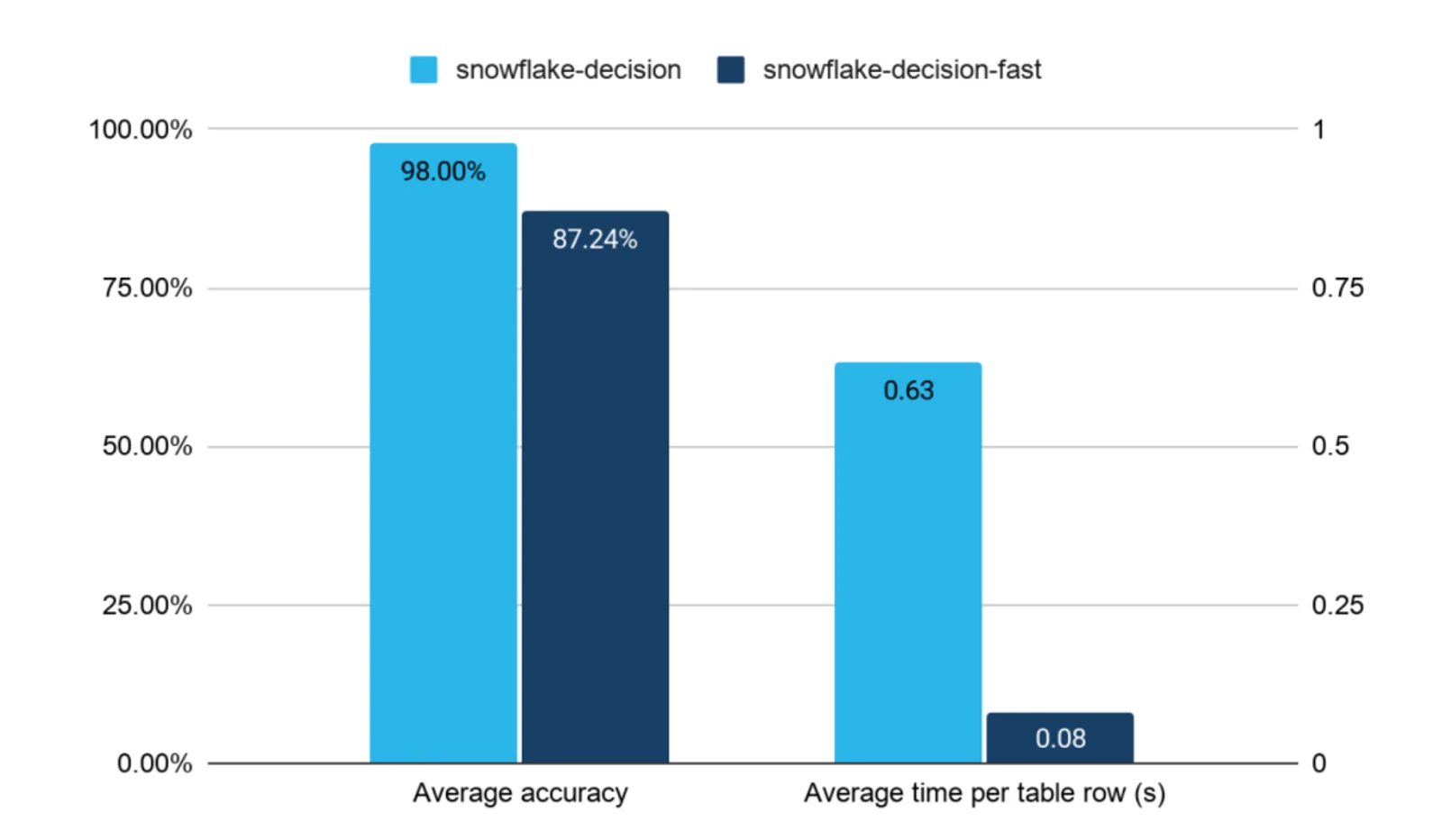
On November 20, Snowflake announced public preview support for Snowflake Decision within Cortex AI's AI_COMPLETE function. The model specializes in classification, scoring, and conditional judgment, executing batch analysis via SQL. Pricing is set at $0.042 per million tokens (≈4.2¢), with a per-row processing time of 1.58 ms (official benchmark; end-to-end latency varies with data volume and environment).
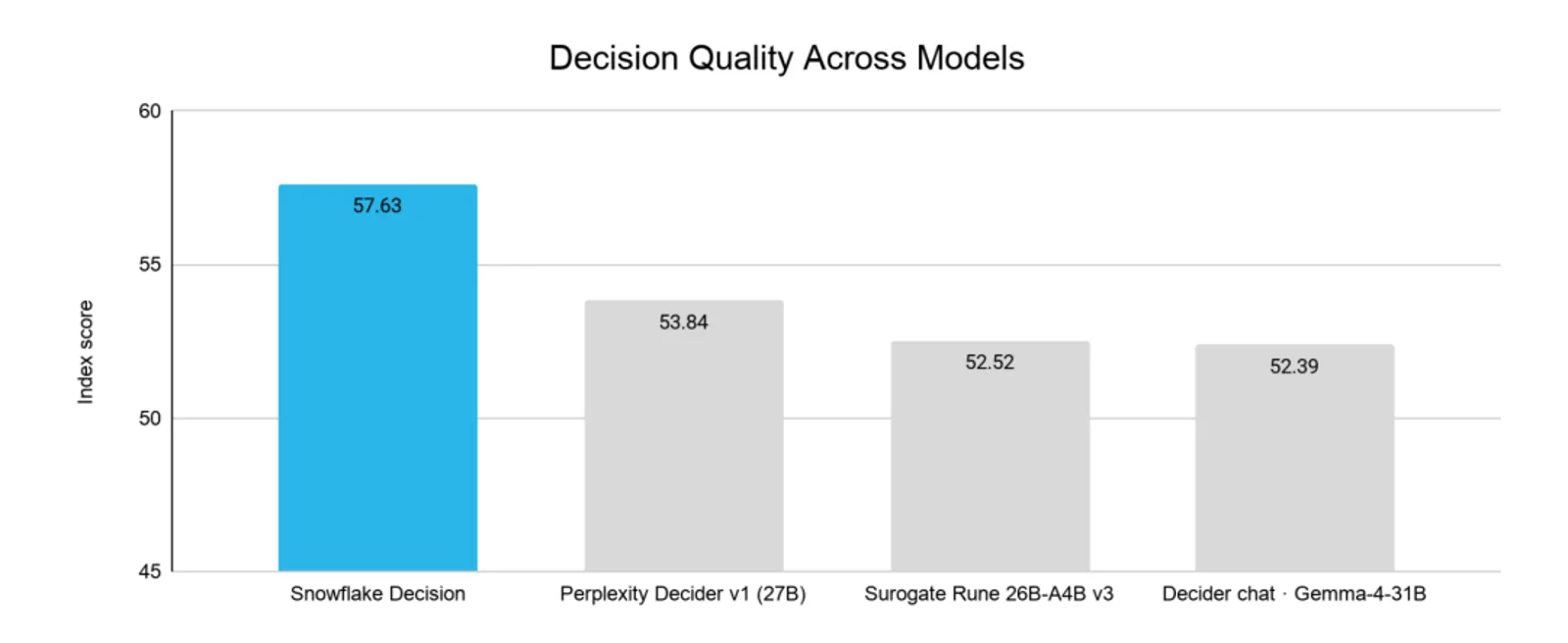
Snowflake previewed the model a month earlier. On October 8, its technical blog disclosed private-preview results: on the Jev Decision Index 0.2.1 (29 benchmark tasks, 88,837 requests covering reasoning, language, retrieval, tool use), Snowflake Decision scored 57.63 , ranking first among 72 evaluated models. However, the 29 tasks are a subset of the full benchmark, and the score uses chance-corrected aggregation, so superiority over general-purpose LLMs across all tasks is not proven.
One SQL Query, Three Judgments — Eliminating Redundant LLM Calls
Snowflake's existing AI_CLASSIFY handles single- or multi-label classification. Snowflake Decision extends this by evaluating multiple independent questions on the same input in one call. Developers specify the model ( snowflake-decision), provide the input text in state, and define questions via questions. Three question types are supported:
choice — select from predefined options (e.g., department routing).
score — assign an ordinal score (e.g., sentiment level).
noul — return probability that a statement is true (e.g., urgency flag).
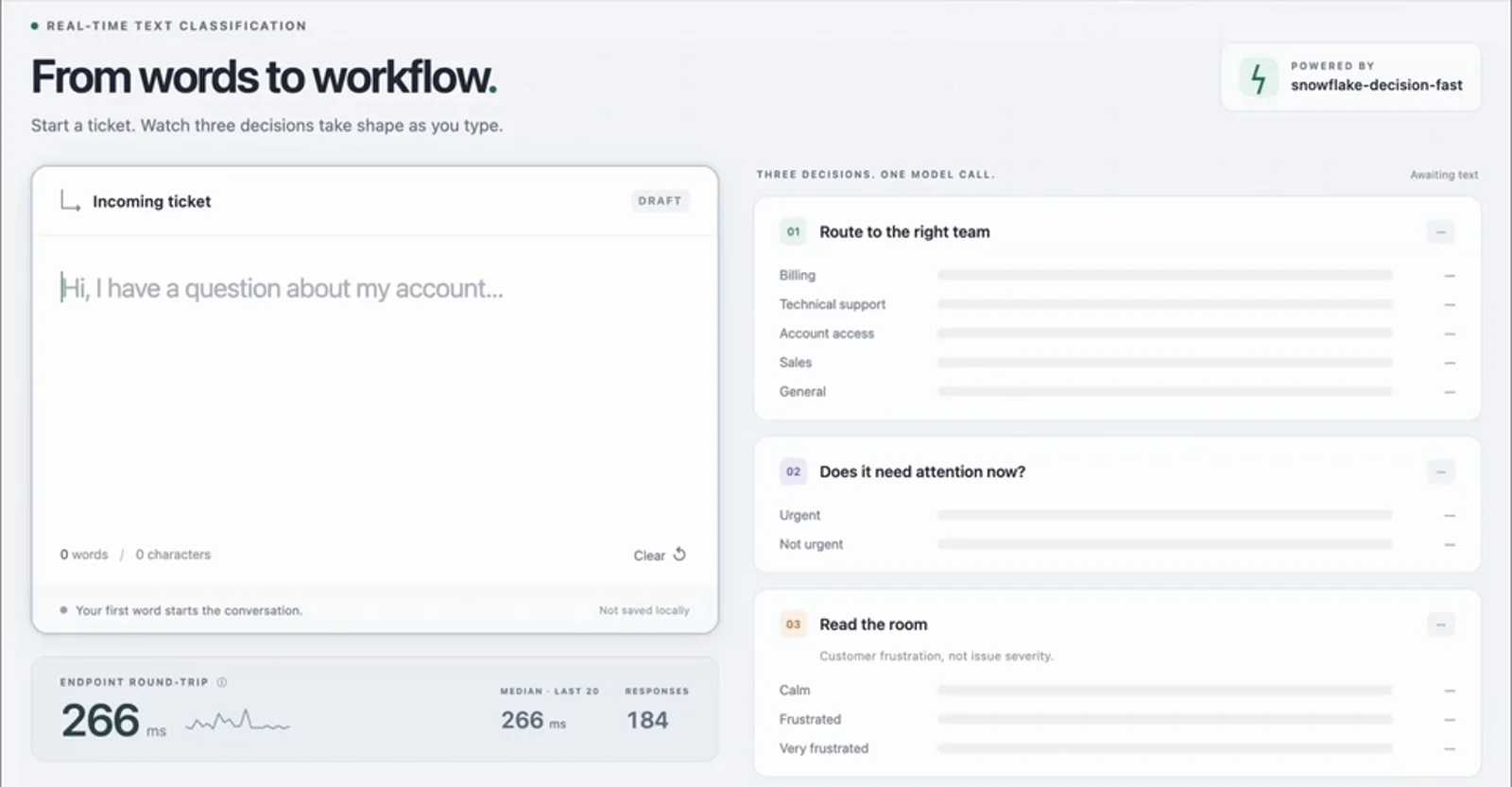
Because all questions share the same input, enterprises avoid separate model requests for each judgment. The official demo uses a support ticket: choice picks department (billing, tech support, sales), score measures customer sentiment, noul detects urgent intent. All three read the same ticket text and return structured results, which downstream SQL or application logic can route, prioritize, or escalate.
Results integrate directly into existing SQL pipelines for companies already on Snowflake. Decision itself does not execute refunds, modify orders, or call external agents ; business actions remain in downstream systems. It can chain with other Cortex functions: AI_TRANSCRIBE for audio, AI_PARSE_DOCUMENT for PDFs, then Decision judges the extracted content.
Current limits: max 64 questions per request , max JSON payload 256 KiB , no streaming or Guardrails. Long-document analysis, complex reasoning, or report generation still require other models.
95.6% Probability ≠ 80.9% Confidence — The Hidden Cost of Auto-Execution
The official support-ticket example exposes a critical gap. For department classification, the top option ( billing ) receives 95.6% probability but Confidence = 80.9% . For priority scoring, the highest level ( Immediate ) gets 78.9% probability yet Confidence = 40.7% . Both lean toward an answer, but confidence diverges sharply.
Snowflake defines Confidence for choice and score as normalized information entropy of the probability distribution . High concentration → high confidence; spread across options → low confidence. Confidence is not calibrated accuracy — even a high-probability prediction can be wrong if category definitions are ambiguous, input lacks information, or production data drifts from test samples.
Priority scoring adds another nuance. The example defines three levels (Can wait=0, Soon=1, Immediate=2). The model returns a weighted average of 1.716 (probability-weighted level indices). This aids sorting but does not mean urgency is measured to three decimal places . Whether to auto-escalate depends on business-defined thresholds (e.g., "Immediate probability > 90% → auto-upgrade"), which must be set per risk tolerance.
In production, misrouting a routine ticket costs a re-assignment; misclassifying a severe complaint as low priority risks churn. Enterprises must validate on labeled historical data, quantify misclassification costs per category and risk level, then define auto-approve, human-review, and model-fallback rules . High-risk or ambiguous tasks can still escalate to general LLMs. Confidence helps flag uncertain results but cannot replace real-world testing.
This bounds the $0.042/M token price : it covers only model inference, not the full business chain (parsing, SQL compute, human review, fallback calls). If many judgments require rework, savings evaporate. The model must reliably complete enough tasks to reduce overall spend.
OpenAI and Google Enter the Fray — Enterprise AI Workloads Are Being Repartitioned
Before Snowflake's public preview, OpenAI launched Decisions API (Oct 22) based on GPT-6 Luna, offering classification, scoring, and option selection at $0.10 per million input tokens (output free), claiming up to 10× speed vs. Responses API with the same model. It delivers structured results directly, cutting latency from generative responses.
Google followed (Nov 11) with Gemini Decisions API (Gemini Decision 1), supporting up to 1,000 independent questions per request , multimodal input (text, image, audio, video, PDF), and outputting boolean judgments, option probabilities, and ordinal scores. Pricing: $0.10 per million input tokens (output free), end-to-end latency 150–250 ms . Direct comparison with Snowflake's 1.58 ms/row is invalid — different metrics, input scales, and conditions.
Vendors chose different entry points: OpenAI and Google expose standalone APIs for real-time apps, model routing, and agent workflows; Snowflake embeds Decision in Cortex AI Functions for batch processing on warehouse data. Real-time apps prioritize API latency; batch jobs prioritize throughput, cost, and downstream dataflow integration.
For enterprises, this enables finer task allocation:
Rules engines handle deterministic checks (amount thresholds, field conditions).
Specialized decision models handle semantic judgments (complaint type, urgency).
General LLMs / Agents handle cross-system analysis, complex reasoning, report generation, multi-step actions.
A single ticket may flow through all layers: rules first, then Decision for semantic tags, then escalation for unresolved cases. This reduces unnecessary expensive LLM calls.
However, adding a decision layer adds overhead if most requests still fall back to LLMs. Enterprises must track token usage, data processing fees, manual review volume, fallback rates, and business loss from errors. The opening ticket example shows Decision can cheaply produce category and priority, but whether the system auto-executes depends on real-data accuracy and business risk . The 4.2¢/M token price solves model cost; the remaining question is how many tickets stay on this low-cost path versus requiring expensive models and human intervention .
For questions about attribution, corrections or content rights, please contactand we will review it promptly.